
Start Stop Battery Market Size, Share and Trends 2026 to 2035
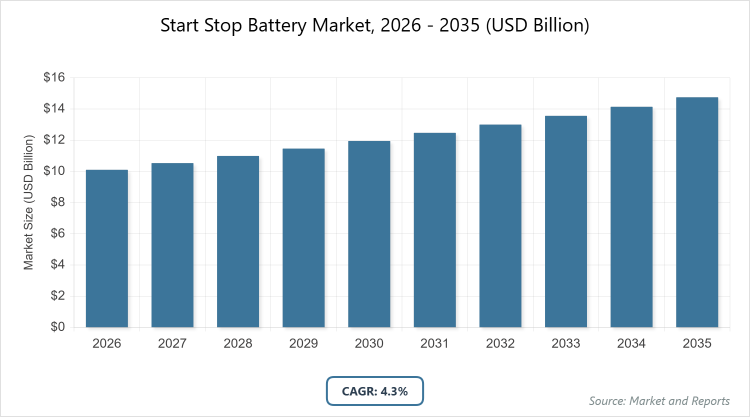
According to MarketnReports, the global Start Stop Battery Market size was estimated at USD 10.1 Billion in 2025 and is expected to reach USD 15.5 Billion by 2035, growing at a CAGR of 4.3% from 2026 to 2035. Start Stop Battery Market is driven by increasing adoption of fuel-efficient vehicles and stringent emission regulations.
What is the Start Stop Battery Market Industry Overview?
The Start Stop Battery Market encompasses specialized energy storage solutions designed to support vehicles equipped with start-stop technology, which automatically shuts off and restarts the engine to reduce fuel consumption and emissions during idling. This market focuses on batteries that endure frequent cycling, high charge acceptance, and reliable power delivery for automotive applications, primarily in internal combustion engine vehicles with micro-hybrid features. Market definition includes batteries optimized for enhanced durability in stop-start systems, distinguishing them from conventional automotive batteries by their ability to handle repeated discharges without compromising lifespan or performance.
What are the Key Insights of Start Stop Battery Market?
The global Start Stop Battery Market size was valued at USD 10.1 Billion in 2025 and is projected to reach USD 15.5 Billion by 2035.
- The market is expected to grow at a CAGR of 4.3% during the forecast period from 2026 to 2035.
- The market is driven by stringent emission regulations, rising fuel efficiency demands, and the growing adoption of micro-hybrid vehicles.
- The AGM subsegment dominates the battery type segment with a 58% share due to its superior charge acceptance, vibration resistance, and suitability for high electrical loads in modern vehicles.
- The passenger cars subsegment dominates the application segment with a 72% share because of widespread integration of start-stop systems in sedans and SUVs to meet consumer preferences for eco-friendly driving.
- Europe dominates the regional segment with a 35% share owing to strict EU emission standards and high penetration of fuel-efficient technologies in countries like Germany.
What are the Market Dynamics of Start Stop Battery?
Growth Drivers
The primary growth drivers in the Start Stop Battery Market include escalating global regulations on vehicle emissions, such as Euro 6d and Euro 7 standards in Europe, which compel automakers to integrate start-stop systems for compliance. Additionally, rising fuel prices and consumer awareness of environmental sustainability are boosting demand for micro-hybrid vehicles that rely on these batteries for efficient engine management. Technological advancements in battery chemistries, like improved AGM and EFB designs, further enhance performance, enabling seamless integration with advanced driver-assistance systems (ADAS) and infotainment, thereby accelerating market expansion across passenger and commercial vehicle sectors.
Restraints
Key restraints hindering the Start Stop Battery Market involve the high initial costs associated with advanced battery technologies, such as lithium-ion variants, which can increase vehicle prices and deter adoption in price-sensitive emerging markets. Supply chain vulnerabilities for raw materials like lead, lithium, and cobalt also pose challenges, leading to price volatility and production delays. Moreover, the complexity of integrating these batteries into existing vehicle architectures requires significant R&D investments, limiting smaller manufacturers’ participation and slowing overall market penetration in regions with underdeveloped automotive infrastructure.
Opportunities
Opportunities in the Start Stop Battery Market arise from the rapid electrification trend, where start-stop batteries can complement hybrid and electric vehicle ecosystems by providing auxiliary power for non-propulsion functions. Expanding aftermarket services, including battery recycling and upgrades, offer revenue streams amid growing environmental focus on circular economies. Emerging markets in Asia Pacific, with increasing urbanization and traffic congestion, present untapped potential for affordable start-stop solutions, while innovations in solid-state batteries could unlock new applications in heavy-duty vehicles, fostering long-term growth through partnerships and localized production.
Challenges
Challenges facing the Start Stop Battery Market include thermal management issues, as frequent cycling in extreme weather conditions can degrade battery performance and lifespan, necessitating advanced cooling systems that add to costs. Compatibility with diverse powertrains, particularly in transitioning fleets from traditional to electrified models, creates integration hurdles for manufacturers. Additionally, ecological concerns over battery disposal and recycling regulations demand sustainable practices, pressuring companies to invest in eco-friendly processes while competing against evolving alternatives like full-electric systems that may eventually reduce reliance on start-stop technologies.
Start Stop Battery Market Report Scope
| Report Attributes | Report Details |
| Report Name | Start Stop Battery Market |
| Market Size 2025 | USD 10.1 Billion |
| Market Forecast 2035 | USD 15.5 Billion |
| Growth Rate | CAGR of 4.3% |
| Report Pages | 220 |
| Key Companies Covered | Clarios, Exide Technologies, GS Yuasa, East Penn Manufacturing, Bosch, VARTA, Camel Group, and Others |
| Segments Covered | By Battery Type, By Application, By Distribution Channel, and By Region |
| Regions Covered | North America, Europe, Asia Pacific (APAC), Latin America, and The Middle East and Africa (MEA) |
| Base Year | 2025 |
| Historical Year | 2020 – 2024 |
| Forecast Year | 2026 – 2035 |
| Customization Scope | Avail customized purchase options to meet your exact research needs. |
What is the Market Segmentation of Start Stop Battery?
The Start Stop Battery Market is segmented by battery type, application, distribution channel, and region. All the segments have been analyzed based on present and future trends and the market is estimated from 2026 to 2035.
Based on Battery Type Segment, AGM emerges as the most dominant subsegment due to its high durability, low self-discharge rate, and ability to support frequent engine restarts, which drives market growth by enabling compliance with emission norms and enhancing vehicle efficiency; EFB ranks as the second most dominant, offering cost-effective performance for mid-range vehicles with moderate start-stop demands, contributing to market expansion through broader accessibility in emerging economies.
Based on Application Segment, passenger cars stand out as the most dominant subsegment owing to high consumer demand for fuel-efficient personal mobility solutions in urban settings, propelling the market by integrating start-stop features in mass-produced models; commercial vehicles follow as the second most dominant, driven by fleet operators seeking reduced operational costs through emission control, thereby supporting market growth via large-scale adoptions in logistics and transportation.
Based on Distribution Channel Segment, OEM dominates as the primary subsegment because of direct integration during vehicle manufacturing to meet regulatory standards, fueling market advancement by ensuring standardized quality and performance; aftermarket is the second most dominant, catering to replacement needs in aging vehicle fleets, which aids market progression by extending battery lifecycle and promoting upgrades in existing automobiles.
What are the Recent Developments in Start Stop Battery Market?
- In March 2024, General Motors partnered with Bosch to develop next-generation start-stop technologies, incorporating real-time engine monitoring and predictive battery management to improve reliability and integration with ADAS, enhancing overall vehicle efficiency.
- Lightyear Engine secured ¥1 billion in financing in late 2025 and launched solid-state battery products like LY-70 and LY-25 for start-stop applications, addressing high costs and after-sales issues by offering lifespan-matching solutions for automotive aftermarkets.
- Clarios announced expansions in AGM battery production in 2025 to meet rising demand from micro-hybrid vehicles entering replacement cycles, focusing on sustainable manufacturing to align with global emission reduction goals.
What is the Regional Analysis of Start Stop Battery Market?
Europe to dominate the global market.
Europe leads the Start Stop Battery Market due to stringent EU emission regulations and high adoption rates of micro-hybrid technologies, with Germany as the dominating country owing to its robust automotive industry led by manufacturers like BMW and Volkswagen, which prioritize fuel efficiency innovations.
Asia Pacific follows closely, driven by rapid urbanization and increasing vehicle production, where China dominates through government incentives for green vehicles and massive domestic demand from companies like BYD, accelerating market growth in congested urban areas.
North America exhibits steady growth fueled by EPA standards and consumer preference for efficient SUVs, with the United States as the leading country via initiatives from Ford and GM to integrate start-stop systems, supporting emission reductions in a mature automotive landscape.
Latin America shows emerging potential with rising awareness of fuel savings, led by Brazil through local production and adoption in commercial fleets, though challenged by economic fluctuations affecting widespread implementation.
The Middle East and Africa present niche opportunities in commercial applications, with South Africa dominating via investments in mining and logistics vehicles equipped with start-stop batteries to cut operational costs in harsh environments.
Who are the Key Market Players in Start Stop Battery?
Clarios employs strategies focused on expanding AGM and EFB production capacities through acquisitions and sustainability initiatives, emphasizing recycling programs to meet regulatory demands and secure aftermarket dominance.
Exide Technologies leverages innovation in lithium-ion start-stop batteries alongside partnerships with OEMs, prioritizing cost-effective solutions to penetrate emerging markets and enhance product durability for commercial applications.
GS Yuasa adopts a global expansion approach by investing in R&D for high-cycle batteries, collaborating with Asian automakers to integrate advanced technologies and capitalize on the shift toward micro-hybrids.
East Penn Manufacturing emphasizes domestic manufacturing and quality control, using vertical integration to reduce costs and offer customized batteries, targeting North American fleets with reliable aftermarket support.
Bosch pursues technological leadership through alliances for predictive battery management, integrating start-stop solutions with ADAS to drive premium vehicle segments and ensure compliance with emission standards.
VARTA focuses on European market penetration with AGM advancements, employing eco-friendly production and branding strategies to appeal to environmentally conscious consumers in passenger cars.
Camel Group targets cost leadership in Asia by scaling lithium-ion alternatives, forming joint ventures for localized supply chains to address affordability and expand in commercial vehicle sectors.
What are the Market Trends in Start Stop Battery?
– Increasing shift toward lithium-ion batteries for start-stop systems due to their lighter weight and longer cycle life compared to traditional lead-acid options.
- Growing integration of start-stop batteries with regenerative braking and energy recovery systems to enhance overall vehicle efficiency.
- Rising emphasis on sustainable battery recycling and circular economy practices to address environmental concerns over disposal.
- Expansion of aftermarket services for battery upgrades in aging micro-hybrid vehicles entering replacement cycles.
- Advancements in solid-state battery technologies for improved thermal management and durability in extreme conditions.
- Heightened adoption in commercial fleets for cost savings amid rising fuel prices and emission regulations.
- Development of predictive maintenance features using IoT for real-time battery health monitoring.
What are the Market Segments and their Subsegments Covered in the Start Stop Battery Report?
By Battery Type
- AGM
- EFB
- Lithium-Ion
- Flooded Lead-Acid
- Gel Cell
- Sodium-Ion
- Nickel-Cadmium
- Polymer
- Others
By Application
- Passenger Cars
- Commercial Vehicles
- Motorcycles
- Heavy Machinery
- Marine
- Others
By Distribution Channel
- OEM
- Aftermarket
- Online Retailers
- Specialized Stores
- Others
By Region
-
- North America
- U.S.
- Canada
- Europe
- UK
- Germany
- France
- Rest of Europe
- Asia Pacific
- China
- India
- Japan
- Rest of Asia Pacific
- Latin America
- Brazil
- Mexico
- Rest of Latin America
- Middle East & Africa
- UAE
- South Africa
- Rest of Middle East & Africa
- North America