
Starch Derivatives Market Size, Share and Trends 2026 to 2035
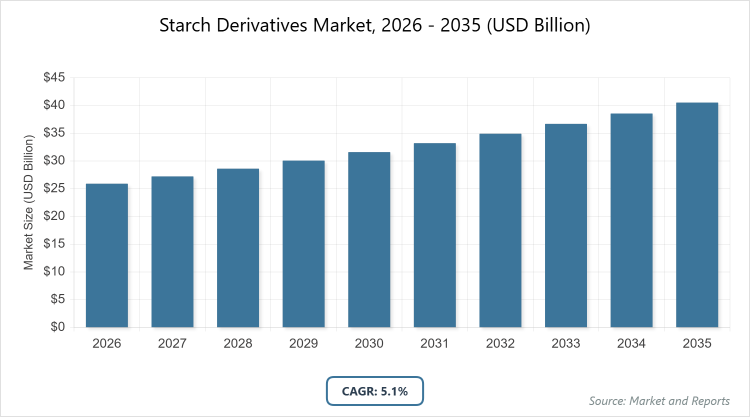
According to MarketnReports, the global Starch Derivatives market size was estimated at USD 25.9 billion in 2025 and is expected to reach USD 42.7 billion by 2035, growing at a CAGR of 5.1% from 2026 to 2035. Starch Derivatives Market is driven by expanding applications in food & beverage and pharmaceutical industries.
What is the Overview of Starch Derivatives Market?
The starch derivatives market involves the processing and modification of starch sourced from crops like corn, wheat, and potatoes to create versatile compounds used in various industries for their functional properties such as thickening, stabilizing, and binding. This market encompasses chemical, physical, or enzymatic alterations to enhance starch’s characteristics like solubility, viscosity, and resistance to heat or acid, catering to diverse applications from food texturizers to pharmaceutical excipients. Market definition refers to the sector focused on derived products like glucose syrups, maltodextrins, and modified starches that improve product performance, shelf life, and nutritional profiles, driven by consumer demand for clean-label ingredients and sustainable alternatives in processed foods, biofuels, and industrial processes to address evolving regulatory and environmental standards.
What are the Key Insights into Starch Derivatives Market?
- The global starch derivatives market was valued at USD 25.9 billion in 2025 and is projected to reach USD 42.7 billion by 2035.
- The market is expected to grow at a CAGR of 5.1% during the forecast period from 2026 to 2035.
- The market is driven by rising demand for processed foods and bio-based products in emerging economies.
- In the type segment, modified starch dominates with a 40% share.
- This dominance is due to its versatility in texture enhancement and stability, driving market growth by enabling clean-label formulations in food processing.
- In the application segment, food & beverage dominates with a 50% share.
- This is attributed to increasing use in convenience foods and beverages, fueling expansion through functional improvements like thickening and emulsification.
- In the end-use industry segment, food processing dominates with a 45% share.
- This stems from demand for natural additives, propelling the market by supporting nutritional enhancements and shelf-life extension.
- Asia Pacific dominates the global market with a 45% share.
- This is owing to rapid industrialization, population growth, and food industry expansion in China.
What are the Market Dynamics in Starch Derivatives?
Growth Drivers
Growth drivers in the starch derivatives market are primarily fueled by the expanding food and beverage industry, where derivatives enhance texture, stability, and nutritional value in processed foods, attracting manufacturers seeking clean-label solutions amid consumer preferences for natural ingredients. Advancements in biotechnology enable efficient production from diverse sources like cassava and rice, reducing costs and supporting sustainable practices. Rising demand in pharmaceuticals for excipients in drug formulations and in biofuels for eco-friendly alternatives further propels expansion. Additionally, urbanization in developing regions increases consumption of convenience foods, driving overall market growth through diversified applications and innovation.
Restraints
Restraints in the starch derivatives market include fluctuating raw material prices due to agricultural dependencies on weather and crop yields, which elevate production costs and impact profitability for manufacturers in volatile markets. Stringent regulations on food additives and genetically modified sources add compliance burdens, delaying product launches. Supply chain disruptions from global events affect availability, while competition from synthetic alternatives limits adoption in certain industries. Moreover, health concerns over high-glycemic derivatives in diets hinder growth in wellness-focused segments.
Opportunities
Opportunities in the starch derivatives market arise from the shift toward bio-based and sustainable products, enabling innovations like resistant starch for gut health in functional foods, targeting health-conscious consumers. Expansion in emerging economies with growing pharmaceutical and textile sectors presents untapped potential for customized derivatives. Partnerships for R&D in enzyme-modified starches offer differentiation, while demand for gluten-free alternatives in baking opens premium segments. Furthermore, biofuel applications align with green energy transitions, fostering growth through eco-friendly solutions.
Challenges
Challenges in the starch derivatives market encompass supply volatility from climate impacts on starch sources, requiring resilient sourcing strategies that increase costs. Intellectual property issues in modification technologies limit innovation for smaller players. Evolving consumer preferences for non-GMO products complicate formulations, while regulatory variations across regions hinder global expansion. Additionally, competition from alternative thickeners like gums adds pressure on market share.
Starch Derivatives Market: Report Scope
| Report Attributes | Report Details |
| Report Name | Starch Derivatives Market |
| Market Size 2025 | USD 25.9 Billion |
| Market Forecast 2035 | USD 42.7 Billion |
| Growth Rate | CAGR of 5.1% |
| Report Pages | 220 |
| Key Companies Covered | Cargill, Ingredion, ADM, Tate & Lyle, Roquette, and Others |
| Segments Covered | By Type, By Application, By End-Use Industry, and By Region |
| Regions Covered | North America, Europe, Asia Pacific (APAC), Latin America, and The Middle East and Africa (MEA) |
| Base Year | 2025 |
| Historical Year | 2020 – 2024 |
| Forecast Year | 2026 – 2035 |
| Customization Scope | Avail customized purchase options to meet your exact research needs. |
The Starch Derivatives market is segmented by type, application, end-use industry, and region.
Based on Type Segment, the most dominant subsegment is modified starch, while the second most dominant is glucose syrup. Modified starch leads due to its adaptable properties for viscosity and stability in diverse conditions, driving market growth by enabling versatile use in food texturizing and pharmaceutical binding that improves product quality and shelf life; glucose syrup ranks second as a sweetener and humectant, contributing to expansion through cost-effective applications in confectionery and beverages for enhanced sweetness and moisture retention.
Based on Application Segment, the most dominant subsegment is food & beverage, while the second most dominant is pharmaceuticals. Food & beverage dominates owing to demand for functional additives in processed items, propelling market growth via improvements in texture and nutrition that cater to consumer trends; pharmaceuticals follows as the second dominant, driven by excipient needs, enhancing the market through stable drug formulations.
Based on End-Use Industry Segment, the most dominant subsegment is food processing, while the second most dominant is pharmaceutical. Food processing leads because of extensive use in product enhancement, fueling market growth by supporting clean-label trends; pharmaceutical ranks second with binder applications, advancing the market through precise delivery systems.
What are Recent Developments in Starch Derivatives?
- In 2025, Cargill launched a new line of organic modified starches for clean-label foods, targeting premium markets.
- In late 2024, Ingredion acquired a biotech firm for enzyme-modified starch technology, enhancing pharmaceutical applications.
- In 2025, ADM expanded its glucose syrup production in Asia to meet beverage demand.
- In 2024, Tate & Lyle introduced resistant starch variants for gut health supplements.
What is the Regional Analysis for Starch Derivatives Market?
- Asia Pacific to dominate the global market.
Asia Pacific dominates the starch derivatives market, driven by rapid population growth and food industry expansion, demanding versatile ingredients for processed goods. The region’s growth is supported by agricultural abundance and investments in processing. China dominates within Asia Pacific, fueled by its massive food sector and biofuel initiatives, with companies like Cargill expanding facilities; India contributes through pharmaceutical growth, Japan focuses on functional foods, but challenges include supply fluctuations.
North America holds a significant share in the starch derivatives market, characterized by innovation in bio-based products and regulatory support for clean labels. The United States dominates the region, supported by firms like ADM leading in corn-derived derivatives for snacks; Canada benefits from wheat sources, Mexico from trade ties, though high costs restrain.
Europe exhibits steady growth in the starch derivatives market, emphasizing sustainability with EU regulations promoting non-GMO. Germany leads as the dominating country, bolstered by pharmaceutical expertise and companies like Avebe; the UK and France follow with food innovations, Eastern Europe offers cost advantages, despite strict rules.
Latin America shows emerging potential in the starch derivatives market, influenced by cassava production and food exports. Brazil dominates as the key country, with its biofuel sector; Mexico benefits from corn, Argentina from wheat, though volatility challenges.
The Middle East and Africa (MEA) region is nascent in the starch derivatives market, driven by food imports and industrial growth. South Africa dominates within MEA, supported by corn processing; UAE invests in food security, Saudi Arabia through diversification, but infrastructure gaps restrain.
Who are the Key Market Players in Starch Derivatives?
Cargill focuses on organic expansions and acquisitions for sustainable starch solutions.
Ingredion employs biotech innovations for modified starches in pharmaceuticals.
ADM pursues production scaling in Asia for glucose syrups.
Tate & Lyle adopts health-focused resistant starches for supplements.
Roquette concentrates on plant-based derivatives for cosmetics.
Avebe emphasizes non-GMO potato starches for Europe.
What are the Market Trends in Starch Derivatives?
- Shift toward clean-label and non-GMO products.
- Rise in functional starches for gut health.
- Growth in bio-based adhesives and biofuels.
- Expansion of resistant starch in low-carb foods.
- Focus on sustainable sourcing from alternative crops.
- Integration in plant-based meat alternatives.
- Surge in pharmaceutical excipients for drug delivery.
- Adoption of enzyme-modified for better functionality.
What Market Segments and Subsegments are Covered in the Starch Derivatives Report?
By Type
-
- Cyclodextrin
- Glucose Syrup
- Hydrolysates
- Modified Starch
- Maltodextrin
- Dextrin
- Starch Esters
- Starch Ethers
- Resistant Starch
- Cationic Starch
- Others
By Application
-
- Food & Beverage
- Feed
- Paper
- Pharmaceuticals
- Cosmetics & Personal Care
- Textiles
- Biofuel
- Adhesives
- Industrial Binders
- Construction Materials
- Others
By End-Use Industry
-
- Food Processing
- Pharmaceutical
- Paper & Pulp
- Cosmetics
- Textile
- Animal Feed
- Biofuel Production
- Construction
- Adhesives & Sealants
- Chemical
- Others
By Region
-
- North America
- U.S.
- Canada
- Europe
- UK
- Germany
- France
- Rest of Europe
- Asia Pacific
- China
- India
- Japan
- Rest of Asia Pacific
- Latin America
- Brazil
- Mexico
- Rest of Latin America
- Middle East & Africa
- UAE
- South Africa
- Rest of Middle East & Africa
- North America
Chapter 1. Preface
Chapter 2. Executive Summary
Chapter 3. Global Starch Derivatives Market - Industry Analysis
Chapter 4. Global Starch Derivatives Market- Competitive Landscape
Chapter 5. Global Starch Derivatives Market - Type Analysis
Chapter 6. Global Starch Derivatives Market - Application Analysis
Chapter 7. Global Starch Derivatives Market - End-Use Industry Analysis
Chapter 8. Starch Derivatives Market - Regional Analysis
Chapter 9. Company Profiles
Frequently Asked Questions
Starch derivatives are modified forms of starch used for functional properties in various industries like food and pharmaceuticals.
Key factors include demand for processed foods, bio-based products, and sustainable innovations.
The Starch Derivatives market is projected to grow from approximately USD 25.9 billion in 2025 to USD 42.7 billion by 2035.
The Starch Derivatives market is expected to register a CAGR of 5.1% during the forecast period from 2026 to 2035.
Asia Pacific will contribute notably, holding around 45% of the market share due to industrial growth.
Major players include Cargill, Ingredion, ADM, Tate & Lyle, Roquette, and Avebe, driving growth through innovations and expansions.
The report provides comprehensive analysis including market size, trends, segmentation, regional insights, key players, and forecasts.
The value chain includes raw material sourcing, modification processing, formulation, distribution, and end-use application.
Trends are evolving toward functional and sustainable derivatives, with preferences shifting to clean-label and health-focused products.
Regulatory factors include food safety standards, while environmental factors involve sustainable sourcing to reduce ecological impact.