
Spraying Nozzles Market Size, Share and Trends 2026 to 2035
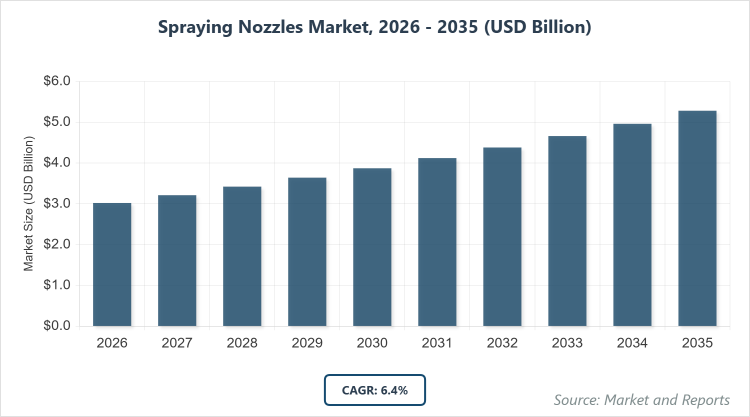
According to MarketnReports, the global Spraying Nozzles market size was estimated at USD 3.02 billion in 2025 and is expected to reach USD 6.05 billion by 2035, growing at a CAGR of 6.4% from 2026 to 2035. The increasing demand for precision agriculture and industrial automation.
What are the Key Insights into the Spraying Nozzles Market?
- The global spraying nozzles market was valued at USD 3.02 billion in 2025 and is projected to reach USD 6.05 billion by 2035.
- The market is expected to grow at a CAGR of 6.4% during the forecast period from 2026 to 2035.
- The market is driven by rising adoption in precision agriculture, stringent environmental regulations, and advancements in industrial automation.
- The flat fan nozzles subsegment dominates the type segment with a 32% share due to their precision in uniform coverage, ideal for agricultural and coating applications.
- The agricultural spraying subsegment dominates the application segment with a 38% share because of the need for efficient pesticide and fertilizer distribution in farming.
- The agriculture subsegment dominates the end-user segment with a 40% share owing to the global emphasis on increasing crop yields and sustainable farming practices.
- Asia Pacific dominates the regional segment with a 35% share attributed to rapid industrialization, expanding agricultural activities, and manufacturing growth in countries like China and India.
What are the Spraying Nozzles?
Industry Overview
Spraying nozzles are critical components designed to atomize liquids into fine droplets for efficient distribution in various applications, enhancing performance in processes like coating, cleaning, and irrigation. The market includes a wide array of nozzles made from materials such as stainless steel, plastic, and brass, tailored for specific flow rates, spray patterns, and pressures to meet diverse industrial needs. Market definition encompasses all devices used for controlled spraying of fluids, supporting sectors from agriculture to manufacturing by optimizing resource usage and improving operational efficiency.
What are the Market Dynamics of Spraying Nozzles?
Growth Drivers
The spraying nozzles market is fueled by the escalating demand for precision agriculture, where advanced nozzles enable targeted application of agrochemicals, reducing waste and environmental impact while boosting crop productivity. Industrial sectors are increasingly adopting automated spraying systems to enhance efficiency and consistency in processes like painting and cleaning, driven by the push towards Industry 4.0. Additionally, growing awareness of water conservation and the need for efficient resource utilization in water-scarce regions propel the adoption of high-performance nozzles that minimize overspray. Government incentives for sustainable farming and industrial upgrades further accelerate market growth, encouraging investments in innovative nozzle technologies.
Restraints
Market growth is hampered by the high costs associated with advanced nozzle materials and technologies, which can limit adoption among small-scale farmers and manufacturers in developing regions. Volatility in raw material prices, such as metals and polymers, affects production costs and profitability for suppliers. The presence of counterfeit products in the market undermines trust and quality standards, leading to potential failures in critical applications. Moreover, the complexity of integrating new nozzle systems into existing equipment poses technical challenges, requiring additional training and modifications that deter rapid uptake.
Opportunities
Opportunities lie in the development of eco-friendly nozzles using biodegradable materials and low-emission designs, aligning with global sustainability goals and opening new markets in green industries. The rise of smart farming technologies, including IoT-enabled nozzles for real-time monitoring and adjustment, presents avenues for innovation and market expansion. Emerging economies offer untapped potential with increasing investments in agriculture and infrastructure, where customized nozzles can address specific regional needs. Partnerships between manufacturers and research institutions can lead to breakthroughs in nozzle efficiency, such as nanotechnology-enhanced designs for finer atomization.
Challenges
Challenges include maintaining consistent performance across varying fluid viscosities and pressures, which requires ongoing R&D to adapt nozzles for diverse applications. Supply chain disruptions from global events impact the availability of specialized components, leading to delays and increased costs. Regulatory compliance with evolving environmental and safety standards demands continuous product updates, straining resources for smaller players. Additionally, competition from alternative spraying methods, like drip irrigation in agriculture, challenges the market share of traditional nozzles in certain sectors.
Spraying Nozzles Market: Report Scope
| Report Attributes | Report Details |
| Report Name | Spraying Nozzles Market |
| Market Size 2025 | USD 3.02 Billion |
| Market Forecast 2035 | USD 6.05 Billion |
| Growth Rate | CAGR of 6.4% |
| Report Pages | 220 |
| Key Companies Covered |
Spraying Systems Co., Lechler GmbH, BETE Fog Nozzle, Alfa Laval, EXAIR, and Others |
| Segments Covered | By Type, By Application, By End-User, and By Region |
| Regions Covered | North America, Europe, Asia Pacific (APAC), Latin America, and The Middle East and Africa (MEA) |
| Base Year | 2025 |
| Historical Year | 2020 – 2024 |
| Forecast Year | 2026 – 2035 |
| Customization Scope | Avail customized purchase options to meet your exact research needs. |
What is the Market Segmentation of Spraying Nozzles?
The Spraying Nozzles market is segmented by type, application, end-user, and region.
Based on Type Segment, flat fan nozzles emerge as the most dominant subsegment, followed by full cone nozzles as the second most dominant. Flat fan nozzles lead due to their ability to provide even distribution and precise control in row crop spraying and industrial coating, driving the market by reducing chemical usage and improving application efficiency in agriculture and manufacturing; full cone nozzles follow for their robust performance in cooling and washing applications, contributing to market growth through reliable coverage in high-volume processes that enhance operational productivity.
Based on Application Segment, agricultural spraying stands out as the most dominant subsegment, with industrial processing as the second most dominant. Agricultural spraying dominates because it supports efficient delivery of pesticides and fertilizers, driving market growth by enabling higher yields and sustainable practices amid global food demand; industrial processing follows for its role in precise fluid application in manufacturing, propelling the market through improved process control and reduced material waste in sectors like automotive and chemicals.
Based on the end-user segment, agriculture is the most dominant subsegment, followed by chemical as the second most dominant. Agriculture leads owing to the critical need for optimized spraying solutions to maximize crop protection and nutrition, driving market expansion by addressing food security challenges and adopting precision technologies; chemical ranks second for utilizing nozzles in mixing and dispensing processes, aiding market growth by ensuring safety and efficiency in handling hazardous materials across industrial operations.
What are the Recent Developments in the Spraying Nozzles Market?
- In 2025, Spraying Systems Co. introduced a new line of precision flat fan nozzles with enhanced anti-drift technology, aimed at reducing environmental impact in agricultural applications.
- Lechler GmbH announced a strategic partnership with a leading agrochemical company in early 2026 to develop customized nozzles for sustainable crop protection solutions.
- BETE Fog Nozzle launched an innovative air atomizing nozzle series in 2025, focusing on improved atomization for industrial cooling and humidification systems.
What is the Regional Analysis of Spraying Nozzles Market?
- Asia Pacific to dominate the global market.
Asia Pacific holds the largest market share, driven by China as the dominating country with its vast agricultural lands and booming manufacturing sector. The region’s rapid urbanization and government support for modern farming techniques fuel demand for efficient nozzles, enhanced by investments in infrastructure and export-oriented industries.
North America exhibits strong growth, led by the United States as the dominating country due to advanced precision agriculture and stringent environmental regulations. Technological innovations and the presence of key manufacturers drive adoption in industrial and agricultural applications across the region.
Europe maintains a significant position, dominated by Germany with its focus on engineering excellence and sustainable practices. EU policies on reducing chemical usage promote high-efficiency nozzles, supporting growth in the automotive and food processing sectors.
Latin America shows emerging opportunities, led by Brazil with its expansive agribusiness. Investments in crop protection and irrigation systems drive nozzle demand, though economic variability affects market pace.
The Middle East and Africa experience gradual expansion, dominated by South Africa with its mining and agricultural needs. Water scarcity issues push for efficient spraying solutions, aided by international aid and infrastructure projects.
Who are the Key Market Players in Spraying Nozzles and Their Strategies?
- Spraying Systems Co. emphasizes product innovation and customization, investing in R&D for precision nozzles while expanding global distribution networks to capture emerging markets.
- Lechler GmbH focuses on sustainability, developing low-drift nozzles and forming alliances with industry leaders to enhance application efficiency in agriculture and industry.
- BETE Fog Nozzle prioritizes technological advancements in atomization, targeting niche applications like fire protection and offering tailored solutions through customer collaborations.
- Alfa Laval leverages its expertise in fluid handling, integrating nozzles into comprehensive systems and pursuing acquisitions to broaden its industrial portfolio.
- EXAIR adopts a strategy of energy-efficient designs, promoting compressed air nozzles for cost savings and complying with environmental standards in manufacturing sectors.
What are the Market Trends in Spraying Nozzles?
- Rising adoption of precision spraying technologies to minimize chemical usage and environmental impact.
- Shift towards sustainable materials like recyclable plastics and corrosion-resistant alloys in nozzle manufacturing.
- Integration of IoT and sensors for real-time monitoring and adjustment in smart spraying systems.
- Growing demand for anti-drift nozzles in agriculture to comply with regulatory standards.
- Expansion of customized nozzles for specialized industrial applications like 3D printing and pharmaceuticals.
What Market Segments and Their Subsegments are Covered in the Spraying Nozzles Report?
By Type
- Full Cone Nozzles
- Hollow Cone Nozzles
- Flat Fan Nozzles
- Solid Stream Nozzles
- Air Atomizing Nozzles
- Hydraulic Nozzles
- Pneumatic Nozzles
- Ultrasonic Nozzles
- Electrostatic Nozzles
- Mist Nozzles
- Others
By Application
- Cleaning
- Coating
- Cooling
- Humidification
- Dust Control
- Gas Scrubbing
- Fire Protection
- Agricultural Spraying
- Industrial Processing
- Pharmaceutical Spraying
- Others
By End-User
- Agriculture
- Automotive
- Chemical
- Food and Beverage
- Pharmaceutical
- Oil and Gas
- Electronics
- Mining
- Paper and Pulp
- Water Treatment
- Others
By Region
- North America
- U.S.
- Canada
- Europe
- UK
- Germany
- France
- Rest of Europe
- Asia Pacific
- China
- India
- Japan
- Rest of Asia Pacific
- Latin America
- Brazil
- Mexico
- Rest of Latin America
- Middle East & Africa
- UAE
- South Africa
- Rest of Middle East & Africa
Chapter 1. Preface
Chapter 2. Executive Summary
Chapter 3. Global Spraying Nozzles Market - Industry Analysis
Chapter 4. Global Spraying Nozzles Market- Competitive Landscape
Chapter 5. Global Spraying Nozzles Market - Type Analysis
Chapter 6. Global Spraying Nozzles Market - Application Analysis
Chapter 7. Global Spraying Nozzles Market - End-User Analysis
Chapter 8. Spraying Nozzles Market - Regional Analysis
Chapter 9. Company Profiles
Frequently Asked Questions
Spraying nozzles are devices that convert liquids into a spray of fine droplets, used for applications like coating, cleaning, and irrigation in various industries.
Key factors include advancements in precision agriculture, industrial automation, environmental regulations, and innovations in nozzle technology.
The market is projected to grow from approximately USD 3.2 billion in 2026 to USD 6.05 billion by 2035.
The CAGR is expected to be 6.4% during the forecast period.
Asia Pacific will contribute notably, holding around 35% of the market share due to industrialization and agricultural expansion.
Major players include Spraying Systems Co., Lechler GmbH, BETE Fog Nozzle, Alfa Laval, and EXAIR.
The report provides detailed analysis of market size, trends, segmentation, regional insights, key players, and forecasts from 2026 to 2035.
The value chain includes raw material procurement, manufacturing, design and engineering, distribution, and end-user application.
Trends are evolving towards eco-friendly, precision-based nozzles, with consumers preferring durable, efficient options that reduce waste and comply with regulations.
Stringent regulations on chemical usage and emissions are driving demand for low-drift, efficient nozzles to minimize environmental impact.