
Spatial Computing Market Size, Share and Trends 2026 to 2035
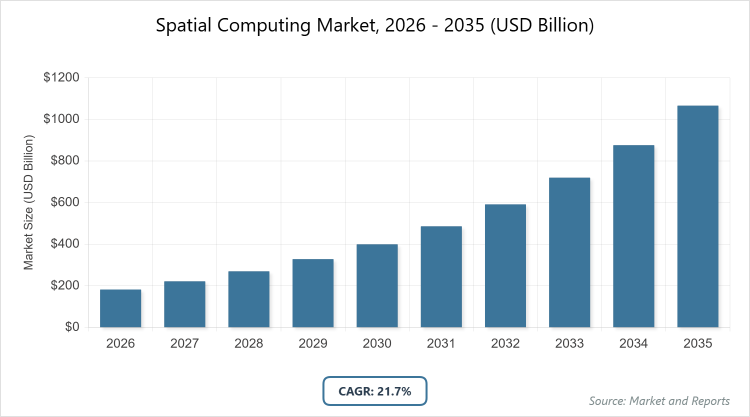
According to MarketnReports, the global Spatial Computing market size was estimated at USD 182.05 billion in 2025 and is expected to reach USD 1,297 billion by 2035, growing at a CAGR of 21.7% from 2026 to 2035. Spatial Computing Market is driven by the increasing integration of AR, VR, and AI technologies in various sectors.
What are the Key Insights of the Spatial Computing Market?
- The global Spatial Computing market was valued at USD 182.05 billion in 2025 and is projected to reach USD 1,297 billion by 2035.
- The market is expected to grow at a CAGR of 21.7% during the forecast period from 2026 to 2035.
- The market is driven by advancements in immersive technologies and rising adoption across industries.
- The Hardware subsegment dominated the Component segment with over 65% share due to its essential role in providing the foundational devices like headsets and glasses that enable real-world spatial interactions.
- The Augmented Reality subsegment dominated the Technology segment with over 20.5% share because of its versatile applications in mobile devices and enterprise solutions, allowing seamless overlay of digital information on the physical world.
- The Healthcare subsegment dominated the End User segment with over 10% share owing to its critical applications in medical training, surgical planning, and patient care simulations that improve accuracy and outcomes.
- North America dominated with 32% share due to its concentration of leading technology companies, robust R&D infrastructure, and early adoption of innovative solutions.
What is the Industry Overview of Spatial Computing?
Spatial computing encompasses the integration of digital and physical environments, enabling machines and humans to interact in three-dimensional spaces through advanced technologies. It involves the use of sensors, computer vision, and processing power to understand and manipulate real-world contexts, blurring the lines between virtual and reality. The market definition refers to the ecosystem of hardware, software, and services that facilitate this interaction, including augmented reality for overlaying data, virtual reality for immersive simulations, and mixed reality for hybrid experiences. This field is revolutionizing how industries operate by enhancing productivity, creativity, and user engagement without relying on traditional screens or interfaces.
What are the Market Dynamics in Spatial Computing?
Growth Drivers
The growth of the spatial computing market is propelled by rapid advancements in hardware and software technologies, such as improved sensors and AI algorithms, which enable more accurate and immersive experiences. Increasing demand from industries like healthcare and manufacturing for training simulations and remote collaboration tools further accelerates adoption. The proliferation of 5G networks enhances low-latency connectivity, making real-time spatial applications feasible on a global scale. Investments from tech giants and startups in innovative solutions, coupled with consumer interest in metaverse and XR experiences, are key catalysts driving market expansion.
Restraints
High initial costs associated with developing and deploying spatial computing infrastructure pose significant barriers, particularly for small and medium enterprises. Privacy and data security concerns arise from the extensive collection of spatial data, leading to regulatory hurdles and user hesitation. Technical limitations, such as battery life and processing power in wearable devices, restrict widespread usability. Additionally, a lack of standardized platforms results in interoperability issues, hindering seamless integration across systems and slowing market penetration.
Opportunities
Emerging opportunities lie in the expansion of spatial computing into untapped sectors like retail and education, where AR can enhance customer experiences and interactive learning. The convergence with AI and IoT opens avenues for smart city applications and predictive maintenance in industries. Growing investments in metaverse platforms create potential for new business models in virtual economies. Furthermore, advancements in lightweight AR glasses and cloud-based solutions can democratize access, fostering innovation in developing regions.
Challenges
Challenges include the need for skilled professionals to develop and maintain complex spatial systems, leading to talent shortages. Rapid technological evolution requires continuous updates, straining resources for companies. Ethical issues surrounding augmented content and its impact on human perception pose societal challenges. Moreover, infrastructure disparities in rural or underdeveloped areas limit equitable access to high-speed networks essential for optimal performance.
Spatial Computing Market: Report Scope
| Report Attributes | Report Details |
| Report Name | Spatial Computing Market |
| Market Size 2025 | USD 182.05 Billion |
| Market Forecast 2035 | USD 1,297 Billion |
| Growth Rate | CAGR of 21.7% |
| Report Pages | 220 |
| Key Companies Covered |
Apple Inc., Microsoft Corporation, NVIDIA Corporation, Oculus (Face Reality Labs_, PTC, Qualcomm Technologies Inc., Avegant Corporation, Blippar, DAQRI, Google LLC, HTC Corporation, Lenovo Group Limited, Magic Leap Inc., Marxent, Seiko Epson Corporation, Sony Group Corporation, Unity Software Inc., Vuzix, Zappar Ltd. |
| Segments Covered | By Component, By Technology, By End User, and By Region |
| Regions Covered | North America, Europe, Asia Pacific (APAC), Latin America, and The Middle East and Africa (MEA) |
| Base Year | 2025 |
| Historical Year | 2020 – 2024 |
| Forecast Year | 2026 – 2035 |
| Customization Scope | Avail customized purchase options to meet your exact research needs. |
How is the Spatial Computing Market Segmented?
The Spatial Computing market is segmented by component, technology, end user, and region.
Based on Component Segment, the Hardware subsegment is the most dominant, holding over 65% market share, followed by Software as the second most dominant. Hardware’s dominance stems from its critical function as the physical enabler of spatial experiences through devices like AR glasses and VR headsets, which are indispensable for user interaction; this drives the market by providing the foundation for software applications and services to build upon, fostering widespread adoption and innovation across industries.
Based on Technology Segment, the Augmented Reality subsegment is the most dominant with over 20.5% share, while Mixed Reality is the second most dominant. Augmented Reality leads due to its accessibility via mobile devices and broad utility in overlaying digital elements on real environments, which propels market growth by enabling practical applications in training, navigation, and entertainment that require minimal specialized equipment.
Based on End User Segment, the Healthcare subsegment is the most dominant with over 10% share, and Architecture, Engineering, & Construction (AEC) is the second most dominant. Healthcare’s prominence is driven by its use in precise surgical visualizations and medical education simulations, contributing to market expansion by improving efficiency, reducing errors, and enhancing patient outcomes in a high-stakes sector.
What are the Recent Developments in Spatial Computing?
- In July 2025, PICO partnered with Blender to integrate open-source 3D tools into enterprise XR pipelines, enhancing content creation capabilities and accelerating adoption in professional settings.
- In July 2025, CREAL secured USD 8.9 million in funding to advance miniaturization of light-field displays, paving the way for thinner and more comfortable AR glasses that could broaden consumer appeal.
- In July 2025, Augmodo raised USD 37.5 million to expand its spatial commerce analytics platform, enabling brick-and-mortar stores to leverage AR for better inventory management and customer insights.
- In June 2025, NVIDIA initiated the construction of an industrial AI cloud in Germany with 10,000 GPUs, aimed at supporting Omniverse workloads and boosting spatial computing applications in manufacturing.
- In May 2025, HUMAIN and NVIDIA announced a 500-MW AI factory in Saudi Arabia, aligning with Vision 2030 to foster regional advancements in spatial technologies and AI integration.
What is the Regional Analysis for Spatial Computing Market?
- North America to dominate the global market
North America leads the spatial computing market with a 32% share, driven by its ecosystem of tech innovators like Apple, Microsoft, and Google, which invest heavily in R&D. The United States dominates within the region due to Silicon Valley’s influence, supportive policies, and high consumer tech adoption; this fosters advancements in AR/VR applications across healthcare and entertainment, contributing to economic growth through job creation and exports. Canada’s contributions in AI and software development complement this, enhancing cross-border collaborations.
Asia Pacific is the fastest-growing region with a projected CAGR of 22.2%, fueled by high smartphone penetration in countries like China and India. China dominates here with massive investments in 5G and metaverse initiatives, enabling mobile AR experiences; this drives market expansion by catering to a large population base and emerging tech startups, positioning the region as a manufacturing hub for hardware components.
Europe shows steady growth, supported by regulatory frameworks and industrial applications in countries like Germany and the UK. Germany leads with its focus on automotive and engineering sectors using spatial tools for design; this thorough integration improves efficiency and innovation, though challenges like data privacy regulations temper pace compared to other regions.
Latin America is emerging with potential in education and retail, led by Brazil’s adoption of VR for training. Brazil dominates due to its large market size and government initiatives in digital transformation; however, infrastructure limitations hinder faster growth, yet opportunities in remote collaboration could accelerate progress.
Middle East and Africa experiences nascent development, with the UAE leading through smart city projects incorporating IoT and AR. The UAE’s dominance stems from Vision 2031 investments in tech diversification; this region benefits from oil-funded innovations, though skill gaps and connectivity issues present ongoing challenges.
Who are the Key Market Players in Spatial Computing?
Apple Inc. focuses on integrating spatial computing into consumer devices, as seen with the Vision Pro headset, emphasizing seamless user experiences through proprietary hardware and software ecosystems to capture market share in entertainment and productivity.
Microsoft Corporation employs strategies centered on enterprise solutions like HoloLens, leveraging partnerships with industries for mixed reality applications in training and collaboration, driving growth through Azure cloud integration.
Meta pursues aggressive expansion in metaverse platforms via Oculus, investing in content creation and social VR to build user communities and monetize through advertising and virtual economies.
Google LLC prioritizes AI-driven AR tools like Google Glass and Maps integrations, forming alliances with developers to enhance mobile spatial experiences and dominate search-related applications.
NVIDIA Corporation concentrates on GPU technologies for rendering immersive environments, collaborating on AI factories and Omniverse platforms to support industrial simulations and accelerate market adoption.
What are the Market Trends in Spatial Computing?
- Convergence of physical AI with spatial computing for autonomous machine actions in 3D environments.
- Resurgence of VR enhanced by generative AI and mixed reality for immersive social and entertainment experiences.
- Rise of consumer AR smart glasses powered by multimodal large language models from companies like Snap and Meta.
- Expansion of spatial commerce analytics in retail for better physical store management.
- Increased investments in industrial AI clouds to support Omniverse and metaverse workloads.
What Market Segments and Subsegments are Covered in the Report?
By Component
- Software
- Hardware
- Services
By Technology
- Augmented Reality
- Virtual Reality
- Mixed Reality
- Artificial Intelligence
- Digital Twins
- Internet of Things
- Others
By End User
- Aerospace & Defense
- Healthcare
- Automotive
- Gaming
- Energy & Utilities
- Consumer Electronics
- Architecture, Engineering, & Construction
- Government & Public Sector
- Information Technology
- Others
By Region
- North America
- U.S.
- Canada
- Europe
- UK
- Germany
- France
- Rest of Europe
- Asia Pacific
- China
- India
- Japan
- Rest of Asia Pacific
- Latin America
- Brazil
- Mexico
- Rest of Latin America
- Middle East & Africa
- UAE
- South Africa
- Rest of Middle East & Africa
Chapter 1. Preface
1.1 Report Description and Scope1.2 Research Scope1.3 Research Methodology1.3.1 Market Research Type1.3.2 Market Research MethodologyChapter 2. Executive Summary
2.1 Global Spatial Computing Market, (2026 - 2035) (USD Billion)2.2 Global Spatial Computing Market: SnapshotChapter 3. Global Spatial Computing Market - Industry Analysis
3.1 Spatial Computing Market: Market Dynamics3.2 Market Drivers3.2.1 The spatial computing market is driven by advances in AI-enabled hardware and software, rising adoption across healthcare and manufacturing, 5G-enabled real-time connectivity, strong investments, and growing interest in metaverse and XR experiences.3.3 Market Restraints3.3.1 The spatial computing market is constrained by high deployment costs, privacy and data security concerns, device limitations, and lack of standardization causing interoperability issues.3.4 Market Opportunities3.4.1 Opportunities in the spatial computing market stem from expansion into retail and education, AI and IoT integration for smart cities, metaverse growth, and advancements in lightweight AR and cloud-based solutions driving broader adoption.3.5 Market Challenges3.5.1 The spatial computing market faces challenges from talent shortages, rapid technology evolution, ethical concerns around augmented content, and limited high-speed infrastructure in underserved regions.3.6 Porter’s Five Forces Analysis3.7 Market Attractiveness Analysis3.7.1 Market Attractiveness Analysis By Component3.7.2 Market Attractiveness Analysis By Technology3.7.3 Market Attractiveness Analysis By End UserChapter 4. Global Spatial Computing Market- Competitive Landscape
4.1 Company Market Share Analysis4.1.1 Global Spatial Computing Market: Company Market Share, 20254.2 Strategic Development4.2.1 Acquisitions & mergers4.2.2 New Product launches4.2.3 Agreements, partnerships, collaborations, and joint ventures4.2.4 Research and development and regional expansion4.3 Price Trend AnalysisChapter 5. Global Spatial Computing Market - Component Analysis
5.1 Global Spatial Computing Market Overview: Component5.1.1 Global Spatial Computing Market share, By Component, 2025 and 20355.2 Software5.2.1 Global Spatial Computing Market by Software, 2026 - 2035 (USD Billion)5.3 Hardware5.3.1 Global Spatial Computing Market by Hardware, 2026 - 2035 (USD Billion)5.4 Services5.4.1 Global Spatial Computing Market by Services, 2026 - 2035 (USD Billion)Chapter 6. Global Spatial Computing Market - Technology Analysis
6.1 Global Spatial Computing Market Overview: Technology6.1.1 Global Spatial Computing Market Share, By Technology, 2025 and 20356.2 Augmented Reality6.2.1 Global Spatial Computing Market by Augmented Reality, 2026 - 2035 (USD Billion)6.3 Virtual Reality6.3.1 Global Spatial Computing Market by Virtual Reality, 2026 - 2035 (USD Billion)6.4 Mixed Reality6.4.1 Global Spatial Computing Market by Mixed Reality, 2026 - 2035 (USD Billion)6.5 Artificial Intelligence6.5.1 Global Spatial Computing Market by Artificial Intelligence, 2026 - 2035 (USD Billion)6.6 Digital Twins6.6.1 Global Spatial Computing Market by Digital Twins, 2026 - 2035 (USD Billion)6.7 Internet of Things6.7.1 Global Spatial Computing Market by Internet of Things, 2026 - 2035 (USD Billion)6.8 Others6.8.1 Global Spatial Computing Market by Others, 2026 - 2035 (USD Billion)Chapter 7. Global Spatial Computing Market - End User Analysis
7.1 Global Spatial Computing Market Overview: End User7.1.1 Global Spatial Computing Market Share, By End User, 2025 and 20357.2 Aerospace & Defense7.2.1 Global Spatial Computing Market by Aerospace & Defense, 2026 - 2035 (USD Billion)7.3 Healthcare7.3.1 Global Spatial Computing Market by Healthcare, 2026 - 2035 (USD Billion)7.4 Automotive7.4.1 Global Spatial Computing Market by Automotive, 2026 - 2035 (USD Billion)7.5 Gaming7.5.1 Global Spatial Computing Market by Gaming, 2026 - 2035 (USD Billion)7.6 Energy & Utilities7.6.1 Global Spatial Computing Market by Energy & Utilities, 2026 - 2035 (USD Billion)7.7 Consumer Electronics7.7.1 Global Spatial Computing Market by Consumer Electronics, 2026 - 2035 (USD Billion)7.8 Architecture7.8.1 Global Spatial Computing Market by Architecture, 2026 - 2035 (USD Billion)7.9 Engineering7.9.1 Global Spatial Computing Market by Engineering, 2026 - 2035 (USD Billion)7.10 & Construction7.10.1 Global Spatial Computing Market by & Construction, 2026 - 2035 (USD Billion)7.11 Government & Public Sector7.11.1 Global Spatial Computing Market by Government & Public Sector, 2026 - 2035 (USD Billion)Chapter 8. Spatial Computing Market - Regional Analysis
8.1 Global Spatial Computing Market Regional Overview8.2 Global Spatial Computing Market Share, by Region, 2025 & 2035 (USD Billion)8.3 North America8.3.1 North America Spatial Computing Market, 2026 - 2035 (USD Billion)8.3.1.1 North America Spatial Computing Market, by Country, 2026 - 2035 (USD Billion)8.3.2 North America Spatial Computing Market, by Component, 2026 - 20358.3.2.1 North America Spatial Computing Market, by Component, 2026 - 2035 (USD Billion)8.3.3 North America Spatial Computing Market, by Technology, 2026 - 20358.3.3.1 North America Spatial Computing Market, by Technology, 2026 - 2035 (USD Billion)8.3.4 North America Spatial Computing Market, by End User, 2026 - 20358.3.4.1 North America Spatial Computing Market, by End User, 2026 - 2035 (USD Billion)8.4 Europe8.4.1 Europe Spatial Computing Market, 2026 - 2035 (USD Billion)8.4.1.1 Europe Spatial Computing Market, by Country, 2026 - 2035 (USD Billion)8.4.2 Europe Spatial Computing Market, by Component, 2026 - 20358.4.2.1 Europe Spatial Computing Market, by Component, 2026 - 2035 (USD Billion)8.4.3 Europe Spatial Computing Market, by Technology, 2026 - 20358.4.3.1 Europe Spatial Computing Market, by Technology, 2026 - 2035 (USD Billion)8.4.4 Europe Spatial Computing Market, by End User, 2026 - 20358.4.4.1 Europe Spatial Computing Market, by End User, 2026 - 2035 (USD Billion)8.5 Asia Pacific8.5.1 Asia Pacific Spatial Computing Market, 2026 - 2035 (USD Billion)8.5.1.1 Asia Pacific Spatial Computing Market, by Country, 2026 - 2035 (USD Billion)8.5.2 Asia Pacific Spatial Computing Market, by Component, 2026 - 20358.5.2.1 Asia Pacific Spatial Computing Market, by Component, 2026 - 2035 (USD Billion)8.5.3 Asia Pacific Spatial Computing Market, by Technology, 2026 - 20358.5.3.1 Asia Pacific Spatial Computing Market, by Technology, 2026 - 2035 (USD Billion)8.5.4 Asia Pacific Spatial Computing Market, by End User, 2026 - 20358.5.4.1 Asia Pacific Spatial Computing Market, by End User, 2026 - 2035 (USD Billion)8.6 Latin America8.6.1 Latin America Spatial Computing Market, 2026 - 2035 (USD Billion)8.6.1.1 Latin America Spatial Computing Market, by Country, 2026 - 2035 (USD Billion)8.6.2 Latin America Spatial Computing Market, by Component, 2026 - 20358.6.2.1 Latin America Spatial Computing Market, by Component, 2026 - 2035 (USD Billion)8.6.3 Latin America Spatial Computing Market, by Technology, 2026 - 20358.6.3.1 Latin America Spatial Computing Market, by Technology, 2026 - 2035 (USD Billion)8.6.4 Latin America Spatial Computing Market, by End User, 2026 - 20358.6.4.1 Latin America Spatial Computing Market, by End User, 2026 - 2035 (USD Billion)8.7 The Middle-East and Africa8.7.1 The Middle-East and Africa Spatial Computing Market, 2026 - 2035 (USD Billion)8.7.1.1 The Middle-East and Africa Spatial Computing Market, by Country, 2026 - 2035 (USD Billion)8.7.2 The Middle-East and Africa Spatial Computing Market, by Component, 2026 - 20358.7.2.1 The Middle-East and Africa Spatial Computing Market, by Component, 2026 - 2035 (USD Billion)8.7.3 The Middle-East and Africa Spatial Computing Market, by Technology, 2026 - 20358.7.3.1 The Middle-East and Africa Spatial Computing Market, by Technology, 2026 - 2035 (USD Billion)8.7.4 The Middle-East and Africa Spatial Computing Market, by End User, 2026 - 20358.7.4.1 The Middle-East and Africa Spatial Computing Market, by End User, 2026 - 2035 (USD Billion)Chapter 9. Company Profiles
9.1 Apple Inc.9.1.1 Overview9.1.2 Financials9.1.3 Product Portfolio9.1.4 Business Strategy9.1.5 Recent Developments9.2 Avegant Corporation9.2.1 Overview9.2.2 Financials9.2.3 Product Portfolio9.2.4 Business Strategy9.2.5 Recent Developments9.3 Blippar9.3.1 Overview9.3.2 Financials9.3.3 Product Portfolio9.3.4 Business Strategy9.3.5 Recent Developments9.4 DAQRI9.4.1 Overview9.4.2 Financials9.4.3 Product Portfolio9.4.4 Business Strategy9.4.5 Recent Developments9.5 Google LLC9.5.1 Overview9.5.2 Financials9.5.3 Product Portfolio9.5.4 Business Strategy9.5.5 Recent Developments9.6 HTC Corporation9.6.1 Overview9.6.2 Financials9.6.3 Product Portfolio9.6.4 Business Strategy9.6.5 Recent Developments9.7 Lenovo Group Limited9.7.1 Overview9.7.2 Financials9.7.3 Product Portfolio9.7.4 Business Strategy9.7.5 Recent Developments9.8 Magic Leap Inc.9.8.1 Overview9.8.2 Financials9.8.3 Product Portfolio9.8.4 Business Strategy9.8.5 Recent Developments9.9 Marxent9.9.1 Overview9.9.2 Financials9.9.3 Product Portfolio9.9.4 Business Strategy9.9.5 Recent Developments9.10 Microsoft Corporation9.10.1 Overview9.10.2 Financials9.10.3 Product Portfolio9.10.4 Business Strategy9.10.5 Recent Developments9.11 NVIDIA Corporation9.11.1 Overview9.11.2 Financials9.11.3 Product Portfolio9.11.4 Business Strategy9.11.5 Recent Developments9.12 Oculus (Face Reality Labs_9.12.1 Overview9.12.2 Financials9.12.3 Product Portfolio9.12.4 Business Strategy9.12.5 Recent Developments9.13 PTC9.13.1 Overview9.13.2 Financials9.13.3 Product Portfolio9.13.4 Business Strategy9.13.5 Recent Developments9.14 Qualcomm Technologies Inc.9.14.1 Overview9.14.2 Financials9.14.3 Product Portfolio9.14.4 Business Strategy9.14.5 Recent Developments9.15 Seiko Epson Corporation9.15.1 Overview9.15.2 Financials9.15.3 Product Portfolio9.15.4 Business Strategy9.15.5 Recent Developments9.16 Sony Group Corporation9.16.1 Overview9.16.2 Financials9.16.3 Product Portfolio9.16.4 Business Strategy9.16.5 Recent Developments9.17 Unity Software Inc.9.17.1 Overview9.17.2 Financials9.17.3 Product Portfolio9.17.4 Business Strategy9.17.5 Recent Developments9.18 Vuzix9.18.1 Overview9.18.2 Financials9.18.3 Product Portfolio9.18.4 Business Strategy9.18.5 Recent Developments9.19 Zappar Ltd.9.19.1 Overview9.19.2 Financials9.19.3 Product Portfolio9.19.4 Business Strategy9.19.5 Recent Developments
Frequently Asked Questions
Spatial computing is a technology that allows computers to interact with the physical world in three dimensions, using AR, VR, MR, and related tools to blend digital content with real environments for enhanced human-machine interactions.
Key factors include advancements in AR/VR hardware, AI integration, 5G proliferation, industry adoption in healthcare and manufacturing, and investments in metaverse platforms.
The market is projected to grow from USD 182.05 billion in 2025 to USD 1,297 billion by 2035.
The CAGR will be 21.7% during 2026-2035.
North America will contribute notably, holding a dominant 32% share due to its tech innovation hubs.
Major players include Apple Inc., Microsoft Corporation, NVIDIA Corporation, Oculus (Face Reality Labs_, PTC, Qualcomm Technologies Inc., Avegant Corporation, Blippar, DAQRI, Google LLC, HTC Corporation, Lenovo Group Limited, Magic Leap Inc., Marxent, Seiko Epson Corporation, Sony Group Corporation, Unity Software Inc., Vuzix, Zappar Ltd.
The report provides in-depth analysis of market size, trends, segments, regional outlook, key players, and forecasts from 2026 to 2035.
Stages include hardware manufacturing, software development, content creation, integration services, distribution, and end-user application deployment.
Trends are shifting towards AI-enhanced VR and AR glasses, with consumers preferring immersive, mobile-friendly experiences for entertainment and productivity.
Data privacy regulations like GDPR and environmental concerns over electronic waste from devices are influencing growth by requiring sustainable practices and secure data handling.