
Sous Vide Machine Market Size, Share, and Trends 2026 to 2035
What are the Key Insights into the Sous Vide Machine Market?
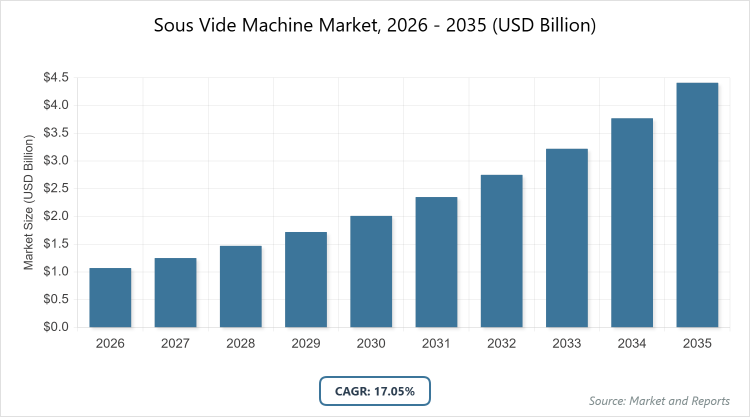
- The global sous vide machine market is projected to grow from approximately USD 1.07 billion in 2026 to USD 4.42 billion by 2035, reflecting a compound annual growth rate (CAGR) of around 17.05%.
- Among types, immersion circulators dominate as the leading subsegment, valued for their versatility and ease of use in home settings.
- In end-use segments, residential holds the dominant position, driven by consumer interest in home cooking.
- By distribution channel, online channels are the most prominent, facilitated by e-commerce growth.
- North America emerges as the dominant region, contributing the largest market share due to high adoption and culinary trends.
What is the Sous Vide Machine Industry?
Industry Overview
The sous vide machine industry encompasses precision cooking appliances designed for vacuum-sealed food immersion in temperature-controlled water baths to achieve consistent, evenly cooked results with enhanced flavor retention and nutritional preservation, primarily used in residential kitchens, commercial restaurants, and food processing settings. These devices, often featuring immersion circulators or water ovens with digital controls for time and temperature settings, enable low-temperature, long-duration cooking that minimizes overcooking risks and supports culinary techniques favored by professional chefs and home enthusiasts alike.
Positioned at the intersection of kitchen appliances and food technology, the market emphasizes innovation in smart connectivity, energy efficiency, and user-friendly designs to cater to evolving consumer preferences for healthy, convenient meal preparation, while addressing commercial needs for scalability and hygiene in high-volume operations, ultimately promoting gourmet cooking accessibility amid global trends in home dining and sustainable food practices.
What Drives the Sous Vide Machine Market?
Growth Drivers
The sous vide machine market is fueled by the rising popularity of home cooking and gourmet meal preparation among consumers seeking precise, restaurant-quality results with minimal effort, coupled with increasing awareness of healthy eating habits that preserve nutrients through low-temperature cooking.
Technological advancements, such as app-integrated devices with remote monitoring and recipe guidance, enhance user appeal and adoption in smart kitchens, while the expansion of e-commerce platforms facilitates broader accessibility and product variety. Additionally, the growth of commercial applications in restaurants and food services, driven by efficiency in bulk preparation and consistent quality, supports market penetration through professional endorsements and culinary education initiatives.
Restraints
High initial costs of premium sous vide machines, including accessories like vacuum sealers and containers, deter budget-conscious consumers, particularly in price-sensitive emerging markets where affordability remains a barrier. Limited awareness and technical knowledge among potential users, combined with the perception of sous vide as a niche or complex method, hinder widespread adoption. Moreover, supply chain disruptions for electronic components and fluctuating raw material prices increase manufacturing expenses, restraining growth amid economic uncertainties.
Opportunities
The integration of IoT and AI for personalized cooking experiences opens avenues for smart sous vide models, appealing to tech-savvy millennials and expanding into premium segments. Emerging markets in Asia and Latin America offer untapped potential through rising disposable incomes and culinary tourism, where localized marketing and partnerships can capture demand. Furthermore, innovations in energy-efficient and portable designs align with sustainability trends, enabling differentiation and entry into eco-conscious consumer bases via online channels.
Challenges
Regulatory standards for electrical safety and food hygiene require continuous compliance investments, complicating global expansions for manufacturers navigating diverse international guidelines. Intense competition from alternative cooking appliances like multi-cookers erodes market share, while consumer skepticism about long cooking times demands enhanced education. Additionally, environmental concerns over plastic vacuum bags pressure companies to develop reusable alternatives without compromising functionality.
Sous Vide Machine Market: Report Scope
| Report Attributes | Report Details |
| Report Name | Sous Vide Machine Market |
| Market Size 2025 | USD 1.07 Billion |
| Market Forecast 2035 | USD 4.42 Billion |
| Growth Rate | CAGR of 17.05% |
| Report Pages | 195 |
| Key Companies Covered | Anova Culinary, Breville (ChefSteps), PolyScience, Sous Vide Supreme, Instant Brands, Gourmia, and Vesta Precision |
| Segments Covered | By Type, By End-Use, By Distribution Channel, By Region |
| Regions Covered | North America, Europe, Asia Pacific (APAC), Latin America, The Middle East and Africa (MEA) |
| Base Year | 2025 |
| Historical Year | 2020 – 2024 |
| Forecast Year | 2026 – 2035 |
| Customization Scope | Avail customized purchase options to meet your exact research needs. |
How is the Sous Vide Machine Market Segmented?
The sous vide machine market is segmented by type, end-use, distribution channel, and region.
By type, including immersion circulators and water baths/ovens, with immersion circulators emerging as the most dominant due to their compact design, precise temperature control, and compatibility with existing pots, making them accessible for home users; this dominance drives the market by lowering entry barriers and encouraging volume sales through affordability, while water baths/ovens rank as the second most dominant, preferred for integrated, all-in-one solutions in commercial kitchens, supporting growth via professional applications and higher capacity needs.
By end-use, the market divides into residential and commercial, where residential dominates owing to the surge in home cooking enthusiasts seeking professional results, fueled by social media and recipe apps; its prevalence propels market expansion by broadening consumer base and fostering innovations like app connectivity, whereas commercial follows as the second dominant, essential for restaurants ensuring consistent quality, contributing through bulk procurements and efficiency gains.
By distribution channel, segments include online and offline, with online leading as it offers convenience, reviews, and competitive pricing through platforms like Amazon; this segment fuels dynamics by reaching global audiences, while offline secures second place, utilized in specialty stores for hands-on demonstrations, enhancing trust in premium purchases.
What are the Recent Developments in the Sous Vide Machine Market?
- In 2023, Anova Culinary launched an upgraded precision cooker with enhanced Wi-Fi connectivity and app features for recipe sharing, targeting home users to capitalize on the home cooking trend post-pandemic.
- In 2024, Breville introduced a compact sous vide immersion circulator with energy-efficient modes, aiming to appeal to eco-conscious consumers and expand its market share in Europe.
- In early 2025, PolyScience partnered with a major retailer for bundled kits including vacuum sealers, boosting accessibility and sales in the residential segment.
How Does Regional Performance Vary in the Sous Vide Machine Market?
- North America to dominate the market
North America dominates the sous vide machine market, supported by high consumer spending on kitchen appliances, strong e-commerce infrastructure, and culinary trends promoted by media and chefs; the United States leads this region with widespread adoption in homes and restaurants, innovative product launches, and major players like Anova driving awareness through marketing, while Canada contributes through similar lifestyle preferences and growing interest in precision cooking for healthy meals. Mexico adds emerging momentum via cross-border e-commerce and rising middle-class culinary experimentation, supported by urban food delivery services incorporating sous vide techniques. The region’s tech-savvy population accelerates smart device uptake, with influencer endorsements further boosting residential sales. Overall, North America’s mature retail ecosystem ensures consistent availability and after-sales support.
Europe exhibits steady growth through emphasis on gourmet cooking and energy efficiency; Germany stands out as the dominating country, leveraging precision engineering for high-quality devices and exports, with France and the UK adding via culinary heritage and premium kitchen trends. Italy and Spain enhance regional dynamics with Mediterranean diet influences favoring nutrient-preserving methods, while Nordic countries focus on sustainable, app-integrated models for eco-aware consumers. The Netherlands and Belgium contribute through professional chef communities promoting sous vide in fine dining. Eastern Europe gains traction via EU economic alignments and online platforms introducing affordable models. Europe’s stringent energy regulations drive demand for efficient devices, solidifying its position in commercial applications.
Asia Pacific emerges dynamically, propelled by rising middle-class incomes and western cooking influences; China predominates with manufacturing hubs and growing domestic demand, supported by Japan’s tech-savvy integrations in smart appliances. India accelerates through e-commerce platforms and urban food enthusiasts, with South Korea contributing advanced connectivity features and Southeast Asia gaining from tourism-driven professional adoption. Thailand and Malaysia boost commercial use in hotels, while Indonesia and Vietnam see residential growth via social media trends. The region’s rapid urbanization fuels demand for convenient cooking solutions amid busy lifestyles.
Latin America advances moderately amid improving economies; Brazil excels with urban foodie culture and e-commerce growth, promoting affordable models. Mexico and Argentina support through trade integrations and rising home cooking trends, while Chile benefits from wine industry applications in precise temperature control. Colombia and Peru add via culinary tourism and influencer-driven adoption. Economic stabilization encourages investment in premium appliances.
The Middle East & Africa region shows nascent expansion, focused on luxury hospitality; the United Arab Emirates leads via high-end restaurant applications and imports, with Saudi Arabia growing through Vision 2030’s culinary investments. South Africa emerges via affluent urban markets and online sales, complemented by Egypt’s tourism sector and Nigeria’s gradual adoption in premium households. Kenya and Morocco contribute through emerging chef communities. Infrastructure improvements facilitate e-commerce penetration.
Who are the Key Market Players in the Sous Vide Machine Industry?
- Anova Culinary invests in app integrations and user communities to enhance home cooking experiences.
- Breville (ChefSteps) focuses on multifunctional devices and partnerships with retailers for broader distribution.
- PolyScience emphasizes professional-grade innovations and collaborations with culinary schools.
- Sous Vide Supreme pursues premium water bath models targeting commercial kitchens.
- Instant Brands leverages multi-cooker synergies for affordable sous vide functions.
- Gourmia optimizes cost-effective immersion circulators for online sales.
- Vesta Precision adopts energy-efficient designs for eco-conscious markets.
What are the Current Market Trends in Sous Vide Machines?
- Increasing adoption of smart connectivity for remote monitoring and recipe integration.
- Shift toward energy-efficient and compact designs for urban kitchens.
- Growth in multifunctional appliances combining sous vide with other cooking modes.
- Rise in eco-friendly materials and low-energy consumption models.
- Expansion of online tutorials and communities promoting home use.
- Focus on precision temperature controls for professional results.
- Adoption of portable options for outdoor and travel cooking.
What Market Segments are Covered in the Report?
By Type
- Immersion Circulators
- Water Baths/Ovens
By End-Use
- Residential
- Commercial
By Distribution Channel
- Online
- Offline
By Region
-
- North America
- U.S.
- Canada
- Europe
- UK
- Germany
- France
- Rest of Europe
- Asia Pacific
- China
- India
- Japan
- Rest of Asia Pacific
- Latin America
- Brazil
- Mexico
- Rest of Latin America
- Middle East & Africa
- UAE
- South Africa
- Rest of Middle East & Africa
- North America
Frequently Asked Questions
Sous vide machines are precision cooking devices that heat water to exact temperatures for vacuum-sealed food immersion, ensuring even cooking and flavor retention.
What key factors will influence the Sous Vide Machine market growth from 2026 to 2035?
The market is projected to grow from approximately USD 1.07 billion in 2026 to USD 4.42 billion by 2035, driven by consumer adoption.
The CAGR is expected to be around 17.05% from 2026 to 2035, indicating strong expansion.
North America will contribute notably, holding the largest share due to high adoption rates.
Major players include Anova Culinary, Breville (ChefSteps), PolyScience, Sous Vide Supreme, Instant Brands, Gourmia, and Vesta Precision, driving growth through innovations.
The report provides insights into size, trends, segmentation, regions, players, and forecasts for strategic planning.
Stages include raw material sourcing, manufacturing assembly, distribution, retail sales, and after-sales support.
Trends are shifting toward smart, energy-efficient models, with consumers preferring user-friendly devices for healthy, precise cooking.
Regulations on electrical safety drive quality improvements; environmental concerns push for energy-efficient designs, increasing costs but fostering innovation.