
Socks Market Size, Share and Trends 2026 to 2035
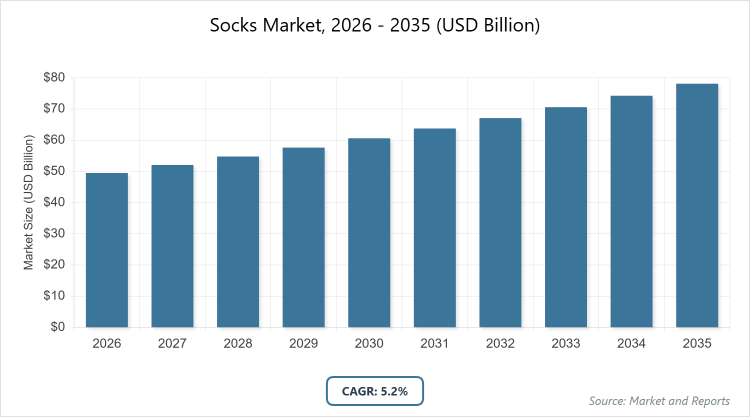
According to MarketnReports, the global Socks market size was estimated at USD 49.48 billion in 2025 and is expected to reach USD 82.05 billion by 2035, growing at a CAGR of 5.2% from 2026 to 2035. Socks Market is driven by the rising athleisure trend and increasing demand for comfortable, performance-oriented footwear accessories.
What are the Key Insights into the Socks Market?
- The global socks market was valued at USD 49.48 billion in 2025 and is projected to reach USD 82.05 billion by 2035.
- The market is anticipated to grow at a CAGR of 5.2% from 2026 to 2035.
- The market is driven by evolving consumer preferences for comfort, style, and performance in daily and athletic wear.
- In the product segment, lifestyle socks dominated with a 60.16% revenue share.
- Lifestyle socks lead due to their versatility in everyday fashion, blending comfort with aesthetic appeal, which drives repeat purchases and broad consumer adoption across demographics.
- In the socks length segment, mid-calf socks dominated with a 45.59% revenue share.
- Mid-calf socks are preferred for their balance of coverage and comfort, suitable for various activities like casual wear and sports, reducing slippage and enhancing durability.
- In the material segment, cotton socks dominated with a 49.09% revenue share.
- Cotton’s natural breathability, softness, and affordability make it the go-to choice for everyday use, minimizing skin irritation and appealing to health-conscious consumers.
- In the end-use segment, men’s socks dominated with a 55.97% revenue share.
- Men’s higher participation in sports and occupational activities requiring durable footwear accessories contributes to this dominance, supported by targeted marketing.
- In the distribution channel segment, retail dominated with a 69.23% revenue share.
- Retail’s tactile shopping experience allows consumers to assess fit and quality firsthand, fostering trust and impulse buys in physical stores.
- Asia Pacific dominated the regional market with a 38.46% revenue share.
- Asia Pacific’s lead stems from rapid urbanization, large population bases in countries like China and India, and growing disposable incomes fueling athleisure adoption.
What is the Overview of the Socks Industry?
The socks industry encompasses the production, distribution, and consumption of various types of foot coverings designed for comfort, protection, and style. Market definition refers to socks as essential apparel items that serve functional purposes such as moisture management, cushioning, and thermal regulation while also acting as fashion accessories. This market includes a wide array of products tailored to diverse consumer needs, from everyday casual wear to specialized athletic and performance gear. It is characterized by innovation in materials and designs that prioritize ergonomics, sustainability, and personalization, reflecting shifts in lifestyle where socks are no longer mere necessities but integral to self-expression and wellness. The industry thrives on blending traditional craftsmanship with modern technology to address foot health concerns like blister prevention and odor control, catering to global demographics influenced by cultural, climatic, and activity-based preferences.
What are the Dynamics Shaping the Socks Market?
Growth Drivers
The socks market is propelled by the surging popularity of athleisure and fitness lifestyles, where consumers increasingly prioritize high-performance socks for activities like running, gym workouts, and yoga. This trend is evidenced by surveys indicating that a significant portion of athletes view quality socks as crucial for enhancing performance and preventing injuries. Additionally, rising awareness of foot health amid prolonged standing or walking in professions such as healthcare and retail drives demand for ergonomic designs with features like arch support and moisture-wicking properties. Urbanization in emerging economies boosts disposable incomes, enabling purchases of premium, branded socks made from advanced fabrics. E-commerce growth further accelerates this by offering convenience, variety, and access to reviews, allowing consumers to make informed choices on fit and durability. Sustainability initiatives, including the use of eco-friendly materials, align with environmentally conscious buyers, fostering innovation and market expansion.
Restraints
Despite growth prospects, the socks market faces restraints from material-related challenges, such as discomfort caused by poor fabric choices leading to blisters, chafing, or allergic reactions in sensitive users. High production costs for premium, sustainable materials like Merino wool or recycled yarns can elevate prices, limiting accessibility in price-sensitive markets. Supply chain disruptions, including raw material shortages or fluctuations in cotton and polyester prices due to global events, hinder consistent manufacturing. Moreover, the difficulty in achieving precise fits for diverse foot shapes often results in customer dissatisfaction and returns, particularly in online sales where physical trials are absent. Intense competition from low-cost, unbranded alternatives in developing regions erodes profit margins for established players, while counterfeit products undermine brand trust and quality standards.
Opportunities
Opportunities in the socks market abound with innovations in fabric technologies, such as antimicrobial treatments and smart textiles that monitor foot health or provide compression for medical uses. The shift toward sustainability opens avenues for brands to introduce lines made from bamboo, recycled polyester, or organic cotton, appealing to eco-aware millennials and Gen Z consumers. Expansion into untapped segments like gender-inclusive designs and customized socks via 3D printing could capture niche markets, including occupational wear for industries like construction or hospitality. Growing e-commerce and direct-to-consumer models enable global reach, with personalization options driving loyalty. Partnerships with fitness influencers and sports brands can amplify visibility, while emerging markets in Asia and Latin America offer potential through rising middle-class populations seeking affordable yet stylish options.
Challenges
The socks market encounters challenges in addressing high-friction and microclimate issues within footwear, requiring continuous R&D for durable, breathable materials that withstand prolonged wear without degrading. Ensuring universal fit precision across demographics is complex, as variations in foot anatomy lead to slippage or discomfort, impacting customer retention. Visual and tactile assessment limitations in digital channels rely heavily on accurate labeling and user reviews, which can be inconsistent. Environmental regulations on textile production add compliance costs, particularly for synthetic materials. Balancing affordability with quality in competitive landscapes poses difficulties, as consumers demand longevity post-washing without fading or losing elasticity, necessitating robust testing and supply chain oversight.
Socks Market: Report Scope
| Report Attributes | Report Details |
| Report Name | Socks Market |
| Market Size 2025 | USD 49.48 Billion |
| Market Forecast 2035 | USD 82.05 Billion |
| Growth Rate | CAGR of 5.2% |
| Report Pages | 214 |
| Key Companies Covered | Dick’s Sporting Goods, Fila, H&M (sport), Inditex, Zalando, Intersport, Lidl, Columbia Sportswear, Lululemon, Hoka, Deckers, Skechers, Brooks (Brooks Sports, Inc), Gymshark, Under Armour, JD Sports, Li Ning, Asics, Salomon, Anta Group, VF Corp, On Running, Superdry, Patagonia, Kari Traa, and Foot Locker |
| Segments Covered | By Product, By Socks Length, By Material, By End Use, By Distribution Channel, and By Region |
| Regions Covered | North America, Europe, Asia Pacific (APAC), Latin America, and The Middle East and Africa (MEA) |
| Base Year | 2025 |
| Historical Year | 2020 – 2024 |
| Forecast Year | 2026 – 2035 |
| Customization Scope | Avail customized purchase options to meet your exact research needs. |
How is the Socks Market Segmented?
The Socks market is segmented by type, application, end-user, and region.
Based on Product Segment, The most dominant subsegment is lifestyle socks, holding a 60.16% share, while athletic socks are the second most dominant. Lifestyle socks dominate due to their integration into daily fashion and casual wear, offering versatility that appeals to a broad consumer base seeking both comfort and style; this drives the market by encouraging frequent purchases and brand loyalty through aesthetic innovations like patterns and colors. Athletic socks, as the second dominant, contribute by catering to fitness enthusiasts with specialized features such as cushioning and ventilation, boosting overall growth through the athleisure boom and performance demands in sports.
Based on Socks Length Segment, Mid-calf socks are the most dominant with 45.59% share, followed by ankle socks as second dominant. Mid-calf’s leadership arises from its optimal coverage for various activities, providing support without restricting movement, which drives market expansion by meeting needs in both casual and professional settings; its popularity enhances sales volumes through multipack offerings. Ankle socks gain traction for their low-profile design suitable for sneakers and warm climates, propelling growth via trends in urban mobility and lightweight apparel preferences.
Based on Material Segment, Cotton leads as the most dominant with 49.09% share, with polyester as the second dominant. Cotton’s dominance is rooted in its natural properties like breathability and hypoallergenic nature, making it ideal for everyday use and driving market growth by satisfying health-focused consumers who prioritize skin-friendly options. Polyester supports this by offering durability and quick-drying features, aiding in performance segments and overall market advancement through cost-effective blends that extend product lifespan.
Based on End-Use Segment, Men’s socks dominate with 55.97% share, while women’s are second dominant. Men’s segment leads owing to higher engagement in sports and labor-intensive jobs requiring robust socks, fueling market drive through targeted products like compression variants that improve circulation and reduce fatigue. Women’s socks contribute significantly by embracing fashion-forward designs, promoting growth via seasonal collections and e-commerce personalization.
Based on Distribution Channel Segment, Retail is the most dominant with 69.23% share, followed by e-commerce. Retail’s stronghold comes from hands-on shopping experiences that allow fit testing, driving the market by building consumer confidence and enabling impulse buys in stores. E-commerce, as second, accelerates growth with its convenience and vast selection, facilitating global access and review-based decisions that expand reach to remote areas.
What are the Recent Developments in the Socks Market?
- In August 2025, Gildan completed the acquisition of Hanesbrands for USD 2.2 billion, incorporating iconic brands like Hanes into its portfolio to strengthen its position in the apparel sector, including socks, by leveraging expanded manufacturing capabilities and distribution networks for greater market penetration.
- In July 2025, Nester Hosiery acquired key assets from Fox River Mills, relocating operations to North Carolina, which enhances production efficiency and allows for innovation in premium sock lines focused on outdoor and performance categories, addressing growing demand in athleisure.
- In November 2023, Damensch Apparel launched aloe vera-infused socks, emphasizing skin care and comfort, which taps into wellness trends and differentiates the brand in competitive markets by offering unique moisture-retaining properties for sensitive feet.
- In January 2025, BONJOUR introduced bamboo-based socks, highlighting sustainability with eco-friendly materials that provide natural antibacterial benefits, attracting environmentally conscious consumers and driving sales through online platforms.
How Does Regional Analysis Impact the Socks Market?
- Asia Pacific to dominate the global market.
Asia Pacific region’s dominance is fueled by its massive population and rapid urbanization in countries like China and India, where increasing disposable incomes spur demand for affordable, stylish socks. China stands out as the dominating country, with its manufacturing prowess and export focus enabling low-cost production, while domestic consumption rises with athleisure adoption among the youth. This region’s projected fastest CAGR stems from e-commerce boom and fitness culture, making it a hub for innovation in breathable fabrics suited to humid climates.
North America exhibits strong growth through advanced retail infrastructure and high consumer spending on premium products. The United States dominates here, driven by Gen Z’s preference for performance socks in sports and daily wear, with brands emphasizing moisture management. E-commerce integration and health awareness further propel the market, positioning the region for steady expansion amid lifestyle shifts toward active living.
Europe focuses on socks as fashion statements, with versatile designs catering to walking and cycling lifestyles. Germany leads as the dominating country, holding the largest share due to its emphasis on quality and durability in outdoor activities. The region’s significant CAGR is supported by sustainability trends, with consumers favoring natural materials like wool, enhancing market dynamics through regulatory pushes for eco-friendly textiles.
Central & South America anticipates a 5.5% CAGR, influenced by athleisure penetration and warm weather preferences for lightweight socks. Brazil dominates, with its vibrant sports culture and growing middle class boosting demand for comfortable, breathable options. This region’s growth is aided by improving e-commerce access, allowing brands to reach underserved areas and capitalize on urbanization.
Middle East & Africa shows potential in premium segments, though smaller in share, with demand for functional socks in arid climates. Saudi Arabia emerges as a key player, driven by increasing fitness centers and youth engagement in sports. Challenges like import dependencies are offset by opportunities in sustainable materials, contributing to gradual market development.
Who are the Key Market Players in the Socks Market?
H&M employs strategies focused on affordable athleisure lines, integrating sustainable materials like recycled cotton to appeal to eco-conscious consumers, while expanding e-commerce presence for global reach and collaborating with influencers to boost brand visibility in fashion-forward segments.
Inditex leverages its fast-fashion model to quickly adapt to trends, offering diverse sock designs through brands like Zara, emphasizing gender-inclusive fits and material innovations such as breathable blends to drive sales in lifestyle categories.
Under Armour concentrates on performance socks with advanced technologies like compression and moisture-wicking, targeting athletes via partnerships with sports teams and digital marketing to enhance loyalty in the athletic segment.
Lululemon adopts a premium strategy, using high-quality Merino wool and ergonomic designs for yoga and fitness enthusiasts, while promoting sustainability through recycled yarns to attract wellness-oriented buyers.
VF Corp focuses on brand diversification, incorporating durable polyester blends in lines like The North Face socks for outdoor use, and investing in R&D for odor-control features to maintain dominance in activewear.
What are the Current Trends in the Socks Market?
- Integration of athleisure, where socks blend into athletic apparel with spandex and nylon for enhanced flexibility and support.
- Preference for natural fabrics like bamboo and Merino wool, offering odor control and temperature regulation for daily comfort.
- Rise in performance features such as cushioning, ventilation, and compression, particularly among runners and athletes.
- Dominance of e-commerce for product discovery, with reliance on reviews and multipacks for bulk purchases.
- Emphasis on sustainability through recycled materials and antimicrobial treatments to meet eco-friendly demands.
- Adoption of ergonomic designs like left-right shaping and zonal cushioning for precise fit and reduced discomfort.
- Regional adaptations, including breathable options for warm climates and versatile styles for urban mobility.
What Market Segments and Subsegments are Covered in the Socks Report?
By Product
- Athletic
- Lifestyle
- Others
By Socks Length
- Over-the-calf
- Mid-calf
- Ankle
By Material
- Cotton
- Polyester
- Polyamide
- Wool
- Elastane
By End Use
- Men
- Women
- Kids
By Distribution Channel
- Retail
- E-commerce
- DTC
By Region
- North America
- U.S.
- Canada
- Europe
- UK
- Germany
- France
- Rest of Europe
- Asia Pacific
- China
- India
- Japan
- Rest of Asia Pacific
- Latin America
- Brazil
- Mexico
- Rest of Latin America
- Middle East & Africa
- UAE
- South Africa
- Rest of Middle East & Africa
Chapter 1. Preface
1.1 Report Description and Scope1.2 Research Scope1.3 Research Methodology1.3.1 Market Research Type1.3.2 Market Research MethodologyChapter 2. Executive Summary
2.1 Global Socks Market, (2026 - 2035) (USD Billion)2.2 Global Socks Market: SnapshotChapter 3. Global Socks Market - Industry Analysis
3.1 Socks Market: Market Dynamics3.2 Market Drivers3.2.1 The socks market is growing due to rising athleisure and fitness trends, increased foot-health awareness, higher demand for premium and ergonomic designs, expanding e-commerce access, urbanization-driven spending power, and sustainability-focused consumer preferences.3.3 Market Restraints3.3.1 The socks market is restrained by high costs of premium materials, supply chain disruptions, fit and comfort issues, strong competition from low-cost alternatives, counterfeit products, and pricing pressures in cost-sensitive markets.3.4 Market Opportunities3.4.1 The socks market offers strong opportunities through smart and sustainable fabric innovations, customization and gender-inclusive designs, e-commerce and D2C expansion, strategic partnerships, and rising demand from emerging middle-class consumers in developing markets.3.5 Market Challenges3.5.1 The socks market faces challenges from fit precision, material durability and breathability demands, digital sales limitations, rising environmental compliance costs, and the need to balance affordability with long-lasting quality in a competitive market.3.6 Porter’s Five Forces Analysis3.7 Market Attractiveness Analysis3.7.1 Market Attractiveness Analysis By Product3.7.2 Market Attractiveness Analysis By Socks Length3.7.3 Market Attractiveness Analysis By Material3.7.4 Market Attractiveness Analysis By End Use3.7.5 Market Attractiveness Analysis By Distribution ChannelChapter 4. Global Socks Market- Competitive Landscape
4.1 Company Market Share Analysis4.1.1 Global Socks Market: Company Market Share, 20254.2 Strategic Development4.2.1 Acquisitions & mergers4.2.2 New Product launches4.2.3 Agreements, partnerships, collaborations, and joint ventures4.2.4 Research and development and regional expansion4.3 Price Trend AnalysisChapter 5. Global Socks Market - Product Analysis
5.1 Global Socks Market Overview: Product5.1.1 Global Socks Market share, By Product, 2025 and 20355.2 Athletic5.2.1 Global Socks Market by Athletic, 2026 - 2035 (USD Billion)5.3 Lifestyle5.3.1 Global Socks Market by Lifestyle, 2026 - 2035 (USD Billion)5.4 Others5.4.1 Global Socks Market by Others, 2026 - 2035 (USD Billion)Chapter 6. Global Socks Market - Socks Length Analysis
6.1 Global Socks Market Overview: Socks Length6.1.1 Global Socks Market Share, By Socks Length, 2025 and 20356.2 Over-the-calf6.2.1 Global Socks Market by Over-the-calf, 2026 - 2035 (USD Billion)6.3 Mid-calf6.3.1 Global Socks Market by Mid-calf, 2026 - 2035 (USD Billion)6.4 Ankle6.4.1 Global Socks Market by Ankle, 2026 - 2035 (USD Billion)Chapter 7. Global Socks Market - Material Analysis
7.1 Global Socks Market Overview: Material7.1.1 Global Socks Market Share, By Material, 2025 and 20357.2 Cotton7.2.1 Global Socks Market by Cotton, 2026 - 2035 (USD Billion)7.3 Polyester7.3.1 Global Socks Market by Polyester, 2026 - 2035 (USD Billion)7.4 Polyamide7.4.1 Global Socks Market by Polyamide, 2026 - 2035 (USD Billion)7.5 Wool7.5.1 Global Socks Market by Wool, 2026 - 2035 (USD Billion)7.6 Elastane7.6.1 Global Socks Market by Elastane, 2026 - 2035 (USD Billion)Chapter 8. Global Socks Market - End Use Analysis
8.1 Global Socks Market Overview: End Use8.1.1 Global Socks Market Share, By End Use, 2025 and 20358.2 Men8.2.1 Global Socks Market by Men, 2026 - 2035 (USD Billion)8.3 Women8.3.1 Global Socks Market by Women, 2026 - 2035 (USD Billion)8.4 Kids8.4.1 Global Socks Market by Kids, 2026 - 2035 (USD Billion)Chapter 9. Global Socks Market - Distribution Channel Analysis
9.1 Global Socks Market Overview: Distribution Channel9.1.1 Global Socks Market Share, By Distribution Channel, 2025 and 20359.2 Retail9.2.1 Global Socks Market by Retail, 2026 - 2035 (USD Billion)9.3 E-commerce9.3.1 Global Socks Market by E-commerce, 2026 - 2035 (USD Billion)9.4 DTC9.4.1 Global Socks Market by DTC, 2026 - 2035 (USD Billion)Chapter 10. Socks Market - Regional Analysis
10.1 Global Socks Market Regional Overview10.2 Global Socks Market Share, by Region, 2025 & 2035 (USD Billion)10.3 North America10.3.1 North America Socks Market, 2026 - 2035 (USD Billion)10.3.1.1 North America Socks Market, by Country, 2026 - 2035 (USD Billion)10.3.2 North America Socks Market, by Product, 2026 - 203510.3.2.1 North America Socks Market, by Product, 2026 - 2035 (USD Billion)10.3.3 North America Socks Market, by Socks Length, 2026 - 203510.3.3.1 North America Socks Market, by Socks Length, 2026 - 2035 (USD Billion)10.3.4 North America Socks Market, by Material, 2026 - 203510.3.4.1 North America Socks Market, by Material, 2026 - 2035 (USD Billion)10.3.5 North America Socks Market, by End Use, 2026 - 203510.3.5.1 North America Socks Market, by End Use, 2026 - 2035 (USD Billion)10.3.6 North America Socks Market, by Distribution Channel, 2026 - 203510.3.6.1 North America Socks Market, by Distribution Channel, 2026 - 2035 (USD Billion)10.4 Europe10.4.1 Europe Socks Market, 2026 - 2035 (USD Billion)10.4.1.1 Europe Socks Market, by Country, 2026 - 2035 (USD Billion)10.4.2 Europe Socks Market, by Product, 2026 - 203510.4.2.1 Europe Socks Market, by Product, 2026 - 2035 (USD Billion)10.4.3 Europe Socks Market, by Socks Length, 2026 - 203510.4.3.1 Europe Socks Market, by Socks Length, 2026 - 2035 (USD Billion)10.4.4 Europe Socks Market, by Material, 2026 - 203510.4.4.1 Europe Socks Market, by Material, 2026 - 2035 (USD Billion)10.4.5 Europe Socks Market, by End Use, 2026 - 203510.4.5.1 Europe Socks Market, by End Use, 2026 - 2035 (USD Billion)10.4.6 Europe Socks Market, by Distribution Channel, 2026 - 203510.4.6.1 Europe Socks Market, by Distribution Channel, 2026 - 2035 (USD Billion)10.5 Asia Pacific10.5.1 Asia Pacific Socks Market, 2026 - 2035 (USD Billion)10.5.1.1 Asia Pacific Socks Market, by Country, 2026 - 2035 (USD Billion)10.5.2 Asia Pacific Socks Market, by Product, 2026 - 203510.5.2.1 Asia Pacific Socks Market, by Product, 2026 - 2035 (USD Billion)10.5.3 Asia Pacific Socks Market, by Socks Length, 2026 - 203510.5.3.1 Asia Pacific Socks Market, by Socks Length, 2026 - 2035 (USD Billion)10.5.4 Asia Pacific Socks Market, by Material, 2026 - 203510.5.4.1 Asia Pacific Socks Market, by Material, 2026 - 2035 (USD Billion)10.5.5 Asia Pacific Socks Market, by End Use, 2026 - 203510.5.5.1 Asia Pacific Socks Market, by End Use, 2026 - 2035 (USD Billion)10.5.6 Asia Pacific Socks Market, by Distribution Channel, 2026 - 203510.5.6.1 Asia Pacific Socks Market, by Distribution Channel, 2026 - 2035 (USD Billion)10.6 Latin America10.6.1 Latin America Socks Market, 2026 - 2035 (USD Billion)10.6.1.1 Latin America Socks Market, by Country, 2026 - 2035 (USD Billion)10.6.2 Latin America Socks Market, by Product, 2026 - 203510.6.2.1 Latin America Socks Market, by Product, 2026 - 2035 (USD Billion)10.6.3 Latin America Socks Market, by Socks Length, 2026 - 203510.6.3.1 Latin America Socks Market, by Socks Length, 2026 - 2035 (USD Billion)10.6.4 Latin America Socks Market, by Material, 2026 - 203510.6.4.1 Latin America Socks Market, by Material, 2026 - 2035 (USD Billion)10.6.5 Latin America Socks Market, by End Use, 2026 - 203510.6.5.1 Latin America Socks Market, by End Use, 2026 - 2035 (USD Billion)10.6.6 Latin America Socks Market, by Distribution Channel, 2026 - 203510.6.6.1 Latin America Socks Market, by Distribution Channel, 2026 - 2035 (USD Billion)10.7 The Middle-East and Africa10.7.1 The Middle-East and Africa Socks Market, 2026 - 2035 (USD Billion)10.7.1.1 The Middle-East and Africa Socks Market, by Country, 2026 - 2035 (USD Billion)10.7.2 The Middle-East and Africa Socks Market, by Product, 2026 - 203510.7.2.1 The Middle-East and Africa Socks Market, by Product, 2026 - 2035 (USD Billion)10.7.3 The Middle-East and Africa Socks Market, by Socks Length, 2026 - 203510.7.3.1 The Middle-East and Africa Socks Market, by Socks Length, 2026 - 2035 (USD Billion)10.7.4 The Middle-East and Africa Socks Market, by Material, 2026 - 203510.7.4.1 The Middle-East and Africa Socks Market, by Material, 2026 - 2035 (USD Billion)10.7.5 The Middle-East and Africa Socks Market, by End Use, 2026 - 203510.7.5.1 The Middle-East and Africa Socks Market, by End Use, 2026 - 2035 (USD Billion)10.7.6 The Middle-East and Africa Socks Market, by Distribution Channel, 2026 - 203510.7.6.1 The Middle-East and Africa Socks Market, by Distribution Channel, 2026 - 2035 (USD Billion)Chapter 11. Company Profiles
11.1 Dick's Sporting Goods11.1.1 Overview11.1.2 Financials11.1.3 Product Portfolio11.1.4 Business Strategy11.1.5 Recent Developments11.2 Fila11.2.1 Overview11.2.2 Financials11.2.3 Product Portfolio11.2.4 Business Strategy11.2.5 Recent Developments11.3 H&M (sport)11.3.1 Overview11.3.2 Financials11.3.3 Product Portfolio11.3.4 Business Strategy11.3.5 Recent Developments11.4 Inditex11.4.1 Overview11.4.2 Financials11.4.3 Product Portfolio11.4.4 Business Strategy11.4.5 Recent Developments11.5 Zalando11.5.1 Overview11.5.2 Financials11.5.3 Product Portfolio11.5.4 Business Strategy11.5.5 Recent Developments11.6 Intersport11.6.1 Overview11.6.2 Financials11.6.3 Product Portfolio11.6.4 Business Strategy11.6.5 Recent Developments11.7 Lidl11.7.1 Overview11.7.2 Financials11.7.3 Product Portfolio11.7.4 Business Strategy11.7.5 Recent Developments11.8 Columbia Sportswear11.8.1 Overview11.8.2 Financials11.8.3 Product Portfolio11.8.4 Business Strategy11.8.5 Recent Developments11.9 Lululemon11.9.1 Overview11.9.2 Financials11.9.3 Product Portfolio11.9.4 Business Strategy11.9.5 Recent Developments11.10 Hoka11.10.1 Overview11.10.2 Financials11.10.3 Product Portfolio11.10.4 Business Strategy11.10.5 Recent Developments11.11 Deckers11.11.1 Overview11.11.2 Financials11.11.3 Product Portfolio11.11.4 Business Strategy11.11.5 Recent Developments11.12 Skechers11.12.1 Overview11.12.2 Financials11.12.3 Product Portfolio11.12.4 Business Strategy11.12.5 Recent Developments11.13 Brooks (Brooks Sports Inc)11.13.1 Overview11.13.2 Financials11.13.3 Product Portfolio11.13.4 Business Strategy11.13.5 Recent Developments11.14 Gymshark11.14.1 Overview11.14.2 Financials11.14.3 Product Portfolio11.14.4 Business Strategy11.14.5 Recent Developments11.15 Under Armour11.15.1 Overview11.15.2 Financials11.15.3 Product Portfolio11.15.4 Business Strategy11.15.5 Recent Developments11.16 JD Sports11.16.1 Overview11.16.2 Financials11.16.3 Product Portfolio11.16.4 Business Strategy11.16.5 Recent Developments11.17 Li Ning11.17.1 Overview11.17.2 Financials11.17.3 Product Portfolio11.17.4 Business Strategy11.17.5 Recent Developments11.18 Asics11.18.1 Overview11.18.2 Financials11.18.3 Product Portfolio11.18.4 Business Strategy11.18.5 Recent Developments11.19 Salomon11.19.1 Overview11.19.2 Financials11.19.3 Product Portfolio11.19.4 Business Strategy11.19.5 Recent Developments11.20 Anta Group11.20.1 Overview11.20.2 Financials11.20.3 Product Portfolio11.20.4 Business Strategy11.20.5 Recent Developments
Frequently Asked Questions
Socks are protective and comfortable foot coverings made from various materials, designed to provide cushioning, moisture management, and style for everyday and specialized use.
Key factors include the athleisure trend, demand for sustainable materials, e-commerce expansion, and innovations in ergonomic designs, alongside rising fitness awareness and urbanization.
The market is expected to grow from USD 49.48 billion in 2025 to USD 82.05 billion by 2035.
The CAGR is projected at 5.2%.
Asia Pacific will contribute notably, driven by its large population and rapid growth in consumer spending.
Major players include Dick's Sporting Goods, Fila, H&M (sport), Inditex, Zalando, Intersport, Lidl, Columbia Sportswear, Lululemon, Hoka, Deckers, Skechers, Brooks (Brooks Sports Inc), Gymshark, Under Armour, JD Sports, Li Ning, Asics, Salomon, Anta Group, VF Corp, On Running, Superdry, Patagonia, Kari Traa, Foot Locker, and Others.
The report provides comprehensive analysis on size, trends, segments, dynamics, players, and forecasts.
Stages include raw material sourcing, manufacturing, distribution, retail/e-commerce sales, and end-consumer use.
Trends are shifting toward sustainability and performance, with consumers preferring natural, breathable fabrics and personalized fits.
Factors include regulations on textile sustainability, eco-labeling requirements, and environmental policies promoting recycled materials.