
Smart Scale Market Size, Share and Trends 2026 to 2035
According to MarketnReports, the global Smart Scale market size was estimated at USD 2.43 billion in 2025 and is expected to reach USD 8.05 billion by 2035, growing at a CAGR of 11.6% from 2026 to 2035. Smart Scale Market is driven by increasing health and fitness awareness among consumers.
What are the Key Insights into Smart Scale Market?
- The global smart scale market was valued at USD 2.43 billion in 2025 and is projected to reach USD 8.05 billion by 2035.
- The market is expected to grow at a CAGR of 11.6% during the forecast period from 2026 to 2035.
- The smart scale market is driven by rising obesity rates, increasing health consciousness, advancements in sensor and connectivity technologies, and growing integration with fitness apps.
- The body composition scales dominate the type segment with approximately 40% share due to their ability to provide detailed health metrics beyond weight, appealing to fitness-focused consumers; bluetooth enabled scales dominate the connectivity segment with around 45% share owing to seamless smartphone integration and affordability; fitness enthusiasts dominate the target audience segment with about 35% share as they require precise tracking for training progress; personalized health metrics dominate the features segment with roughly 30% share because of tailored insights enhancing user engagement; budget smart scales dominate the price range segment with nearly 50% share driven by accessibility for mass adoption.
- North America dominates the global smart scale market with around 35% share due to high health awareness, advanced technology adoption, and strong presence of key players.
What is the Industry Overview of Smart Scale Market?
The smart scale market encompasses electronic weighing devices that go beyond traditional weight measurement by incorporating advanced sensors and connectivity features to track comprehensive body metrics such as body fat percentage, muscle mass, bone density, and body mass index (BMI). These devices typically integrate with smartphones, fitness apps, and wearable technologies via Bluetooth or Wi-Fi, enabling users to monitor health data over time and receive personalized insights for better wellness management. Market definition includes both consumer-oriented bathroom scales for personal use and specialized models for professional settings, driven by the convergence of health technology and IoT advancements, catering to a growing demand for data-driven fitness and preventive healthcare solutions.
What are the Market Dynamics Affecting Smart Scale Market?
Growth Drivers
The primary growth drivers for the smart scale market include the escalating global obesity epidemic and heightened fitness consciousness post-COVID-19, which have prompted individuals to adopt proactive health monitoring tools. Governments and healthcare organizations are promoting awareness campaigns on obesity control, emphasizing metrics like BMI and body fat percentage that smart scales accurately measure, thus aiding in personalized weight management plans. Additionally, technological advancements in bioelectrical impedance analysis (BIA) and seamless app integrations allow users to track progress effortlessly, boosting market expansion as consumers seek comprehensive wellness solutions over basic scales.
Restraints
High costs associated with smart scales, ranging from USD 50 to USD 250 depending on features, act as a significant restraint, limiting accessibility for price-sensitive consumers who may opt for cheaper traditional scales. This pricing barrier is particularly evident in developing regions where disposable incomes are lower, and the perceived value of additional metrics like body composition may not justify the expense for casual users not engaged in regular fitness activities. Furthermore, concerns over data accuracy in varying conditions, such as hydration levels affecting BIA readings, can deter potential buyers and slow market penetration.
Opportunities
The expanding telehealth sector presents substantial opportunities for smart scale manufacturers, as these devices enable remote monitoring of vital health parameters for conditions like diabetes, hypertension, and obesity. Integration with telemedicine platforms allows healthcare providers to access real-time patient data, facilitating virtual consultations and personalized treatment plans without in-person visits. This trend, accelerated by the pandemic, opens avenues for partnerships with health apps and wearable ecosystems, potentially increasing market reach among aging populations and chronic disease patients seeking convenient home-based health management tools.
Challenges
Intense competition from alternative health monitoring devices, such as smartwatches and fitness trackers that offer overlapping features like activity tracking and heart rate monitoring, poses a major challenge to the smart scale market. These wearables provide continuous data without the need for dedicated scale usage, appealing to users who prefer multifunctional gadgets. Additionally, the nascent stage of the smart scale industry requires overcoming user skepticism regarding privacy in data sharing and the need for consistent technological education to maximize device utility, which could hinder widespread adoption if not addressed through innovation and marketing.
Smart Scale Market: Report Scope
| Report Attributes | Report Details |
| Report Name | Smart Scale Market |
| Market Size 2025 | USD 2.43 Billion |
| Market Forecast 2035 | USD 8.05 Billion |
| Growth Rate | CAGR of 11.6% |
| Report Pages | 240 |
| Key Companies Covered |
Fitbit, Withings, Garmin, Tanita, iHealth Labs, Qardio, Blipcare, Pyle, Taylor, RENPH, and Others 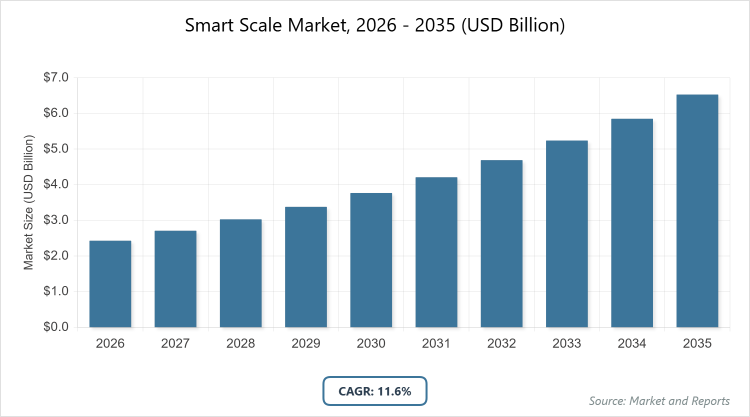 |
| Segments Covered | By Type, By Connectivity, By Target Audience, By Features, By Price Range, and By Region |
| Regions Covered | North America, Europe, Asia Pacific (APAC), Latin America, and The Middle East and Africa (MEA) |
| Base Year | 2025 |
| Historical Year | 2020 – 2024 |
| Forecast Year | 2026 – 2035 |
| Customization Scope | Avail customized purchase options to meet your exact research needs. |
How is the Market Segmentation Structured in Smart Scale Market?
The Smart Scale market is segmented by type, connectivity, target audience, features, price range, and region.
Based on Type Segment, the body composition scales emerge as the most dominant subsegment due to their comprehensive analysis of body metrics like fat, muscle, and bone mass, which appeals to health-conscious users seeking detailed insights over simple weight measurement; this dominance drives the market by enabling preventive healthcare and personalized fitness regimes that encourage repeat purchases and app subscriptions. The body fat scales rank as the second most dominant, offering focused tracking of fat percentage crucial for weight loss programs, thereby contributing to market growth through targeted applications in obesity management and sports training where precise body composition data optimizes performance and health outcomes.
Based on Connectivity Segment, bluetooth enabled scales stand out as the most dominant subsegment owing to their ease of pairing with smartphones and cost-effectiveness compared to Wi-Fi models, making them accessible for everyday users; this leads market expansion by facilitating seamless data syncing to fitness apps, enhancing user adherence to health tracking. Wi-Fi enabled scales are the second most dominant, providing automatic cloud uploads without manual intervention, which drives the market by supporting multi-device integration in smart homes and enabling real-time sharing with healthcare providers for remote monitoring.
Based on Target Audience Segment, fitness enthusiasts represent the most dominant subsegment because of their need for accurate, ongoing body metric tracking to monitor training progress and adjust routines; this propels market growth by increasing demand for advanced features that integrate with workout apps and promote premium product sales. Health-conscious individuals are the second most dominant, utilizing scales for general wellness maintenance and preventive health, thereby fueling the market through broader adoption in households focused on lifestyle improvements and chronic disease prevention.
Based on Features Segment, personalized health metrics dominate as the leading subsegment due to their ability to deliver tailored insights based on user data, fostering engagement and loyalty; this accelerates market development by differentiating products in a competitive landscape and encouraging ecosystem integrations with other health tech. Integration with wearable devices is the second most dominant, allowing synchronized data across gadgets like smartwatches, which drives the market by creating comprehensive health profiles that attract tech-savvy consumers seeking holistic wellness solutions.
Based on Price Range Segment, budget smart scales hold the most dominant position thanks to their affordability, attracting entry-level users and expanding market reach in emerging economies; this contributes to overall growth by lowering entry barriers and promoting widespread health monitoring adoption. Mid-range smart scales are the second most dominant, balancing features and cost for value-seeking consumers, thereby boosting the market through upgrades from basic models and catering to mid-tier fitness needs.
What are the Recent Developments in Smart Scale Market?
- In November 2021, Garmin launched its Index S2 digital wellness tool specifically for the Indian fitness market, featuring measurements of BMI, body fat percentage, bone mass, body water percentage, and skeletal muscle mass, available in two variants through e-commerce platforms to target expanding sports and health sectors.
- In September 2023, Withings introduced the FDA-approved Body Scan Connected Health Station, a luxury smart scale priced at USD 400, capable of detecting atrial fibrillation and providing advanced body composition analysis, aimed at enhancing heart health management and premium consumer wellness.
- In September 2023, Titan Company, a leading Indian luxury goods provider, ventured into the smart weight scales and rings segment, leveraging its wearable business that generated INR 500 crore in revenue, to capitalize on growing demand for affordable smart health devices in Asia-Pacific.
What is the Regional Analysis of Smart Scale Market?
North America to dominate the global market.
North America leads the smart scale market with the United States as the dominating country, driven by high obesity rates, advanced healthcare infrastructure, and widespread adoption of fitness technologies; the region’s emphasis on preventive care and integration with telehealth services further strengthens its position, supported by key players like Fitbit and Garmin innovating for consumer demands.
Europe exhibits strong growth potential with Germany as the dominating country, fueled by increasing health awareness campaigns and technological advancements in smart devices; the focus on telehealth expansion and product launches like Withings’ premium scales cater to an aging population prioritizing home-based health monitoring.
Asia-Pacific shows promising expansion with China as the dominating country, propelled by rising disposable incomes, a massive consumer base, and government initiatives on obesity control; entries like Titan’s smart scales highlight the region’s shift toward affordable wellness tech amid growing fitness trends.
Latin America experiences gradual growth with Brazil as the dominating country, attributed to improving economic conditions and rising health consciousness; adoption is driven by urban fitness centers and telehealth applications addressing chronic diseases in diverse populations.
The Middle East and Africa register emerging interest with South Africa as the dominating country, supported by urban health initiatives and increasing smartphone penetration; challenges like affordability are offset by opportunities in telehealth for remote areas, fostering gradual market integration.
Who are the Key Market Players in Smart Scale Market?
- Fitbit focuses on integrating its smart scales with comprehensive health ecosystems, including app-based tracking and partnerships with fitness platforms to provide seamless data synchronization, enhancing user retention through personalized wellness recommendations and community features.
- Withings emphasizes innovation in premium health monitoring, launching advanced models with FDA approvals for features like atrial fibrillation detection, while pursuing global expansions and collaborations with telehealth providers to target professional and consumer markets.
- Garmin prioritizes sports and fitness-oriented strategies, developing scales with multi-metric capabilities tailored for athletes, and leveraging e-commerce channels for regional launches like in India to capture emerging markets through durable, app-integrated products.
- Tanita concentrates on accurate body composition analysis, investing in BIA technology advancements and B2B partnerships with gyms and healthcare facilities to supply reliable scales for professional use, driving growth via quality certifications and customization options.
- iHealth Labs adopts a consumer-centric approach, offering affordable connected scales with cloud-based data storage and integrations with major health apps, focusing on user-friendly designs to appeal to home users and expand through online retail channels.
- Qardio pursues smart home ecosystem compatibility, creating scales that sync with voice assistants and wearables, while emphasizing sleek designs and data privacy to attract tech-savvy households and build brand loyalty through subscription-based insights.
- Blipcare targets budget segments with simple, reliable Wi-Fi scales for remote monitoring, partnering with healthcare providers for telehealth applications to address chronic care needs and grow in underserved regions.
- Pyle focuses on multifunctional scales for diverse applications like kitchen and bathroom use, utilizing offline and online distribution to reach retail and hospitality sectors, with emphasis on durability and value pricing.
- Taylor invests in user profile customization for multi-user households, enhancing accuracy through sensor improvements and marketing via mass retailers to broaden accessibility in residential markets.
- RENPH collaborates with sports organizations like USA Triathlon for event integrations, promoting its scales for athlete monitoring while expanding product lines with advanced metrics to strengthen presence in fitness communities.
What are the Market Trends in Smart Scale Market?
– Rising integration with AI for predictive health analytics and personalized recommendations.
- Increasing adoption in telehealth for remote patient monitoring of chronic conditions.
- Growing demand for eco-friendly and sustainable materials in scale designs.
- Expansion of multi-user profiles with enhanced data privacy features.
- Advancements in BIA sensors for more accurate body composition readings.
- Surge in app ecosystems offering gamified fitness tracking and community support.
- Focus on affordability through budget models targeting emerging markets.
- Incorporation of voice assistance for hands-free operation and insights.
- Partnerships between scale manufacturers and wearable brands for data synergy.
- Emphasis on waterproof and durable builds for versatile usage environments.
What Market Segments and Their Subsegments are Covered in the Smart Scale Report?
By Type
-
Body Composition Scales
-
Body Fat Scales
-
Smart Bathroom Scales
-
Multi-User Scales
-
Glass Platform
-
Stainless Steel Platform
-
Plastic Platform
-
Bamboo Platform
-
Bluetooth Enabled Scales
-
Wi-Fi Enabled Scales
-
Others
By Connectivity
-
- Bluetooth Enabled Scales
- Wi-Fi Enabled Scales
- USB Connectivity Scales
- App-Integrated Scales
- Advanced And Adaptive Network Technology Plus
- Others
By Target Audience
-
- Fitness Enthusiasts
- Health-Conscious Individuals
- Healthcare Professionals
- Senior Citizens
- Athletes
- Obese Individuals
- Gym Users
- Home Users
- Sports Teams
- Retail Users
- Others
By Features
-
- Personalized Health Metrics
- Water Resistance
- Color Display
- Integration with Wearable Devices
- Voice Assistance Features
- Multi-Function Capabilities
- Eco-Friendly Designs
- Heavy-Duty Builds
- Portable Options
- Anti-Fingerprint Coating
- Others
By Price Range
-
- Budget Smart Scales
- Mid-Range Smart Scales
- Premium Smart Scales
- Luxury Smart Scales
- Others
By Region
- North America
- U.S.
- Canada
- Europe
- UK
- Germany
- France
- Rest of Europe
- Asia Pacific
- China
- India
- Japan
- Rest of Asia Pacific
- Latin America
- Brazil
- Mexico
- Rest of Latin America
- Middle East & Africa
- UAE
- South Africa
- Rest of Middle East & Africa
Frequently Asked Questions
Smart scales are electronic devices that measure weight and additional body metrics like fat percentage, muscle mass, and BMI using bioelectrical impedance analysis, connecting to apps for data tracking and health insights.
Key factors include rising obesity rates, increasing health consciousness, technological advancements in sensors and connectivity, integration with fitness apps, and expansion in telehealth applications.
The smart scale market is projected to grow from approximately USD 2.43 billion in 2025 to USD 8.05 billion by 2035.
The CAGR is expected to be 11.6% during the forecast period from 2026 to 2035.
North America will contribute notably, driven by high adoption rates, advanced infrastructure, and strong consumer focus on fitness and health monitoring.
Major players include Fitbit, Withings, Garmin, Tanita, iHealth Labs, Qardio, Blipcare, Pyle, Taylor, and RENPH.
The report provides in-depth analysis of market size, trends, segments, regional insights, key players, dynamics, and forecasts from 2026 to 2035.
The value chain includes raw material sourcing, manufacturing of sensors and components, assembly and integration, distribution through online/offline channels, and end-user support via apps and services.
Trends are shifting toward AI-driven insights, eco-friendly designs, and telehealth integration, with consumers preferring affordable, app-connected models for personalized and remote health tracking.
Regulatory factors include FDA approvals for health metrics accuracy and data privacy laws like GDPR; environmental factors involve sustainable manufacturing practices and recyclable materials to meet eco-conscious demands.