
Smart Kitchen Appliances Market Size, Share and Trends 2026 to 2035
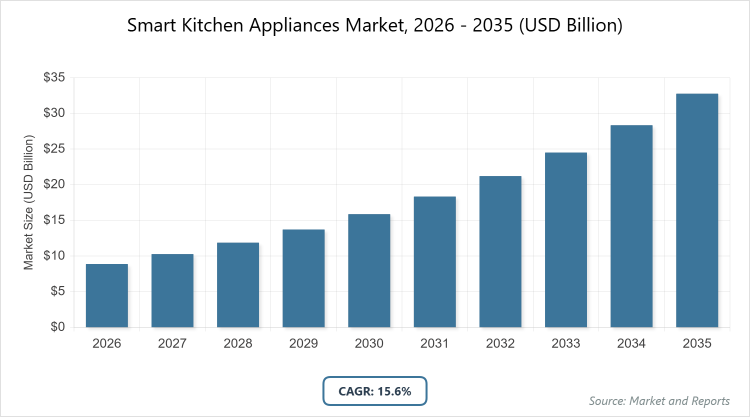
According to MarketnReports, the global Smart Kitchen Appliances market size was estimated at USD 8.89 billion in 2025 and is expected to reach USD 37.89 billion by 2035, growing at a CAGR of 15.6% from 2026 to 2035. Increasing integration of IoT and AI for enhanced convenience and energy efficiency.
What are the Key Insights into Smart Kitchen Appliances Market?
- The global smart kitchen appliances market size was valued at USD 8.89 billion in 2025 and is projected to reach USD 37.89 billion by 2035.
- The market is expected to grow at a CAGR of 15.6% during the forecast period from 2026 to 2035.
- The market is driven by rising smart home adoption, AI advancements, and consumer demand for energy-efficient, connected devices.
- In the product type segment, the smart refrigerators subsegment dominated with a 34.2% share, owing to their advanced features like inventory tracking and energy management, which appeal to tech-savvy consumers seeking convenience.
- In the connectivity technology segment, the Wi-Fi subsegment held the largest share at around 46.8%, driven by its seamless integration with smart home ecosystems for remote control and updates.
- In the application segment, the residential subsegment accounted for 72.3% of the market, primarily due to increasing urbanization and demand for automated home cooking solutions in single-person households.
- North America dominated the regional market with a 40% share, attributed to high disposable incomes, early adoption of smart technologies, and strong presence of key players like Whirlpool and GE.
What is the Smart Kitchen Appliances Market?
Industry Overview
The smart kitchen appliances market involves connected devices equipped with IoT, AI, and wireless technologies to automate and optimize cooking, storage, and cleaning processes, enhancing user convenience, energy efficiency, and food management in modern households and commercial settings. Market definition encompasses appliances like refrigerators, ovens, dishwashers, and cooktops that integrate voice control, remote monitoring, and predictive maintenance via apps or smart home ecosystems, enabling seamless interactions with platforms like Alexa or Google Assistant to streamline daily tasks and support sustainable living.
What are the Market Dynamics of Smart Kitchen Appliances Market?
Growth Drivers
Growth drivers in the smart kitchen appliances market are propelled by the surge in smart home ecosystems and IoT integration, enabling remote monitoring and automation that cater to busy lifestyles and energy-conscious consumers. Advancements in AI for features like recipe suggestions and predictive maintenance enhance user experience, while rising disposable incomes in emerging markets boost demand for premium connected devices. Urbanization and the trend toward compact living spaces further accelerate adoption, as multifunctional appliances save time and space, supported by e-commerce growth for easy accessibility.
Restraints
Restraints include high initial costs of smart appliances, limiting penetration in price-sensitive regions and among lower-income households, coupled with concerns over data privacy and cybersecurity vulnerabilities in connected devices. Compatibility issues with existing home infrastructures hinder seamless integration, while limited internet connectivity in rural areas restricts functionality. Economic uncertainties and supply chain disruptions also pose challenges, inflating prices and delaying product launches.
Opportunities
Opportunities abound with the expansion of 5G and edge computing, enabling faster, more responsive appliances for real-time interactions and enhanced AI capabilities. Emerging markets in Asia Pacific offer potential through increasing smartphone penetration and urban middle-class growth, driving demand for affordable smart solutions. Partnerships with e-commerce platforms for bundled smart home packages, along with sustainability-focused innovations like energy-efficient models, can capture eco-conscious consumers and align with global green initiatives.
Challenges
Challenges persist in standardizing connectivity protocols across brands, complicating user ecosystems and increasing setup frustrations. Rapid technological obsolescence requires frequent updates, risking consumer fatigue and higher maintenance costs. Regulatory variations on data protection demand compliance adaptations, while counterfeit products erode trust. Supply chain dependencies on semiconductors amid global shortages can delay innovations and inflate costs.
Smart Kitchen Appliances Market: Report Scope
| Report Attributes | Report Details |
| Report Name | Smart Kitchen Appliances Market |
| Market Size 2025 | USD 8.89 Billion |
| Market Forecast 2035 | USD 37.89 Billion |
| Growth Rate | CAGR of 15.6% |
| Report Pages | 220 |
| Key Companies Covered |
Samsung Electronics Co., Ltd., LG Electronics Inc., Whirlpool Corporation, Bosch Home Appliances, Electrolux AB, GE Appliances, Panasonic Corporation, Miele & Cie. KG, and Others |
| Segments Covered | By Product Type (Smart Refrigerators, Smart Ovens, Smart Dishwashers, Smart Cooktops, Smart Coffee Makers, Smart Kettles, Smart Blenders, Smart Air Fryers, Smart Microwaves, Smart Food Processors, and Others), By Connectivity Technology (Wi-Fi, Bluetooth, NFC, Zigbee, Z-Wave, and Others), By Application (Residential, Commercial, and Others), and By Region |
| Regions Covered | North America, Europe, Asia Pacific (APAC), Latin America, and The Middle East and Africa (MEA) |
| Base Year | 2025 |
| Historical Year | 2020 – 2024 |
| Forecast Year | 2026 – 2035 |
| Customization Scope | Avail customized purchase options to meet your exact research needs. |
What is the Market Segmentation of Smart Kitchen Appliances Market?
The Smart Kitchen Appliances market is segmented by product type, connectivity technology, application, and region.
Based on Product Type Segment, the smart refrigerators subsegment is the most dominant, holding over 34.2% share, followed by smart ovens as the second most dominant. Smart refrigerators’ dominance stems from their multifunctional features like food inventory management and integration with smart home systems, driving the market by promoting energy savings and convenience, which encourages broader adoption of connected kitchens and boosts overall consumer spending on premium appliances.
Based on the Connectivity Technology Segment, Wi-Fi leads with approximately 46.8% share, with Bluetooth as the second dominant. Wi-Fi’s leading position is due to its reliable long-range connectivity for app-based controls, propelling market growth by enabling seamless remote operations and updates, thus enhancing user engagement and integrating with broader IoT ecosystems for smarter homes.
Based on Application Segment, residential dominates with 72.3% share, followed by commercial. Residential’s supremacy arises from rising single-person households and demand for time-saving devices, aiding market drive by fostering habitual use of smart features that promote upgrades and expansions in home automation.
What are the Recent Developments in Smart Kitchen Appliances Market?
- In March 2025, Samsung launched smart refrigerators with an intuitive 9” AI home screen and 32” or 21.5” family hub screens, featuring improved AI Vision Inside for recognizing 37 food types and personalized meal planning.
- In October 2024, Trimble released Unity Suite for unified project management, indirectly supporting smart kitchen integrations through better asset tracking.
- In August 2024, Zapata AI reported revenue growth from AI-based asset management, enhancing smart appliance functionalities.
- In October 2023, LTi Technology Solutions partnered with Capteris Capital to advance lease and loan cloud technology, benefiting smart appliance financing.
- In May 2023, LeaseAccelerator acquired LeaseController from Deloitte to expand lease lifecycle automation, aiding smart kitchen asset management.
What is the Regional Analysis of Smart Kitchen Appliances Market?
- North America is expected to dominate the global market.
North America leads the smart kitchen appliances market, holding approximately 40% share, driven by high consumer spending, advanced smart home infrastructure, and innovation in connected devices. The United States dominates within the region, supported by major players like Whirlpool and GE, widespread broadband access, and trends toward energy-efficient homes, fostering rapid adoption of AI-integrated appliances.
Asia Pacific is the fastest-growing region, with a projected CAGR of 17%, attributed to urbanization, rising middle-class incomes, and government smart city initiatives. China leads as the dominant country, fueled by massive manufacturing capabilities, e-commerce growth, and demand for affordable smart solutions in compact urban living spaces.
Europe exhibits strong growth at a CAGR of 13%, bolstered by sustainability regulations and premium appliance preferences. Germany is the leading country, driven by engineering excellence, eco-friendly innovations, and integration with smart grids for energy management.
Latin America shows emerging potential, with growth from increasing disposable incomes and urban development. Brazil dominates, thanks to expanding e-commerce and the adoption of convenience appliances in middle-class households for convenience appliances.
The Middle East and Africa region holds about 5% share, with gradual expansion through luxury developments and tourism. The United Arab Emirates leads, propelled by smart city projects and high-end residential demand for connected kitchens.
Who are the Key Market Players in Smart Kitchen Appliances Market?
- Samsung Electronics Co., Ltd. focuses on AI-integrated appliances like Family Hub refrigerators, emphasizing ecosystem connectivity for seamless smart home experiences.
- LG Electronics Inc. develops ThinQ-enabled devices, prioritizing voice control and energy efficiency to enhance user convenience.
- Whirlpool Corporation offers Wi-Fi connected ovens and dishwashers, collaborating on app-based monitoring for predictive maintenance.
- Bosch Home Appliances specializes in Home Connect platforms, focusing on sustainable, IoT-driven solutions for premium markets.
- Electrolux AB advances smart steam ovens, emphasizing health-focused features with AI recipe guidance.
- GE Appliances integrates appliances with Google Assistant, prioritizing affordability and integration for mass adoption.
- Panasonic Corporation develops microwave ovens with inverter technology, focusing on compact, energy-efficient designs for urban users.
- Miele & Cie. KG offers high-end connected appliances, emphasizing durability and advanced automation for luxury segments.
What are the Market Trends in Smart Kitchen Appliances Market?
- Integration of AI for personalized recipe suggestions and automated cooking adjustments.
- Rise of voice control and remote access via assistants like Alexa and Google.
- Focus on energy-efficient and sustainable appliances aligning with ESG goals.
- Expansion of Wi-Fi connectivity for seamless smart home integration.
- Growth in multifunctional devices for space-saving in urban homes.
- Adoption of AR-based interfaces for immersive cooking experiences.
- Emphasis on health monitoring features like nutrition tracking.
- Partnerships for cloud-connected ecosystems enhancing data analytics.
What are the Market Segments and their Subsegments Covered in the Smart Kitchen Appliances Report?
By Product Type
- Smart Refrigerators
- Smart Ovens
- Smart Dishwashers
- Smart Cooktops
- Smart Coffee Makers
- Smart Kettles
- Smart Blenders
- Smart Air Fryers
- Smart Microwaves
- Smart Food Processors
- Others
By Connectivity Technology
- Wi-Fi
- Bluetooth
- NFC
- Zigbee
- Z-Wave
- Others
By Application
- Residential
- Commercial
- Others
By Region
- North America
- U.S.
- Canada
- Europe
- UK
- Germany
- France
- Rest of Europe
- Asia Pacific
- China
- India
- Japan
- Rest of Asia Pacific
- Latin America
- Brazil
- Mexico
- Rest of Latin America
- Middle East & Africa
- UAE
- South Africa
- Rest of Middle East & Africa
Frequently Asked Questions
Smart kitchen appliances are connected devices using IoT, AI, and wireless tech for automated cooking, monitoring, and energy management via apps or voice control.
Key factors include AI advancements, smart home adoption, urbanization, energy efficiency demands, and e-commerce growth.
The market is projected to grow from USD 9.81 billion in 2026 to USD 37.89 billion by 2035.
The CAGR is expected to be 15.6% from 2026 to 2035.
North America will contribute notably, holding around 40% of the market value due to high tech adoption.
Major players include Samsung Electronics Co., Ltd., LG Electronics Inc., Whirlpool Corporation, Bosch Home Appliances, Electrolux AB, GE Appliances, Panasonic Corporation, and Miele & Cie. KG.
The report provides comprehensive analysis including market size, trends, segmentation, regional insights, key players, growth drivers, restraints, opportunities, challenges, and forecasts from 2026 to 2035.
The value chain includes component sourcing, manufacturing, software development, assembly, distribution, retail, and after-sales support.
Trends are moving toward AI personalization and sustainability, while consumers prefer connected, energy-efficient devices for convenience.
Regulations on energy efficiency and data privacy promote compliant designs, while environmental concerns drive eco-friendly innovations.