
Smart Homes Systems Market Size, Share and Trends 2026 to 2035
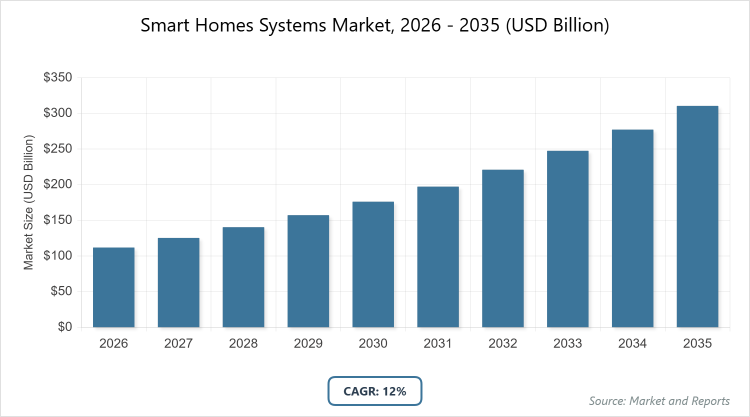
According to MarketnReports, the global Smart Homes Systems market size was estimated at USD 112 billion in 2025 and is expected to reach USD 350 billion by 2035, growing at a CAGR of 12% from 2026 to 2035. The Smart Homes Systems Market is driven by increasing adoption of IoT devices and demand for energy-efficient home automation.
What are the Key Insights into Smart Homes Systems?
- The global Smart Homes Systems market was valued at USD 112 billion in 2025 and is projected to reach USD 350 billion by 2035.
- The market is expected to grow at a CAGR of 12% during the forecast period from 2026 to 2035.
- The market is driven by rising IoT penetration, energy efficiency demands, smart city initiatives, and advancements in AI and 5G connectivity.
- In the type segment, security & surveillance systems dominate with a 30% share due to growing safety concerns and integration with AI for real-time monitoring.
- In the application segment, safety & security dominates with a 35% share as it provides comprehensive protection through cameras, sensors, and alerts.
- In the end-user segment, residential users dominate with a 60% share owing to increasing home automation adoption for convenience and energy savings.
- North America dominates the regional market with a 35% share, driven by high tech adoption, strong infrastructure, and presence of key players like Google and Amazon.
What is the Industry Overview of Smart Homes Systems?
The Smart Homes Systems market encompasses interconnected devices and platforms that automate and control home functions such as lighting, security, heating, and entertainment through IoT, AI, and wireless technologies, offering convenience, energy savings, and enhanced security for residential and commercial spaces. Market definition includes integrated systems using sensors, hubs, voice assistants, and mobile apps to enable remote monitoring, automation, and data analytics, promoting seamless user experiences while addressing challenges in interoperability, data privacy, and cybersecurity for intelligent living environments.
What are the Market Dynamics of Smart Homes Systems?
Growth Drivers
The Smart Homes Systems market is propelled by the proliferation of IoT devices and 5G networks, enabling seamless connectivity and real-time control of home functions like lighting and HVAC, which enhances user convenience and reduces energy consumption by up to 30% through automated optimization. Rising urbanization and smart city projects integrate these systems for efficient resource management, while aging populations benefit from health monitoring features like fall detection and medication reminders. Advancements in AI for predictive maintenance and voice assistants like Alexa and Google Home drive adoption, with government incentives for energy-efficient homes further accelerating growth. Increasing consumer awareness of cybersecurity and sustainability pushes demand for secure, eco-friendly solutions.
Restraints
High initial installation costs for comprehensive smart systems, including devices, wiring, and professional setup, deter adoption among middle-income households in developing regions, where ROI perceptions remain low. Interoperability issues between devices from different manufacturers, due to lack of universal standards, complicate integration and user experience. Data privacy concerns and cybersecurity vulnerabilities, with risks of hacking smart locks or cameras, erode consumer trust and require constant updates. Limited internet infrastructure in rural areas hinders reliable operation, while regulatory variations on data handling add compliance burdens.
Opportunities
Opportunities arise from integrating AI and machine learning for personalized automation, such as adaptive lighting based on user habits, attracting tech-savvy consumers in urban markets. Expansion into emerging economies with rising middle-class spending offers potential for affordable, modular systems tailored to local needs. Partnerships with utility companies for energy management can create bundled services, while health-focused features for elderly care open niches in aging societies. The growth of 5G enables advanced AR/VR home design apps, and sustainable materials for devices align with green building trends.
Challenges
Challenges include cybersecurity threats, where breaches could compromise home security, requiring robust encryption and regular patches. Rapid technological obsolescence demands frequent upgrades, straining consumer budgets. Skill gaps in installation and maintenance among users and technicians hinder widespread use. Environmental concerns over e-waste from discarded devices necessitate recycling programs. Varying global standards for IoT connectivity complicate international expansion.
Smart Homes Systems Market: Report Scope
| Report Attributes | Report Details |
| Report Name | Smart Homes Systems Market |
| Market Size 2025 | USD 112 Billion |
| Market Forecast 2035 | USD 350 Billion |
| Growth Rate | CAGR of 12% |
| Report Pages | 210 |
| Key Companies Covered | Google LLC, Amazon.com, Inc., Apple Inc., Samsung Electronics Co., Ltd., Siemens AG, Honeywell International Inc., Schneider Electric SE, Johnson Controls International Plc, and Others |
| Segments Covered | By Type, By Application, By End-User, and By Region |
| Regions Covered | North America, Europe, Asia Pacific (APAC), Latin America, and The Middle East and Africa (MEA) |
| Base Year | 2025 |
| Historical Year | 2020 – 2024 |
| Forecast Year | 2026 – 2035 |
| Customization Scope | Avail customized purchase options to meet your exact research needs. |
What is the Market Segmentation of Smart Homes Systems?
The Smart Homes Systems market is segmented by type, application, end-user, and region.
By Type. Security & surveillance systems are the most dominant subsegment, holding approximately 30% market share, due to AI-enhanced features like motion detection and facial recognition for proactive threat response. This dominance drives the market by addressing rising crime concerns and increasing home insurance discounts. Lighting control systems rank as the second most dominant, with around 25% share, offering energy savings through automation, propelling growth via integration with voice assistants.
By Application. Safety & security emerges as the most dominant subsegment, capturing about 35% share, primarily because it combines cameras, alarms, and locks for comprehensive protection. This leads to market growth by enhancing peace of mind and property value. Energy management follows as the second most dominant, with roughly 20% share, optimizing consumption, driving the market via cost savings and sustainability.
By End-User. Residential users represent the most dominant subsegment at about 60% share, driven by personal convenience needs. This dominance accelerates market expansion through mass consumer adoption. Commercial buildings rank second most dominant, holding around 25% share, for office efficiency, contributing to growth via corporate investments.
What are the Recent Developments in Smart Homes Systems?
- In January 2025, Google Nest launched an AI-powered thermostat with predictive energy saving, integrating with renewable sources.
- In December 2024, Amazon Echo expanded with new security features, including drone patrols for home monitoring.
- In November 2024, Apple HomeKit received updates for better interoperability with third-party devices.
- In October 2024, Samsung SmartThings partnered with a utility firm for grid-optimized energy management.
- In September 2024, Philips Hue introduced voice-activated lighting with health monitoring integration.
What is the Regional Analysis of Smart Homes Systems?
- North America is expected to dominate the global market.
North America holds the largest share at approximately 35%, with the United States as the dominating country, due to high-tech adoption, strong infrastructure, and the presence of key players like Google and Amazon. This region’s growth is fueled by consumer demand for convenience and security, positioning it as an innovation hub. High disposable incomes support premium smart device purchases. Canada’s smart grid initiatives integrate home energy management. The region’s focus on privacy laws drives secure platforms. Venture capital in Silicon Valley funds startups. Regulatory frameworks support IoT standards. Strong retail networks like Best Buy accelerate consumer access.
Europe follows with steady growth, driven by energy efficiency regulations and smart city projects, where Germany dominates through engineering and firms like Siemens. The region’s expansion benefits from EU subsidies for green homes. The UK’s post-Brexit focus on digital infrastructure boosts adoption. France’s smart building codes promote HVAC integration. Italy and Spain emphasize hospitality applications. Multilingual support and EU data standards facilitate adoption. Sustainability directives encourage energy-efficient devices. Collaborative initiatives under the European Digital Single Market enhance interoperability.
Asia Pacific is the fastest-growing region, with China leading due to the urban boom and government IoT initiatives. This area’s potential is enhanced by low-cost devices in India and Japan. China’s smart city projects integrate home automation. India’s affordable 5G rollout drives adoption. Japan’s aging population favors health monitoring features. South Korea’s tech-savvy consumers adopt entertainment systems. Southeast Asian nations like Singapore pioneer luxury smart homes. Rapid urbanization increases demand for security solutions. Cultural acceptance of mobile control boosts engagement.
Latin America demonstrates moderate progress, dominated by Brazil’s growing middle class, supported by foreign investments though challenged by infrastructure. Mexico benefits from proximity to North America, facilitating technology transfer. Government digital inclusion programs in Argentina promote adoption. Chile’s real estate sector adopts for new developments. Colombia’s urban centers drive security system demand. However, connectivity gaps slow rural growth. Emerging middle-class spending fuels entry-level devices.
The Middle East and Africa remain emerging, with the UAE leading through smart city developments, limited by costs but promising via luxury housing. Saudi Arabia’s Vision 2030 funds smart home projects. South Africa’s gated communities adopt security systems. Egypt’s urban growth drives entertainment integration. However, power reliability issues constrain adoption. International partnerships support infrastructure development. Emerging middle-class demand in Nigeria fuels entry-level solutions.
What are the Key Market Players in Smart Homes Systems?
- Google LLC. Google focuses on the Nest ecosystem with AI integration, expanding through partnerships for voice control.
- Amazon.com, Inc. Amazon emphasizes Echo devices, investing in Ring for security and Alexa for automation.
- Apple Inc. Apple pursues HomeKit for secure, seamless integration across iOS devices.
- Samsung Electronics Co., Ltd. Samsung offers SmartThings hub, strategizing on appliance connectivity.
- Siemens AG. Siemens specializes in energy management, focusing on building automation for commercial use.
- Honeywell International Inc. invests in thermostats and security, targeting smart home retrofits.
- Schneider Electric SE. Schneider emphasizes the Wiser platform for energy efficiency.
- Johnson Controls International Plc. Johnson Controls focuses on HVAC integration for commercial buildings.
What are the Market Trends in Smart Homes Systems?
- Increasing AI integration for predictive automation.
- Rise of voice and gesture control interfaces.
- Adoption of 5G for faster connectivity.
- Focus on cybersecurity and data privacy.
- Growth in energy-efficient, sustainable systems.
- Expansion of health monitoring features.
What Market Segments and Subsegments are Covered in the Smart Homes Systems Report?
By Type
- Lighting Control Systems
- Security & Surveillance Systems
- HVAC Control Systems
- Entertainment Systems
- Smart Appliances
- Energy Management Systems
- Access Control Systems
- Smart Plugs & Switches
- Voice Assistants
- Home Automation Hubs
- Others
By Application
- Safety & Security
- Lighting Control
- Entertainment
- Energy Management
- Comfort & Convenience
- Health Monitoring
- Remote Monitoring
- Climate Control
- Access Management
- Appliance Control
- Others
By End-User
- Residential Users
- Commercial Buildings
- Hospitality Sector
- Healthcare Facilities
- Educational Institutions
- Government Buildings
- Retail Spaces
- Industrial Facilities
- Smart Cities Projects
- Real Estate Developers
- Others
By Region
-
- North America
- U.S.
- Canada
- Europe
- UK
- Germany
- France
- Rest of Europe
- Asia Pacific
- China
- India
- Japan
- Rest of Asia Pacific
- Latin America
- Brazil
- Mexico
- Rest of Latin America
- Middle East & Africa
- UAE
- South Africa
- Rest of Middle East & Africa
- North America
Frequently Asked Questions
Smart Homes Systems are interconnected devices and platforms that automate home functions like lighting, security, and energy management using IoT and AI.
Key factors include IoT proliferation, energy efficiency demands, smart city growth, and AI advancements.
The market is projected to grow from USD 112 billion in 2025 to USD 350 billion by 2035.
The CAGR is expected to be 12%.
North America will contribute notably, holding around 35% share due to tech adoption and infrastructure.
Major players include Google LLC, Amazon.com, Inc., Apple Inc., Samsung Electronics Co., Ltd., and Siemens AG.
The report provides detailed analysis of size, trends, segments, regional outlook, key players, and forecasts.
Stages include component manufacturing, system integration, software development, distribution, installation, and maintenance.
Trends evolve toward AI and 5G integration, with preferences for secure, energy-efficient, and health-focused systems.
Data privacy regulations and environmental standards for energy efficiency influence design and adoption.