
Smart Healthcare Market Size, Share and Trends 2026 to 2035
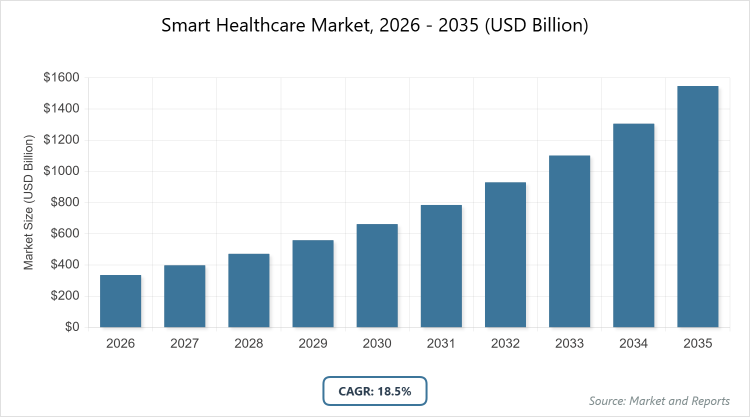
According to MarketnReports, the global Smart Healthcare market size was estimated at USD 335.85 billion in 2025 and is expected to reach USD 1833.7 billion by 2035, growing at a CAGR of 18.5% from 2026 to 2035. Smart Healthcare Market is driven by the growing demand for better healthcare services, home-based services, and telehealth.
What are the Key Insights of Smart Healthcare Market?
- Market size valued at USD 335.85 billion in 2025 and projected to reach USD 1833.7 billion by 2035
- CAGR of 18.5% during the forecast period 2026-2035
- Market is driven by technological advancements in AI and IoT, increasing prevalence of chronic diseases, and rising demand for remote patient monitoring
- mHealth dominates the product segment with 39% share due to high smartphone penetration and the proliferation of health apps enabling continuous monitoring and user engagement
- Chronic disease management dominates the application segment with 35% share as it leverages smart technologies for ongoing tracking and early intervention in conditions like diabetes and hypertension
- Hospitals dominate the end-user segment with 61% share owing to their adoption of integrated systems for workflow optimization and patient data management
- North America dominates with 40% market share attributed to advanced infrastructure, supportive government policies, and high digital literacy
What is Smart Healthcare?
The smart healthcare market encompasses the integration of advanced technologies such as artificial intelligence, Internet of Things, big data analytics, and wearable devices into healthcare systems to enhance efficiency, patient outcomes, and accessibility. It includes solutions like telemedicine, electronic health records, remote monitoring, and smart medical devices that enable real-time data collection, predictive analytics, and personalized care. The market definition refers to the ecosystem of digital tools and platforms that transform traditional healthcare delivery into intelligent, connected, and patient-centric models, addressing challenges like rising chronic diseases, aging populations, and the need for cost-effective care.
What are the Market Dynamics in Smart Healthcare?
Growth Drivers
The growth drivers in the smart healthcare market are primarily fueled by rapid technological advancements and the increasing burden of chronic diseases worldwide. Innovations in AI, machine learning, and IoT enable predictive diagnostics, personalized treatment plans, and seamless data integration, reducing healthcare costs and improving outcomes. The aging global population and rising demand for remote care, especially post-pandemic, have accelerated adoption of telemedicine and wearables. Government initiatives promoting digital health infrastructure, such as subsidies for EHR implementation, further propel market expansion by enhancing accessibility in underserved areas.
Restraints
Restraints in the smart healthcare market include data privacy and security concerns, as the integration of connected devices increases vulnerability to cyberattacks and breaches of sensitive patient information. High initial implementation costs for advanced systems pose barriers for smaller healthcare providers, particularly in developing regions with limited budgets. Regulatory hurdles and varying standards across countries complicate global deployment, while interoperability issues between different platforms hinder seamless data exchange and system efficiency.
Opportunities
Opportunities in the smart healthcare market arise from the expansion into emerging economies, where improving internet infrastructure and rising healthcare investments create demand for affordable digital solutions. The integration of blockchain for secure data sharing and AI for advanced analytics opens avenues for innovative applications like precision medicine. Partnerships between tech giants and healthcare providers can drive scalable solutions, while the focus on preventive care through wearables presents growth in consumer health segments.
Challenges
Challenges in the smart healthcare market stem from the lack of skilled professionals to manage and interpret complex data from smart systems, leading to underutilization of technologies. Cybersecurity threats remain a persistent issue, requiring ongoing investments in robust defenses. Additionally, resistance to change from traditional healthcare models and ethical concerns around AI decision-making in patient care complicate widespread adoption.
Smart Healthcare Market: Report Scope
| Report Attributes | Report Details |
| Report Name | Smart Healthcare Market |
| Market Size 2025 | USD 335.85 Billion |
| Market Forecast 2035 | USD 1833.7 Billion |
| Growth Rate | CAGR of 18.5% |
| Report Pages | 220 |
| Key Companies Covered | IBM, Cisco Systems, Allscripts Healthcare Solutions, Oracle (Cerner), Philips Healthcare, GE Healthcare, Siemens Healthineers, Medtronic, Epic Systems, McKesson Corporation, and Others |
| Segments Covered | By Product (Telemedicine, mHealth, Electronic Health Records (EHR), RFID Systems, Smart Pills, Smart Syringes, Wearable Devices, Healthcare Analytics, Blockchain in Healthcare, AI-Based Solutions, and Others), By Application (Remote Patient Monitoring, Hospital Management, Fitness and Wellness, Chronic Disease Management, Medication Management, Clinical Workflow Management, Storage and Inventory Management, Teleconsultation, Diagnostic Services, Emergency Response, and Others), By End-User (Hospitals, Home Care Settings, Clinics, Diagnostic Centers, Pharmaceutical Companies, Insurance Providers, Ambulatory Surgical Centers, Nursing Homes, Research Institutions, Patients, and Others), and By Region |
| Regions Covered | North America, Europe, Asia Pacific (APAC), Latin America, and The Middle East and Africa (MEA) |
| Base Year | 2025 |
| Historical Year | 2020 – 2024 |
| Forecast Year | 2026 – 2035 |
| Customization Scope | Avail customized purchase options to meet your exact research needs. |
How is the Smart Healthcare Market Segmented?
The Smart Healthcare market is segmented by product, application, end-user, and region.
Based on Product Segment. The mHealth subsegment is the most dominant with a 39% share, followed by telemedicine as the second most dominant at 25%. mHealth’s dominance stems from widespread smartphone usage and app-based health tracking, which drives the market by enabling real-time monitoring, patient engagement, and cost-effective preventive care; telemedicine supports this growth by facilitating virtual consultations that reduce hospital visits and expand access in remote areas, collectively enhancing overall healthcare efficiency and outcomes.
Based on Application Segment. Chronic disease management is the most dominant with a 35% share, followed by remote patient monitoring at 28%. Chronic disease management’s leading position is due to the rising prevalence of conditions like diabetes and cardiovascular diseases, where smart tools provide continuous tracking and alerts to prevent complications, driving market growth through improved patient adherence and reduced healthcare burdens; remote patient monitoring complements this by offering home-based data collection that supports timely interventions and integrates with broader digital ecosystems for holistic care.
Based on End-User Segment. Hospitals are the most dominant with a 61% share, followed by home care settings at 22%. Hospitals dominate because of their need for integrated systems like EHR and analytics to streamline operations and enhance clinical decisions, propelling market expansion by optimizing resource use and patient safety; home care settings grow as the second dominant through wearable and telehealth adoption, which drives the market by shifting care outside facilities, lowering costs, and improving quality of life for elderly and chronic patients.
What are the Recent Developments in Smart Healthcare?
- In December 2025, the American Hospital Association released a report on smart hospitals, highlighting the integration of digital tools, ambient intelligence, and virtual care workflows to improve clinical efficiency and patient experience, with examples of automated check-ins and home monitoring reducing hospital readmissions.
- In January 2026, during the JP Morgan Healthcare Conference, Boston Scientific announced acquisitions of early-stage medtech firms focused on AI-driven diagnostics, aiming to expand their portfolio in remote monitoring and predictive analytics for cardiovascular care.
- In November 2025, Cerner Corporation merged with Siemens Healthineers in a $16.4 billion deal to enhance digital healthcare solutions, combining EHR expertise with imaging technologies for better data interoperability.
- In December 2025, Google Health acquired Tempus for $3.2 billion to integrate AI-driven healthcare analytics, focusing on oncology and personalized medicine through advanced data platforms.
How is the Regional Analysis for Smart Healthcare Market?
North America to dominate the global market.
North America’s dominance in the smart healthcare market is driven by robust technological infrastructure, high adoption rates of digital health solutions, and supportive policies like the HITECH Act promoting EHR usage. The United States, as the dominating country, contributes significantly with major investments from tech hubs and companies like Epic Systems, leading to innovations in AI and telemedicine that enhance patient care and operational efficiency.
Europe follows as a key region, with strong growth fueled by EU initiatives for digital health interoperability and data privacy under GDPR. Germany dominates within Europe due to its advanced manufacturing in medical devices and widespread adoption of smart hospital systems, which improve care coordination and reduce costs across the continent.
Asia Pacific is experiencing the fastest growth, driven by rapid urbanization, increasing healthcare expenditures, and government pushes for digital transformation. China leads as the dominating country with massive investments in AI and 5G-enabled telemedicine, addressing its large population’s needs and expanding access in rural areas.
Latin America shows emerging potential through rising mobile penetration and telehealth adoption to bridge healthcare gaps. Brazil dominates the region with initiatives integrating smart wearables and analytics in public health systems, enhancing preventive care amid economic constraints.
The Middle East and Africa lag but are growing with investments in infrastructure. The United Arab Emirates dominates in the Middle East through visionary projects like Dubai’s smart city health integrations, while South Africa leads in Africa with EHR rollouts improving disease management in underserved communities.
Who are the Key Market Players in Smart Healthcare?
- IBM focuses on leveraging its Watson Health platform for AI-driven analytics and cloud-based solutions, emphasizing partnerships with hospitals to enhance data interoperability and predictive care strategies.
- Cisco Systems specializes in secure networking and IoT infrastructure for healthcare, with strategies centered on cybersecurity enhancements and edge computing to support real-time data transmission in smart hospitals.
- Allscripts Healthcare Solutions prioritizes EHR and population health management tools, employing acquisition strategies to integrate telehealth capabilities and improve workflow automation for providers.
- Oracle (Cerner Corporation) integrates comprehensive EHR systems with AI for clinical decision support, focusing on global expansions and data analytics to drive value-based care models.
- Philips Healthcare emphasizes connected care devices and imaging solutions, with strategies involving R&D in ambient intelligence and collaborations for integrated patient monitoring ecosystems.
- GE Healthcare leads in diagnostic imaging and monitoring equipment, adopting strategies like AI algorithm development and partnerships for smart hospital deployments to optimize resource utilization.
- Siemens Healthineers invests in digital twins and radiology AI, with growth strategies targeting emerging markets through localized innovations and sustainability-focused healthcare solutions.
- Medtronic concentrates on wearable and implantable devices, employing strategies such as data platform integrations for chronic disease management and regulatory advocacy for faster approvals.
- Epic Systems focuses on interoperable EHR platforms, with strategies emphasizing user-centric designs and expansions into analytics for population health insights.
- McKesson Corporation specializes in supply chain and inventory management tools, using AI-driven strategies to enhance pharmaceutical distribution and reduce operational inefficiencies in healthcare settings.
What are the Market Trends in Smart Healthcare?
- Increasing integration of generative AI for drug discovery and personalized treatment simulations
- Rise of home-based blood collection and robotic phlebotomy for enhanced patient convenience
- Shift toward practical longevity solutions combining AI scribes and wearable tech for aging-in-place
- Growing adoption of FHIR standards for better data interoperability across systems
- Expansion of hybrid care models blending virtual visits with automated workflows
- Focus on cybersecurity enhancements amid rising data breaches in connected devices
- Emergence of blockchain for secure patient data sharing and consent management
- Proliferation of ambient intelligence in smart hospitals for proactive care delivery
- Increased use of predictive analytics for population health and resource allocation
- Emphasis on ethical AI frameworks to address biases in healthcare decision-making
What Market Segments and Subsegments are Covered in the Smart Healthcare Report?
By Product
- Telemedicine
- mHealth
- Electronic Health Records (EHR)
- RFID Systems
- Smart Pills
- Smart Syringes
- Wearable Devices
- Healthcare Analytics
- Blockchain in Healthcare
- AI-Based Solutions
- Others
By Application
- Remote Patient Monitoring
- Hospital Management
- Fitness and Wellness
- Chronic Disease Management
- Medication Management
- Clinical Workflow Management
- Storage and Inventory Management
- Teleconsultation
- Diagnostic Services
- Emergency Response
- Others
By End-User
- Hospitals
- Home Care Settings
- Clinics
- Diagnostic Centers
- Pharmaceutical Companies
- Insurance Providers
- Ambulatory Surgical Centers
- Nursing Homes
- Research Institutions
- Patients
- Others
By Region
- North America
- U.S.
- Canada
- Europe
- UK
- Germany
- France
- Rest of Europe
- Asia Pacific
- China
- India
- Japan
- Rest of Asia Pacific
- Latin America
- Brazil
- Mexico
- Rest of Latin America
- Middle East & Africa
- UAE
- South Africa
- Rest of Middle East & Africa
Frequently Asked Questions
Smart healthcare refers to the use of advanced technologies like AI, IoT, and data analytics to create connected, efficient, and patient-focused healthcare systems, including tools for remote monitoring, telemedicine, and electronic records.
Key factors include technological advancements in AI and wearables, rising chronic disease prevalence, government support for digital health, and increasing demand for cost-effective remote care solutions.
The market is projected to grow from approximately USD 397.98 billion in 2026 to USD 1833.7 billion by 2035.
The CAGR is expected to be 18.5% during 2026-2035.
North America will contribute notably, holding around 40% of the market share due to advanced infrastructure and high adoption rates.
Major players include IBM, Cisco Systems, Allscripts Healthcare Solutions, Oracle (Cerner), Philips Healthcare, GE Healthcare, Siemens Healthineers, Medtronic, Epic Systems, and McKesson Corporation.
The report provides comprehensive analysis including market size, trends, segmentation, regional insights, key players, and forecasts from 2026 to 2035.
Stages include technology development and R&D, manufacturing of devices and software, integration and deployment in healthcare settings, data management and analytics, and end-user application with ongoing support.
Trends are shifting toward AI-driven personalization and home-based care, with consumers preferring user-friendly wearables, privacy-focused solutions, and seamless telehealth experiences.
Regulatory factors include data privacy laws like GDPR and HIPAA, while environmental factors involve sustainable device manufacturing and energy-efficient IoT systems to reduce carbon footprints.