
Smart Fleet Management Market Size, Share and Trends 2026 to 2035
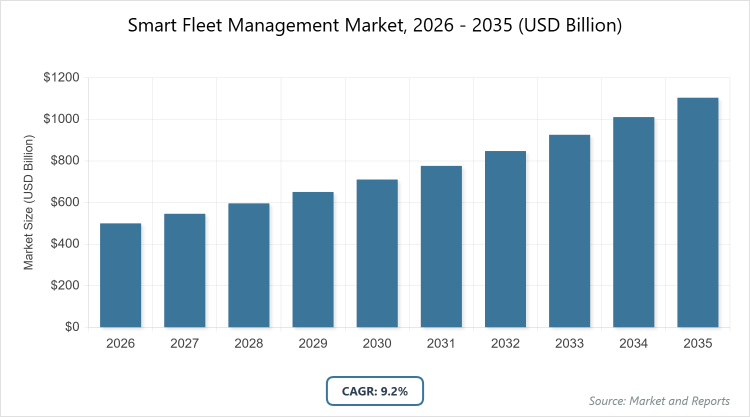
According to MarketnReports, the global Smart Fleet Management Market size was estimated at USD 500 billion in 2025 and is expected to reach USD 1200 billion by 2035, growing at a CAGR of 9.2% from 2026 to 2035. Smart Fleet Management Market is driven by increasing adoption of IoT and AI technologies for operational efficiency and cost reduction.What are the Key Insights of the Smart Fleet Management Market?
- The smart fleet management market was valued at USD 500 billion in 2025 and is projected to reach USD 1200 billion by 2035.
- The market is expected to grow at a CAGR of 9.2% during the forecast period from 2026 to 2035.
- The market is driven by advancements in IoT, AI, and telematics that enable real-time data analytics and operational efficiencies.
- Fleet Optimization dominates the solution segment with a 35% share because it integrates multiple functions like route planning and fuel management to drive comprehensive cost savings and efficiency gains; Long Range dominates the connectivity segment with a 40% share due to its ability to provide extensive coverage for remote and widespread fleet operations; Transportation & Logistics dominates the industry segment with a 45% share owing to the high volume of vehicles and the need for optimized delivery networks.
- Asia Pacific dominates the market with a 41% share due to rapid industrialization, e-commerce expansion, and government initiatives for smart transportation infrastructure.
What is the Industry Overview of the Smart Fleet Management Market?
The smart fleet management market encompasses the integration of advanced technologies such as IoT, AI, telematics, and data analytics to optimize fleet operations, enhance vehicle safety, reduce costs, and improve overall efficiency. Market definition refers to systems and solutions that enable real-time monitoring, predictive maintenance, route optimization, and compliance management for commercial and passenger vehicles across various industries. This market addresses the need for digital transformation in transportation, logistics, and related sectors by providing tools for asset tracking, driver behavior analysis, and sustainable fleet practices, ultimately leading to reduced downtime and better resource utilization.
What are the Market Dynamics of the Smart Fleet Management Market?
Growth Drivers
The primary growth drivers in the smart fleet management market include the rising demand for operational efficiency amid escalating fuel costs and supply chain complexities. Advancements in IoT and AI technologies allow for real-time vehicle tracking, predictive maintenance, and data-driven decision-making, which significantly reduce downtime and operational expenses. Additionally, stringent government regulations on vehicle emissions, safety, and compliance are compelling fleet operators to adopt these solutions. The expansion of e-commerce and last-mile delivery services further accelerates market growth by necessitating faster, more reliable fleet management to meet consumer expectations.
Restraints
High initial implementation costs pose a significant restraint, particularly for small and medium-sized enterprises, as deploying hardware like sensors and telematics devices, along with software integration, requires substantial upfront investment. Data privacy and cybersecurity concerns also hinder adoption, with increasing risks of data breaches in connected fleets leading to hesitation among operators. Moreover, the lack of standardized infrastructure in developing regions and compatibility issues with legacy systems can complicate deployment and limit market penetration.
Opportunities
Emerging opportunities lie in the integration of 5G technology and edge computing, which enable faster data transmission and real-time analytics for enhanced fleet performance. The shift toward electric and autonomous vehicles opens avenues for specialized management solutions focused on battery monitoring and autonomous navigation. Expanding into untapped markets in developing economies, coupled with partnerships between telematics providers and OEMs, presents growth potential. Additionally, the emphasis on sustainability offers opportunities for solutions that track and reduce carbon emissions through optimized routing and eco-friendly practices.
Challenges
Integration challenges with existing fleet systems remain a key hurdle, as many operators struggle to merge new smart technologies with outdated infrastructure without disrupting operations. Skilled workforce shortages for managing advanced analytics and AI-driven tools also pose difficulties, requiring ongoing training and expertise. Volatility in global supply chains for hardware components, such as sensors and chips, can lead to delays and increased costs. Furthermore, varying regulatory landscapes across regions create compliance complexities for multinational fleet operators.
Smart Fleet Management Market: Report Scope
| Report Attributes | Report Details |
| Report Name | Smart Fleet Management Market |
| Market Size 2025 | USD 500 Billion |
| Market Forecast 2035 | USD 1200 Billion |
| Growth Rate | CAGR of 9.2% |
| Report Pages | 220 |
| Key Companies Covered |
Verizon Connect, Geotab Inc., Trimble Inc., Continental AG, Robert Bosch GmbH, IBM Corporation, and Others. |
| Segments Covered | By Solution, By Connectivity, By Industry, and By Region. |
| Regions Covered | North America, Europe, Asia Pacific (APAC), Latin America, and The Middle East and Africa (MEA) |
| Base Year | 2025 |
| Historical Year | 2020 - 2024 |
| Forecast Year | 2026 - 2035 |
| Customization Scope | Avail customized purchase options to meet your exact research needs. |
What is the Market Segmentation of the Smart Fleet Management Market?
The Smart Fleet Management Market is segmented by solution, connectivity, industry, and region.By Solution Segment: The Fleet Optimization segment dominates with a 35% share, as it combines route planning, fuel efficiency, and resource allocation to significantly lower costs and boost productivity, driving the market by addressing core operational needs. The Vehicle Tracking segment is the second most dominant at 25%, offering real-time location data that enhances security and enables quick response to disruptions, helping propel market growth through improved asset utilization and reduced theft risks.
By Connectivity Segment: The Long Range segment dominates with a 40% share, providing reliable communication over vast distances essential for global and remote fleets, which drives the market by ensuring seamless data flow for monitoring and decision-making. The Cloud segment is the second most dominant at 30%, facilitating scalable storage and analytics that support advanced features like predictive maintenance, contributing to market expansion by enabling cost-effective, flexible solutions for diverse fleet sizes.
By Industry Segment: The Transportation & Logistics segment dominates with a 45% share, leveraging smart management for efficient supply chains and timely deliveries amid e-commerce growth, propelling the market through high-volume adoption and innovation in last-mile optimization. The Automotive segment is the second most dominant at 20%, focusing on OEM-integrated telematics for vehicle performance and safety, driving market growth by fostering connected ecosystems that enhance manufacturer services and customer experiences.
What are the Recent Developments in the Smart Fleet Management Market?
- In October 2025, Geotab acquired the commercial operations of Verizon Connect in Australia, expanding its regional presence and integrating advanced telematics capabilities to enhance fleet analytics for local operators.
- In July 2025, Teletrac Navman launched the Multi IQ Camera, a cloud-based AI dashcam providing 360-degree visibility and real-time safety insights, aimed at reducing accidents in large commercial vehicles.
- In April 2025, Solera introduced the Solera Fleet Platform, unifying vehicle claims, repairs, and management data into an AI-driven ecosystem to streamline operations for fleet owners.
- In September 2024, Azuga unveiled a next-generation Bluetooth Low Energy Asset Tracking solution, allowing fleets to monitor tools and equipment alongside vehicles to prevent theft and improve asset utilization.
- In January 2024, Tata Motors connected 500,000 commercial vehicles to its Fleet Edge platform, offering real-time insights on vehicle health, location, and driver behavior to boost efficiency and reduce logistics costs.
- In April 2024, Seaward Services partnered with Spinergie to implement a comprehensive Smart Fleet Management solution across its offshore vessels, focusing on operational optimization in the US East Coast wind sector.
What is the Regional Analysis of the Smart Fleet Management Market?
Asia Pacific to dominate the global market.Asia Pacific holds the dominant position in the smart fleet management market, driven by rapid urbanization, booming e-commerce, and government investments in smart infrastructure. China leads as the dominating country, with extensive adoption in logistics and manufacturing sectors fueled by initiatives like Made in China 2025, which emphasize digital transformation and EV integration for sustainable fleet operations.
North America follows closely, supported by stringent regulations on safety and emissions, along with advanced technological adoption. The United States is the dominating country here, where major logistics firms leverage AI-driven telematics for efficiency, particularly in e-commerce delivery networks and cross-border trade.
Europe exhibits steady growth through a focus on sustainability and compliance with EU directives on carbon reduction. Germany dominates the region, with its automotive industry giants integrating smart fleet solutions for predictive maintenance and autonomous vehicle testing, enhancing export-oriented supply chains.
Latin America is emerging with increasing investments in transportation infrastructure and mining operations. Brazil leads as the dominating country, adopting fleet optimization tools to manage vast agricultural and resource extraction fleets amid economic recovery efforts.
The Middle East and Africa show potential through oil & gas and construction sectors. The United Arab Emirates dominates, utilizing smart management for diversified economies, including tourism and logistics hubs like Dubai, where real-time tracking supports efficient urban mobility.
What are the Key Market Players and Strategies in the Smart Fleet Management Market?
Verizon Connect: Verizon Connect focuses on expanding its telematics offerings through acquisitions and 5G integration, emphasizing real-time tracking and AI analytics to provide scalable solutions for large enterprises, enhancing customer retention via data-driven insights.
Geotab Inc.: Geotab Inc. prioritizes open-platform ecosystems and partnerships with OEMs, investing in EV management and sustainability tools to differentiate in competitive markets, while using big data for predictive maintenance to reduce client downtime.
Trimble Inc.: Trimble Inc. employs a strategy of merging hardware and software innovations, targeting construction and logistics with integrated navigation and asset management, fostering growth through acquisitions that broaden its geospatial and analytics capabilities.
Continental AG: Continental AG leverages its automotive expertise for ADAS and sensor technologies, collaborating with tech firms for seamless integration, aiming to lead in autonomous fleet solutions by focusing on safety and efficiency enhancements.
Robert Bosch GmbH: Robert Bosch GmbH pursues innovation in IoT and edge computing, developing modular platforms for global fleets, with a strategy centered on sustainability and regulatory compliance to secure long-term contracts in Europe and beyond.
IBM Corporation: IBM Corporation utilizes cloud and AI expertise for advanced analytics platforms, partnering with telematics providers to offer customized solutions, driving adoption through emphasis on data security and scalable enterprise integrations.
What are the Market Trends in the Smart Fleet Management Market?
- Integration of AI and machine learning for predictive maintenance and driver behavior analysis to minimize risks and costs.
- Adoption of 5G connectivity enabling real-time video telematics and faster data processing for enhanced decision-making.
- Focus on sustainability with tools for EV fleet management, emission tracking, and eco-friendly routing.
- Growth in cloud-based platforms offering scalable, subscription-based models for small to large fleets.
- Expansion of video analytics and dashcams for safety compliance and insurance premium reductions.
- Emphasis on cybersecurity measures to protect connected fleets from data breaches and threats.
- Rise of autonomous vehicle integration, supporting mixed fleets with human and self-driving operations.
- Partnerships between OEMs and tech firms for embedded telematics in new vehicles.
- Use of big data for supply chain optimization and last-mile delivery improvements.
- Regulatory-driven adoption in regions emphasizing green transportation and safety standards.
What are the Market Segments and their Subsegments Covered in the Smart Fleet Management Market Report?
By Solution
- Vehicle Tracking
- Fleet Optimization
- ADAS
- Remote Diagnostics
- Driver Management
- Fuel Management
- Predictive Maintenance
- Telematics
- Route Optimization
- Asset Management
- Others
By Connectivity
- Short Range
- Long Range
- Cloud
- 5G
- Bluetooth
- Wi-Fi
- Cellular
- Satellite
- LoRa
- NB-IoT
- Others
By Industry
- Transportation & Logistics
- Automotive
- Oil & Gas
- Government
- Retail & E-commerce
- Construction
- Utilities
- Mining
- Healthcare
- Manufacturing
- Others
By Region
- North America
- U.S.
- Canada
- Europe
- UK
- Germany
- France
- Rest of Europe
- Asia Pacific
- China
- India
- Japan
- Rest of Asia Pacific
- Latin America
- Brazil
- Mexico
- Rest of Latin America
- Middle East & Africa
- UAE
- South Africa
- Rest of Middle East & Africa
Frequently Asked Questions
The smart fleet management market involves technologies and solutions that use IoT, AI, and telematics to monitor, optimize, and manage vehicle fleets for efficiency, safety, and cost savings.
Key factors include IoT advancements, regulatory pressures on emissions and safety, e-commerce expansion, and the shift to electric vehicles driving demand for intelligent management systems.
The market is projected to grow from USD 500 billion in 2025 to USD 1200 billion by 2035.
The CAGR is expected to be 9.2% from 2026 to 2035.
Asia Pacific will contribute notably, holding a 41% share due to rapid industrialization and e-commerce growth.
Major players include Verizon Connect, Geotab Inc., Trimble Inc., Continental AG, Robert Bosch GmbH, and IBM Corporation.
The report provides in-depth analysis of market size, trends, segments, regional insights, key players, and forecasts from 2026 to 2035.
Stages include hardware manufacturing (sensors, devices), software development (platforms, analytics), system integration, deployment and maintenance services, and end-user application.
Trends are shifting toward AI-driven predictive tools and sustainable EV management, with consumers preferring cloud-based, scalable solutions for real-time insights and cost efficiency.
Regulations on emissions, safety standards, and data privacy, along with environmental pushes for green fleets, are accelerating adoption of compliant, eco-friendly technologies.