
Slouchy Boots Market Size, Share and Trends 2026 to 2035
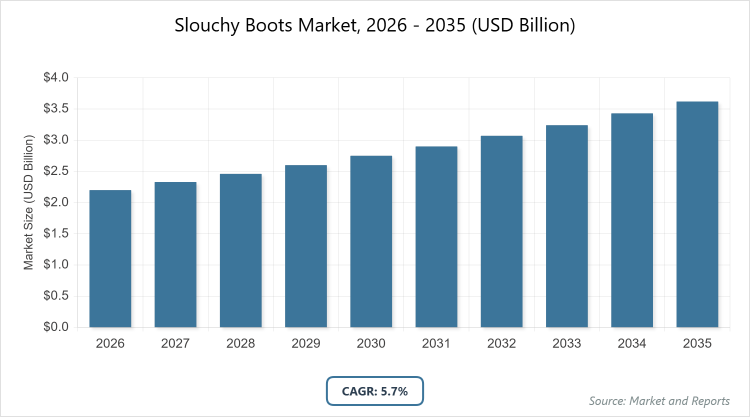
According to MarketnReports, the global Slouchy Boots market size was estimated at USD 2.2 billion in 2025 and is expected to reach USD 3.8 billion by 2035, growing at a CAGR of 5.7% from 2026 to 2035. Slouchy Boots Market is driven by the resurgence of boho-chic fashion trends and demand for comfortable, versatile footwear.
What are the Key Insights into the Slouchy Boots Market?
- The global slouchy boots market was valued at USD 2.2 billion in 2025 and is projected to reach USD 3.8 billion by 2035.
- The market is expected to grow at a CAGR of 5.7% during the forecast period from 2026 to 2035.
- The slouchy boots market is driven by the revival of 2000s boho trends and increasing preference for relaxed, comfortable styles in fashion.
- The suede segment dominates the material category with a 50% share due to its soft texture, aesthetic appeal, and alignment with bohemian vibes, enabling brands to create tactile, versatile options that resonate with trend-conscious buyers.
- The women segment dominates the end-user category with a 75% share because slouchy boots complement feminine outfits, offering effortless style and height variation, enhanced by influencer and celebrity adoption.
- North America dominates the regional market with a 35% share thanks to strong consumer interest in nostalgic fashion, robust retail presence, and cultural influences from events like music festivals.
What is the Industry Overview of Slouchy Boots Market?
Slouchy boots are characterized by their relaxed, folded-over or wrinkled shaft design, offering a casual yet stylish alternative to structured footwear, often featuring soft materials that drape naturally around the ankle or calf. This market includes boots with varying heights from ankle to over-the-knee, crafted for fashion-forward consumers who prioritize comfort and bohemian aesthetics in everyday and seasonal wear. The market definition covers slouchy boots produced from diverse materials, sold via multiple channels, and targeted at various end-users, emphasizing trends in sustainability, nostalgia-driven designs, and adaptability to urban lifestyles within the larger footwear sector.
What are the Market Dynamics in the Slouchy Boots Market?
Growth Drivers
The slouchy boots market is experiencing robust growth driven by the resurgence of boho-chic aesthetics, popularized through runway shows by designers like Chloé and Isabel Marant, which blend nostalgia with modern comfort. Consumers are drawn to the boots’ versatile styling options, from pairing with jeans to dresses, catering to urban lifestyles that demand both fashion and functionality. The rise of sustainable materials, such as eco-friendly suede alternatives, appeals to environmentally aware shoppers, while social media platforms amplify trends through influencers showcasing effortless looks. Additionally, seasonal demands in fall and winter, coupled with collaborations between high-street brands and celebrities, boost accessibility and desirability, propelling market expansion globally.
Restraints
Market growth for slouchy boots is hampered by high production costs associated with premium materials like suede and leather, which elevate retail prices and limit appeal in price-sensitive segments. Intense competition from alternative boot styles, such as structured knee-highs or minimalist ankle boots, diverts consumer attention amid shifting preferences toward timeless classics. Seasonal limitations restrict year-round demand, primarily peaking in cooler months, while global supply chain issues, including material shortages and logistics delays, impact availability. Furthermore, counterfeit products erode brand trust, particularly in emerging markets, constraining overall market penetration and profitability for authentic manufacturers.
Opportunities
Emerging opportunities in the slouchy boots market include leveraging digital customization tools, allowing consumers to personalize designs with colors, heights, and embellishments via apps, targeting tech-savvy millennials and Gen Z. Expansion into Asia-Pacific regions, with rising fashion adoption and e-commerce growth, offers untapped potential through affordable synthetic variants. Brands can innovate with vegan and recycled materials to capture the sustainability wave, while limited-edition drops tied to cultural events like festivals create hype. Partnerships with influencers for virtual try-ons and augmented reality experiences enhance online sales, fostering loyalty and driving premium segments in a competitive landscape.
Challenges
Challenges in the slouchy boots market revolve around ensuring consistent quality in draping and fit across sizes, as variations in material stretch can lead to customer dissatisfaction and high return rates. Rapid trend cycles demand frequent design updates, straining resources for smaller brands against fast-fashion giants. Environmental regulations on leather tanning and dyeing processes increase compliance costs, while counterfeit influx dilutes market integrity. Economic uncertainties affect discretionary spending on fashion items, and adapting to diverse regional climates—where slouchy designs may not suit extreme weather—poses logistical hurdles for global distribution.
Slouchy Boots Market: Report Scope
| Report Attributes | Report Details |
| Report Name | Slouchy Boots Market |
| Market Size 2025 | USD 2.2 Billion |
| Market Forecast 2035 | USD 3.8 Billion |
| Growth Rate | CAGR of 5.7% |
| Report Pages | 195 |
| Key Companies Covered |
Isabel Marant, Chloé, Louis Vuitton, Free People, Steve Madden, Schutz, Manolo Blahnik, and Others |
| Segments Covered | By Type, By Material, By Distribution Channel, By End-User, and By Region |
| Regions Covered | North America, Europe, Asia Pacific (APAC), Latin America, and The Middle East and Africa (MEA) |
| Base Year | 2025 |
| Historical Year | 2020 – 2024 |
| Forecast Year | 2026 – 2035 |
| Customization Scope | Avail customized purchase options to meet your exact research needs. |
What is the Market Segmentation of the Slouchy Boots Market?
The Slouchy Boots market is segmented by type, material, distribution channel, end-user, and region.
By Type: The knee-high slouchy segment dominates with a significant share, followed by ankle slouchy as the second most dominant. Knee-high slouchy’s prominence comes from their dramatic silhouette that enhances outfits with a boho flair, providing versatility for layering over jeans or with skirts; this drives the market by appealing to fashion enthusiasts seeking statement pieces, increasing sales through seasonal collections and social media virality.
By Material: The suede segment dominates with a substantial share, followed by leather as the second most dominant. Suede leads owing to its plush texture and ability to create natural folds, offering a luxurious yet casual look that’s ideal for autumn trends; it propels growth by attracting premium buyers, encouraging brand innovations in colors and treatments that expand accessibility across demographics.
By Distribution Channel: The offline segment dominates with a major share, followed by online as the second most dominant. Offline channels excel due to tactile shopping experiences in stores like Nordstrom, allowing fit trials essential for slouchy designs; this boosts the market by building consumer confidence, facilitating impulse purchases, and supporting pop-up events that heighten brand visibility.
By End-User: The women segment dominates with an overwhelming share, followed by unisex as the second most dominant. Women’s leadership stems from targeted marketing emphasizing bohemian style and comfort for daily wear; it fuels market momentum via celebrity endorsements, promoting inclusivity and higher-margin products that sustain long-term loyalty.
What are the Recent Developments in the Slouchy Boots Market?
- Chloé unveiled a new slouchy boot collection in its fall 2025 runway, featuring suede and shearling accents for a boho-grunge fusion, which garnered widespread attention and boosted pre-orders through influencer partnerships.
- Isabel Marant relaunched its signature slouchy ankle boots in early 2025 with updated vegan suede options, aligning with sustainability trends and seeing a 400% increase in online searches post-launch.
- Louis Vuitton introduced embellished slouchy over-the-knee boots in its spring 2026 preview, incorporating metallic details for a luxurious twist, driving buzz at Paris Fashion Week and elevating premium segment sales.
- Free People expanded its slouchy boot line in mid-2025 with colorful fabric variants, targeting younger demographics and resulting in heightened e-commerce traffic via social media campaigns.
What is the Regional Analysis of Slouchy Boots Market?
- North America is expected to dominate the global market.
North America commands the slouchy boots market with approximately 35% share, fueled by fashion-savvy consumers embracing boho revivals, high disposable incomes, and widespread adoption of nostalgic trends amplified by celebrities and social media. The United States dominates the region, leading sales through extensive retail networks like Nordstrom and Free People, bolstered by urban centers such as New York and Los Angeles where street style influences drive demand for versatile, comfortable designs; Canada adds momentum with growing e-commerce in Toronto and Vancouver, favoring sustainable options amid diverse weather, while Mexico supports as a manufacturing base with cost advantages, though economic variability poses minor hurdles. The region’s projected CAGR of 6.0% to 2035 is underpinned by innovative collaborations, like those with influencers, and a shift toward eco-materials appealing to millennials.
Europe maintains a strong foothold with about 30% share, rooted in its fashion legacy, craftsmanship emphasis, and rising hybrid styles blending tradition with contemporary urban needs. France leads as the dominant country, propelled by designers like Isabel Marant and Chloé showcasing slouchy boots in Paris Fashion Week, igniting interest in bohemian aesthetics with vegan and suede variants in cities like Paris. The United Kingdom trails closely, with London and Manchester fueling growth via high-street brands and ASOS e-commerce, targeting premium consumers via celebrity-driven seasonal trends. Germany and Italy contribute through durable manufacturing—Germany for tech-infused comfort, Italy for luxury leather—while Eastern Europe emerges with income rises. Europe’s CAGR of 5.2% through 2035 benefits from eco-regulations, Instagram marketing, and economic challenges offset by customization opportunities.
Asia-Pacific displays explosive growth with around 25% current share, poised to lead in expansion with a CAGR of 6.8% from 2026 to 2035, driven by urbanization, middle-class expansion, and Western fashion influx amid higher incomes. China dominates as the key nation, flooding markets with affordable synthetic slouchy boots via Alibaba and Tmall, backed by Guangdong factories enabling rapid production and trend adaptations, appealing to youth via social media and K-fashion in Shanghai and Beijing. India follows with potential in Mumbai and Delhi, where Flipkart boosts access despite price sensitivity. Japan and South Korea add via innovative designs—Japan’s minimalist Tokyo styles, South Korea’s idol-influenced Seoul trends. The region’s growth leverages manufacturing edges, collaborations, and bio-material shifts, countering counterfeits with IP measures.
Latin America exhibits budding growth with a roughly 5% share, marked by fashion evolution, athleisure integration, and global brand introductions to lively street scenes. Brazil dominates, spearheading through São Paulo and Rio’s vibrant culture, where Mercado Libre and local stores propel colorful, climate-suited designs, aided by celebrities and post-pandemic recovery. Mexico bridges North American influences with local production in Mexico City, fueled by imports and middle-class growth, while Argentina and Colombia promise via online youth trends. The region’s CAGR of 5.5% to 2035 gains from modernization, digital efforts, and recycled materials, navigating economic instability and low-cost rivals with niche customizations.
The Middle East and Africa (MEA) offer emerging prospects with about 5% share, growing from luxury aspirations, tourism retail, and diversification into modern trends. The United Arab Emirates leads, with Dubai and Abu Dhabi’s malls like The Dubai Mall drawing premium slouchy boots from Steve Madden, supported by expats, oil-derived incomes, and social campaigns for urban comfort. Saudi Arabia accelerates under Vision 2030, expanding retail in Riyadh and Jeddah amid women’s workforce rise. South Africa pioneers in Africa via Johannesburg’s hubs, with Takealot e-commerce adopting global athleisure. MEA’s CAGR of 5.3% through 2035 thrives on infrastructure, digital uptake, and eco-shifts, despite instability and manufacturing limits, via halal materials and tourism.
Who are the Key Market Players in the Slouchy Boots Market?
- Isabel Marant revives boho classics with slouchy designs, focusing on sustainable suede and runway collaborations to secure premium market appeal among fashion influencers.
- Chloé incorporates grunge-boho elements in slouchy boots, using tactile materials like shearling for luxury differentiation, driving sales through global fashion weeks and e-commerce.
- Louis Vuitton innovates with embellished slouchy styles, leveraging metallic accents and high-end craftsmanship to expand its share via exclusive drops and celebrity endorsements.
- Free People offers affordable, colorful slouchy variants, emphasizing online accessibility and youth-targeted campaigns to capture mass-market growth in emerging regions.
- Steve Madden delivers trend-forward slouchy boots at accessible prices, utilizing retail expansions and social media to attract urban consumers seeking versatile options.
- Schutz specializes in sleek slouchy ankle boots, prioritizing pointed toes and quality leathers for premium positioning through influencer partnerships.
- Manolo Blahnik crafts sophisticated slouchy silhouettes, focusing on artisanal details and limited editions to maintain elite status in luxury segments.
What are the Market Trends in the Slouchy Boots Market?
- Resurgence of boho-chic with slouchy suede designs blending nostalgia and modern comfort for versatile styling.
- Emphasis on sustainable materials like vegan suede and recycled fabrics to attract eco-aware consumers.
- Rise in chocolate brown and tan colorways for earthy, luxurious appeal in fall/winter collections.
- Integration of subtle Western influences, such as buckles and shearling linings for added texture.
- Growth in customizable options via digital tools for personalized shaft heights and fits.
- Adoption of low-heel slouchy variants for everyday wearability in urban settings.
- Focus on hybrid glove-slouch styles for a sleek yet relaxed silhouette.
What Market Segments and Subsegments are Covered in the Slouchy Boots Report?
By Type
- Ankle Slouchy
- Mid-Calf Slouchy
- Knee-High Slouchy
- Over-the-Knee Slouchy
- Others
By Material
- Suede
- Leather
- Synthetic
- Fabric
- Others
By Distribution Channel
- Online
- Offline
- Others
By End-User
- Women
- Men
- Unisex
- Others
By Region
-
- North America
- U.S.
- Canada
- Europe
- UK
- Germany
- France
- Rest of Europe
- Asia Pacific
- China
- India
- Japan
- Rest of Asia Pacific
- Latin America
- Brazil
- Mexico
- Rest of Latin America
- Middle East & Africa
- UAE
- South Africa
- Rest of Middle East & Africa
- North America
Chapter 1. Preface
Chapter 2. Executive Summary
Chapter 3. Global Slouchy Boots Market - Industry Analysis
Chapter 4. Global Slouchy Boots Market- Competitive Landscape
Chapter 5. Global Slouchy Boots Market - Type Analysis
Chapter 6. Global Slouchy Boots Market - Material Analysis
Chapter 7. Global Slouchy Boots Market - Distribution Channel Analysis
Chapter 8. Global Slouchy Boots Market - End-User Analysis
Chapter 9. Slouchy Boots Market - Regional Analysis
Chapter 10. Company Profiles
Frequently Asked Questions
Slouchy boots feature a relaxed, wrinkled shaft that drapes casually, combining comfort with bohemian style for casual and transitional wear.
Key factors encompass boho trend revivals, sustainable material demands, e-commerce expansion, and celebrity-driven fashion influences.
The market is projected to grow from USD 2.2 billion in 2025 to USD 3.8 billion by 2035.
The CAGR is expected to be 5.7% from 2026 to 2035.
North America will contribute notably, with around 35% share due to fashion trends and high spending.
Major players include Isabel Marant, Chloé, Louis Vuitton, Free People, Steve Madden, Schutz, and Manolo Blahnik.
The report offers in-depth analysis covering size, trends, segments, regions, players, and forecasts from 2026 to 2035.
Stages involve material sourcing, design/manufacturing, channel distribution, marketing, and consumer use with support services.
Trends shift to boho sustainability and customization, with preferences for comfortable, versatile designs via social and celebrity impacts.
Sustainability regulations promote eco-materials, while environmental awareness boosts low-impact production, positively driving innovation and growth.