
Sleeping Aids Market Size, Share and Trends 2026 to 2035
According to MarketnReports, the global Sleeping Aids market size was estimated at USD 92.39 billion in 2025 and is expected to reach USD 173.42 billion by 2035, growing at a CAGR of 6.5% from 2026 to 2035. Sleeping Aids Market is driven by the increasing prevalence of sleep disorders worldwide.
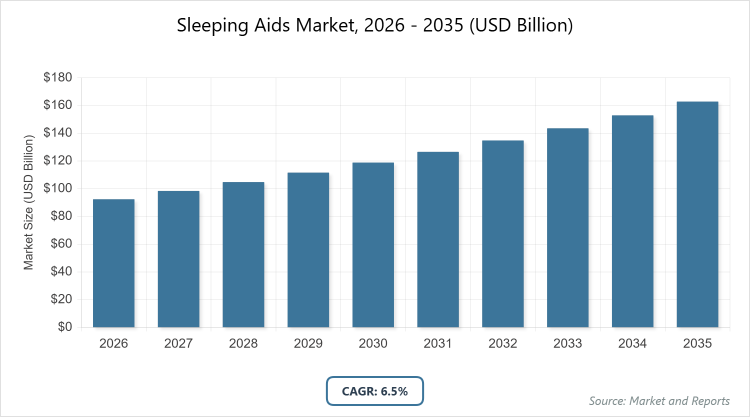
What are the key insights from the Sleeping Aids market report?
- Market valued at USD 92.39 billion in 2025 and projected to reach USD 173.42 billion by 2035.
- Anticipated to grow at a CAGR of 6.5% during the forecast period.
- Market is driven by increasing prevalence of sleep disorders, rising stress and anxiety levels, and growing awareness of sleep health.
- The OTC drugs subsegment dominates the product segment with approximately 35% share.
- This dominance is due to widespread accessibility, consumer preference for self-medication, and the availability of natural and herbal variants perceived as safer alternatives.
- The insomnia subsegment dominates the sleep disorder segment with approximately 40% share.
- It is dominated because of its high prevalence affecting a significant portion of the global population, combined with growing awareness and common use of medications like benzodiazepines.
- North America dominates with approximately 42% share.
- Due to high prevalence of sleep disorders, advanced healthcare infrastructure, strong public awareness, and widespread adoption of devices like CPAP machines.
What is the industry overview of the Sleeping Aids market?
The sleeping aids market encompasses the production and distribution of products aimed at enhancing sleep quality and addressing sleep-related disorders. This includes prescription and over-the-counter medications, herbal supplements, mattresses and pillows, sleep apnea devices, and sleep laboratories. The market definition refers to any aids that assist in managing conditions such as insomnia, sleep apnea, and other sleep disturbances, driven by the need to improve overall health and well-being through better sleep. As lifestyles become more hectic and stress levels rise, the demand for these aids continues to grow, incorporating both pharmaceutical and non-pharmaceutical solutions to cater to diverse consumer preferences.
What are the market dynamics in the Sleeping Aids market?
Growth Drivers
The primary growth drivers in the sleeping aids market include the rising prevalence of sleep disorders globally, such as insomnia and sleep apnea, which affect millions and are linked to modern lifestyles, stress, and aging populations. Increased awareness about the health impacts of poor sleep, including weakened immunity and chronic diseases, as highlighted by organizations like the World Health Organization, is pushing consumers towards effective solutions. Additionally, advancements in technology, such as wearable sleep trackers and AI-integrated devices, are enhancing product efficacy and accessibility, further fueling market expansion.
Restraints
Key restraints include a lack of awareness about sleep disorders and available treatments in certain regions, particularly in developing countries, which limits market penetration. Regulatory challenges and concerns over the side effects of pharmaceutical aids, such as dependency and drowsiness, deter some consumers from using them. Moreover, the high cost of advanced devices like CPAP machines and limited insurance coverage in some areas pose barriers to adoption.
Opportunities
Opportunities abound in the adoption of natural and herbal remedies, as consumers increasingly prefer non-habit-forming alternatives like melatonin and CBD-infused products. Expansion into emerging markets in Asia Pacific, driven by urbanization and rising middle-class populations, presents significant growth potential. Innovation in personalized sleep solutions, including smart technology and AI-powered devices, offers avenues for differentiation and market capture.
Challenges
Challenges in the market involve moderate bargaining power among suppliers and buyers, coupled with high rivalry from existing firms, as analyzed through Porter’s Five Forces. Low diagnosis rates for disorders like sleep apnea, where only a fraction of cases are identified, hinder demand. Additionally, regulatory hurdles from bodies like the European Medicines Agency and the need for greater public education in underdeveloped regions complicate market growth.
Sleeping Aids Market: Report Scope
| Report Attributes | Report Details |
| Report Name | Sleeping Aids Market |
| Market Size 2025 | USD 92.39 Billion |
| Market Forecast 2035 | USD 173.42 Billion |
| Growth Rate | CAGR of 6.5% |
| Report Pages | 220 |
| Key Companies Covered | Pfizer Inc., GlaxoSmithKline (GSK), Johnson & Johnson, Sanofi S.A., Merck & Co., Inc., Mylan N.V., Teva Pharmaceutical Industries Ltd., Bayer AG, ResMed Inc., Philips Healthcare, and Others |
| Segments Covered | By Product, By Sleep Disorder, and By Region |
| Regions Covered | North America, Europe, Asia Pacific (APAC), Latin America, and The Middle East and Africa (MEA) |
| Base Year | 2025 |
| Historical Year | 2020 – 2024 |
| Forecast Year | 2026 – 2035 |
| Customization Scope | Avail customized purchase options to meet your exact research needs. |
What is the market segmentation in the Sleeping Aids market?
The Sleeping Aids market is segmented by product, sleep disorder, and region.
Based on Product Segment, the OTC drugs segment is the most dominant, holding approximately 35% of the market share, primarily due to its easy availability without prescriptions, affordability, and consumer shift towards self-care solutions; the second most dominant is mattresses and pillows, with around 30% share, as they provide non-invasive comfort enhancements that appeal to a broad audience seeking long-term sleep improvements, both driving the market by addressing immediate and preventive needs for better sleep quality.
Based on Sleep Disorder Segment, the insomnia segment is the most dominant, accounting for approximately 40% of the market, owing to its widespread occurrence influenced by stress and lifestyle factors, making it a key target for medications and supplements that directly aid in sleep initiation; the second most dominant is sleep apnea, with about 30% share, propelled by increasing diagnoses and technological advancements in devices like CPAP machines, which not only treat the condition but also contribute to overall market growth through innovation and health awareness.
What are the recent developments in the Sleeping Aids market?
- In May 2025, BON Natural Life Limited introduced a new sleep health product series utilizing a proprietary “Glucoraphanin-Myrosinase” delivery system to enhance bioavailability and effectiveness.
- In January 2025, VIV Health launched the VIV RING smart ring at CES 2025, featuring generative sleep aid sounds for improved user experience.
- In December 2024, Pfizer announced the expansion of its portfolio with non-habit-forming treatments for sleep disorders.
- In October 2024, ResMed introduced a new AI-incorporated CPAP machine model designed for personalized therapy.
What is the regional analysis of the Sleeping Aids market?
- North America to dominate the global market.
North America leads the sleeping aids market with the highest share, driven by a high incidence of sleep disorders, robust healthcare systems, and extensive use of advanced technologies; the United States is the dominating country, benefiting from strong consumer awareness, widespread availability of OTC products, and significant investments in sleep research.
Europe exhibits steady growth, supported by developed healthcare infrastructure and increasing demand for natural remedies; Germany and the United Kingdom are key contributors, with the UK dominating due to high stress levels among the population and government initiatives promoting mental health and sleep hygiene.
Asia Pacific is experiencing rapid expansion due to urbanization, rising stress from modern lifestyles, and a growing middle class; China dominates the region, fueled by increasing awareness, expanding e-commerce for sleep products, and government efforts to improve public health infrastructure.
Latin America shows moderate growth, influenced by improving access to healthcare and rising awareness of sleep health; Brazil is the dominating country, driven by a large population base, increasing prevalence of sleep issues linked to economic stress, and growing adoption of affordable OTC aids.
Middle East and Africa is in the early stages of market development, with growth hampered by limited awareness but boosted by urbanization; Saudi Arabia dominates, supported by investments in healthcare and rising demand for sleep apnea devices amid increasing obesity rates.
What are the key market players and their strategies in the Sleeping Aids market?
- Pfizer Inc. focuses on research-driven development of prescription and OTC sleep medications like Zolpidem, emphasizing innovation in non-habit-forming formulations and expanding its portfolio through acquisitions and partnerships to address diverse sleep disorders.
- GlaxoSmithKline (GSK) prioritizes OTC alternatives such as Nytol, investing in consumer education campaigns and natural ingredient-based products to capture the growing demand for safer, self-medication options.
- Johnson & Johnson (McNeil Consumer Healthcare) offers products like Unisom, employing strategies centered on marketing through e-commerce and retail channels, while integrating consumer feedback to develop user-friendly OTC solutions.
- Sanofi S.A. specializes in insomnia treatments like Ambien, with strategies involving global expansion, clinical trials for new formulations, and collaborations with tech firms for integrated sleep management apps.
- Merck & Co., Inc. concentrates on prescription drugs, utilizing R&D investments to create advanced therapies and generics, aiming to reduce costs and increase accessibility in emerging markets.
- Mylan N.V. and Teva Pharmaceutical Industries Ltd. focus on generic medications, employing cost-effective production and distribution strategies to dominate the affordable segment, partnering with retailers for wider reach.
- Bayer AG emphasizes herbal products like those with Valerian, adopting sustainability-focused strategies and marketing natural remedies to appeal to health-conscious consumers.
- ResMed Inc. leads in CPAP machines, integrating AI and remote monitoring technologies, with strategies including product innovation and collaborations with healthcare providers for better patient outcomes.
- Philips Healthcare develops advanced sleep apnea solutions, focusing on user-centric design and digital health integrations to enhance therapy adherence and market penetration.
- Abbott Laboratories and Eli Lilly and Co. offer sleep medications, with strategies revolving around clinical research and expanding into combination therapies that address co-occurring conditions like anxiety.
- Nature’s Bounty specializes in melatonin supplements, using direct-to-consumer models and emphasizing organic sourcing to build trust and loyalty among natural product seekers.
- Sleep Innovations and Tempur-Sealy International focus on specialty mattresses, employing innovation in materials and customization, with marketing strategies targeting online sales and partnerships with sleep clinics.
What are the market trends in the Sleeping Aids market?
- Rising adoption of natural and herbal products like melatonin, valerian root, and CBD due to concerns over pharmaceutical side effects.
- Technological integration with connected devices, mobile apps, and AI for personalized sleep management and monitoring.
- Focus on non-habit-forming alternatives to minimize dependency and long-term health risks.
- Customization of sleep aids based on individual data from wearables and apps.
- Combination of sleep aids with stress relief products, such as aromatherapy and relaxation tools.
What market segments and their subsegments are covered in the Sleeping Aids market report?
By Product
- Mattresses & Pillows
- Sleep Laboratories
- Medications
- Prescription-Based Drugs
- OTC Drugs
- Herbal Drugs
- Sleep Apnea Devices
By Sleep Disorder
- Insomnia
- Sleep Apnea
- Restless Legs Syndrome
- Narcolepsy
- Sleep Walking
- Others
By Region
- North America
- U.S.
- Canada
- Europe
- UK
- Germany
- France
- Rest of Europe
- Asia Pacific
- China
- India
- Japan
- Rest of Asia Pacific
- Latin America
- Brazil
- Mexico
- Rest of Latin America
- Middle East & Africa
- UAE
- South Africa
- Rest of Middle East & Africa
Chapter 1. Preface
1.1 Report Description and Scope1.2 Research Scope1.3 Research Methodology1.3.1 Market Research Type1.3.2 Market Research MethodologyChapter 2. Executive Summary
2.1 Global Sleeping Aids Market, (2026 - 2035) (USD Billion)2.2 Global Sleeping Aids Market: SnapshotChapter 3. Global Sleeping Aids Market - Industry Analysis
3.1 Sleeping Aids Market: Market Dynamics3.2 Market Drivers3.2.1 The sleeping aids market is driven by the rising prevalence of sleep disorders, growing awareness of sleep-related health risks, aging populations, lifestyle stress, and advancements in wearable and AI-powered sleep technologies.3.3 Market Restraints3.3.1 The sleeping aids market is restrained by low awareness in developing regions, regulatory and safety concerns over pharmaceuticals, high costs of advanced devices like CPAP, and limited insurance coverage.3.4 Market Opportunities3.4.1 The sleeping aids market offers strong opportunities through rising demand for natural and herbal remedies, expansion in emerging Asia-Pacific markets, and innovation in personalized, AI-powered sleep solutions.3.5 Market Challenges3.5.1 The sleeping aids market faces challenges from intense competition, moderate buyer and supplier power, low diagnosis rates of sleep disorders, regulatory hurdles, and limited public awareness in underdeveloped regions.3.6 Porter’s Five Forces Analysis3.7 Market Attractiveness Analysis3.7.1 Market Attractiveness Analysis By Product3.7.2 Market Attractiveness Analysis By Sleep DisorderChapter 4. Global Sleeping Aids Market- Competitive Landscape
4.1 Company Market Share Analysis4.1.1 Global Sleeping Aids Market: Company Market Share, 20254.2 Strategic Development4.2.1 Acquisitions & mergers4.2.2 New Product launches4.2.3 Agreements, partnerships, collaborations, and joint ventures4.2.4 Research and development and regional expansion4.3 Price Trend AnalysisChapter 5. Global Sleeping Aids Market - Product Analysis
5.1 Global Sleeping Aids Market Overview: Product5.1.1 Global Sleeping Aids Market share, By Product, 2025 and 20355.2 (Mattresses & Pillows5.2.1 Global Sleeping Aids Market by (Mattresses & Pillows, 2026 - 2035 (USD Billion)5.3 Sleep Laboratories5.3.1 Global Sleeping Aids Market by Sleep Laboratories, 2026 - 2035 (USD Billion)5.4 Medications5.4.1 Global Sleeping Aids Market by Medications, 2026 - 2035 (USD Billion)5.5 Prescription-Based Drugs5.5.1 Global Sleeping Aids Market by Prescription-Based Drugs, 2026 - 2035 (USD Billion)5.6 OTC Drugs5.6.1 Global Sleeping Aids Market by OTC Drugs, 2026 - 2035 (USD Billion)5.7 Herbal Drugs5.7.1 Global Sleeping Aids Market by Herbal Drugs, 2026 - 2035 (USD Billion)5.8 Sleep Apnea Devices5.8.1 Global Sleeping Aids Market by Sleep Apnea Devices, 2026 - 2035 (USD Billion)5.9 Others5.9.1 Global Sleeping Aids Market by Others, 2026 - 2035 (USD Billion)Chapter 6. Global Sleeping Aids Market - Sleep Disorder Analysis
6.1 Global Sleeping Aids Market Overview: Sleep Disorder6.1.1 Global Sleeping Aids Market Share, By Sleep Disorder, 2025 and 20356.2 Insomnia6.2.1 Global Sleeping Aids Market by Insomnia, 2026 - 2035 (USD Billion)6.3 Sleep Apnea6.3.1 Global Sleeping Aids Market by Sleep Apnea, 2026 - 2035 (USD Billion)6.4 Restless Legs Syndrome6.4.1 Global Sleeping Aids Market by Restless Legs Syndrome, 2026 - 2035 (USD Billion)6.5 Narcolepsy6.5.1 Global Sleeping Aids Market by Narcolepsy, 2026 - 2035 (USD Billion)6.6 Sleep Walking6.6.1 Global Sleeping Aids Market by Sleep Walking, 2026 - 2035 (USD Billion)6.7 Others6.7.1 Global Sleeping Aids Market by Others, 2026 - 2035 (USD Billion)Chapter 7. Sleeping Aids Market - Regional Analysis
7.1 Global Sleeping Aids Market Regional Overview7.2 Global Sleeping Aids Market Share, by Region, 2025 & 2035 (USD Billion)7.3 North America7.3.1 North America Sleeping Aids Market, 2026 - 2035 (USD Billion)7.3.1.1 North America Sleeping Aids Market, by Country, 2026 - 2035 (USD Billion)7.3.2 North America Sleeping Aids Market, by Product, 2026 - 20357.3.2.1 North America Sleeping Aids Market, by Product, 2026 - 2035 (USD Billion)7.3.3 North America Sleeping Aids Market, by Sleep Disorder, 2026 - 20357.3.3.1 North America Sleeping Aids Market, by Sleep Disorder, 2026 - 2035 (USD Billion)7.4 Europe7.4.1 Europe Sleeping Aids Market, 2026 - 2035 (USD Billion)7.4.1.1 Europe Sleeping Aids Market, by Country, 2026 - 2035 (USD Billion)7.4.2 Europe Sleeping Aids Market, by Product, 2026 - 20357.4.2.1 Europe Sleeping Aids Market, by Product, 2026 - 2035 (USD Billion)7.4.3 Europe Sleeping Aids Market, by Sleep Disorder, 2026 - 20357.4.3.1 Europe Sleeping Aids Market, by Sleep Disorder, 2026 - 2035 (USD Billion)7.5 Asia Pacific7.5.1 Asia Pacific Sleeping Aids Market, 2026 - 2035 (USD Billion)7.5.1.1 Asia Pacific Sleeping Aids Market, by Country, 2026 - 2035 (USD Billion)7.5.2 Asia Pacific Sleeping Aids Market, by Product, 2026 - 20357.5.2.1 Asia Pacific Sleeping Aids Market, by Product, 2026 - 2035 (USD Billion)7.5.3 Asia Pacific Sleeping Aids Market, by Sleep Disorder, 2026 - 20357.5.3.1 Asia Pacific Sleeping Aids Market, by Sleep Disorder, 2026 - 2035 (USD Billion)7.6 Latin America7.6.1 Latin America Sleeping Aids Market, 2026 - 2035 (USD Billion)7.6.1.1 Latin America Sleeping Aids Market, by Country, 2026 - 2035 (USD Billion)7.6.2 Latin America Sleeping Aids Market, by Product, 2026 - 20357.6.2.1 Latin America Sleeping Aids Market, by Product, 2026 - 2035 (USD Billion)7.6.3 Latin America Sleeping Aids Market, by Sleep Disorder, 2026 - 20357.6.3.1 Latin America Sleeping Aids Market, by Sleep Disorder, 2026 - 2035 (USD Billion)7.7 The Middle-East and Africa7.7.1 The Middle-East and Africa Sleeping Aids Market, 2026 - 2035 (USD Billion)7.7.1.1 The Middle-East and Africa Sleeping Aids Market, by Country, 2026 - 2035 (USD Billion)7.7.2 The Middle-East and Africa Sleeping Aids Market, by Product, 2026 - 20357.7.2.1 The Middle-East and Africa Sleeping Aids Market, by Product, 2026 - 2035 (USD Billion)7.7.3 The Middle-East and Africa Sleeping Aids Market, by Sleep Disorder, 2026 - 20357.7.3.1 The Middle-East and Africa Sleeping Aids Market, by Sleep Disorder, 2026 - 2035 (USD Billion)Chapter 8. Company Profiles
8.1 Pfizer Inc.8.1.1 Overview8.1.2 Financials8.1.3 Product Portfolio8.1.4 Business Strategy8.1.5 Recent Developments8.2 GlaxoSmithKline (GSK)8.2.1 Overview8.2.2 Financials8.2.3 Product Portfolio8.2.4 Business Strategy8.2.5 Recent Developments8.3 Johnson & Johnson8.3.1 Overview8.3.2 Financials8.3.3 Product Portfolio8.3.4 Business Strategy8.3.5 Recent Developments8.4 Sanofi S.A.8.4.1 Overview8.4.2 Financials8.4.3 Product Portfolio8.4.4 Business Strategy8.4.5 Recent Developments8.5 Merck & Co. Inc.8.5.1 Overview8.5.2 Financials8.5.3 Product Portfolio8.5.4 Business Strategy8.5.5 Recent Developments8.6 Mylan N.V.8.6.1 Overview8.6.2 Financials8.6.3 Product Portfolio8.6.4 Business Strategy8.6.5 Recent Developments8.7 Teva Pharmaceutical Industries Ltd.8.7.1 Overview8.7.2 Financials8.7.3 Product Portfolio8.7.4 Business Strategy8.7.5 Recent Developments8.8 Bayer AG8.8.1 Overview8.8.2 Financials8.8.3 Product Portfolio8.8.4 Business Strategy8.8.5 Recent Developments8.9 ResMed Inc.8.9.1 Overview8.9.2 Financials8.9.3 Product Portfolio8.9.4 Business Strategy8.9.5 Recent Developments8.10 Philips Healthcare8.10.1 Overview8.10.2 Financials8.10.3 Product Portfolio8.10.4 Business Strategy8.10.5 Recent Developments
Frequently Asked Questions
Sleeping aids are products designed to improve sleep quality and manage sleep disorders, including medications, supplements, devices like CPAP machines, and accessories such as mattresses and pillows for conditions like insomnia and sleep apnea.
Key factors include increasing prevalence of sleep disorders, rising stress levels, technological advancements in sleep devices, growing awareness of sleep health, and expansion in emerging markets.
The market is projected to grow from approximately USD 92.39 billion in 2025 to USD 173.42 billion by 2035.
The CAGR is expected to be 6.5%.
North America will contribute notably, holding the largest share due to advanced healthcare and high disorder prevalence.
Major players include Pfizer Inc., GlaxoSmithKline (GSK), Johnson & Johnson, Sanofi S.A., Merck & Co., Inc., ResMed Inc., and Philips Healthcare.
The report provides comprehensive analysis, including market size, trends, segmentation, regional insights, key players, drivers, restraints, opportunities, and forecasts.
The value chain includes raw material sourcing, manufacturing, distribution through retail and online channels, marketing, and end-user consumption with after-sales support.
Trends are shifting towards natural, non-habit-forming products and tech-integrated solutions; consumers prefer personalized, sustainable options with minimal side effects.
Regulatory approvals for new drugs and devices, environmental concerns over sustainable sourcing for herbal products, and policies promoting mental health awareness are key influencers.