
Skin Antiseptic Products Market Size, Share and Trends 2026 to 2035
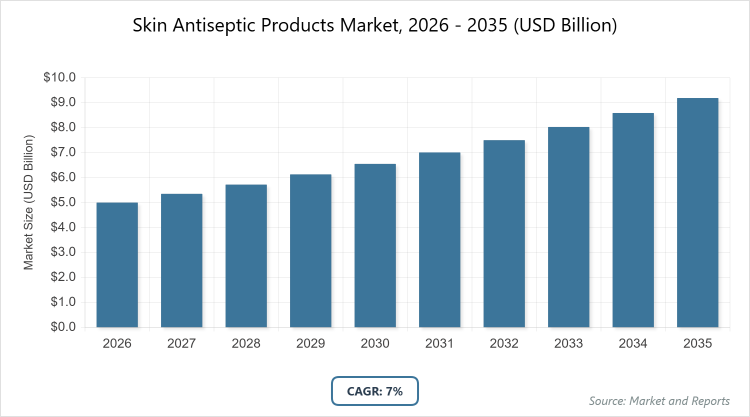
According to MarketnReports, the global Skin Antiseptic Products market size was estimated at USD 5 billion in 2025 and is expected to reach USD 10 billion by 2035, growing at a CAGR of 7% from 2026 to 2035. Rising prevalence of hospital-acquired infections and increasing number of surgical and minimally invasive procedures.
What are the Key Insights in the Skin Antiseptic Products Market?
- The global Skin Antiseptic Products market was valued at USD 5 billion in 2025 and is projected to reach USD 10 billion by 2035.
- The market is expected to grow at a CAGR of 7% during the forecast period 2026-2035.
- The market is driven by increasing hospital-acquired infections, expanding surgical volumes, and heightened focus on infection prevention protocols.
- Alcohol-based holds the dominant share among types (approximately 45%) due to its rapid action, broad-spectrum efficacy, and cost-effectiveness.
- Surgeries dominates applications (around 58%) because of mandatory pre-operative skin preparation requirements in high-volume procedural settings.
- Hospitals lead end-user segments (over 48%) owing to large-scale usage in operating rooms and procedural areas for strict compliance with infection control standards.
- North America dominates regionally (approximately 38%) due to advanced healthcare infrastructure, stringent regulatory standards, and high surgical procedure rates.
What defines the Skin Antiseptic Products Market?
Industry Overview
The Skin Antiseptic Products Market involves topical antimicrobial solutions designed to reduce or eliminate pathogenic microorganisms on the skin, preventing infections during medical procedures, wound management, or daily hygiene. These products include formulations such as alcohol-based solutions, chlorhexidine gluconate, iodine compounds, and others, available in forms like solutions, wipes, sprays, and foams. The market addresses critical needs in healthcare settings for pre-operative skin preparation, injection site disinfection, catheter insertion, and wound cleansing, as well as non-clinical uses for personal hygiene. It plays a vital role in infection control protocols, supporting patient safety amid growing concerns over antimicrobial resistance and healthcare-associated infections.
What are the Market Dynamics in the Skin Antiseptic Products Market?
Growth Drivers
Growth is primarily propelled by the escalating incidence of hospital-acquired infections, which affect millions globally and drive demand for effective skin antiseptics in clinical settings. The surge in surgical procedures, including minimally invasive and outpatient surgeries, necessitates reliable pre-operative skin disinfection to minimize postoperative complications. Increased awareness of infection control post-COVID-19, regulatory mandates for hygiene in healthcare facilities, and expansion of ambulatory care centers further boost adoption. Advancements in ready-to-use formats like single-dose applicators and wipes enhance convenience and compliance, supporting sustained market expansion.
Restraints
Key restraints include potential skin irritation, allergic reactions, and toxicity concerns associated with certain active ingredients like chlorhexidine or iodine, limiting use in sensitive patients. Stricter regulations on volatile organic compounds and biocides restrict alcohol content in formulations, while emerging antiseptic-resistant microbial strains pose efficacy challenges. High costs of advanced formulations and supply chain vulnerabilities for key raw materials like high-purity chlorhexidine also hinder accessibility, particularly in price-sensitive markets.
Opportunities
Significant opportunities lie in emerging markets of the Asia Pacific and Latin America, where rising healthcare investments, growing surgical volumes, and increasing hygiene awareness create demand for affordable antiseptics. Innovations in alcohol-free, long-acting alternatives, such as antimicrobial peptides or nanoparticle-based products, address resistance and irritation issues. Expansion into home care and telehealth segments, along with the development of eco-friendly and single-use formats, offers growth potential amid shifting preferences toward outpatient and self-administered care.
Challenges
Challenges encompass the rise of microbial resistance to common antiseptics, necessitating continuous R&D for new formulations. Competition from alternative infection prevention methods, such as antimicrobial coatings or systemic prophylactics, adds pressure. Ensuring consistent quality across global supply chains, complying with varying international regulations, and educating end-users on proper application to avoid misuse remain ongoing hurdles.
Skin Antiseptic Products Market: Report Scope
| Report Attributes | Report Details |
| Report Name | Skin Antiseptic Products Market |
| Market Size 2025 | USD 5 Billion |
| Market Forecast 2035 | USD 10 Billion |
| Growth Rate | CAGR of 7% |
| Report Pages | 220 |
| Key Companies Covered |
Becton, Dickinson and Company (BD), Ecolab Inc., Johnson & Johnson (Ethicon), Solventum, B. Braun SE, Cardinal Health, and Others |
| Segments Covered | By Type, By Application, By End-User, and By Region |
| Regions Covered | North America, Europe, Asia Pacific (APAC), Latin America, and The Middle East and Africa (MEA) |
| Base Year | 2025 |
| Historical Year | 2020 – 2024 |
| Forecast Year | 2026 – 2035 |
| Customization Scope | Avail customized purchase options to meet your exact research needs. |
How is the Skin Antiseptic Products Market Segmented?
The Skin Antiseptic Products market is segmented by type, application, end-user, and region.
Based on Type Segment, Alcohol-based is the most dominant segment due to its rapid microbial kill rate, broad-spectrum activity against bacteria, viruses, and fungi, and widespread use in pre-injection and pre-operative settings, driving market growth through high adoption in hospitals and cost-effective performance. The second most dominant is Chlorhexidine Gluconate, valued for its persistent antimicrobial effect lasting hours after application, making it preferred for surgical scrubs and catheter site care, contributing to growth by enhancing long-term infection prevention in procedural environments.
Based on Application Segment, Surgeries is the most dominant segment as skin antiseptics are essential for pre-operative preparation to reduce surgical site infections, supporting market expansion through mandatory protocols in high-volume operating rooms and increasing elective procedures. The second most dominant is Injection and Catheter Site Preparation, where quick-drying and effective disinfection minimize bloodstream infection risks, driving demand via rising use of intravenous therapies and chronic disease management.
Based on End-User Segment, Hospitals are the most dominant segment due to extensive procedural volumes, strict infection control standards, and bulk procurement needs, propelling market growth through consistent high-volume usage in surgical and intensive care units. The second most dominant is Clinics and Ambulatory Centers, benefiting from growing outpatient surgeries and minimally invasive treatments, contributing to growth by expanding access to antiseptics in cost-effective care settings.
What Recent Developments have occurred in the Skin Antiseptic Products Market?
- Ecolab expanded production capacity for alcohol-based antiseptics with new lines in Singapore in March 2025 to meet rising global demand and supply chain resilience.
- B. Braun received FDA clearance for a novel film-forming povidone-iodine antiseptic in February 2025, targeting improved adhesion and efficacy in regional anesthesia applications.
- Johnson & Johnson (Ethicon) completed a USD 120 million acquisition of an antiseptic-technology firm in January 2025 to bolster its portfolio in advanced infection prevention solutions.
- BD launched an updated chlorhexidine-impregnated dressing in December 2024 aimed at reducing central-line-associated bloodstream infections in hospital settings.
- Solventum (spun off from 3M) focused on enhancing infection-prevention product lines in January 2025, including improved chlorhexidine-alcohol blends for pre-operative use.
Which Region Dominates the Skin Antiseptic Products Market?
- North America is expected to dominate the global market.
North America dominates the Skin Antiseptic Products market primarily due to advanced healthcare infrastructure, high surgical procedure volumes, stringent FDA regulations on infection control, and strong reimbursement policies supporting antiseptic usage; the United States leads within the region with extensive hospital networks and high awareness of HAIs.
Europe holds a significant share supported by robust EU directives on patient safety, widespread adoption of evidence-based protocols, and aging populations driving procedural demand across Germany, France, and the UK.
Asia Pacific is the fastest-growing region, driven by rapid healthcare infrastructure development, increasing surgical rates, government initiatives against infections, and rising disposable incomes in countries like China, India, and Japan.
Latin America and the Middle East & Africa exhibit emerging growth from improving access to healthcare, urbanization, and infection control awareness, though constrained by economic and infrastructural challenges.
Who are the Key Market Players in the Skin Antiseptic Products Market?
- Becton, Dickinson and Company (BD) focuses on innovative chlorhexidine-based products like ChloraPrep applicators, with strategies emphasizing FDA clearances, acquisitions, and expansion in catheter-related infection prevention.
- Ecolab Inc. prioritizes large-scale production and distribution of alcohol-based solutions, leveraging global manufacturing expansions and sustainability initiatives to serve hospitals and ambulatory centers.
- Johnson & Johnson (Ethicon) invests in acquisitions and portfolio diversification, including Betadine iodine products, targeting surgical applications through R&D in reduced-irritation formulations.
- Solventum (formerly 3M Health Care) emphasizes advanced chlorhexidine-alcohol blends and sterile applicators, driving growth via a spin-off focus on infection prevention innovation.
- B. Braun SE develops film-forming and octenidine-based antiseptics, with strategies centered on regulatory approvals and partnerships in outpatient and home care segments.
- Cardinal Health focuses on distribution networks and ready-to-use wipes, employing supply chain optimization and private-label expansions to capture hospital and clinic demand.
What are the Market Trends in the Skin Antiseptic Products Market?
- Shift toward alcohol-free and long-acting formulations to address irritation and resistance concerns.
- Rising demand for single-use, ready-to-use applicators and wipes for convenience and infection control.
- Growing adoption in home care and telehealth settings amid outpatient care expansion.
- Innovation in nanoparticle and antimicrobial peptide-based antiseptics for enhanced efficacy.
- Increased focus on eco-friendly and low-VOC products in response to regulatory pressures.
- Expansion of e-commerce and retail channels for consumer-grade antiseptics.
What Market Segments and Subsegments are Covered in the Report?
By Type
- Alcohol-based
- Chlorhexidine Gluconate
- Iodine & Iodophors
- Hydrogen Peroxide
- Others
By Application
- Surgeries
- Injection and Catheter Site Preparation
- Wound Care
- Non-Clinical Hygiene
- Others
By End-User
- Hospitals
- Clinics and Ambulatory Centers
- Home Care
- Others
By Region
- North America
- U.S.
- Canada
- Europe
- UK
- Germany
- France
- Rest of Europe
- Asia Pacific
- China
- India
- Japan
- Rest of Asia Pacific
- Latin America
- Brazil
- Mexico
- Rest of Latin America
- Middle East & Africa
- UAE
- South Africa
- Rest of Middle East & Africa
Chapter 1. Preface
Chapter 2. Executive Summary
Chapter 3. Global Skin Antiseptic Products Market - Industry Analysis
Chapter 4. Global Skin Antiseptic Products Market- Competitive Landscape
Chapter 5. Global Skin Antiseptic Products Market - Type Analysis
Chapter 6. Global Skin Antiseptic Products Market - Application Analysis
Chapter 7. Global Skin Antiseptic Products Market - End-User Analysis
Chapter 8. Skin Antiseptic Products Market - Regional Analysis
Chapter 9. Company Profiles
Frequently Asked Questions
Skin antiseptic products are topical antimicrobial agents used to kill or inhibit microorganisms on the skin to prevent infections, commonly applied before surgeries, injections, or wound care.
Key factors include rising hospital-acquired infections, increasing surgical and outpatient procedures, regulatory emphasis on infection prevention, and innovations in formulation and application formats.
The market is projected to grow from USD 5 billion in 2025 to USD 10 billion by 2035.
The market is expected to grow at a CAGR of 7% during 2026-2035.
North America will contribute notably due to its dominant share from advanced healthcare and high procedural volumes.
Major players include Becton, Dickinson and Company (BD), Ecolab Inc., Johnson & Johnson (Ethicon), Solventum, B. Braun SE, and Cardinal Health.
The report offers detailed analysis of market size, growth drivers, segmentation, regional insights, key players, trends, and forecasts for informed strategic planning.
Stages include raw material sourcing (active ingredients), formulation and manufacturing, packaging into applicators/wipes, distribution through medical suppliers, and end-use in healthcare facilities or home settings.
Preferences are evolving toward convenient single-use formats, alcohol-free options for sensitive skin, and sustainable products, with increased home care adoption.
Regulatory factors include FDA/EU standards on efficacy and safety, limits on VOCs/alcohol content; environmental factors involve sustainability pressures for biodegradable formulations and reduced chemical waste.