
Site Dumper Market Size, Share and Trends 2026 to 2035
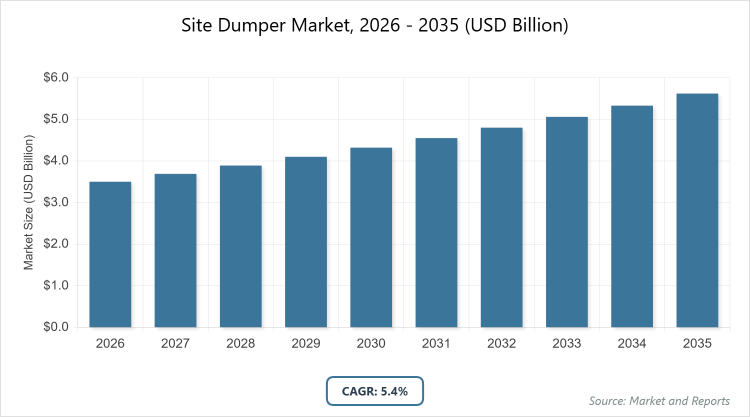
According to MarketnReports, the global site dumper market size was estimated at USD 3.5 billion in 2025 and is expected to reach USD 6.1 billion by 2035, growing at a CAGR of 5.4% from 2026 to 2035. Site Dumper Market is driven by surging global construction and infrastructure development activities, particularly in rapidly urbanizing regions, which creates sustained demand for efficient, heavy-duty material handling equipment for earthmoving and mining operations.
What are the Key Insights into the Site Dumper Market?
- Global site dumper market valued at approximately USD 3.5 billion in 2025, projected to reach USD 6.1 billion by 2035.
- Expected CAGR of around 5.4% from 2026 to 2035, driven by infrastructure growth and electrification.
- Dominant subsegment by type: Wheeled dumpers, accounting for the largest share due to versatility in urban sites.
- Dominant subsegment by capacity: Above 5 tons, holding over 50% market share for heavy-duty applications.
- Dominant subsegment by application: Construction, contributing around 60% revenue.
- Dominant region: Asia-Pacific, contributing over 38% of global revenue with China as the leading country.
What is the Site Dumper Industry Overview?
Industry Overview
Site dumpers are compact, versatile construction vehicles designed for transporting and dumping loose materials such as soil, gravel, sand, and debris on job sites, featuring a tipping bucket or skip mounted on a chassis with wheels or tracks for maneuverability in rough terrains. These machines are essential in the construction, mining, and agricultural sectors for efficient material handling, offering advantages like high payload capacity, ease of operation, and adaptability to confined spaces where larger dump trucks cannot access.
The market includes the manufacturing, distribution, rental, and maintenance of site dumpers, encompassing various propulsion types like diesel, electric, and hybrid models that prioritize safety, fuel efficiency, and environmental compliance. Site dumpers typically incorporate features such as hydrostatic transmission, articulated steering, and roll-over protection systems to enhance operator safety and productivity, serving as a bridge between manual labor and heavy machinery in infrastructure projects. This industry is influenced by global construction trends, where demand arises from the need for reliable, cost-effective equipment that reduces labor costs and accelerates project timelines while adhering to evolving emission standards and sustainability practices.
What are the Market Dynamics in the Site Dumper Sector?
Growth Drivers
The site dumper market is driven by surging infrastructure development worldwide, including roads, bridges, and urban projects, which necessitate efficient material transport solutions in confined construction sites, boosted by government investments in emerging economies. Rising adoption of compact equipment for residential and commercial building activities, coupled with the mining sector’s expansion for resource extraction, increases demand for durable dumpers capable of handling heavy loads in rugged environments.
Technological integrations like telematics for fleet management and ergonomic designs enhance operational efficiency, attracting contractors focused on productivity gains. Additionally, the shift toward sustainable construction practices promotes electric and hybrid models, aligning with environmental regulations and reducing operational costs over time.
Restraints
High initial acquisition costs for advanced site dumpers, including those with electric propulsion or automated features, restrict adoption among small contractors and in developing regions where budget constraints favor rented or second-hand equipment. Volatility in raw material prices, such as steel and components for engines, elevates manufacturing expenses and impacts profitability, while supply chain disruptions from global events delay deliveries.
Stringent emission norms in developed markets require costly upgrades, potentially slowing market entry for non-compliant models. Furthermore, competition from alternative material handling equipment like skid steers or mini excavators limits market share in niche applications.
Opportunities
Opportunities emerge from the electrification trend, with governments offering incentives for low-emission equipment, enabling manufacturers to develop battery-powered dumpers for urban sites with noise restrictions, expanding into eco-friendly segments. Growing rental markets in construction provide avenues for fleet expansions, as operators prefer flexible access without ownership burdens, fostering partnerships with rental firms.
Innovations in autonomous and remote-controlled dumpers open prospects in hazardous mining environments, improving safety and efficiency. Rapid urbanization in Asia and Africa creates demand for compact models in space-limited projects, supported by infrastructure initiatives like smart cities.
Challenges
Adhering to diverse regional safety and emission regulations poses challenges, requiring manufacturers to invest in customized designs and certifications, increasing R&D expenditures. The need for skilled operators in advanced models demands training programs, while battery life limitations in electric variants hinder performance in remote sites without charging infrastructure. Intense market competition pressures pricing, with low-cost imports from Asia challenging established brands. Balancing durability with lightweight designs for better fuel efficiency remains a technical hurdle amid rising material costs.
Site Dumper Market: Report Scope
| Report Attributes | Report Details |
| Report Name | Site Dumper Market |
| Market Size 2025 | USD 3.5 billion |
| Market Forecast 2035 | USD 6.1 billion |
| Growth Rate | CAGR of 5.4% |
| Report Pages | 220 |
| Key Companies Covered | JCB, Thwaites Limited, Terex Corporation, Wacker Neuson SE, AUSA CENTER, Caterpillar Inc., and Volvo Construction Equipment |
| Segments Covered | By Type, Capacity, Application, and Region |
| Regions Covered | North America, Europe, Asia Pacific (APAC), Latin America, The Middle East and Africa (MEA) |
| Base Year | 2025 |
| Historical Year | 2020 – 2024 |
| Forecast Year | 2026 – 2035 |
| Customization Scope | Avail customized purchase options to meet your exact research needs. |
How is the Site Dumper Market Segmented?
The site dumper market is segmented by type, capacity, application, and region
By Type, The wheeled dumpers segment dominates the site dumper market, primarily because of their superior mobility on even surfaces, cost-effectiveness, and ease of maintenance, making them ideal for urban construction and landscaping where quick maneuvering is essential. This dominance drives the market by enabling high-volume production and widespread adoption in infrastructure projects, reducing downtime and enhancing productivity through features like four-wheel drive, thereby supporting global construction booms and generating steady revenue.
The tracked dumpers segment ranks second, excelling in soft or uneven terrains like mining sites due to better traction and stability, helping to propel market growth by addressing specialized needs in rugged environments, improving safety in challenging conditions, and expanding applications in forestry and agriculture.
By Capacity, Above 5 tons leads the capacity segment, as these heavy-duty models handle larger loads efficiently in major construction and mining operations, supported by their robust build and higher productivity rates that align with large-scale projects. This subsegment drives the market by catering to industrial demands for durable equipment, fostering innovations in engine power and tipping mechanisms that boost operational efficiency and attract investments from big contractors.
Below 5 tons follows as the second dominant, favored for smaller sites and residential builds where compactness and lower costs are priorities, contributing to market expansion through accessibility for SMEs, enabling retrofits in confined spaces, and supporting urbanization trends.
By Application, Construction dominates the application segment, driven by the global surge in building activities requiring reliable material transport, with site dumpers optimizing workflows in site preparation and debris removal. This leadership accelerates market growth by synchronizing with infrastructure investments, promoting equipment rentals, and integrating safety features that comply with regulations, thus increasing adoption rates. Mining ranks second, essential for ore and overburden handling in extraction sites, helping to drive the market through demand for rugged, high-capacity models that enhance resource efficiency and support energy transitions in mineral-dependent economies.
What are the Recent Developments in the Site Dumper Market?
- In January 2024, Fliegl Agrartechnik introduced a new agricultural dumper with advanced features for optimal field applications, including enhanced tipping stability and hydraulic systems, targeting the growing need for versatile equipment in farming and construction crossovers, which expanded their market footprint in Europe.
- In March 2023, JCB launched an electric site dumper model featuring zero emissions and quiet operation, designed for urban environments with noise restrictions, boosting adoption in sustainable projects and positioning the company as a leader in green construction equipment.
- In 2025, major companies developed all-electric three-tonne dumpers to reduce carbon emissions, incorporating advanced battery tech for extended runtime, addressing environmental regulations and appealing to eco-focused contractors in North America and Europe.
- In late 2024, Terex partnered with a tech firm to integrate telematics in their dumpers, enabling real-time tracking and predictive maintenance, enhancing fleet management and reducing operational costs for mining applications worldwide.
What is the Regional Analysis of the Site Dumper Market?
- Asia-Pacific to dominate the market
Asia-Pacific dominates the site dumper market, propelled by extensive infrastructure projects, urbanization, and industrial growth, with China as the dominating country due to its massive construction initiatives under Belt and Road, government subsidies for equipment, and leadership in manufacturing that drive affordable exports. The region’s expansion is fueled by demand in India and Southeast Asia for compact models in residential builds, supported by foreign investments; Japan’s tech advancements contribute, but China’s dominance stems from its vast domestic market, policy support for green tech, and supply chain efficiencies, boosting overall revenue through high-volume sales and localization.
North America holds a strong position in the site dumper market, characterized by advanced mining operations and residential construction, with the United States as the dominating country owing to its shale energy sector, strict safety regulations, and innovative players focusing on electric models. The region benefits from rental market growth and infrastructure renewals; Canada supports through resource extraction, but the U.S. leads with R&D in automation, enhancing productivity and compliance, driving market expansion via premium products and sustainability trends.
Europe shows steady growth in the site dumper market, emphasizing eco-friendly equipment and urban redevelopment, with Germany as the dominating country due to its engineering heritage, EU emission standards, and strong construction sector integrating hybrid dumpers. The region is driven by projects in the UK and France; Germany’s leadership arises from export-oriented firms and investments in autonomous tech, fostering market development by addressing labor shortages and green building mandates.
The Rest of the World, including Latin America, Middle East, and Africa, exhibits emerging growth, with Brazil dominating in Latin America through mining and infrastructure, while Saudi Arabia leads in the Middle East with Vision 2030 projects. Growth is spurred by resource booms and aid; South Africa contributes in Africa, but the region’s progress relies on imports and partnerships to meet safety standards, gradually increasing share in energy sectors.
Who are the Key Market Players and Their Strategies in the Site Dumper Industry?
JCB: Focuses on electrification and innovation, launching battery-powered models while expanding through dealer networks to capture urban markets, emphasizing sustainability to meet regulations.
Thwaites Limited: Prioritizes compact designs for confined sites, investing in R&D for improved tipping mechanisms and partnerships for global distribution.
Terex Corporation: Employs telematics integration for fleet optimization, targeting mining with rugged models and acquisitions to broaden portfolios.
Wacker Neuson SE: Concentrates on versatile wheeled dumpers, leveraging European manufacturing for quality and expanding into rentals for flexibility.
AUSA CENTER: Specializes in multi-terrain solutions, focusing on export strategies and customizations for agriculture and construction.
Caterpillar Inc.: Utilizes global presence for heavy-duty dumpers, investing in autonomous tech and sustainability to serve mining clients.
Volvo Construction Equipment: Adopts hybrid propulsion, pursuing collaborations for smart features to enhance efficiency in infrastructure projects.
What are the Current Market Trends in the Site Dumper Sector?
- Increasing adoption of electric and hybrid models to comply with emission regulations and reduce operational costs.
- Integration of telematics and IoT for real-time monitoring and predictive maintenance.
- Growth in autonomous and remote-controlled dumpers for safety in hazardous sites.
- Emphasis on compact designs for urban construction with space constraints.
- Rise in rental services to provide flexible access without high upfront costs.
- Focus on ergonomic features and operator comfort to address labor shortages.
What Market Segments are Covered in the Report?
By Type
-
- Wheeled Dumpers
- Tracked Dumpers
By Capacity
-
- Below 5 Tons
- Above 5 Tons
By Application
-
- Construction
- Mining
- Others
By Region
-
- North America
- U.S.
- Canada
- Europe
- UK
- Germany
- France
- Rest of Europe
- Asia Pacific
- China
- India
- Japan
- Rest of Asia Pacific
- Latin America
- Brazil
- Mexico
- Rest of Latin America
- Middle East & Africa
- UAE
- South Africa
- Rest of Middle East & Africa
- North America
Chapter 1. Preface
Chapter 2. Executive Summary
Chapter 3. Global Site Dumper Market - Industry Analysis
Chapter 4. Global Site Dumper Market- Competitive Landscape
Chapter 5. Global Site Dumper Market - Type Analysis
Chapter 6. Global Site Dumper Market - Capacity Analysis
Chapter 7. Global Site Dumper Market - Application Analysis
Chapter 8. Site Dumper Market - Regional Analysis
Chapter 9. Company Profiles
Frequently Asked Questions
Site dumpers are compact vehicles used for transporting and dumping materials on construction sites, featuring tipping skips and designed for maneuverability in rough terrains.
Key factors include infrastructure investments, electrification trends, regulatory compliance for emissions, and technological advancements in automation.
The site dumper market is projected to grow from approximately USD 3.5 billion in 2026 to USD 6.1 billion by 2035, driven by sector expansions.
The CAGR for the site dumper market during 2026-2035 is expected to be around 5.4%, supported by construction demands.
Asia-Pacific will contribute notably, accounting for over 38% of the market value, led by infrastructure in China.
Major players include JCB, Thwaites Limited, Terex Corporation, Wacker Neuson SE, AUSA CENTER, Caterpillar Inc., and Volvo Construction Equipment, through innovations.
The global site dumper market report provides insights into size, segmentation, dynamics, regional analysis, players, trends, and forecasts for strategic planning.
The value chain includes raw material sourcing, manufacturing, assembly, distribution, sales, rental services, and aftermarket maintenance.
Market trends are evolving toward sustainable and automated solutions, with preferences shifting to electric models and tech-integrated equipment for efficiency.
Regulatory factors include emission standards like Euro Stage V, while environmental factors involve pushes for low-carbon equipment, driving green innovations but increasing costs.