
Shoe Packaging Market Size, Share and Trends 2026 to 2035
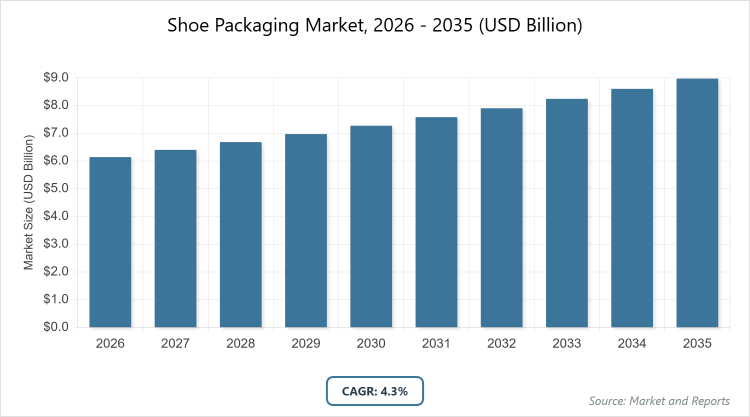
According to MarketnReports, the global Shoe Packaging market size was estimated at USD 6.14 billion in 2025 and is expected to reach USD 9.36 billion by 2035, growing at a CAGR of 4.3% from 2026 to 2035. Shoe Packaging Market is driven by increasing e-commerce sales and demand for sustainable packaging solutions.
What is the Industry Overview of Shoe Packaging?
The shoe packaging market involves the design, production, and distribution of containers and materials specifically tailored for protecting, storing, and presenting footwear products throughout the supply chain, from manufacturing to retail and consumer use. This market includes a variety of formats such as rigid boxes, flexible bags, and protective wraps that ensure product integrity while enhancing brand visibility and consumer appeal. Market definition encompasses all packaging solutions dedicated to shoes, driven by the growth of the global footwear industry, e-commerce expansion, and a shift toward eco-friendly and customizable options that address environmental concerns and marketing needs.
What are the Key Insights into Shoe Packaging?
- The global Shoe Packaging market size was estimated at USD 6.14 billion in 2025 and is expected to reach USD 9.36 billion by 2035.
- The market is expected to grow at a CAGR of 4.3% during the forecast period from 2026 to 2035.
- The market is driven by rising footwear production, e-commerce growth, and emphasis on sustainable materials.
- In the product type segment, boxes dominate with a 38% share due to their durability and branding potential.
- In the application segment, retail packaging holds the largest share at 45% because of its role in enhancing shelf appeal and consumer experience.
- In the end-user segment, footwear manufacturers dominate with 55% share owing to bulk requirements for protection during production and distribution.
- Asia Pacific dominates the market with a 40% share, attributed to major footwear manufacturing hubs in China and India.
What are the Market Dynamics in Shoe Packaging?
Growth Drivers
Growth drivers in the shoe packaging market are primarily fueled by the booming footwear industry, particularly in emerging economies, where increased production demands efficient and protective packaging solutions. The surge in e-commerce has necessitated lightweight, durable, and customizable packaging to reduce shipping costs and damage rates, while consumer preferences for premium unboxing experiences drive innovations in design and materials. Additionally, sustainability initiatives, such as the adoption of recyclable and biodegradable options, are supported by regulatory pressures and brand commitments to eco-friendliness, further accelerating market expansion through enhanced corporate responsibility and consumer loyalty.
Restraints
Restraints include volatile raw material prices, such as paper and plastic, which impact production costs and profitability for manufacturers. Stringent environmental regulations on packaging waste and recyclability require significant investments in compliance and R&D, posing challenges for smaller players. Competition from alternative packaging formats and the shift toward minimalism in design can limit demand for traditional bulky options, while supply chain disruptions from global events exacerbate material shortages and delay timelines.
Opportunities
Opportunities lie in the integration of smart technologies, like QR codes and NFC tags, for interactive packaging that enhances consumer engagement and traceability. The growing focus on circular economy principles opens avenues for reusable and returnable packaging systems, particularly in e-commerce. Expansion in untapped markets in Africa and Latin America, coupled with collaborations between packaging firms and footwear brands for co-developed sustainable solutions, can capture new revenue streams, while advancements in bio-based materials offer differentiation in a competitive landscape.
Challenges
Challenges encompass balancing cost-effectiveness with sustainability, as eco-friendly materials often come at a premium, affecting adoption rates in price-sensitive regions. Ensuring compatibility with diverse shoe designs and sizes requires versatile manufacturing capabilities, while counterfeit packaging in informal markets undermines brand integrity. Rapid changes in consumer trends toward minimal packaging demand agile adaptation, and global trade barriers complicate international supply chains for raw materials and finished products.
Shoe Packaging Market: Report Scope
| Report Attributes | Report Details |
| Report Name | Shoe Packaging Market |
| Market Size 2025 | USD 6.14 Billion |
| Market Forecast 2035 | USD 9.36 Billion |
| Growth Rate | CAGR of 4.3% |
| Report Pages | 220 |
| Key Companies Covered |
Smurfit Kappa Group, DS Smith Plc, Mondi Group, WestRock Company, International Paper Company, Elevate Packaging, Packman Packaging Pvt. Ltd., Packqueen, ZEE Packaging, Great Little Box Company, and Others |
| Segments Covered | By Product Type, By Application, By End-User, and By Region |
| Regions Covered | North America, Europe, Asia Pacific (APAC), Latin America, and The Middle East and Africa (MEA) |
| Base Year | 2025 |
| Historical Year | 2020 – 2024 |
| Forecast Year | 2026 – 2035 |
| Customization Scope | Avail customized purchase options to meet your exact research needs. |
The Shoe Packaging market is segmented by product type, application, end-user, and region.
Based on Product Type Segment, boxes is the most dominant subsegment, holding approximately 38% market share, followed by bags as the second most dominant. Boxes dominate due to their structural integrity for protecting high-value footwear and ample surface for branding, driving the market by facilitating safe transportation and retail display; bags follow, providing cost-effective, lightweight alternatives for casual shoes, contributing to growth through e-commerce efficiency and material savings.
Based on Application Segment, retail packaging is the most dominant subsegment with around 45% share, while e-commerce packaging ranks second. Retail packaging leads because it enhances visual appeal and protects products on shelves, driving market growth via increased sales through attractive designs; e-commerce packaging follows, addressing shipping needs with durable, compact solutions, expanding the market by supporting online retail surge.
Based on End-User Segment, footwear manufacturers dominate with about 55% share, with retailers as the second dominant. Footwear manufacturers’ dominance stems from their need for high-volume, standardized packaging to safeguard products during assembly and distribution, propelling the market through economies of scale; retailers follow, requiring customized options for in-store presentation, sustaining growth via branding enhancements.
What are the Recent Developments in Shoe Packaging?
- In February 2025, Mondi and CMC launched an on-demand e-commerce line that sizes every shoe box to order, slashing fiber and filler waste for sustainable shipping.
- In September 2025, Nike launched fully circular shoes designed for disassembly and recyclability, incorporating innovative packaging that aligns with zero-waste goals.
- In 2024, Smurfit Kappa introduced recyclable shoe boxes with enhanced durability, adopted by major brands to reduce plastic usage.
- In early 2025, DS Smith developed smart packaging with NFC tags for interactive consumer experiences in footwear retail.
- In late 2024, WestRock expanded its digital printing capabilities for custom shoe packaging, targeting e-commerce personalization.
How Does Regional Analysis Impact Shoe Packaging?
- Asia Pacific to dominate the global market.
Asia Pacific holds the largest share, driven by extensive footwear manufacturing and export activities in China and India, where cost-effective production and rising domestic consumption fuel demand. China dominates the region with its massive supply chain infrastructure, government support for sustainable practices, and integration with global brands, ensuring efficient scaling and innovation in eco-friendly materials.
North America maintains a significant position, supported by advanced e-commerce and premium branding demands. The United States leads with robust retail networks and investments in smart packaging technologies, facilitating customized solutions for luxury and athletic footwear markets.
Europe exhibits strong growth, influenced by stringent environmental regulations and consumer preferences for sustainable products. Germany dominates through its focus on recyclable materials and collaborations with footwear giants, promoting circular economy models in packaging.
Latin America shows promising expansion, bolstered by growing footwear production and regional trade. Brazil leads with investments in corrugated solutions and local manufacturing, addressing both domestic and export needs efficiently.
The Middle East and Africa represent emerging opportunities, driven by urbanization and import growth. The UAE dominates in the Middle East with luxury retail demands, while South Africa leads in Africa through developed supply chains for protective packaging.
Who are the Key Market Players in Shoe Packaging?
Smurfit Kappa Group focuses on sustainable innovations like recyclable boxes and partnerships with footwear brands for eco-friendly solutions.
DS Smith Plc emphasizes smart packaging with digital integrations, targeting e-commerce efficiency and customization.
Mondi Group invests in biodegradable wraps and on-demand sizing technologies to reduce waste in shipping.
WestRock Company leverages digital printing for personalized designs, expanding in Asia-Pacific markets.
International Paper Company prioritizes corrugated materials for durable transport packaging, focusing on cost optimization.
Elevate Packaging adopts compostable options and certifications for premium blister packs.
Packman Packaging Pvt. Ltd. concentrates on affordable custom pouches for Asian manufacturers.
Packqueen pursues lightweight bags with branding features for wholesale applications.
ZEE Packaging focuses on bulk envelope solutions for distributors.
Great Little Box Company emphasizes modular inserts for specialty retail.
What are the Market Trends Shaping Shoe Packaging?
- Adoption of eco-friendly and recyclable materials to meet sustainability demands.
- Integration of smart technologies like NFC and QR codes for interactivity.
- Growth in customized and personalized packaging for branding.
- Shift toward minimalistic designs to reduce material usage.
- Expansion of e-commerce-specific solutions for efficient shipping.
- Use of biodegradable alternatives amid plastic reduction regulations.
- Focus on circular economy with reusable packaging systems.
- Innovation in protective inserts for luxury footwear.
- Rise in digital printing for small-batch customization.
- Collaboration for co-developed sustainable lines with brands.
By Product Type
-
- Boxes
- Bags
- Wraps
- Pouches
- Envelopes
- Tubes
- Clamshells
- Blisters
- Containers
- Inserts
- Others
By Application
-
- Retail Packaging
- Transport Packaging
- Gift Packaging
- E-commerce Packaging
- Wholesale Packaging
- Protective Packaging
- Promotional Packaging
- Custom Packaging
- Bulk Packaging
- Specialty Packaging
- Others
By End-User
-
- Footwear Manufacturers
- Retailers
- E-commerce Platforms
- Wholesalers
- Distributors
- Luxury Brands
- Sports Brands
- Online Sellers
- Department Stores
- Specialty Stores
- Others
By Region
-
- North America
- U.S.
- Canada
- Europe
- UK
- Germany
- France
- Rest of Europe
- Asia Pacific
- China
- India
- Japan
- Rest of Asia Pacific
- Latin America
- Brazil
- Mexico
- Rest of Latin America
- Middle East & Africa
- UAE
- South Africa
- Rest of Middle East & Africa
- North America
Chapter 1. Preface
Chapter 2. Executive Summary
Chapter 3. Global Shoe Packaging Market - Industry Analysis
Chapter 4. Global Shoe Packaging Market- Competitive Landscape
Chapter 5. Global Shoe Packaging Market - Product Type Analysis
Chapter 6. Global Shoe Packaging Market - Application Analysis
Chapter 7. Global Shoe Packaging Market - End-User Analysis
Chapter 8. Shoe Packaging Market - Regional Analysis
Chapter 9. Company Profiles
Frequently Asked Questions
Shoe packaging consists of specialized containers and materials designed to protect, store, and display footwear, enhancing product safety and brand presentation.
Key factors include e-commerce expansion, sustainability regulations, footwear industry growth, and technological innovations in materials.
The market value is projected to grow from USD 6.14 billion in 2025 to USD 9.36 billion by 2035.
The market is expected to grow at a CAGR of 4.3% during the forecast period from 2026 to 2035.
Asia Pacific will contribute notably, holding the largest share due to manufacturing dominance.
Major players include Smurfit Kappa Group, DS Smith Plc, Mondi Group, WestRock Company, and International Paper Company.
The report provides detailed analysis of market size, trends, segmentation, regional insights, key players, and forecasts.
Stages include raw material procurement, design and manufacturing, distribution, retail application, and recycling.
Trends emphasize sustainability and interactivity, with preferences for eco-friendly, customizable designs.
Regulations on waste reduction and recyclability are driving adoption of sustainable materials.