
Seafood Snacks Market Size, Share and Trends 2026 to 2035
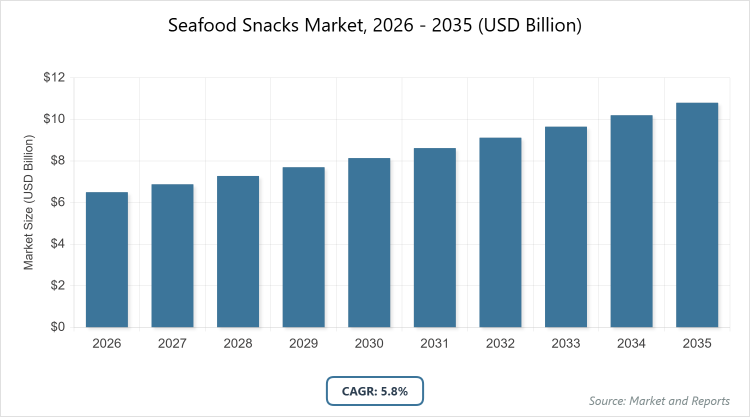
According to MarketnReports, the global Seafood Snacks market size was estimated at USD 6.5 billion in 2025 and is expected to reach USD 11.5 billion by 2035, growing at a CAGR of 5.8% from 2026 to 2035. Seafood Snacks Market is driven by increasing consumer preference for healthy and convenient snack options.
What are the Key Insights of the Seafood Snacks Market?
- The global Seafood Snacks market was valued at USD 6.5 billion in 2025 and is expected to reach USD 11.5 billion by 2035.
- The market is anticipated to grow at a CAGR of 5.8% during the forecast period from 2026 to 2035.
- The market is driven by rising health consciousness among consumers and the demand for nutritious, protein-rich snack alternatives.
- In the product type segment, Dried Seafood Snacks dominates with a 35% share.
- This dominance is attributed to its long shelf life, ease of portability, and ability to incorporate diverse flavors, making it ideal for on-the-go consumption and appealing to busy lifestyles, thereby driving overall market expansion through increased accessibility and repeat purchases.
- In the source segment, Fish holds the largest share of 40%.
- Fish dominates due to its abundant availability, high omega-3 content promoting heart and brain health, and versatility in processing into various snack forms, which helps propel market growth by aligning with global trends toward functional foods and sustainable sourcing.
- In the distribution channel segment, Supermarkets/Hypermarkets lead with a 38% share.
- This leadership stems from their wide product assortment, competitive pricing, and in-store promotions that enhance visibility and impulse buying, contributing to market drive by facilitating broader consumer reach and volume sales in urban areas.
- Asia Pacific dominates the regional market with a 45% share, driven by deep-rooted seafood consumption traditions, a large population base, and rapid urbanization that boosts demand for convenient snacks.
What is the Industry Overview of the Seafood Snacks Market?
The seafood snacks market encompasses the production, processing, and distribution of ready-to-eat or easy-to-prepare snack products derived from marine sources, offering a blend of convenience, nutrition, and flavor variety to meet modern consumer lifestyles. Market definition includes items like dried, smoked, canned, and frozen variants made from fish, shellfish, and other aquatic species, which are positioned as healthier alternatives to traditional snacks due to their natural protein, vitamins, and mineral content. This industry thrives on innovation in taste profiles, packaging for portability, and sustainable practices to address environmental concerns, catering to a diverse global audience seeking quick, guilt-free indulgence options that align with wellness trends and cultural preferences for seafood-based treats.
What are the Market Dynamics of the Seafood Snacks Market?
Growth Drivers
Rising awareness of the health benefits associated with seafood, such as omega-3 fatty acids for cardiovascular and cognitive support, coupled with a shift toward high-protein diets, is fueling demand for seafood snacks as nutritious alternatives to conventional processed foods. Additionally, the expanding global middle class in emerging economies is increasing disposable incomes, enabling greater spending on premium and convenient snack products that fit busy urban lifestyles. The proliferation of diverse distribution channels, including e-commerce platforms and modern retail outlets, further enhances accessibility and variety, driving market growth through improved consumer reach and innovative product offerings tailored to dietary preferences like organic or gluten-free options.
Restraints
Environmental and sustainability issues, including overfishing, habitat degradation, and illegal fishing practices, pose significant challenges by raising consumer concerns and leading to stricter regulations that increase operational costs for producers. These factors can result in supply chain disruptions and negative perceptions if not addressed through certified sourcing, potentially limiting market expansion in regions with high eco-conscious consumer bases. Moreover, fluctuating raw material prices due to climate change impacts on marine ecosystems add financial pressure on manufacturers, constraining profitability and innovation in product development.
Opportunities
The growing trend toward healthy, functional snacks opens avenues for product innovation, such as developing organic, low-sodium, or allergen-free variants that cater to specific dietary needs and attract health-focused demographics. Expansion into untapped emerging markets through strengthened retail networks and digital marketing strategies can capitalize on rising urbanization and e-commerce adoption, broadening market penetration. Investments in sustainable aquaculture and traceability technologies present opportunities to build consumer trust and differentiate brands in a competitive landscape, fostering long-term growth.
Challenges
Ensuring consistent supply chain transparency and obtaining sustainability certifications remain hurdles, as failure to do so can erode consumer confidence and invite regulatory scrutiny in an increasingly environmentally aware market. Intense competition from alternative protein snacks requires ongoing R&D for unique flavors and packaging to maintain market share. Additionally, navigating varying international trade policies and food safety standards complicates global operations, demanding adaptable strategies to mitigate risks.
Seafood Snacks Market: Report Scope
| Report Attributes | Report Details |
| Report Name | Seafood Snacks Market |
| Market Size 2025 | USD 6.5 Billion |
| Market Forecast 2035 | USD 11.5 Billion |
| Growth Rate | CAGR of 5.8% |
| Report Pages | 220 |
| Key Companies Covered |
Thai Union Group PCL, Bumble Bee Foods, Mowi ASA, Nippon Suisan Kaisha, High Liner Foods Inc., and Others |
| Segments Covered | By Product Type, By Source, By Distribution Channel, and By Region |
| Regions Covered | North America, Europe, Asia Pacific (APAC), Latin America, and The Middle East and Africa (MEA) |
| Base Year | 2025 |
| Historical Year | 2020 – 2024 |
| Forecast Year | 2026 – 2035 |
| Customization Scope | Avail customized purchase options to meet your exact research needs. |
How is the Market Segmentation of the Seafood Snacks Market?
The Seafood Snacks market is segmented by product type, source, distribution channel, and region.
Based on Product Type Segment, the most dominant is Dried Seafood Snacks, while the second most dominant is Smoked Seafood Snacks. Dried Seafood Snacks leads due to its extended shelf life without refrigeration, making it highly suitable for storage and transportation, and its ability to retain natural flavors enhanced by seasonings, which appeals to consumers seeking convenient, non-perishable options; this dominance drives the market by boosting export potential and catering to the rising demand for portable snacks in fast-paced environments, whereas Smoked Seafood Snacks ranks second for its distinctive smoky taste that adds gourmet appeal, helping to expand the market through premium positioning and attracting health-conscious users who value preserved nutritional benefits without added preservatives.
Based on Source Segment, the most dominant is Fish, while the second most dominant is Shrimp. Fish dominates owing to its widespread availability from both wild and farmed sources, coupled with its rich nutritional profile including essential fatty acids that position it as a staple in health-oriented snacks, driving market growth by enabling diverse product formulations and appealing to a broad consumer base focused on wellness; Shrimp follows as the second dominant due to its versatile texture and mild flavor that lend well to various processing methods like chipping or drying, contributing to market expansion by targeting flavor innovation and meeting demands in regions with strong shellfish traditions.
Based on Distribution Channel Segment, the most dominant is Supermarkets/Hypermarkets, while the second most dominant is Online Stores. Supermarkets/Hypermarkets hold the top position because of their extensive shelf space for displaying a wide array of products, combined with promotional strategies like discounts and tastings that encourage impulse purchases, propelling market growth by enhancing visibility and accessibility in high-traffic urban locations; Online Stores are second for their convenience in offering home delivery and product comparisons, which drives the market through expanded reach to tech-savvy consumers and facilitating global sales amid rising e-commerce trends.
What are the Recent Developments in the Seafood Snacks Market?
- Thai Union Group PCL announced a strategic partnership with a sustainability organization in 2025 to launch a new line of eco-certified dried shrimp snacks, aiming to address consumer demands for responsible sourcing and enhance brand loyalty through transparent supply chains.
- Bumble Bee Foods introduced innovative canned tuna snack packs with added flavors in early 2026, focusing on convenience for on-the-go consumers and incorporating health-boosting ingredients to capitalize on the wellness trend.
- Mowi ASA expanded its smoked salmon snack offerings through an acquisition of a regional processor in 2025, strengthening its market presence in Europe and integrating advanced packaging technologies for longer freshness.
- Nippon Suisan Kaisha invested in R&D for plant-based hybrid seafood snacks in 2026, blending traditional squid sources with alternative proteins to appeal to flexitarian diets and reduce environmental impact.
- High Liner Foods Inc. collaborated with e-commerce platforms in 2025 to boost online distribution of frozen seafood snacks, leveraging digital marketing to target younger demographics and increase sales volume.
What is the Regional Analysis of the Seafood Snacks Market?
- Asia Pacific to dominate the global market
Asia Pacific: This region leads the market due to its longstanding cultural affinity for seafood, supported by a massive population and thriving aquaculture industries that ensure abundant supply. Rapid urbanization and rising disposable incomes in countries like China, Japan, and India fuel demand for convenient snacks, with innovative flavors tailored to local tastes driving consumption. The dominating country, China, excels through its extensive processing capabilities and export focus, contributing significantly to global supply chains while benefiting from government support for sustainable fishing practices that mitigate overfishing risks and promote long-term market stability.
North America: Growth here is propelled by increasing health awareness and preference for protein-rich snacks, with consumers favoring premium, sustainably sourced products amid stringent regulations. The United States dominates as the key country, leveraging advanced retail infrastructure and marketing campaigns that highlight nutritional benefits, enabling market expansion through e-commerce and specialty stores while addressing challenges like supply chain volatility through local aquaculture investments.
Europe: The market benefits from a strong emphasis on sustainability and quality, with eco-labeling and traceability becoming standard to meet consumer expectations. Germany stands out as the dominating country, driven by its robust distribution networks and cultural appreciation for smoked and canned variants, fostering growth via innovation in organic options and collaborations with environmental groups to overcome restraints like habitat concerns.
Latin America: Emerging opportunities arise from expanding middle-class populations and improving cold chain logistics, though challenges include regulatory hurdles in sustainable sourcing. Brazil dominates, capitalizing on its coastal resources and growing urban demand for frozen snacks, which helps drive regional market penetration through partnerships with international players.
Middle East and Africa: This area shows potential through increasing urbanization and tourism, with demand for exotic flavors rising, but faces restraints from limited infrastructure. South Africa leads as the dominating country, utilizing its fishing heritage and export-oriented strategies to enhance market presence, supported by investments in processing facilities to meet global standards.
Who are the Key Market Players and Their Strategies in the Seafood Snacks Market?
Thai Union Group PCL
- Focuses on sustainability initiatives, including certifications for responsible sourcing to build consumer trust.
- Employs product diversification by introducing new flavor profiles and organic lines to capture premium segments.
- Utilizes strategic acquisitions and partnerships to expand global distribution networks.
Bumble Bee Foods
- Prioritizes innovation in packaging for convenience, such as single-serve pouches to appeal to busy consumers.
- Invests in marketing campaigns emphasizing health benefits like omega-3 content to drive brand awareness.
- Collaborates with retailers for exclusive product launches to boost market share.
Mowi ASA
- Emphasizes vertical integration from farming to processing to ensure quality control and cost efficiency.
- Develops eco-friendly products through R&D in aquaculture techniques to address environmental concerns.
- Expands into emerging markets via joint ventures for localized production.
Nippon Suisan Kaisha
- Leverages technology for traceability systems to enhance transparency in supply chains.
- Focuses on flavor innovation blending traditional and modern tastes for diverse consumer preferences.
- Strengthens online presence through e-commerce partnerships to tap into digital sales growth.
High Liner Foods Inc.
- Pursues mergers and acquisitions to broaden product portfolios and enter new regions.
- Invests in sustainable practices, including waste reduction in processing for brand differentiation.
- Uses data analytics for targeted marketing to optimize sales strategies.
What are the Market Trends in the Seafood Snacks Market?
- Increasing adoption of sustainable and traceable sourcing to meet consumer demands for ethical products.
- Rise in demand for plant-based or hybrid seafood snacks catering to flexitarian and vegan trends.
- Growth in e-commerce channels facilitating direct-to-consumer sales and personalized offerings.
- Innovation in packaging for enhanced shelf life and eco-friendliness to reduce environmental impact.
- Shift toward health-focused variants with added nutrients like vitamins and low-sodium options.
- Expansion of exotic flavors influenced by global cuisines to attract adventurous consumers.
What are the Market Segments and Their Subsegments Covered in the Report for the Seafood Snacks Market?
By Product Type
- Dried Seafood Snacks
- Smoked Seafood Snacks
- Canned Seafood Snacks
- Frozen Seafood Snacks
- Shrimp Chips
- Fish Crackers
- Squid Rings
- Crab Sticks
- Seaweed Snacks
- Octopus Jerky
- Others
By Source
- Fish
- Shrimp
- Crab
- Squid
- Salmon
- Tuna
- Mackerel
- Anchovy
- Octopus
- Eel
- Others
By Distribution Channel
- Online Stores
- Supermarkets/Hypermarkets
- Convenience Stores
- Specialty Stores
- Vending Machines
- Foodservice Outlets
- Retail Stores
- Department Stores
- Independent Grocers
- Wholesale Clubs
- Others
By Region
- North America
- U.S.
- Canada
- Europe
- UK
- Germany
- France
- Rest of Europe
- Asia Pacific
- China
- India
- Japan
- Rest of Asia Pacific
- Latin America
- Brazil
- Mexico
- Rest of Latin America
- Middle East & Africa
- UAE
- South Africa
- Rest of Middle East & Africa
Chapter 1. Preface
1.1 Report Description and Scope1.2 Research Scope1.3 Research Methodology1.3.1 Market Research Type1.3.2 Market Research MethodologyChapter 2. Executive Summary
2.1 Global Seafood Snacks Market, (2026 - 2035) (USD Billion)2.2 Global Seafood Snacks Market: SnapshotChapter 3. Global Seafood Snacks Market - Industry Analysis
3.1 Seafood Snacks Market: Market Dynamics3.2 Market Drivers3.2.1 The seafood snacks market is driven by rising health awareness, demand for high-protein diets, growing middle-class incomes, and wider access through e-commerce and modern retail channels.3.3 Market Restraints3.3.1 Market growth is restrained by sustainability concerns, strict fishing regulations, supply chain disruptions, and volatile raw material prices driven by climate impacts.3.4 Market Opportunities3.4.1 Opportunities lie in healthy and functional snack innovation, expansion into emerging markets, digital retail growth, and investments in sustainable aquaculture and traceability.3.5 Market Challenges3.5.1 Key challenges include ensuring supply chain transparency, meeting sustainability certifications, intense competition from alternative protein snacks, and navigating diverse global trade and food safety regulations.3.6 Porter’s Five Forces Analysis3.7 Market Attractiveness Analysis3.7.1 Market Attractiveness Analysis By Product Type3.7.2 Market Attractiveness Analysis By Source3.7.3 Market Attractiveness Analysis By Distribution ChannelChapter 4. Global Seafood Snacks Market- Competitive Landscape
4.1 Company Market Share Analysis4.1.1 Global Seafood Snacks Market: Company Market Share, 20254.2 Strategic Development4.2.1 Acquisitions & mergers4.2.2 New Product launches4.2.3 Agreements, partnerships, collaborations, and joint ventures4.2.4 Research and development and regional expansion4.3 Price Trend AnalysisChapter 5. Global Seafood Snacks Market - Product Type Analysis
5.1 Global Seafood Snacks Market Overview: Product Type5.1.1 Global Seafood Snacks Market share, By Product Type, 2025 and 20355.2 Dried Seafood Snacks5.2.1 Global Seafood Snacks Market by Dried Seafood Snacks, 2026 - 2035 (USD Billion)5.3 Smoked Seafood Snacks5.3.1 Global Seafood Snacks Market by Smoked Seafood Snacks, 2026 - 2035 (USD Billion)5.4 Canned Seafood Snacks5.4.1 Global Seafood Snacks Market by Canned Seafood Snacks, 2026 - 2035 (USD Billion)5.5 Frozen Seafood Snacks5.5.1 Global Seafood Snacks Market by Frozen Seafood Snacks, 2026 - 2035 (USD Billion)5.6 Shrimp Chips5.6.1 Global Seafood Snacks Market by Shrimp Chips, 2026 - 2035 (USD Billion)5.7 Fish Crackers5.7.1 Global Seafood Snacks Market by Fish Crackers, 2026 - 2035 (USD Billion)5.8 Squid Rings5.8.1 Global Seafood Snacks Market by Squid Rings, 2026 - 2035 (USD Billion)5.9 Crab Sticks5.9.1 Global Seafood Snacks Market by Crab Sticks, 2026 - 2035 (USD Billion)5.10 Seaweed Snacks5.10.1 Global Seafood Snacks Market by Seaweed Snacks, 2026 - 2035 (USD Billion)5.11 Octopus Jerky5.11.1 Global Seafood Snacks Market by Octopus Jerky, 2026 - 2035 (USD Billion)Chapter 6. Global Seafood Snacks Market - Source Analysis
6.1 Global Seafood Snacks Market Overview: Source6.1.1 Global Seafood Snacks Market Share, By Source, 2025 and 20356.2 Fish6.2.1 Global Seafood Snacks Market by Fish, 2026 - 2035 (USD Billion)6.3 Shrimp6.3.1 Global Seafood Snacks Market by Shrimp, 2026 - 2035 (USD Billion)6.4 Crab6.4.1 Global Seafood Snacks Market by Crab, 2026 - 2035 (USD Billion)6.5 Squid6.5.1 Global Seafood Snacks Market by Squid, 2026 - 2035 (USD Billion)6.6 Salmon6.6.1 Global Seafood Snacks Market by Salmon, 2026 - 2035 (USD Billion)6.7 Tuna6.7.1 Global Seafood Snacks Market by Tuna, 2026 - 2035 (USD Billion)6.8 Mackerel6.8.1 Global Seafood Snacks Market by Mackerel, 2026 - 2035 (USD Billion)6.9 Anchovy6.9.1 Global Seafood Snacks Market by Anchovy, 2026 - 2035 (USD Billion)6.10 Octopus6.10.1 Global Seafood Snacks Market by Octopus, 2026 - 2035 (USD Billion)6.11 Eel6.11.1 Global Seafood Snacks Market by Eel, 2026 - 2035 (USD Billion)Chapter 7. Global Seafood Snacks Market - Distribution Channel Analysis
7.1 Global Seafood Snacks Market Overview: Distribution Channel7.1.1 Global Seafood Snacks Market Share, By Distribution Channel, 2025 and 20357.2 Online Stores7.2.1 Global Seafood Snacks Market by Online Stores, 2026 - 2035 (USD Billion)7.3 Supermarkets/Hypermarkets7.3.1 Global Seafood Snacks Market by Supermarkets/Hypermarkets, 2026 - 2035 (USD Billion)7.4 Convenience Stores7.4.1 Global Seafood Snacks Market by Convenience Stores, 2026 - 2035 (USD Billion)7.5 Specialty Stores7.5.1 Global Seafood Snacks Market by Specialty Stores, 2026 - 2035 (USD Billion)7.6 Vending Machines7.6.1 Global Seafood Snacks Market by Vending Machines, 2026 - 2035 (USD Billion)7.7 Foodservice Outlets7.7.1 Global Seafood Snacks Market by Foodservice Outlets, 2026 - 2035 (USD Billion)7.8 Retail Stores7.8.1 Global Seafood Snacks Market by Retail Stores, 2026 - 2035 (USD Billion)7.9 Department Stores7.9.1 Global Seafood Snacks Market by Department Stores, 2026 - 2035 (USD Billion)7.10 Independent Grocers7.10.1 Global Seafood Snacks Market by Independent Grocers, 2026 - 2035 (USD Billion)7.11 Wholesale Clubs7.11.1 Global Seafood Snacks Market by Wholesale Clubs, 2026 - 2035 (USD Billion)Chapter 8. Seafood Snacks Market - Regional Analysis
8.1 Global Seafood Snacks Market Regional Overview8.2 Global Seafood Snacks Market Share, by Region, 2025 & 2035 (USD Billion)8.3 North America8.3.1 North America Seafood Snacks Market, 2026 - 2035 (USD Billion)8.3.1.1 North America Seafood Snacks Market, by Country, 2026 - 2035 (USD Billion)8.3.2 North America Seafood Snacks Market, by Product Type, 2026 - 20358.3.2.1 North America Seafood Snacks Market, by Product Type, 2026 - 2035 (USD Billion)8.3.3 North America Seafood Snacks Market, by Source, 2026 - 20358.3.3.1 North America Seafood Snacks Market, by Source, 2026 - 2035 (USD Billion)8.3.4 North America Seafood Snacks Market, by Distribution Channel, 2026 - 20358.3.4.1 North America Seafood Snacks Market, by Distribution Channel, 2026 - 2035 (USD Billion)8.4 Europe8.4.1 Europe Seafood Snacks Market, 2026 - 2035 (USD Billion)8.4.1.1 Europe Seafood Snacks Market, by Country, 2026 - 2035 (USD Billion)8.4.2 Europe Seafood Snacks Market, by Product Type, 2026 - 20358.4.2.1 Europe Seafood Snacks Market, by Product Type, 2026 - 2035 (USD Billion)8.4.3 Europe Seafood Snacks Market, by Source, 2026 - 20358.4.3.1 Europe Seafood Snacks Market, by Source, 2026 - 2035 (USD Billion)8.4.4 Europe Seafood Snacks Market, by Distribution Channel, 2026 - 20358.4.4.1 Europe Seafood Snacks Market, by Distribution Channel, 2026 - 2035 (USD Billion)8.5 Asia Pacific8.5.1 Asia Pacific Seafood Snacks Market, 2026 - 2035 (USD Billion)8.5.1.1 Asia Pacific Seafood Snacks Market, by Country, 2026 - 2035 (USD Billion)8.5.2 Asia Pacific Seafood Snacks Market, by Product Type, 2026 - 20358.5.2.1 Asia Pacific Seafood Snacks Market, by Product Type, 2026 - 2035 (USD Billion)8.5.3 Asia Pacific Seafood Snacks Market, by Source, 2026 - 20358.5.3.1 Asia Pacific Seafood Snacks Market, by Source, 2026 - 2035 (USD Billion)8.5.4 Asia Pacific Seafood Snacks Market, by Distribution Channel, 2026 - 20358.5.4.1 Asia Pacific Seafood Snacks Market, by Distribution Channel, 2026 - 2035 (USD Billion)8.6 Latin America8.6.1 Latin America Seafood Snacks Market, 2026 - 2035 (USD Billion)8.6.1.1 Latin America Seafood Snacks Market, by Country, 2026 - 2035 (USD Billion)8.6.2 Latin America Seafood Snacks Market, by Product Type, 2026 - 20358.6.2.1 Latin America Seafood Snacks Market, by Product Type, 2026 - 2035 (USD Billion)8.6.3 Latin America Seafood Snacks Market, by Source, 2026 - 20358.6.3.1 Latin America Seafood Snacks Market, by Source, 2026 - 2035 (USD Billion)8.6.4 Latin America Seafood Snacks Market, by Distribution Channel, 2026 - 20358.6.4.1 Latin America Seafood Snacks Market, by Distribution Channel, 2026 - 2035 (USD Billion)8.7 The Middle-East and Africa8.7.1 The Middle-East and Africa Seafood Snacks Market, 2026 - 2035 (USD Billion)8.7.1.1 The Middle-East and Africa Seafood Snacks Market, by Country, 2026 - 2035 (USD Billion)8.7.2 The Middle-East and Africa Seafood Snacks Market, by Product Type, 2026 - 20358.7.2.1 The Middle-East and Africa Seafood Snacks Market, by Product Type, 2026 - 2035 (USD Billion)8.7.3 The Middle-East and Africa Seafood Snacks Market, by Source, 2026 - 20358.7.3.1 The Middle-East and Africa Seafood Snacks Market, by Source, 2026 - 2035 (USD Billion)8.7.4 The Middle-East and Africa Seafood Snacks Market, by Distribution Channel, 2026 - 20358.7.4.1 The Middle-East and Africa Seafood Snacks Market, by Distribution Channel, 2026 - 2035 (USD Billion)Chapter 9. Company Profiles
9.1 Thai Union Group PCL9.1.1 Overview9.1.2 Financials9.1.3 Product Portfolio9.1.4 Business Strategy9.1.5 Recent Developments9.2 Bumble Bee Foods9.2.1 Overview9.2.2 Financials9.2.3 Product Portfolio9.2.4 Business Strategy9.2.5 Recent Developments9.3 Mowi ASA9.3.1 Overview9.3.2 Financials9.3.3 Product Portfolio9.3.4 Business Strategy9.3.5 Recent Developments9.4 Nippon Suisan Kaisha9.4.1 Overview9.4.2 Financials9.4.3 Product Portfolio9.4.4 Business Strategy9.4.5 Recent Developments9.5 High Liner Foods Inc.9.5.1 Overview9.5.2 Financials9.5.3 Product Portfolio9.5.4 Business Strategy9.5.5 Recent Developments
Frequently Asked Questions
Seafood snacks are processed and packaged products derived from marine sources like fish and shellfish, designed for convenient consumption as nutritious, flavorful treats in forms such as dried, smoked, or canned.
Key factors include rising health awareness, demand for protein-rich foods, sustainability trends, e-commerce expansion, and product innovation in flavors and packaging.
The market is projected to grow from approximately USD 6.5 billion in 2025 to USD 11.5 billion by 2035.
The CAGR is expected to be 5.8% during 2026-2035.
Asia Pacific will contribute notably, holding the largest share due to high consumption and population growth.
Major players include Thai Union Group PCL, Bumble Bee Foods, Mowi ASA, Nippon Suisan Kaisha, and High Liner Foods Inc.
The report provides comprehensive analysis, including market size, trends, segmentation, regional insights, key players, drivers, restraints, opportunities, and forecasts.
Stages include raw material sourcing from fishing or aquaculture, processing and packaging, distribution through retail channels, and end-consumer consumption.
Trends are shifting toward sustainable, health-enhanced products with exotic flavors, while consumers prefer convenient, eco-friendly options via online platforms.
Factors include strict sustainability regulations, overfishing bans, certification requirements, and climate change impacts on marine resources.