
School Uniform Market Size, Share and Trends 2026 to 2035
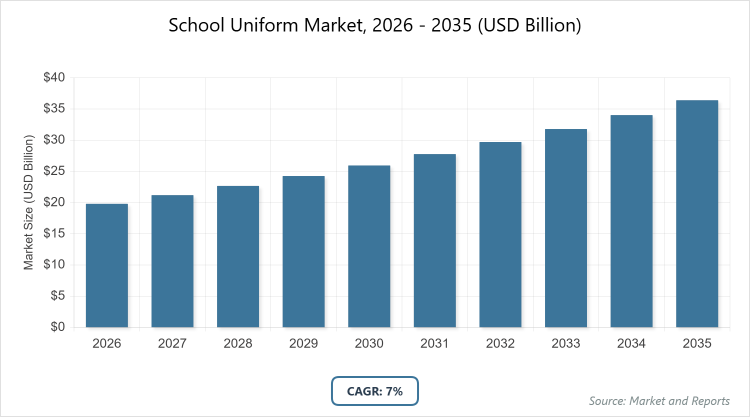
According to MarketnReports, the global school uniform market size was estimated at USD 19.8 billion in 2026 and is expected to reach USD 36.4 billion by 2035, growing at a CAGR of 7.0% from 2026 to 2035. School Uniform Market is driven by rising global school enrollment rates stemming from growing youth populations, particularly in emerging economies, coupled with the widespread enforcement of mandatory uniform policies by educational institutions aimed at fostering discipline, safety, and socioeconomic equality among students.
What are the Key Insights into the School Uniform Market?
- Global school uniform market valued at approximately USD 19.8 billion in 2026, projected to reach USD 36.4 billion by 2035.
- Expected CAGR of around 7.0% from 2026 to 2035, driven by enrollment growth and sustainability trends.
- Dominant subsegment by type: Shirts & blouses, accounting for the largest share due to essential daily wear.
- Dominant subsegment by application: Primary schools, holding over 40% market share for foundational education.
- Dominant subsegment by distribution channel: Offline retail, contributing around 55% revenue for direct inspections.
- Dominant region: Asia-Pacific, contributing over 42% of global revenue with India as the leading country.
What is the School Uniform Industry Overview?
Industry Overview
School uniforms are standardized clothing ensembles mandated by educational institutions to promote equality, discipline, and a sense of community among students, typically consisting of items like shirts, trousers, skirts, blazers, tracksuits, and accessories made from durable fabrics such as cotton, polyester, or blends to withstand daily wear while ensuring comfort and modesty. This market encompasses the design, manufacturing, distribution, and retailing of uniforms tailored for primary, secondary, and higher education levels, serving public, private, and international schools where uniforms foster a focused learning environment and reduce socioeconomic distinctions.
School uniforms are categorized by type, material, age group, and gender, emphasizing features like breathability, wrinkle resistance, and eco-friendliness to meet diverse climatic and cultural needs.The industry involves raw material suppliers for textiles and dyes, manufacturers employing sewing and printing techniques for customization, and distributors through direct school supply, retail outlets, and online platforms, prioritizing quality certifications for safety and sustainability. This market is driven by rising global enrollment rates, institutional policies on dress codes, and consumer trends toward functional apparel, balancing traditional formal wear with sportswear for physical activities in a competitive landscape focused on innovation and ethical production.
What are the Market Dynamics in the School Uniform Sector?
Growth Drivers
The school uniform market is driven by increasing global student enrollment rates, particularly in emerging economies where governments prioritize education infrastructure, leading to higher demand for standardized attire that promotes discipline and equality while aligning with policies aimed at reducing social disparities among students. Rising awareness of sustainability encourages the adoption of eco-friendly fabrics like recycled polyester and organic cotton, supported by consumer preferences for durable, comfortable uniforms that minimize environmental impact amid climate concerns.
Technological advancements in textile manufacturing, such as wrinkle-resistant and UV-protective materials, attract investments from schools seeking long-lasting options, while the expansion of e-commerce platforms facilitates convenient purchasing for parents. Urbanization and the growth of private and international schools further boost the market, as these institutions often mandate branded uniforms to enhance their image and foster a sense of belonging.
Restraints
High production costs associated with sustainable materials and customization limit market growth in low-income regions where affordable generic clothing suffices, compounded by fluctuating raw material prices like cotton that increase expenses for manufacturers. Regulatory variations on dress codes and uniform mandates across countries create compliance challenges, delaying product launches and restricting exports in markets with relaxed policies. Supply chain disruptions from geopolitical tensions affect textile imports, while limited awareness of premium features in rural areas hinders adoption of advanced uniforms. Competition from casual wear trends in schools without strict codes further restrains expansion, as parents opt for versatile clothing over specialized uniforms.
Opportunities
Opportunities arise from the integration of smart technologies like IoT sensors in uniforms for health monitoring, appealing to tech-savvy schools funded by educational grants amid digital learning trends. Expansion into gender-neutral and inclusive designs opens niches for diverse demographics, while partnerships with e-commerce giants enhance global reach for customized options. Innovations in modular uniforms with interchangeable parts reduce replacement costs, unlocking demand in cost-conscious markets supported by sustainability initiatives. Government subsidies for education in Asia and Africa enable bulk procurements, fostering long-term contracts for producers.
Challenges
Ensuring uniform quality across diverse climates and body types poses challenges, requiring R&D for adaptable fabrics amid varying standards. Managing ethical sourcing to avoid child labor in textile supply chains demands monitoring, while counterfeit products erode trust in branded uniforms. Regulatory inconsistencies on safety certifications complicate international trade, and economic downturns reduce school budgets for updates. Balancing affordability with innovation in competitive bids remains a hurdle amid price sensitivity.
School Uniform Market: Report Scope
| Report Attributes | Report Details |
| Report Name | School Uniform Market |
| Market Size 2026 | USD 19.8 billion |
| Market Forecast 2035 | USD 36.4 billion |
| Growth Rate | CAGR of 7.0% |
| Report Pages | 235 |
| Key Companies Covered | LT Apparel Group, French Toast, Dennis Uniform, Trutex Limited, Elder Manufacturing Company, Lands’ End, and FlynnO’Hara Uniforms |
| Segments Covered | By Type, Application, Distribution Channel and Region |
| Regions Covered | North America, Europe, Asia Pacific (APAC), Latin America, The Middle East and Africa (MEA) |
| Base Year | 2025 |
| Historical Year | 2020 – 2024 |
| Forecast Year | 2026 – 2035 |
| Customization Scope | Avail customized purchase options to meet your exact research needs. |
How is the School Uniform Market Segmented?
The School Uniform market is segmented by type, application, distribution channel, and region.
By Type, The shirts & blouses segment dominates the school uniform market, primarily because of their versatility, daily wear requirement, and role as the core uniform component across all age groups where breathable fabrics ensure comfort in classrooms, supported by high customization demand. This dominance drives the market by enabling mass production with varied designs, reducing costs through economies of scale, and aligning with school branding, thereby expanding adoption through essential purchases.
The trousers & shorts segment ranks second, essential for mobility and weather adaptability in active environments, helping to propel market growth by catering to gender-specific needs, enhancing durability for long-term use, and supporting seasonal variations in emerging regions.
By Application, Primary schools lead the application segment, as uniforms foster early discipline and equality in foundational education where high enrollment rates require standardized attire, driven by government policies. This subsegment drives the market by synchronizing with population growth, promoting bulk procurements, and complying with safety norms, thus increasing demand globally. Secondary schools follow as the second dominant, utilized for adolescent identity and focus where uniforms reduce distractions, contributing to market expansion through higher student numbers, enhancing customization, and tapping into private institution trends.
By Distribution Channel, Offline retail dominates the distribution channel segment, favored for tactile inspections and bulk fittings in stores where quality assurance is key, supported by school partnerships. This leadership accelerates market growth by facilitating immediate sales, building trust through local vendors, and ensuring fit in rural areas. Online ranks second, providing convenient access for parents via e-commerce, helping to drive the market through digital marketing, enabling global reach, and supporting personalized orders.
What are the Recent Developments in the School Uniform Market?
- In August 2025, George at Asda launched a new and improved school uniform range designed to address parental concerns regarding comfort and durability, incorporating wrinkle-resistant fabrics and reinforced seams to extend wear life, targeting the UK market amid rising back-to-school demands.
- In February 2025, Trutex announced a major expansion of its sustainable schoolwear collection, introducing uniforms made from 100% recycled polyester to meet growing eco-conscious consumer preferences, positioning the company for increased market share in Europe and Asia.
- In August 2024, Banner Ltd published its Annual Impact Report, outlining ambitious sustainability targets including 100% sustainable fabrics by 2025, influencing industry standards and attracting environmentally focused schools globally.
What is the Regional Analysis of the School Uniform Market?
- Asia-Pacific to dominate the market
Asia-Pacific dominates the global school uniform market, driven by massive student populations, mandatory uniform policies in most countries, and rapid urbanization increasing enrollment in private schools, with India as the dominating country due to its over 1.5 million schools and government initiatives like Sarva Shiksha Abhiyan promoting education access for 250 million students. The region’s growth is supported by China’s manufacturing hubs and Southeast Asia’s export focus; Japan’s tech-integrated uniforms contribute, but India’s dominance stems from its low-cost production, cultural emphasis on discipline, and export to neighboring countries, boosting revenue through high-volume primary and secondary applications amid population growth.
North America holds a substantial share in the school uniform market, characterized by debates on policies and adoption in private schools, with the United States as the dominating country owing to its 20% public schools requiring uniforms and premium branding in charter institutions serving 130 million students. The region benefits from Canada’s inclusive designs; the U.S. leads with consumer trends toward sustainable fabrics, enhancing market expansion via e-commerce and aftermarket sales.
Europe exhibits steady growth in the school uniform market, focused on traditional policies and sustainability, with the United Kingdom as the dominating country due to its widespread uniform mandates in 90% of schools and government caps on branded items to reduce costs for 8 million students. The region is propelled by France’s relaxed codes and Germany’s vocational focus; the UK’s leadership arises from exports and green initiatives, fostering market development by addressing affordability.
The Rest of the World shows emerging potential in the school uniform market, with Brazil dominating in Latin America through public school mandates and cultural uniformity, while South Africa leads in Africa with post-apartheid policies. Growth is driven by Middle East private schools in UAE; the region’s progress relies on aid and partnerships, increasing share in education expansions.
Who are the Key Market Players and Their Strategies in the School Uniform Industry?
LT Apparel Group: Focuses on sustainable fabrics, expanding through eco-certifications and partnerships for recycled polyester lines.
French Toast: Emphasizes affordable designs, investing in wrinkle-resistant tech and FDA collaborations for U.S. markets.
Dennis Uniform: Prioritizes stem cell innovations, acquiring startups for regenerative materials in premium segments.
Trutex Limited: Concentrates on sustainable expansions, launching recycled collections for Europe and Asia.
Elder Manufacturing Company: Adopts customization strategies, targeting secondary schools with modular components.
Lands’ End: Utilizes e-commerce growth, investing in AI sizing tools for online sales.
FlynnO’Hara Uniforms: Employs direct-to-school supply, focusing on bulk contracts with institutions.
What are the Current Market Trends in the School Uniform Sector?
- Integration of IoT sensors for health monitoring in smart uniforms.
- Shift toward sustainable fabrics like recycled polyester and organic cotton.
- Rise in gender-neutral and inclusive designs for diverse demographics.
- Growth in modular uniforms with interchangeable components for customization.
- Expansion of e-commerce and AI-powered sizing tools for convenient purchasing.
- Focus on wrinkle-resistant and UV-protective materials for durability.
What Market Segments are Covered in the Report?
By Type
-
- Shirts & Blouses
- Trousers & Shorts
- Skirts & Dresses
- Blazers & Sweaters
- Sportswear & Tracksuits
By Application
-
- Primary Schools
- Secondary Schools
- Higher Education
By Distribution Channel
-
- Offline Retail
- Online Platforms
- Direct-to-School Supply
By Region
-
- North America
- U.S.
- Canada
- Europe
- UK
- Germany
- France
- Rest of Europe
- Asia Pacific
- China
- India
- Japan
- Rest of Asia Pacific
- Latin America
- Brazil
- Mexico
- Rest of Latin America
- Middle East & Africa
- UAE
- South Africa
- Rest of Middle East & Africa
- North America
Chapter 1. Preface
Chapter 2. Executive Summary
Chapter 3. Global School Uniform Market - Industry Analysis
Chapter 4. Global School Uniform Market- Competitive Landscape
Chapter 5. Global School Uniform Market - Type Analysis
Chapter 6. Global School Uniform Market - Application Analysis
Chapter 7. Global School Uniform Market - Distribution Channel Analysis
Chapter 8. School Uniform Market - Regional Analysis
Chapter 9. Company Profiles
Frequently Asked Questions
School uniforms are standardized clothing worn by students in educational institutions to promote equality, discipline, and identity, typically including shirts, trousers, skirts, and accessories made from durable fabrics.
Key factors include rising enrollment, sustainability trends, technological integrations, and government policies on education.
The school uniform market is projected to grow from approximately USD 19.8 billion in 2026 to USD 36.4 billion by 2035.
The CAGR for the school uniform market during 2026-2035 is expected to be around 7.0%, driven by global demands.
Asia-Pacific will contribute notably, accounting for over 42% of the market value, led by India.
Major players include LT Apparel Group, French Toast, Dennis Uniform, Trutex Limited, Elder Manufacturing Company, Lands' End, and FlynnO'Hara Uniforms.
The global school uniform market report provides insights into size, segmentation, dynamics, regional analysis, players, trends, and forecasts.
The value chain includes fabric sourcing, design and manufacturing, quality testing, distribution, and retail sales.
Market trends are evolving toward sustainable and smart uniforms, with preferences shifting to comfortable, customizable options.
Regulatory factors include dress code policies, while environmental factors involve sustainability mandates, driving eco-innovations but increasing costs.