
Same-day Delivery Market Size, Share and Trends 2026 to 2035
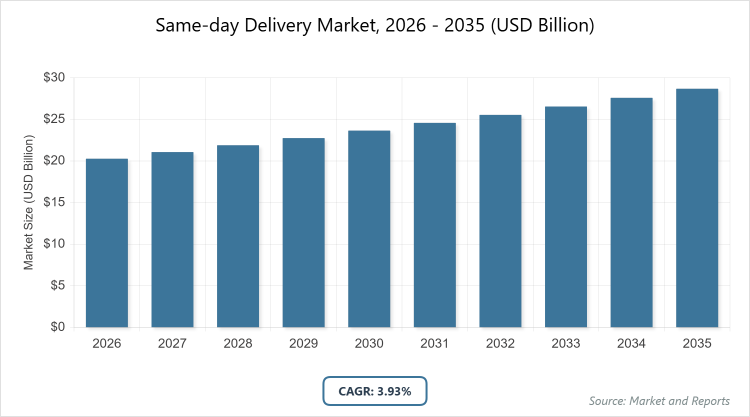
According to MarketnReports, the global Same-day Delivery market size was estimated at USD 20.27 billion in 2025 and is expected to reach USD 29.8 billion by 2035, growing at a CAGR of 3.93% from 2026 to 2035. Same-day Delivery Market is driven by technological advancements and rising consumer demand for immediate gratification.
What is Same-day Delivery? An Industry Overview
Same-day delivery refers to logistics services that enable the shipment and receipt of goods within the same day, leveraging advanced supply chain technologies, urban fulfillment centers, and optimized last-mile solutions to meet consumer expectations for speed and convenience. The market definition includes services encompassing e-commerce fulfillment, food and grocery delivery, pharmaceutical shipments, and business-to-business logistics, often integrated with real-time tracking, AI-driven routing, and sustainable practices to enhance efficiency and customer satisfaction. This industry supports the evolving retail landscape by bridging online and offline commerce, reducing inventory holding costs, and enabling just-in-time delivery models in densely populated urban areas.
What are the Key Insights of Same-day Delivery Market?
- The global Same-day Delivery market was valued at USD 20.27 billion in 2025 and is projected to reach USD 29.8 billion by 2035.
- The global Same-day Delivery market is expected to grow at a CAGR of 3.93% during the forecast period 2026-2035.
- The Same-day Delivery market is driven by e-commerce expansion, urbanization, and technological innovations in logistics.
- The same-day delivery subsegment dominates the service type segment with a 40% share due to high consumer demand for immediate fulfillment in urban areas.
- The e-commerce subsegment dominates the application segment with a 45% share owing to reliance on quick order processing for online retail competitiveness.
- The retail subsegment dominates the end-use segment with a 35% share because of the need for rapid inventory turnover and customer satisfaction.
- North America dominates the global Same-day Delivery market with a 50% share attributed to high e-commerce penetration and advanced logistics infrastructure in the U.S.
What are the Market Dynamics of Same-day Delivery?
Growth Drivers
The same-day delivery market is fueled by the explosive growth of e-commerce platforms, where consumers increasingly expect instant gratification, prompting retailers like Amazon to invest in micro-fulfillment centers and AI-optimized routes to reduce delivery times to hours. Urbanization in emerging economies amplifies demand, as dense populations enable efficient last-mile operations using electric vehicles and drones, supported by government incentives for green logistics. Additionally, the integration of real-time data analytics and mobile apps enhances visibility, allowing providers to manage high-volume orders effectively, thereby improving service reliability and fostering customer loyalty in competitive retail environments.
Restraints
High operational costs associated with maintaining extensive urban networks, including labor, fuel, and technology infrastructure, constrain market expansion, particularly for smaller providers unable to scale efficiently. Regulatory hurdles, such as restrictions on drone usage and urban traffic congestion policies, limit innovation and increase compliance burdens. Moreover, supply chain vulnerabilities, exacerbated by global events like pandemics or fuel shortages, disrupt service consistency, leading to higher denial rates and eroding consumer trust in time-sensitive deliveries.
Opportunities
The adoption of sustainable practices, such as electric fleets and eco-friendly packaging, opens avenues for differentiation in environmentally conscious markets, with partnerships between retailers and logistics firms enabling carbon-neutral services. Expansion into underserved suburban and rural areas through hybrid models combining drones and ground transport presents growth potential, especially in developing regions with rising smartphone penetration. Furthermore, leveraging AI for predictive demand forecasting can optimize inventory and reduce waste, creating new revenue streams via premium subscription models for frequent users.
Challenges
Intense competition from established giants like UPS and new entrants like local startups fragments the market, requiring continuous investment in technology to maintain service quality amid pricing pressures. Adapting to health and safety protocols, such as contactless options, adds operational complexity, particularly in regions with varying regulatory standards. Additionally, ensuring supply chain resilience against disruptions demands robust contingency planning, which can strain resources for providers balancing speed with cost-effectiveness.
Same-day Delivery Market: Report Scope
| Report Attributes | Report Details |
| Report Name | Same-day Delivery Market |
| Market Size 2025 | USD 20.27 Billion |
| Market Forecast 2035 | USD 29.8 Billion |
| Growth Rate | CAGR of 3.93% |
| Report Pages | 220 |
| Key Companies Covered |
Amazon, DHL, FedEx, UPS, DoorDash, Instacart, and Others |
| Segments Covered | By Service Type, By Application, By End-Use, and By Region |
| Regions Covered | North America, Europe, Asia Pacific (APAC), Latin America, and The Middle East and Africa (MEA) |
| Base Year | 2025 |
| Historical Year | 2020 – 2024 |
| Forecast Year | 2026 – 2035 |
| Customization Scope | Avail customized purchase options to meet your exact research needs. |
The Same-day Delivery market is segmented by service type, application, end-use, and region.
Based on Service Type Segment: The same-day delivery segment is the most dominant, holding a 40% market share, as it caters directly to consumer demands for immediate access to goods, driven by e-commerce giants investing in fulfillment infrastructure. This dominance drives market growth by enabling retailers to compete on speed, increasing order volumes and customer retention. The express delivery segment is the second most dominant with a 25% share, offering urgent options for high-value items, which propels the market through premium pricing and specialized logistics.
Based on Application Segment: The e-commerce segment is the most dominant, capturing a 45% share, due to the surge in online shopping requiring fast fulfillment to reduce cart abandonment. Its dominance accelerates market growth by integrating with platforms for seamless tracking and returns. The food delivery segment ranks second with a 30% share, fueled by on-demand apps, driving the market with high-frequency urban orders.
Based on End-Use Segment: The retail segment is the most dominant, with a 35% share, attributed to the need for quick stock replenishment and consumer convenience in omnichannel strategies. This leads market growth by supporting inventory optimization and sales boosts. The healthcare segment is second with a 20% share, ensuring timely medical supply deliveries, propelling growth through regulatory compliance and emergency needs.
What are the Recent Developments in Same-day Delivery Market?
- In October 2025, Amazon expanded its drone delivery service in urban areas, launching new hubs to enable faster same-day options for lightweight packages.
- In September 2025, FedEx enhanced its partnerships with local retailers, improving its network for reliable same-day fulfillment.
- In November 2025, DHL committed to carbon neutrality by 2030, integrating green logistics into its same-day services.
- In August 2025, DoorDash acquired a tech startup for AI route optimization, boosting efficiency in food delivery.
- In December 2025, Instacart introduced subscription-based same-day grocery models, targeting frequent users for enhanced convenience.
What is the Regional Analysis of Same-day Delivery Market?
- North America to dominate the global market
North America commands a 50% share in the Same-day Delivery market, bolstered by high e-commerce activity and technological infrastructure. The United States dominates, with companies like Amazon and FedEx leading through extensive urban networks and regulatory support for logistics innovation in states like California.
Europe holds a significant position in the Same-day Delivery market, driven by consumer preferences for quick service. The UK leads, with NHS and retail integrations promoting efficient deliveries, aligned with GDPR and sustainability goals.
Asia-Pacific is the fastest-growing region for Same-day Delivery, propelled by urbanization and e-commerce. China dominates, with platforms like Alibaba leveraging massive consumer bases and tech for rapid urban fulfillment.
Latin America is emerging in the Same-day Delivery market, focusing on e-commerce expansion. Brazil leads, adopting services for urban centers to improve billing accuracy in public health.
The Middle East and Africa exhibit potential in Same-day Delivery, emphasizing smart city initiatives. The UAE is a key player, integrating services in Dubai for seamless retail and logistics.
Who are the Key Market Players and Strategies in Same-day Delivery?
Amazon leverages its logistics network for urban expansion, focusing on drone and AI technologies.
DHL emphasizes sustainability, committing to carbon-neutral operations through green fleets.
FedEx invests in partnerships, enhancing retailer networks for reliable fulfillment.
UPS pursues supply chain optimization, integrating AI for route efficiency.
DoorDash acquires tech for food delivery, boosting on-demand capabilities.
Instacart develops subscription models, targeting grocery for consumer loyalty.
What are the Market Trends in Same-day Delivery?
- Integration of AI for route optimization and real-time tracking.
- Shift toward sustainable practices with electric vehicles.
- Growth in subscription-based models for frequent deliveries.
- Expansion of drone networks in urban areas.
- Emphasis on contactless and health-safe options.
- Adoption of automated warehousing for efficiency.
What are the Market Segments and their Subsegment Covered in the Same-day Delivery Report?
By Service Type
-
- Same-day Delivery
- Express Delivery
- Standard Delivery
- Scheduled Delivery
- Contactless Delivery
- Priority Delivery
- Overnight Delivery
- Instant Delivery
- Time-Sensitive Delivery
- Eco-Friendly Delivery
- Others
By Application
-
- E-commerce
- Food Delivery
- Grocery Delivery
- Pharmaceutical Delivery
- Document Delivery
- Retail Delivery
- Courier Services
- Logistics Services
- B2B Delivery
- C2C Delivery
- Others
By End-Use
-
- Retail
- Healthcare
- Manufacturing
- Logistics
- Consumer Goods
- E-commerce Platforms
- Food & Beverage
- Pharmaceuticals
- Government
- Education
- Others
By Region
-
- North America
- U.S.
- Canada
- Europe
- UK
- Germany
- France
- Rest of Europe
- Asia Pacific
- China
- India
- Japan
- Rest of Asia Pacific
- Latin America
- Brazil
- Mexico
- Rest of Latin America
- Middle East & Africa
- UAE
- South Africa
- Rest of Middle East & Africa
- North America
Chapter 1. Preface
Chapter 2. Executive Summary
Chapter 3. Global Same-day Delivery Market - Industry Analysis
Chapter 4. Global Same-day Delivery Market- Competitive Landscape
Chapter 5. Global Same-day Delivery Market - Service Type Analysis
Chapter 6. Global Same-day Delivery Market - Application Analysis
Chapter 7. Global Same-day Delivery Market - End-Use Analysis
Chapter 8. Same-day Delivery Market - Regional Analysis
Chapter 9. Company Profiles
Frequently Asked Questions
Same-day Delivery refers to logistics services enabling shipment and receipt of goods within the same day, focusing on speed and convenience.
Key factors include e-commerce growth, technological advancements, and urbanization.
The market is projected to grow from USD 21.07 billion in 2026 to USD 29.8 billion by 2035.
The market is expected to grow at a CAGR of 3.93% during 2026-2035.
North America will contribute notably, holding a 50% share due to advanced infrastructure.
Major players include Amazon, DHL, FedEx, UPS, DoorDash, and Instacart.
The report provides market size, trends, segmentation, regional insights, key players, and forecasts.
Stages include order placement, fulfillment, transportation, last-mile delivery, and customer receipt.
Trends emphasize AI and sustainability, with consumers preferring fast, eco-friendly options.
Urban mobility regulations and sustainability mandates drive green innovations.