
Road Sweeper Market Size, Share and Trends 2026 to 2035
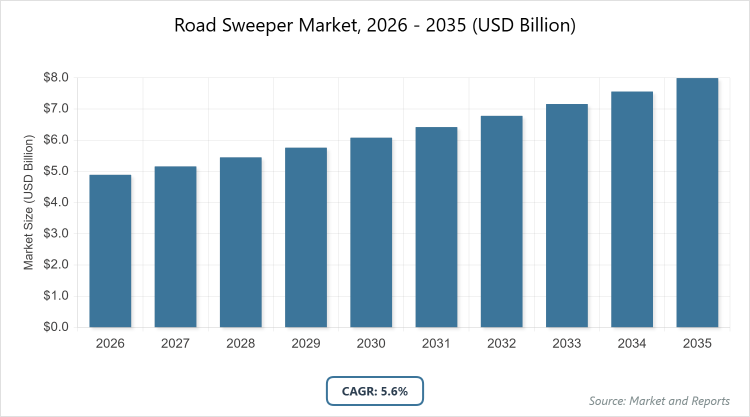
According to MarketnReports, the global Road Sweeper market size was estimated at USD 4.89 billion in 2025 and is expected to reach USD 8.78 billion by 2035, growing at a CAGR of 5.6% from 2026 to 2035. Road Sweeper Market is driven by rapidly growing urbanization worldwide.
What are the Key Insights of Road Sweeper Market?
- The global road sweeper market is valued at USD 4.89 billion in 2025 and is projected to reach USD 8.78 billion by 2035.
- The market is anticipated to grow at a CAGR of 5.6% during the forecast period from 2026 to 2035.
- The market is driven by rapid urbanization, stringent environmental regulations, and advancements in electric and autonomous sweeper technologies.
- In the product type segment, truck-mounted sweeper dominates with approximately 50% share due to its higher capacity for large-scale cleaning operations and premium pricing, making it suitable for extensive road networks and contributing significantly to revenue.
- In the propulsion segment, diesel dominates with around 54% share because of its reliability, power for heavy-duty tasks, and established infrastructure, despite growing shifts toward greener alternatives.
- In the end-use segment, municipal corporation holds the leading position with about 46% share owing to government mandates for public hygiene, smart city initiatives, and large-scale urban cleaning requirements.
- Asia Pacific region dominates with approximately 35% market share, driven by massive infrastructure development, smart city projects in countries like China and India, and increasing focus on pollution control.
What is Road Sweeper Market?
The road sweeper market encompasses equipment designed for cleaning streets, roads, highways, and other public or industrial surfaces by removing debris, dust, and contaminants. This market includes various types of sweepers that utilize mechanical, vacuum, or air-based systems to maintain cleanliness and hygiene in urban, municipal, and industrial environments. Market definition refers to the industry involved in the manufacturing, distribution, and utilization of these specialized vehicles, which are essential for environmental compliance, public health, and infrastructure maintenance.
What are the Market Dynamics in Road Sweeper Industry?
Growth Drivers
Rapid urbanization and population growth in developing regions are key growth drivers, as they increase the need for efficient road cleaning to manage higher levels of waste and contaminants on expanding road networks. Investments in smart city projects further accelerate demand for advanced sweepers equipped with IoT and automation for optimized operations.
Restraints
High initial costs of advanced road sweepers, particularly electric and hybrid models, act as a significant restraint, limiting adoption in budget-constrained municipalities and developing economies where manual labor or outdated equipment remains prevalent. Additionally, the lack of widespread charging infrastructure for electric variants hinders market penetration in rural or less-developed areas.
Opportunities
The shift toward sustainable and zero-emission vehicles presents substantial opportunities, with governments offering subsidies for electric sweepers and retrofitting programs to convert diesel models. Emerging markets in Asia and Latin America offer growth potential through infrastructure expansions and increasing awareness of environmental health.
Challenges
Stringent and varying regional regulations on emissions and safety standards pose challenges for manufacturers, increasing production costs and complicating global supply chains. Labor shortages for skilled operators of high-tech sweepers, combined with resistance to automation in labor-intensive regions, further impede smooth market expansion.
Road Sweeper Market: Report Scope
| Report Attributes | Report Details |
| Report Name | Road Sweeper Market |
| Market Size 2025 | USD 4.89 Billion |
| Market Forecast 2035 | USD 8.78 Billion |
| Growth Rate | CAGR of 5.6% |
| Report Pages | 230 |
| Key Companies Covered |
Johnston Sweepers Limited, Dulevo International S.p.A., Hako GmbH, Nilfisk Group, Bucher Industries AG, Elgin Sweeper Company, Boschung Group, Tennant Company, Aebi Schmidt Holding AG, TYMCO Inc., and Others |
| Segments Covered | By Product Type, By Propulsion, By End-Use, and By Region |
| Regions Covered | North America, Europe, Asia Pacific (APAC), Latin America, and The Middle East and Africa (MEA) |
| Base Year | 2025 |
| Historical Year | 2020 – 2024 |
| Forecast Year | 2026 – 2035 |
| Customization Scope | Avail customized purchase options to meet your exact research needs. |
How is Road Sweeper Market Segmented?
The Road Sweeper market is segmented by product type, propulsion, end-use, and region.
Based on Product Type Segment. The truck-mounted sweeper is the most dominant subsegment, holding about 50% share, while compact sweeper is the second most dominant with around 40%. Truck-mounted sweepers dominate due to their ability to handle large volumes of debris over extensive areas like highways and urban roads, driving the market by enabling efficient, high-capacity cleaning that supports large-scale municipal and industrial projects; compact sweepers, as the second dominant, excel in maneuverability for narrow streets and residential areas, contributing to market growth through accessibility in densely populated urban zones and cost-effectiveness for smaller operations.
Based on Propulsion Segment. Diesel is the most dominant subsegment with approximately 54% share, followed by electric as the second most dominant at about 30%. Diesel dominates because of its proven durability, high torque for demanding tasks, and widespread fuel availability, propelling the market forward by ensuring reliable performance in heavy-duty applications across diverse terrains; electric, as the second dominant, gains traction through zero-emission benefits and government incentives, boosting market expansion by aligning with sustainability goals and reducing operational costs in urban environments.
Based on End-Use Segment. Municipal corporation is the most dominant subsegment, capturing around 46% share, with industrial as the second most dominant at roughly 25%. Municipal corporation dominates owing to regulatory requirements for public sanitation and smart city integrations, driving the market by facilitating large fleet deployments that enhance urban hygiene and air quality; industrial, the second dominant, thrives on needs for dust control in factories and ports, advancing the market through specialized cleaning solutions that ensure compliance and operational safety in high-contaminant settings.
What are the Recent Developments in Road Sweeper Market?
- In October 2020, Trombia Technologies launched the world’s first autonomous, high-power electric street sweeper in Finland, designed to reduce annual CO2 emissions by 3 million metric tons through efficient, emission-free operations.
- In June 2023, Modine partnered with Elgin Sweeper Company to integrate the EVantage L-CON Battery Thermal Management System into hybrid Pelican three-wheeled sweepers, enhancing battery performance and sustainability for urban cleaning.
- In September 2023, the Municipal Corporation of Delhi appointed a consultant for a INR 62 crore project focused on mechanical road cleaning, aiming to improve efficiency and coverage in public areas.
- In March 2025, Nilfisk introduced the CS7500 Combination Sweeper-Scrubber, featuring an intuitive touchscreen and ergonomic design to boost industrial cleaning efficiency and sustainability.
- In January 2025, Boschung unveiled the Urban-Sweeper S2.0 MAX, a fully electric urban maintenance vehicle, expanding their portfolio of eco-friendly solutions for municipal use.
Which Region Dominates Road Sweeper Market?
Asia Pacific to dominate the global market.
Asia Pacific is set to lead the road sweeper market, driven by extensive smart city initiatives and infrastructure growth in China and India, where China dominates as the key country due to its massive urban population and government-backed projects like the involvement of 80% of major cities in smart developments, fostering demand for advanced sweepers to combat pollution.
Europe holds a strong position with a focus on environmental regulations and innovations, where Germany dominates as the primary country through stringent air quality standards and investments in electric and autonomous technologies, supporting market growth via policies like the Next Generation EU recovery plan for modernizing sanitation equipment.
North America exhibits robust growth potential, led by the United States as the dominating country, fueled by infrastructure investments such as the USD 673.8 billion under the Infrastructure Investment and Jobs Act, emphasizing hybrid and electric sweepers for urban mobility and public health.
Latin America shows promising expansion, with Brazil as the leading country, supported by large road networks and hygiene improvements in urban centers, contributing to market development through increased adoption in municipal and airport sectors.
Middle East & Africa is emerging, dominated by the UAE particularly Dubai, due to advanced hygiene services and tourism-driven cleanliness needs, enhancing the market via investments in low-emission equipment for sustainable urban management.
Who are the Key Market Players in Road Sweeper Industry?
- Johnston Sweepers Limited. This player focuses on innovative product launches and expansions in electric sweepers, employing strategies like partnerships for technology integration to enhance efficiency and meet emission standards, thereby strengthening their position in municipal markets.
- Dulevo International S.p.A.. Emphasizing sustainability, the company invests in R&D for low-noise and zero-emission models, utilizing global distribution networks and acquisitions to expand market reach and cater to industrial end-users.
- Hako GmbH. Hako adopts strategies centered on digitalization, incorporating IoT for fleet management, and collaborates with governments for smart city projects to drive adoption of autonomous sweepers.
- Nilfisk Group. The firm pursues growth through product diversification, such as combination sweeper-scrubbers, and strategic alliances for battery technology to target urban and industrial cleaning needs.
- Bucher Industries AG. Bucher leverages mergers and technological advancements in regenerative air systems, focusing on cost-effective solutions and regional expansions to dominate in Europe and Asia.
- Elgin Sweeper Company. Strategies include hybrid technology integrations and U.S.-based manufacturing expansions, partnering with thermal management providers to offer reliable, eco-friendly sweepers for municipal corporations.
- Boschung Group. This player emphasizes electric vehicle portfolios and launches like urban sweepers, using innovation-driven strategies to comply with regulations and penetrate smart city applications.
- Tennant Company. Tennant focuses on sustainable cleaning solutions through R&D in automation and global supply chain optimizations to serve diverse end-uses effectively.
- Aebi Schmidt Holding AG. The company employs strategies of product customization and investments in autonomous tech, strengthening presence via acquisitions in key regions.
- TYMCO Inc.. TYMCO prioritizes regenerative air innovations and customer-centric strategies, including training programs for operators to enhance market penetration in industrial sectors.
What are the Market Trends in Road Sweeper Industry?
- Transition to electric and hybrid propulsion systems for reduced emissions and compliance with environmental regulations.
- Integration of IoT, GPS, and automation for smart fleet management and route optimization.
- Rise in autonomous sweepers to minimize labor needs and improve efficiency in urban areas.
- Growing demand for low-noise models suitable for residential and nighttime operations.
- Adoption of regenerative air technology for energy-efficient cleaning and air recycling.
- Focus on retrofitting diesel sweepers to low-emission variants through government incentives.
- Expansion in smart city projects incorporating data analytics for predictive maintenance.
- Increasing use in industrial applications for hazardous debris control and safety.
- Shift toward zero-emission hydrogen-powered options in advanced markets.
- Emphasis on operator training and ergonomic designs to address labor shortages.
What Market Segments and Subsegments are Covered in Road Sweeper Report?
-
By Product Type
- Mechanical Broom Sweeper
- Regenerative-Air Sweeper
- Vacuum Sweeper
- Others
-
By Propulsion
- Diesel
- Electric
- CNG/Gasoline
- Others
-
By End-Use
- Municipal Corporation
- Industrial
- Others
-
By Region
- North America
- U.S.
- Canada
- Europe
- UK
- Germany
- France
- Rest of Europe
- Asia Pacific
- China
- India
- Japan
- Rest of Asia Pacific
- Latin America
- Brazil
- Mexico
- Rest of Latin America
- Middle East & Africa
- UAE
- South Africa
- Rest of Middle East & Africa
- North America
Frequently Asked Questions
Road sweepers are specialized vehicles equipped with brushes, vacuums, or air systems to clean streets, roads, and surfaces by removing debris, dust, and pollutants, essential for maintaining hygiene and environmental standards.
Key factors include rapid urbanization, stringent environmental regulations, advancements in electric and autonomous technologies, smart city developments, and infrastructure investments in emerging markets.
The market is projected to grow from an estimated value post-2025 to USD 8.78 billion by 2035.
The CAGR is expected to be 5.6% during the forecast period.
Asia Pacific will contribute notably, driven by urbanization and smart city projects in China and India.
Major players include Johnston Sweepers Limited, Dulevo International S.p.A., Hako GmbH, Nilfisk Group, Bucher Industries AG, Elgin Sweeper Company, Boschung Group, Tennant Company, Aebi Schmidt Holding AG, and TYMCO Inc.
The report provides comprehensive analysis including market size, trends, segments, regional insights, key players, drivers, restraints, opportunities, and forecasts.
Stages include raw material sourcing, manufacturing of components like brooms and suction systems, assembly of sweepers, distribution through dealers, end-user deployment, and after-sales maintenance services.
Trends are shifting toward sustainable electric models, automation, and low-noise operations, with consumers preferring eco-friendly, efficient solutions aligned with smart city and emission reduction goals.
Factors include strict emission standards like California's Rule 1186, subsidies for zero-emission vehicles, and regulations on air quality that promote the adoption of low-emission sweepers.