
Respiratory Diagnostics Market Size, Share and Trends 2026 to 2035
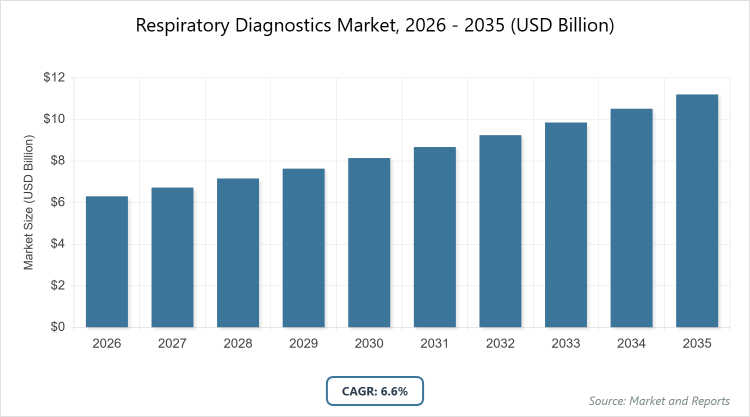
According to MarketnReports, the global Respiratory Diagnostics Market size was estimated at USD 6.3 Billion in 2025 and is expected to reach USD 12 Billion by 2035, growing at a CAGR of 6.6% from 2026 to 2035. Respiratory Diagnostics Market is driven by rising prevalence of respiratory diseases due to pollution, aging population, and technological advancements in diagnostic tools.
What is the Industry Overview of Respiratory Diagnostics Market?
The respiratory diagnostics market encompasses tools, tests, and services used to identify and monitor conditions affecting the lungs and airways, such as chronic obstructive pulmonary disease (COPD), asthma, and infections. Market definition includes diagnostic devices like spirometers and imaging systems, assays for molecular detection, and software for data analysis, all aimed at early detection, disease management, and improving patient outcomes in clinical and home settings. This industry integrates advancements in biotechnology and imaging to address global health challenges from environmental factors and lifestyle changes.
What are the Key Insights into Respiratory Diagnostics Market?
- The global Respiratory Diagnostics Market was valued at USD 6.3 Billion in 2025 and is projected to reach USD 12 Billion by 2035.
- The market is expected to grow at a CAGR of 6.6% during the forecast period from 2026 to 2035.
- The market is driven by increasing prevalence of respiratory diseases, technological innovations in molecular and imaging diagnostics, and rising demand for point-of-care testing.
- In the Product Type segment, Instruments and Devices dominate with a 55% share due to their essential role in accurate, real-time lung function assessment and widespread adoption in healthcare facilities.
- In the Test Type segment, IVD Tests dominate with a 45% share because of their high sensitivity in detecting pathogens and biomarkers, enabling rapid and precise diagnosis of infectious and chronic conditions.
- In the Disease Indication segment, COPD dominates with a 35% share owing to its high global incidence linked to smoking and pollution, driving demand for ongoing monitoring and management tools.
- In the End-User segment, Hospitals and Clinics dominate with a 60% share as they serve as primary points for comprehensive diagnostic procedures and handle a large volume of acute and chronic cases.
- North America dominates the regional market with a 42% share due to advanced healthcare infrastructure, high disease prevalence, and strong investment in R&D and technology adoption.
What are the Market Dynamics of Respiratory Diagnostics Market?
Growth Drivers
The primary growth drivers include the escalating global burden of respiratory diseases, fueled by air pollution, tobacco use, and an aging population susceptible to conditions like COPD and asthma. Technological advancements, such as multiplex PCR for simultaneous pathogen detection and AI-integrated imaging for enhanced accuracy, are accelerating adoption. Additionally, increased healthcare spending in emerging economies and government initiatives for early disease screening are propelling market expansion by improving accessibility and diagnostic efficiency.
Restraints
High costs associated with advanced diagnostic equipment, including molecular testing kits and imaging systems, pose significant barriers, particularly in low-income regions where healthcare budgets are limited. Stringent regulatory approvals for new devices delay market entry and increase development expenses. Furthermore, a shortage of skilled professionals to operate sophisticated tools and interpret results hinders widespread implementation, restricting growth in underserved areas.
Opportunities
Emerging opportunities lie in the development of portable, point-of-care diagnostics that enable home-based testing, catering to the growing demand for remote monitoring amid telemedicine’s rise. Expansion into untapped markets in Asia-Pacific and Latin America, driven by urbanization and improving healthcare access, offers substantial potential. Integration of digital health solutions, like wearable sensors for continuous respiratory tracking, could open new revenue streams by enhancing personalized care and preventive strategies.
Challenges
Key challenges encompass limited healthcare infrastructure in developing regions, leading to unequal access to diagnostics and delayed treatments. Evolving pathogen resistance and the need for frequent updates to testing protocols complicate standardization. Moreover, data privacy concerns with digital diagnostic platforms and supply chain disruptions for reagents and components can impede consistent market progress and reliability.
Respiratory Diagnostics Market: Report Scope
| Report Attributes | Report Details |
| Report Name | Respiratory Diagnostics Market |
| Market Size 2025 | USD 6.3 Billion |
| Market Forecast 2035 | USD 12 Billion |
| Growth Rate | CAGR of 6.6% |
| Report Pages | 220 |
| Key Companies Covered |
Koninklijke Philips N.V., Becton, Dickinson and Company, Abbott Laboratories, Thermo Fisher Scientific Inc., bioMérieux SA, Seegene Inc., Hologic, Inc., QuidelOrtho Corporation, Revvity, COSMED srl, and Others |
| Segments Covered | By Product Type, By Test Type, By Disease Indication, By End-User, and By Region |
| Regions Covered | North America, Europe, Asia Pacific (APAC), Latin America, and The Middle East and Africa (MEA) |
| Base Year | 2025 |
| Historical Year | 2020 – 2024 |
| Forecast Year | 2026 – 2035 |
| Customization Scope | Avail customized purchase options to meet your exact research needs. |
What is the Market Segmentation of Respiratory Diagnostics Market?
The Respiratory Diagnostics Market is segmented by Product Type, Test Type, Disease Indication, End-User, and region. All the segments have been analyzed based on present and future trends and the market is estimated from 2026 to 2035.
Based on Product Type Segment: Instruments and Devices emerge as the most dominant subsegment, followed by Assays and Reagents as the second most dominant. Instruments and Devices lead due to their critical function in providing immediate, quantifiable insights into lung capacity and airflow, which are foundational for diagnosing a range of respiratory issues; this dominance drives the market by enabling efficient, scalable testing in high-volume settings like hospitals, reducing diagnosis time and supporting better clinical decisions.
Based on Test Type Segment: IVD Tests are the most dominant subsegment, with Imaging Tests as the second most dominant. IVD Tests prevail because of their ability to deliver rapid, molecular-level precision in identifying infections and genetic markers, essential for targeted therapies; this drives market growth by facilitating early intervention in outbreaks and chronic management, minimizing healthcare costs through accurate, non-invasive results.
Based on Disease Indication Segment: COPD is the most dominant subsegment, followed by Asthma as the second most dominant. COPD’s dominance stems from its widespread occurrence in aging and polluted environments, necessitating frequent diagnostic monitoring; it propels the market by increasing demand for specialized tools that aid in progression tracking and treatment optimization, ultimately improving quality of life and reducing hospital admissions.
Based on End-User Segment: Hospitals and Clinics represent the most dominant subsegment, with Diagnostic Centers as the second most dominant. Hospitals and Clinics lead owing to their role as central hubs for acute care and comprehensive evaluations; this drives the market by integrating diagnostics into multidisciplinary treatment plans, enhancing efficiency and outcomes in managing complex respiratory cases.
What are the Recent Developments in Respiratory Diagnostics Market?
- In September 2024, Roche launched the cobas Respiratory flex test, utilizing proprietary TAGS technology for multiplex detection of up to 12 respiratory viruses, improving diagnostic speed and accuracy in clinical settings.
- In February 2025, Ginkgo Bioworks collaborated with the European Health and Digital Executive Agency on the RANGER project, valued at up to €24 million, to develop rapid point-of-care metagenomic sequencing for respiratory viruses, enhancing biosecurity and public health response.
- In January 2025, Polarean Imaging plc partnered with SimonMed Imaging to expand access to Xenon MRI technology, focusing on advanced pulmonary function imaging for better detection of lung diseases like COPD.
- In May 2024, QIAGEN received FDA approval for the QIAstat-Dx Respiratory Panel Plus, a syndromic test detecting 21 viral and bacterial targets in about one hour, supporting faster clinical decisions for upper respiratory infections.
- In June 2024, F. Hoffmann-La Roche obtained FDA Emergency Use Authorization for its cobas liat SARS-CoV-2, Influenza A/B & RSV test, an automated multiplex RT-PCR assay delivering results in 20 minutes for point-of-care use.
What is the Regional Analysis of Respiratory Diagnostics Market?
North America to dominate the global market.
North America leads the market, driven by robust healthcare systems, high R&D investments, and a large patient pool affected by respiratory conditions; the United States dominates within the region due to widespread adoption of advanced technologies like molecular diagnostics and favorable reimbursement policies that encourage early screening.
Europe holds a significant share, supported by strong public health initiatives and aging demographics increasing disease incidence; Germany stands out as the dominating country, benefiting from cutting-edge medical research and efficient regulatory frameworks that facilitate quick integration of innovative diagnostic tools.
Asia-Pacific is experiencing rapid growth, attributed to urbanization, pollution, and expanding healthcare access; China dominates the region, propelled by government efforts to combat air quality issues and invest in diagnostic infrastructure, addressing the rising burden of respiratory infections.
Latin America shows emerging potential, with improvements in medical facilities and awareness campaigns; Brazil is the dominating country, driven by increasing prevalence of tuberculosis and asthma, alongside public-private partnerships enhancing diagnostic capabilities in urban centers.
The Middle East and Africa face growth through international aid and infrastructure development; South Africa dominates, leveraging advanced urban hospitals and initiatives to tackle infectious diseases like tuberculosis, supported by global health collaborations.
What are the Key Market Players and Strategies in Respiratory Diagnostics Market?
Koninklijke Philips N.V. Philips focuses on innovation through AI-enhanced imaging and portable devices, alongside strategic acquisitions like Respironics to expand its portfolio, enabling integrated solutions for home and hospital diagnostics that improve patient monitoring and market penetration.
Becton, Dickinson and Company (BD) BD emphasizes R&D in molecular diagnostics and point-of-care testing, with partnerships for reagent development and global distribution networks, driving growth by offering reliable, scalable solutions for infectious disease detection in diverse healthcare settings.
Abbott Laboratories Abbott pursues expansion via rapid test kits and digital health integrations, including acquisitions like Alere to bolster its immunoassay offerings, which enhance accessibility and speed in diagnosing respiratory conditions, strengthening its competitive edge.
Thermo Fisher Scientific Inc. Thermo Fisher invests in multiplex PCR technologies and supply chain optimization, collaborating with labs for customized assays, which accelerates adoption in research and clinical environments by providing high-throughput, accurate diagnostic tools.
bioMérieux SA bioMérieux adopts a strategy of regulatory compliance and innovation in syndromic panels, with global expansions and tech integrations like AI for result interpretation, facilitating faster pathogen identification and supporting outbreak management.
Seegene Inc. Seegene concentrates on multiplex molecular diagnostics, leveraging proprietary technologies for simultaneous testing, and forms alliances for market entry in emerging regions, boosting efficiency in handling complex respiratory infections.
Hologic, Inc. Hologic prioritizes women’s health integrations and Panther system expansions for automated testing, with focused R&D on viral assays, enabling high-volume processing that reduces turnaround times and enhances diagnostic reliability.
QuidelOrtho Corporation QuidelOrtho merges rapid antigen and molecular platforms, pursuing mergers like the Ortho Clinical Diagnostics acquisition to diversify offerings, which improves point-of-care accessibility and supports rapid response in seasonal outbreaks.
Revvity (formerly PerkinElmer) Revvity focuses on genomics and newborn screening extensions into respiratory diagnostics, with software-driven analytics and global lab partnerships, driving precision medicine approaches for chronic conditions.
COSMED srl COSMED specializes in pulmonary function testing devices, emphasizing ergonomic designs and telehealth compatibility, with European market expansions to address asthma and COPD monitoring needs effectively.
What are the Market Trends in Respiratory Diagnostics Market?
- Integration of AI and machine learning for enhanced image analysis and predictive diagnostics, improving accuracy in detecting subtle lung abnormalities.
- Rise of point-of-care and home-based testing devices, driven by telemedicine growth and patient preference for convenient monitoring.
- Expansion of multiplex syndromic panels capable of detecting multiple pathogens simultaneously, aiding in rapid outbreak response.
- Adoption of wearable sensors and digital apps for continuous respiratory tracking, supporting preventive care in chronic disease management.
- Focus on sustainable manufacturing and eco-friendly reagents to meet regulatory and consumer demands for green healthcare solutions.
- Increasing collaborations between tech firms and diagnostics companies for data analytics and cloud-based result sharing.
What are the Market Segments and their Subsegments Covered in the Respiratory Diagnostics Market Report?
By Product Type
- Spirometers
- Peak Flow Meters
- Pulse Oximeters
- Polysomnographs
- Gas Analyzers
- Imaging Devices
- Molecular Diagnostic Kits
- Immunoassay Kits
- Software Platforms
- Diagnostic Services
- Others
By Test Type
- Spirometry Tests
- Peak Flow Measurement
- Pulse Oximetry
- Polysomnography
- Gas Analysis
- X-ray Imaging
- CT Scans
- Molecular PCR Tests
- Immunoassays
- Traditional Culture Tests
- Others
By Disease Indication
- COPD
- Asthma
- Lung Cancer
- Tuberculosis
- Sleep Apnea
- Infectious Respiratory Diseases
- Bronchitis
- Pneumonia
- Cystic Fibrosis
- Interstitial Lung Disease
- Others
By End-User
- Hospitals
- Clinics
- Diagnostic Laboratories
- Ambulatory Surgical Centers
- Home Care Settings
- Research Institutes
- Physician Offices
- Reference Laboratories
- Urgent Care Centers
- Others
By Region
- North America
- U.S.
- Canada
- Europe
- UK
- Germany
- France
- Rest of Europe
- Asia Pacific
- China
- India
- Japan
- Rest of Asia Pacific
- Latin America
- Brazil
- Mexico
- Rest of Latin America
- Middle East & Africa
- UAE
- South Africa
- Rest of Middle East & Africa
Chapter 1. Preface
Chapter 2. Executive Summary
Chapter 3. Global Respiratory Diagnostics Market - Industry Analysis
Chapter 4. Global Respiratory Diagnostics Market- Competitive Landscape
Chapter 5. Global Respiratory Diagnostics Market - Product Type Analysis
Chapter 6. Global Respiratory Diagnostics Market - Test Type Analysis
Chapter 7. Global Respiratory Diagnostics Market - Disease Indication Analysis
Chapter 8. Global Respiratory Diagnostics Market - End-User Analysis
Chapter 9. Respiratory Diagnostics Market - Regional Analysis
Chapter 10. Company Profiles
Frequently Asked Questions
The Respiratory Diagnostics Market refers to the industry focused on tools, tests, and services for detecting and monitoring lung and airway conditions, including devices like spirometers, molecular assays, and imaging systems.
Key factors include rising disease prevalence from pollution and aging, technological advancements in AI and multiplex testing, and expanding healthcare access in emerging markets.
The market was valued at USD 6.3 Billion in 2025 and is projected to reach USD 12 Billion by 2035.
The CAGR is expected to be 6.6% from 2026 to 2035.
North America will contribute notably, holding around 42% share due to advanced infrastructure and high R&D investments.
Major players include Koninklijke Philips N.V., Becton, Dickinson and Company, Abbott Laboratories, Thermo Fisher Scientific Inc., and bioMérieux SA.
The report provides in-depth analysis of market size, trends, segments, regional insights, key players, and forecasts from 2026 to 2035.
Stages include raw material sourcing, manufacturing of devices and assays, distribution through suppliers, end-user application in diagnostics, and post-sale services like data analysis.
Trends are shifting toward portable, AI-enabled devices and home testing, with consumers preferring rapid, non-invasive options for convenience and early detection.
Stringent FDA and EMA approvals ensure safety but delay launches, while environmental concerns push for sustainable materials and reduced waste in diagnostic production.