
Renewable Energy Market Size, Share and Trends 2026 to 2035
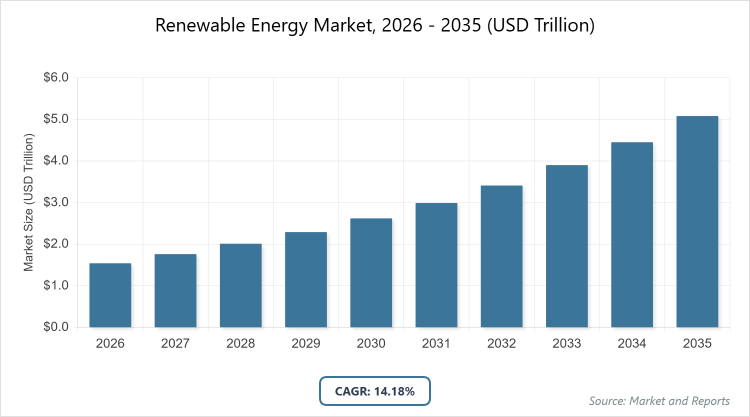
According to MarketnReports, the global Renewable Energy market size was estimated at USD 1.54 trillion in 2025 and is expected to reach USD 5.79 trillion by 2035, growing at a CAGR of 14.18% from 2026 to 2035. The global push for decarbonization and technological advancements in clean energy.
What are the Key Insights into Renewable Energy Market?
- The global renewable energy market size was valued at USD 1.54 trillion in 2025 and is projected to reach USD 5.79 trillion by 2035.
- The market is expected to grow at a CAGR of 14.18% during the forecast period from 2026 to 2035.
- The market is driven by policy support, technological advancements, and the global energy transition toward decarbonization.
- In the type segment, the solar energy subsegment dominated with a 57.9% share, due to rapid cost reductions and scalability, enabling widespread adoption in utility-scale projects.
- In the application segment, the power generation subsegment held the largest share at around 80%, driven by increasing electricity demand and grid integrations for renewables.
- In the end-user segment, the utilities subsegment accounted for 70% of the market, primarily because of large-scale deployments and regulatory mandates for clean energy.
- Asia Pacific dominated the regional market with a 55% share, attributed to massive investments in solar and wind by China and India, supporting rapid capacity additions.
What is the Renewable Energy Market?
Industry Overview
The renewable energy market encompasses the generation, distribution, and utilization of power from sustainable sources such as solar, wind, hydro, bioenergy, and geothermal, aimed at reducing carbon emissions and promoting energy security in a transitioning global economy. Market definition includes technologies and infrastructures that harness natural, replenishable resources to produce electricity, heat, and fuels, integrating with grids, storage systems, and end-user applications to meet residential, commercial, and industrial demands, while addressing climate goals through policy support, innovation, and investments in scalable, efficient solutions.
What are the Market Dynamics of the Renewable Energy Market?
Growth Drivers
Growth drivers in the renewable energy market are fueled by global commitments to net-zero emissions and supportive policies like subsidies and tax incentives, encouraging investments in solar and wind projects to meet climate targets. Technological advancements in storage and efficiency reduce costs, making renewables competitive with fossil fuels, while rising energy demand from electrification in transportation and industries accelerates adoption. Corporate sustainability goals and consumer preferences for green energy further drive market expansion, supported by international agreements like the Paris Accord.
Restraints
Restraints include intermittent supply from sources like solar and wind, requiring costly storage solutions and grid upgrades to ensure reliability, limiting deployment in regions with inadequate infrastructure. High upfront capital costs for projects deter investments in developing economies, while regulatory inconsistencies and permitting delays slow progress. Supply chain vulnerabilities for critical materials like rare earths also pose risks, inflating prices amid geopolitical tensions.
Opportunities
Opportunities emerge from the integration of AI and digital tools for optimized energy management, enabling smart grids and predictive maintenance to enhance efficiency. Expansion in emerging markets through affordable off-grid solutions addresses energy access gaps, while green hydrogen and advanced biofuels open new sectors. Public-private partnerships for large-scale projects and funding from climate finance initiatives provide avenues for growth in underserved regions.
Challenges
Challenges involve grid integration for variable renewables, demanding advanced infrastructure to handle fluctuations and avoid curtailment. Skilled labor shortages in installation and maintenance hinder scaling, while policy reversals in key markets create uncertainty. Environmental impacts from large hydro and bioenergy projects require sustainable practices, and cybersecurity threats to digital systems necessitate robust protections.
Renewable Energy Market: Report Scope
| Report Attributes | Report Details |
| Report Name | Renewable Energy Market |
| Market Size 2025 | USD 1.54 Trillion |
| Market Forecast 2035 | USD 5.79 Trillion |
| Growth Rate | CAGR of 14.18% |
| Report Pages | 220 |
| Key Companies Covered |
NextEra Energy, GE Vernova, Iberdrola SA, Constellation Energy Corp., Vestas Wind Systems A/S, and Others |
| Segments Covered | By Type (Solar Energy, Wind Energy, Hydro Energy, Bioenergy, Geothermal Energy, and Others), By Application (Power Generation, Heating and Cooling, Transportation, and Others), By End-User (Residential, Commercial, Industrial, Utilities, and Others), and By Region |
| Regions Covered | North America, Europe, Asia Pacific (APAC), Latin America, and The Middle East and Africa (MEA) |
| Base Year | 2025 |
| Historical Year | 2020 – 2024 |
| Forecast Year | 2026 – 2035 |
| Customization Scope | Avail customized purchase options to meet your exact research needs. |
What is the Market Segmentation of the Renewable Energy Market?
The Renewable Energy market is segmented by type, application, end-user, and region.
Based on Type Segment, the solar energy subsegment is the most dominant, holding over 57.9% share, followed by wind energy as the second most dominant. Solar energy’s dominance arises from falling costs and versatile applications, driving the market by enabling rapid capacity additions and utility-scale projects that accelerate the global energy transition.
Based on Application Segment, power generation leads with approximately 80% share, with heating and cooling as the second dominant. Power generation’s leading position is due to electrification trends, propelling market growth through large-scale renewable installations that meet rising electricity demands sustainably.
Based on the End-User Segment, utilities dominate with 70% share, followed by industrial. Utilities’ supremacy stems from regulatory mandates for clean energy, aiding market drive by facilitating grid-scale deployments that support energy security and decarbonization goals.
What are the Recent Developments in the Renewable Energy Market?
- In October 2025, US operating storage capacity reached 37.4 GW, up 32% year to date, with another 19 GW under construction through 2026.
- In 2025, renewables overtook coal in electricity generation for the first time, with solar and wind meeting all new demand growth.
- In December 2025, the world added 793 GW of renewable capacity, up 11% from 2024, on track for tripling by 2030.
- In November 2025, China installed 390 GW of solar PV and 86 GW of wind, setting buildout records.
- In December 2025, S&P Global reported solar growth peaking but declining slightly in 2026 due to policy shifts.
What is the Regional Analysis of Renewable Energy Market?
- Asia Pacific to dominate the global market.
Asia Pacific leads the renewable energy market, holding approximately 55% share, driven by massive capacity additions and policy support. China dominates within the region, fueled by aggressive solar and wind installations, achieving 2030 targets early and leading global manufacturing.
North America exhibits strong growth at a CAGR of 7.36%, bolstered by tax incentives and data center demands. The United States leads as the dominant country, with renewables dominating new capacity and storage expansions.
Europe shows steady expansion with a CAGR of 8%, focused on net-zero goals. Germany is the leading country, driven by offshore wind and grid modernization.
Latin America demonstrates emerging potential, with growth from hydropower and solar. Brazil dominates, thanks to favorable policies and resource abundance.
The Middle East and Africa region holds about 5% share, with expansion through solar initiatives. The United Arab Emirates leads, propelled by diversification from oil and massive solar parks.
Who are the Key Market Players in the renewable energy market?
- NextEra Energy focuses on solar and wind expansions, leveraging tax credits for utility-scale projects.
- GE Vernova develops wind turbines and grid solutions, prioritizing digitalization for efficiency.
- Iberdrola SA invests in offshore wind, emphasizing green hydrogen integration.
- Constellation Energy Corp. advances nuclear and renewables, focusing on clean power supply.
- Vestas Wind Systems A/S innovates in turbine technology, targeting emerging markets.
What are the Market Trends in Renewable Energy Market?
- AI-driven storage and grid flexibility for demand management.
- Solar-plus-storage hybrids to meet hyperscaler power needs.
- Electric vehicle adoption with enablers like charging infrastructure.
- Renewables surpassing coal in generation by 2026.
- Policy shifts impacting solar growth in China.
- Affordability through falling battery costs.
- Geopolitical influences on supply chains.
- Acceleration despite policy changes.
What are the Market Segments and their Subsegments Covered in the Renewable Energy Report?
By Type
- Solar Energy
- Wind Energy
- Hydro Energy
- Bioenergy
- Geothermal Energy
- Others
By Application
- Power Generation
- Heating and Cooling
- Transportation
- Others
By End-User
- Residential
- Commercial
- Industrial
- Utilities
- Others
By Region
- North America
- U.S.
- Canada
- Europe
- UK
- Germany
- France
- Rest of Europe
- Asia Pacific
- China
- India
- Japan
- Rest of Asia Pacific
- Latin America
- Brazil
- Mexico
- Rest of Latin America
- Middle East & Africa
- UAE
- South Africa
- Rest of Middle East & Africa
Frequently Asked Questions
Renewable energy refers to power generated from natural, replenishable sources like solar, wind, hydro, bioenergy, and geothermal, offering sustainable alternatives to fossil fuels.
Key factors include policy support, technological advancements, decarbonization goals, and rising energy demand.
The market is projected to grow from USD 1.71 trillion in 2026 to USD 5.79 trillion by 2035.
The CAGR is expected to be 14.18% from 2026 to 2035.
Asia Pacific will contribute notably, holding around 55% of the market value due to rapid installations.
Major players include NextEra Energy, GE Vernova, Iberdrola SA, Constellation Energy Corp., and Vestas Wind Systems A/S.
The report provides comprehensive analysis including market size, trends, segmentation, regional insights, key players, growth drivers, restraints, opportunities, challenges, and forecasts from 2026 to 2035.
The value chain includes resource assessment, technology manufacturing, project development, installation, operation and maintenance, and energy distribution.
Trends are shifting toward AI integration and storage, while preferences favor affordable, sustainable solutions.
Regulations on emissions and incentives promote renewables, while environmental goals drive clean transitions.