
Renewable Chemicals Market Size, Share and Trends 2026 to 2035
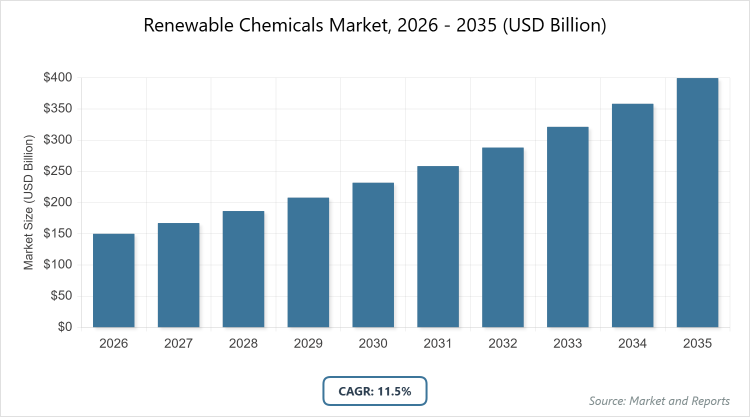
According to MarketnReports, the global Renewable Chemicals Market size was estimated at USD 150 billion in 2025 and is expected to reach USD 445 billion by 2035, growing at a CAGR of 11.5% from 2026 to 2035. Renewable Chemicals Market is driven by increasing demand for sustainable alternatives to petrochemicals.What are the Key Insights of the Renewable Chemicals Market?
- The global renewable chemicals market was valued at USD 150 billion in 2025 and is projected to reach USD 445 billion by 2035.
- The market is anticipated to grow at a CAGR of 11.5% during the forecast period from 2026 to 2035.
- The market is driven by rising environmental regulations, increasing consumer preference for sustainable products, and advancements in bio-based technologies.
- In product type, alcohols dominate with a 35% share due to widespread use of bioethanol in fuels and industrial applications, offering cost-effectiveness and high scalability.
- In application, transportation dominates with a 28% share because of the push for biofuels to reduce emissions in vehicles and aviation.
- In end-user, automotive dominates with a 25% share owing to the integration of biopolymers in vehicle components for lighter, eco-friendly materials.
- Europe dominates the regional market with a 32% share, attributed to stringent EU regulations promoting green chemistry and substantial investments in bio-economy initiatives.
What is the Industry Overview of the Renewable Chemicals Market?
The renewable chemicals market encompasses the production and distribution of chemicals derived from renewable resources such as biomass, agricultural waste, and microorganisms, as opposed to traditional fossil fuel-based petrochemicals. This market focuses on eco-friendly alternatives that reduce carbon footprints and promote sustainability across various industries. Market definition includes bio-based chemicals like alcohols, biopolymers, and organic acids that are manufactured through biological processes or green chemistry principles, aiming to replace conventional chemicals in applications ranging from packaging to pharmaceuticals.
What are the Market Dynamics of the Renewable Chemicals Market?
Growth Drivers
The growth drivers of the renewable chemicals market are primarily fueled by escalating global concerns over climate change and the depletion of fossil fuels, prompting a shift towards sustainable manufacturing. Governments worldwide are implementing policies such as carbon taxes and subsidies for bio-based products, which incentivize industries to adopt renewable alternatives. Technological advancements in biotechnology, including enzyme engineering and fermentation processes, have enhanced production efficiency and reduced costs, making renewable chemicals more competitive. Additionally, corporate sustainability goals and consumer demand for green products are accelerating market expansion, particularly in sectors like packaging and automotive where bio-based materials offer performance comparable to traditional ones.
Restraints
Restraints in the renewable chemicals market include high initial production costs associated with bio-refineries and feedstock sourcing, which often make these chemicals more expensive than their petrochemical counterparts. Volatility in raw material availability, such as biomass dependent on agricultural yields, poses supply chain risks exacerbated by weather events and competition for land use with food production. Limited infrastructure for large-scale production and distribution in developing regions further hinders market penetration. Moreover, performance inconsistencies in some bio-based chemicals, like lower durability in certain applications, can deter adoption despite environmental benefits.
Opportunities
Opportunities abound in the renewable chemicals market through innovation in feedstock diversification, such as utilizing algae or waste streams, which could lower costs and improve sustainability. Emerging markets in Asia Pacific present untapped potential due to rapid industrialization and supportive policies for green technologies. Collaborations between chemical giants and biotech startups are fostering new product developments, like advanced biopolymers for electronics. The integration of renewable chemicals into circular economy models, where waste is repurposed, offers long-term growth prospects amid global efforts to achieve net-zero emissions.
Challenges
Challenges facing the renewable chemicals market involve navigating complex regulatory landscapes that vary by region, potentially delaying product approvals and market entry. Competition from established petrochemical industries, backed by lower prices due to economies of scale, creates barriers for bio-based alternatives. Intellectual property issues in biotechnology and the need for skilled labor in specialized processes add operational hurdles. Finally, ensuring consistent quality and scalability while maintaining environmental integrity remains a key challenge as the market scales up.
Renewable Chemicals Market: Report Scope
| Report Attributes | Report Details |
| Report Name | Renewable Chemicals Market |
| Market Size 2025 | USD 150 Billion |
| Market Forecast 2035 | USD 445 Billion |
| Growth Rate | CAGR of 11.5% |
| Report Pages | 220 |
| Key Companies Covered |
BASF SE, Braskem, NatureWorks LLC, Archer Daniels Midland Company, Cargill, BioAmber Inc., and Others. |
| Segments Covered | By ProductType123, By Application123, By End-User123, and By Region. |
| Regions Covered | North America, Europe, Asia Pacific (APAC), Latin America, and The Middle East and Africa (MEA) |
| Base Year | 2025 |
| Historical Year | 2020 - 2024 |
| Forecast Year | 2026 - 2035 |
| Customization Scope | Avail customized purchase options to meet your exact research needs. |
What is the Market Segmentation of the Renewable Chemicals Market?
The Renewable Chemicals Market is segmented by type123, application123, end-user123, and region.By ProductType123 Segment, alcohols emerge as the most dominant subsegment, holding approximately 35% market share, followed by biopolymers as the second most dominant with around 25%. Alcohols dominate due to their versatile applications in biofuels and solvents, driven by global mandates for renewable energy sources that reduce greenhouse gas emissions; this subsegment propels market growth by enabling cost-effective transitions in energy-intensive industries like transportation, where bioethanol blends enhance fuel efficiency and compliance with emission standards. Biopolymers, the second dominant, gain traction for their biodegradable properties in packaging and consumer goods, fostering market expansion through sustainability-focused innovations that replace petroleum-based plastics and support circular economy practices.
By Application123 Segment, transportation stands out as the most dominant subsegment with a 28% share, while textiles follow as the second most dominant at about 20%. Transportation's dominance stems from the urgent need for low-carbon fuels amid rising electric vehicle adoption and aviation biofuel demands, driving the market by facilitating decarbonization efforts that align with international climate agreements; this helps propel overall growth by integrating renewable chemicals into high-volume fuel markets, boosting scalability and investment. Textiles, as the second dominant, benefit from eco-friendly dyes and fibers derived from bio-sources, advancing the market through fashion industry shifts towards sustainable materials that reduce water pollution and appeal to environmentally conscious consumers.
By End-User123 Segment, automotive is the most dominant subsegment, capturing 25% of the market, with pharmaceutical as the second most dominant at 18%. Automotive leads due to the incorporation of lightweight biocomposites in vehicle manufacturing, which improves fuel economy and meets regulatory requirements for reduced emissions; this dominance drives the market by encouraging R&D in durable, renewable materials that enhance vehicle performance and open new revenue streams in electric and hybrid models. Pharmaceutical, the second dominant, utilizes bio-based excipients and active ingredients for drug formulation, supporting market growth by addressing safety concerns over synthetic chemicals and enabling greener production processes in healthcare.
What are the Recent Developments in the Renewable Chemicals Market?
- In 2025, BASF SE announced a major expansion of its bio-based chemicals production facility in Germany, investing over USD 500 million to increase capacity for biopolymers, aiming to meet rising demand in Europe driven by EU green deal policies.
- Braskem launched a new line of renewable polyethylene derived from sugarcane in Brazil, partnering with local farmers to secure sustainable feedstock, which is expected to reduce carbon emissions by 2 million tons annually and strengthen its position in the Latin American market.
- NatureWorks LLC introduced an advanced PLA biopolymer variant with enhanced heat resistance, targeted at food packaging applications, following successful trials that demonstrated 30% better performance compared to previous generations.
What is the Regional Analysis of the Renewable Chemicals Market?
Europe to dominate the global market.Europe leads the renewable chemicals market, primarily driven by stringent environmental regulations such as the European Green's Deal and REACH standards that mandate reduced reliance on fossil fuels. Germany stands out as the dominating country within the region, contributing significantly through its advanced bio-refineries and government incentives for R&D in green chemistry; this dominance is bolstered by collaborations between industry leaders like BASF and academic institutions, fostering innovation in biopolymers and organic acids that export to global markets. The region's focus on circular economy principles further enhances growth, with countries like the Netherlands and France investing in biomass conversion technologies to achieve carbon neutrality goals by 2050.
North America exhibits robust growth in the renewable chemicals market, supported by abundant agricultural resources and federal initiatives like the U.S. Farm Bill promoting bio-based products. The United States dominates this region, leveraging its vast corn and soybean production for bioethanol and biopolymers, which drives market expansion through partnerships with companies such as Cargill and supportive policies from the Department of Energy; this leadership enables scalability in transportation fuels and consumer goods, positioning North America as a key exporter while addressing domestic sustainability demands. Canada contributes through forestry-based feedstocks, enhancing diversity in raw materials.
Asia Pacific is emerging as a high-growth area in the renewable chemicals market, fueled by rapid industrialization and increasing adoption of green technologies in populous nations. China dominates the region, with massive investments in bio-refineries and government mandates for renewable energy that propel production of platform chemicals and ketones; this supremacy stems from low-cost labor and vast biomass availability from agriculture, driving market growth by supplying affordable bio-based alternatives to petrochemicals for domestic and export markets. India follows with initiatives like the National Biofuel Policy, focusing on jatropha and waste-to-chemical conversions.
Latin America shows promising potential in the renewable chemicals market, benefiting from rich biodiversity and agricultural outputs. Brazil dominates, renowned for its sugarcane-based ethanol production that accounts for a significant portion of global biofuels; this position is strengthened by companies like Braskem and policies promoting sustainable farming, which drive market development by exporting renewable chemicals and integrating them into regional industries like automotive and packaging. Argentina supports through soybean-derived products, aiding in feedstock diversification.
The Middle East and Africa region is gradually advancing in the renewable chemicals market, though at a slower pace due to reliance on oil economies. South Africa emerges as the dominating country, with initiatives in biomass utilization from agricultural waste and investments in bio-based polymers; this leadership is driven by partnerships with international firms and national strategies for green industrialization, helping to diversify economies away from fossils while addressing local environmental challenges like water scarcity through efficient production methods. The UAE is exploring algae-based innovations to complement its energy transition.
Who are the Key Market Players and Strategies in the Renewable Chemicals Market?
BASF SE employs a strategy focused on innovation and sustainability, investing heavily in R&D for bio-based chemicals like organic acids and biopolymers, while forming strategic alliances with biotech firms to expand its portfolio and meet global regulatory demands.
Braskem pursues vertical integration by securing renewable feedstocks from sugarcane plantations, emphasizing cost reduction and carbon footprint minimization through expanded production facilities in Brazil to capture emerging markets in Latin America and beyond.
NatureWorks LLC prioritizes product diversification, developing advanced PLA biopolymers with improved properties for packaging and textiles, backed by collaborations with consumer brands to promote eco-friendly alternatives and drive market penetration.
Archer Daniels Midland Company leverages its agricultural expertise for feedstock optimization, implementing supply chain efficiencies to produce affordable bio-alcohols and platform chemicals, targeting high-volume applications in transportation to enhance profitability.
Cargill adopts a customer-centric approach, offering tailored bio-based solutions for food and industrial sectors, supported by global distribution networks and sustainability certifications to build trust and expand market share.
BioAmber Inc. focuses on niche markets with succinic acid production from renewable sources, utilizing fermentation technology advancements to lower costs and partner with pharmaceutical companies for specialized applications.
What are the Market Trends in the Renewable Chemicals Market?
- Increasing adoption of biopolymers in packaging to replace single-use plastics amid global anti-plastic regulations.
- Rising investments in algae-based feedstocks for scalable and sustainable chemical production.
- Growing integration of renewable chemicals in electric vehicle components for lighter, eco-friendly materials.
- Expansion of circular economy models repurposing agricultural waste into high-value chemicals.
- Advancements in enzyme technologies improving fermentation efficiency and reducing production costs.
- Heightened focus on carbon-neutral certifications to appeal to environmentally conscious consumers.
- Surge in collaborations between chemical giants and startups for innovative bio-refining processes.
- Emerging demand in developing regions driven by urbanization and green policy implementations.
What Market Segments and their Subsegments are Covered in the Report for the Renewable Chemicals Market?
By ProductType123- Alcohols
- Biopolymers
- Organic Acids
- Ketones
- Platform Chemicals
- Bio-based 1,3-PDO
- Bio-based ECH
- Bio-based 1,4-BDO
- Starch Blends
- Regenerated Cellulose
- Others
- Transportation
- Textiles
- Food Safety
- Environment
- Communication
- Housing
- Recreation
- Health & Hygiene
- Bio-Medical
- Agriculture
- Others
- Automotive
- Pharmaceutical
- Consumer Goods
- Food & Beverages
- Healthcare
- Industrial
- Packaging
- Textiles
- Construction
- Agriculture
- Others
By Region
- North America
- U.S.
- Canada
- Europe
- UK
- Germany
- France
- Rest of Europe
- Asia Pacific
- China
- India
- Japan
- Rest of Asia Pacific
- Latin America
- Brazil
- Mexico
- Rest of Latin America
- Middle East & Africa
- UAE
- South Africa
- Rest of Middle East & Africa
Frequently Asked Questions
The renewable chemicals market refers to the industry involved in producing chemicals from renewable sources like biomass, aimed at replacing fossil fuel-based products for sustainability.
Key factors include stringent environmental regulations, technological advancements in biotechnology, rising consumer demand for green products, and government incentives for bio-based manufacturing.
The market is projected to grow from an estimated value USD 150 billion in 2025 and is expected to reach USD 445 billion by 2035.
The CAGR is expected to be 11.5% during 2026-2035.
Europe will contribute notably, driven by strong regulatory frameworks and investments in green technologies.
Major players include BASF SE, Braskem, NatureWorks LLC, Archer Daniels Midland Company, and Cargill.
The report provides in-depth analysis of market size, trends, segments, regional insights, key players, and forecasts.
Stages include feedstock sourcing, bio-refining and processing, chemical synthesis, distribution, and end-use application.
Trends are shifting towards biodegradable materials, with consumers preferring eco-certified products amid sustainability awareness.
Regulations like EU REACH and carbon emission targets are promoting adoption, while environmental concerns over plastics drive demand.