
Refurbished and Used Mobile Phones Market Size, Share and Trends 2026 to 2035
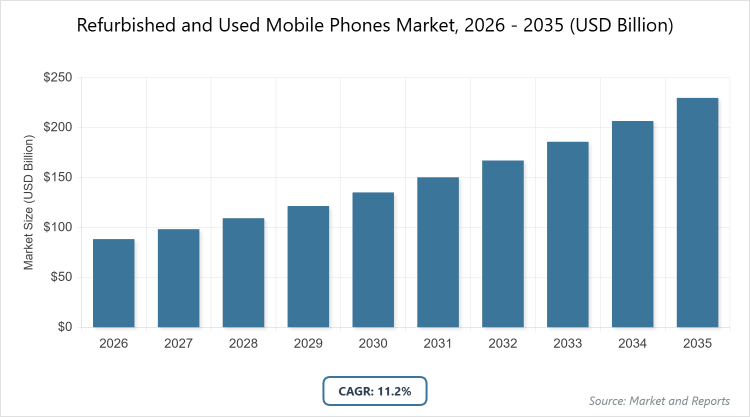
The global Refurbished and Used Mobile Phones Market size was estimated at USD 88.41 Billion in 2025 and is expected to reach USD 206.71 Billion by 2035, growing at a CAGR of 11.2% from 2026 to 2035. The refurbished and used mobile phones market is primarily driven by the increasing demand for affordable premium devices amidst rising prices of new models, coupled with growing consumer awareness of environmental sustainability and electronic waste reduction.
What are the Key Insights?
- Global market value projected at USD 88.41 billion in 2026, reaching USD 206.71 billion by 2035.
- Anticipated CAGR of 11.2% from 2026 to 2035.
- Dominant subsegment in type: Refurbished Phones, holding the largest share due to certified quality assurance.
- Dominant subsegment in price range: Mid-Priced ($200-$500), leading owing to balanced affordability and features.
- Dominant subsegment in application: Individual, capturing the biggest portion from personal consumer demand.
- Dominant region: Asia-Pacific, accounting for the highest market share driven by high population and affordability needs.
What is the Industry Overview?
The Refurbished and Used Mobile Phones Market involves the resale and distribution of pre-owned smartphones that have been either restored to near-new condition through professional testing, repairs, and certifications or sold as-is after previous ownership. Refurbished devices typically undergo rigorous quality checks, including battery replacements, software updates, and cosmetic enhancements, often backed by warranties to build consumer trust, while used phones may be traded directly between individuals or through platforms without extensive modifications. This market caters to cost-conscious consumers seeking affordable access to advanced technology, promotes sustainability by reducing electronic waste, and supports a circular economy by extending the lifecycle of devices across various global regions and demographics.
What are the Market Dynamics?
Growth Drivers
The Refurbished and Used Mobile Phones Market is driven by escalating prices of new smartphones, making pre-owned options an attractive alternative for budget-conscious consumers in emerging economies who desire high-end features without premium costs, thereby expanding market accessibility and boosting adoption rates through trade-in programs and certified refurbishments that ensure reliability. Increasing environmental awareness and regulatory pressures to minimize e-waste have propelled demand, as refurbished devices contribute to sustainability goals by reusing resources and reducing the carbon footprint associated with manufacturing new phones. Technological advancements in refurbishing processes, such as AI-driven diagnostics and automated testing, enhance product quality and consumer confidence, further accelerating market growth by enabling scalable operations for sellers.
Restraints
High variability in device quality and lack of standardization in refurbishing practices pose significant restraints in the Refurbished and Used Mobile Phones Market, as consumers often hesitate due to concerns over reliability, battery life, and potential defects, limiting broader adoption especially in regions with stringent consumer protection laws. Competition from low-cost new smartphones from emerging brands erodes market share, particularly in price-sensitive segments where buyers prefer warranties and originality over refurbished alternatives. Supply chain challenges, including inconsistent availability of high-quality used devices and rising costs for repair components, hinder scalability for refurbishers and increase operational expenses.
Opportunities
The expansion of e-commerce platforms and digital marketplaces presents key opportunities in the Refurbished and Used Mobile Phones Market, as online channels facilitate global reach, transparent quality grading, and convenient trade-ins, enabling sellers to tap into underserved rural and international markets with customized offerings. Growing corporate adoption for employee devices and fleet management opens B2B avenues, where businesses seek cost-effective, sustainable solutions with bulk purchasing and customization options. Innovations in blockchain for traceability and extended warranties can enhance trust, attracting premium segments and fostering partnerships with OEMs for certified programs that align with circular economy initiatives.
Challenges
Building consumer trust amid perceptions of inferior quality remains a major challenge in the Refurbished and Used Mobile Phones Market, as inconsistent grading systems and counterfeit risks deter potential buyers, requiring industry-wide standards and education campaigns to shift mindsets. Regulatory hurdles related to data privacy, import restrictions, and e-waste management vary across regions, complicating cross-border trade and increasing compliance costs for global players. Fluctuating supply of desirable models due to rapid technology cycles and consumer upgrade patterns creates inventory imbalances, challenging sellers to maintain consistent stock levels and pricing stability.
Currency Sorter Market: Report Scope
| Report Attributes | Report Details |
| Report Name | Refurbished and Used Mobile Phones Market |
| Market Size 2025 | USD 88.41 Billion |
| Market Forecast 2035 | USD 206.71 Billion |
| Growth Rate | CAGR of 11.2% |
| Report Pages | 215 |
| Key Companies Covered |
Apple Inc., Samsung Electronics Co. Ltd., Amazon.com Inc., Verizon Communications Inc., AT&T Inc., Flipkart Internet Private Limited, Back Market SAS, Gazelle, Reboxed Limited, Cashify. |
| Segments Covered | By Type, By Price Range, By Application, By Region. |
| Regions Covered | Asia Pacific, North America, Europe, Latin America, The Middle East and Africa. |
| Base Year | 2025 |
| Historical Year | 2020 – 2024 |
| Forecast Year | 2026 – 2035 |
| Customization Scope | Avail customized purchase options to meet your exact research needs. |
What is the Market Segmentation?
Type Segmentation
In the type segmentation of the Refurbished and Used Mobile Phones Market, refurbished phones emerge as the most dominant subsegment, followed by used phones as the second most dominant. Refurbished phones lead because they offer certified reliability through professional restoration, warranties, and quality checks that address consumer concerns over performance, driving the market by appealing to value-seeking buyers who prioritize sustainability and cost savings without compromising on functionality in a landscape of rising new device prices. Used phones, the second dominant, gain traction for their lower entry costs and immediate availability through peer-to-peer platforms, contributing to market growth by serving ultra-budget segments and promoting circular economy practices in emerging regions.
Price Range Segmentation
Within the price range segmentation of the Refurbished and Used Mobile Phones Market, mid-priced ($200-$500) stands out as the most dominant subsegment, with low-priced (below $200) as the second most dominant. Mid-priced dominates owing to its sweet spot of offering modern features like 5G compatibility and decent cameras at accessible costs, fueling market expansion by attracting middle-income consumers upgrading from basic devices while supporting e-waste reduction through extended device lifecycles. Low-priced, the second dominant, is prominent for entry-level buyers in developing markets, aiding growth by enabling digital inclusion and affordability in high-volume sales channels like online marketplaces.
Application Segmentation
The application segmentation of the Refurbished and Used Mobile Phones Market sees individual as the most dominant subsegment, with businesses as the second most dominant. Individual leads due to widespread personal demand for affordable smartphones amid economic pressures, propelling the market through mass adoption via e-commerce and trade-ins that democratize access to technology. Businesses, the second dominant, benefit from cost-efficient fleet solutions and sustainability reporting, driving growth by integrating refurbished devices into corporate IT strategies for remote work and operational efficiency.
What are the Recent Developments?
- In March 2024, Orange Belgium launched a new online store for secondhand smartphones in collaboration with Recommerce, emphasizing sustainability and offering certified devices with warranties to meet growing consumer demand for eco-friendly options.
- In November 2023, Reboxed secured GBP 1.6 million in seed funding led by ACF Investors, focusing on expanding its platform for premium refurbished tech with a circular approach to enhance quality and environmental impact.
- In September 2023, Back Market initiated the “Let Them Buy New” campaign challenging Big Tech’s focus on new products, aiming to boost awareness and adoption of refurbished smartphones globally.
- In February 2024, Magyar Telekom extended its partnership with Recommerce Group to offer a wider range of used smartphones, supporting circular economy goals in Europe.
- In January 2024, Apple introduced its certified refurbished iPhone program in India, targeting affordability and e-waste reduction in a high-growth market.
- In March 2024, Samsung partnered with Microsoft to sell refurbished devices through the Microsoft Store, enhancing accessibility for enterprise users.
- In April 2025, Google Pixel raised USD 100 million in funding to expand refurbished smartphone production and distribution. In January 2024, Best Buy expanded its trade-in program to incentivize refurbished model purchases, promoting sustainability.
- In September 2024, Flipkart invested in supply chain infrastructure to support refurbished smartphone delivery across India.
What is the Regional Analysis?
North America
North America holds a significant position in the Refurbished and Used Mobile Phones Market, driven by high consumer awareness of sustainability, robust e-commerce platforms, and established trade-in programs from carriers like Verizon and AT&T, which facilitate easy access to certified devices. The United States dominates this region, with its tech-savvy population and strong demand for premium refurbished iPhones and Androids, supported by stringent quality standards, widespread online marketplaces like Amazon Renewed, and initiatives to reduce e-waste through corporate and individual adoption, contributing to market stability and innovation in refurbishing technologies.
Asia-Pacific
Asia-Pacific is the dominant and fastest-growing region in the Refurbished and Used Mobile Phones Market, fueled by massive population bases, rapid smartphone penetration, and affordability needs in emerging economies, where refurbished devices bridge the gap for digital inclusion. India dominates, with its surging e-commerce ecosystem, government e-waste regulations, and high-volume platforms like Flipkart Renewed driving demand for mid-priced refurbished phones among price-sensitive consumers, enabling market expansion through localized refurbishing hubs and trade-in schemes that address urban-rural divides.
Europe
Europe maintains a strong share in the Refurbished and Used Mobile Phones Market, emphasizing circular economy principles under EU regulations that promote e-waste reduction and sustainable consumption, with demand for certified devices in mature markets. Germany dominates, leveraging its environmental focus and advanced refurbishing infrastructure to lead in premium refurbished sales, supported by partnerships between telecom operators and platforms like Back Market, fostering growth through consumer trust in warranties and eco-friendly branding.
Latin America
Latin America exhibits promising growth in the Refurbished and Used Mobile Phones Market, supported by economic constraints and increasing digital adoption, where affordable pre-owned devices enable connectivity in diverse demographics. Brazil dominates, with its large mobile user base and inflation-driven shift toward refurbished options, aided by e-commerce growth and local refurbishers offering warranties, propelling the market through initiatives that enhance accessibility and reduce reliance on expensive imports.
Middle East and Africa
The Middle East and Africa region is emerging in the Refurbished and Used Mobile Phones Market, driven by urbanization, youth demographics, and the need for cost-effective smartphones in connectivity-challenged areas. South Africa dominates, with its developed telecom infrastructure and platforms promoting refurbished Android devices, supporting market growth through affordability programs and e-waste awareness campaigns that align with regional sustainability efforts.
Who are the Key Market Players and Their Strategies?
Apple Inc. focuses on certified refurbishment programs with warranties, expanding into emerging markets like India to build trust and sustainability, while leveraging trade-ins to maintain premium positioning.
Samsung Electronics Co. Ltd. emphasizes partnerships with retailers and carriers for refurbished device distribution, investing in AI diagnostics to ensure quality and targeting enterprise solutions for cost savings.
Amazon.com Inc. drives growth through its Renewed program, offering graded devices with guarantees and utilizing its e-commerce dominance for global reach and customer reviews to enhance credibility.
Verizon Communications Inc. prioritizes trade-in incentives and carrier-locked refurbished phones, collaborating with manufacturers to provide affordable upgrades and focusing on network compatibility.
AT&T Inc. pursues B2B strategies with fleet refurbishments, offering warranties and sustainability reporting to attract corporate clients while expanding online sales channels.
Flipkart Internet Private Limited invests in supply chain for refurbished sales in India, using data analytics for inventory management and promotions to capture price-sensitive consumers.
Back Market SAS specializes in premium refurbished tech, raising funds for expansion and campaigning against new device hype to promote eco-friendly alternatives.
Gazelle concentrates on buyback and resale, streamlining processes with app-based valuations to facilitate quick transactions and build a loyal user base.
Reboxed Limited secures funding for circular tech platforms, emphasizing “like new” experiences with environmental tracking to appeal to conscious buyers.
Cashify targets emerging markets with doorstep services for buybacks and refurbishments, using AI for pricing to optimize operations and user convenience.
What are the Market Trends?
- Increasing adoption of certified refurbishment programs by OEMs like Apple and Samsung to build consumer trust with warranties.
- Growth in online marketplaces facilitating transparent grading and global access to refurbished devices.
- Rising focus on sustainability, with consumers preferring refurbished phones to reduce e-waste and carbon footprints.
- Expansion of trade-in and buyback initiatives by carriers and retailers to sustain supply chains.
- Integration of AI and blockchain for quality assurance and traceability in refurbishing processes.
What Market Segments are Covered in the Report?
By Type
- (Refurbished Phones, Used Phones)
By Price Range
- (Low-Priced (Below $200)
- Mid-Priced ($200 to $500)
- Premium (Above $500)
By Application
- (Individual, Businesses)
By Region
-
- North America
- U.S.
- Canada
- Europe
- UK
- Germany
- France
- Rest of Europe
- Asia Pacific
- China
- India
- Japan
- Rest of Asia Pacific
- Latin America
- Brazil
- Mexico
- Rest of Latin America
- Middle East & Africa
- UAE
- South Africa
- Rest of Middle East & Africa
- North America
Frequently Asked Questions
The Refurbished and Used Mobile Phones Market refers to the trade and resale of pre-owned smartphones, either restored with certifications and warranties or sold as-is, catering to affordability and sustainability needs.
Key factors include rising smartphone prices, environmental awareness, advancements in refurbishing technology, expanding e-commerce, and trade-in programs.
The market is projected to grow from approximately USD 88.41 billion in 2026 to USD 206.71 billion by 2035.
The anticipated CAGR is 11.2% from 2026 to 2035.
Asia-Pacific will contribute significantly, driven by population growth and affordability demands in countries like India and China.
Major players include Apple Inc., Samsung Electronics Co. Ltd., Amazon.com Inc., Verizon Communications Inc., and Flipkart Internet Private Limited.
The report provides comprehensive analysis including market size, forecasts, segmentation, regional insights, competitive landscape, and emerging trends.
Stages include device collection via trade-ins, inspection and refurbishment, quality certification, distribution through online/offline channels, and end-user sales.
Trends show a shift toward sustainable, certified devices with consumers preferring affordable, eco-friendly options via online platforms and trade-ins.
Strict e-waste regulations and sustainability initiatives promote refurbishing, while data privacy laws influence cross-border trade and quality standards.