
Private Tutoring Market Size, Share and Trends 2026 to 2035
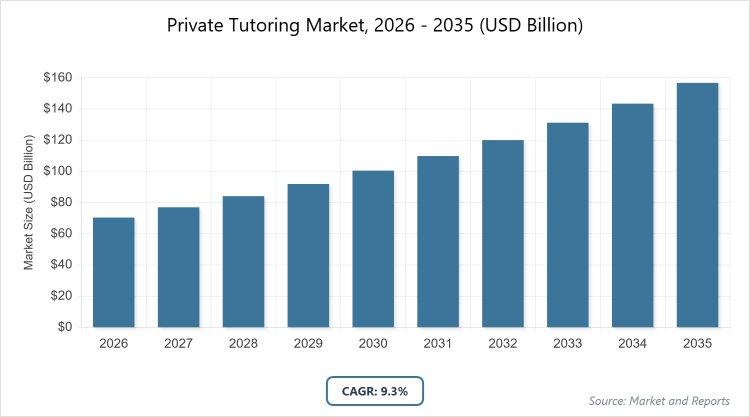
According to MarketnReports, the global Private Tutoring market size was estimated at USD 70.4 billion in 2025 and is expected to reach USD 171.3 billion by 2035, growing at a CAGR of 9.3% from 2026 to 2035. Private Tutoring Market is driven by increasing demand for personalized learning and technological advancements in education.
What are the Key Insights of the Private Tutoring Market?
- The global private tutoring market was valued at USD 70.4 billion in 2025 and is projected to reach USD 171.3 billion by 2035.
- The market is expected to grow at a CAGR of 9.3% during the forecast period from 2026 to 2035.
- The market is driven by reforming education systems, rising competition in academics and jobs, technological integrations like AI, and increasing middle-class affordability.
- In the mode segment, online tutoring dominates with a 55.3% share due to its convenience, flexibility, and widespread adoption of digital platforms enabling access to interactive learning tools and global tutors.
- In the application segment, up-to K-12 leads with a 48.7% share because of high demand for foundational academic support, exam preparation, and parental emphasis on early education in competitive environments.
- In the subject segment, academic tutoring holds a 50.2% share owing to the need for structured instruction in core subjects like math and science to address learning gaps and improve exam performance.
- Asia Pacific dominates the market with an estimated 45% share, driven by intense academic competition, large student populations, and rapid adoption of online education in countries like China, Japan, and South Korea.
What is the Industry Overview of the Private Tutoring Market?
The private tutoring market encompasses personalized educational services delivered by individual tutors or specialized firms to students seeking supplementary learning beyond traditional schooling. This industry focuses on one-on-one or small-group sessions tailored to individual needs, covering academic subjects, skill development, and exam preparation across K-12 and higher education levels. Market definition includes both online and offline formats that provide flexible, customized instruction to enhance academic performance, build confidence, and address specific learning challenges. It thrives on the growing recognition of individualized attention as a key to educational success, with providers leveraging technology to offer interactive and adaptive experiences. The sector serves a diverse audience, from schoolchildren needing homework help to adults pursuing professional certifications, and is influenced by global shifts toward lifelong learning and competitive job markets.
What are the Market Dynamics in the Private Tutoring Market?
Growth Drivers
Reforming education systems globally are significantly boosting the private tutoring market by introducing new curricula, examination patterns, and infrastructure changes that often leave gaps in traditional schooling, prompting students to seek additional support for better comprehension and performance. Technological advancements, including the integration of AI-driven tools, interactive digital content, and online platforms, enhance accessibility and personalization, making tutoring more effective and appealing to tech-savvy generations. Increased competition for university admissions and employment opportunities drives demand as students aim to gain an edge through specialized preparation in key subjects. Rising disposable incomes among middle-class families in emerging economies make premium tutoring services more affordable, expanding market reach. Additionally, heightened parental awareness of the benefits of individualized attention fosters early investment in children’s education, while social media influences promote continuous skill enhancement.
Restraints
High costs associated with private tutoring services pose a major barrier, particularly for lower-income and lower-middle-class families who may find personalized sessions unaffordable, leading them to rely solely on free public education or low-cost alternatives. The proliferation of free or inexpensive online resources, such as educational videos on platforms like YouTube and Google, attracts potential customers away from paid tutoring by offering accessible self-paced learning without the need for scheduled sessions. In some regions, stringent government regulations, such as restrictions on private education in China, limit market expansion and operational flexibility for providers. Moreover, the lack of standardization in tutoring quality can deter trust, as varying tutor expertise levels may result in inconsistent outcomes for students.
Opportunities
The expansion of hybrid tutoring models, blending online convenience with offline personal interaction, presents significant opportunities to cater to diverse preferences and improve engagement through flexible scheduling and real-time feedback. Integration of AI technologies for adaptive learning analytics, personalized assessments, and progress tracking can revolutionize service delivery, enabling scalable solutions that address individual weaknesses efficiently. Growth in emerging markets, fueled by increasing internet penetration and mobile device usage, allows for broader access to digital tutoring platforms, tapping into underserved populations. Partnerships with governments and educational institutions for collaborative programs can enhance credibility and reach, such as integrating tutoring into public school systems. Innovations in content delivery, like gamified learning and virtual reality tools, offer avenues to differentiate services and attract younger demographics seeking interactive experiences.
Challenges
Intense competition among established players and new entrants creates pressure to continuously innovate and expand offerings, making it difficult for smaller companies to gain market share without substantial investments. Government policies in certain regions, including bans or heavy regulations on private tutoring as seen in some Asian countries, can disrupt operations and limit growth potential. Accessibility issues in developing areas, where high costs and limited digital infrastructure hinder participation, exacerbate inequalities in education. Ensuring consistent quality and tutor accountability remains a hurdle, as the decentralized nature of the industry can lead to variability in service standards. Additionally, adapting to rapidly evolving consumer preferences for tech-integrated solutions requires ongoing R&D, posing resource challenges for many providers.
Private Tutoring Market: Report Scope
| Report Attributes | Report Details |
| Report Name | Private Tutoring Market |
| Market Size 2025 | USD 70.4 Billion |
| Market Forecast 2035 | USD 171.3 Billion |
| Growth Rate | CAGR of 9.3% |
| Report Pages | 230 |
| Key Companies Covered | Chegg, Varsity Tutors, Tutor.com, Preply, Wyzant, TutorMe, Club Z!, Sylvan Learning, Tutor Doctor, Skooli, and Others |
| Segments Covered | By Mode, By Application, By Subject, By Duration, By Tutoring Style, and By Region |
| Regions Covered | North America, Europe, Asia Pacific (APAC), Latin America, and The Middle East and Africa (MEA) |
| Base Year | 2025 |
| Historical Year | 2020 – 2024 |
| Forecast Year | 2026 – 2035 |
| Customization Scope | Avail customized purchase options to meet your exact research needs. |
What is the Market Segmentation of the Private Tutoring Market?
The Private Tutoring market is segmented by mode, application, subject, duration, tutoring style, and region.
Based on Mode Segment, the online mode is the most dominant, holding a 55.3% share, primarily because it offers unparalleled convenience, flexibility in scheduling, and access to a global pool of tutors through digital platforms that incorporate interactive tools like video sessions and AI-driven assessments, driving market growth by enabling cost-effective scaling and reaching remote learners; the second most dominant is offline mode, which appeals to those preferring in-person interactions for deeper engagement and immediate feedback in a distraction-free environment, contributing to market expansion by addressing needs for hands-on guidance in complex subjects.
Based on Application Segment, up-to K-12 is the most dominant with a 48.7% share, as it caters to foundational education needs, exam preparation, and skill building for young students in competitive academic landscapes, propelled by parental investments and digital tracking tools that enhance outcomes and fuel overall market demand; the second most dominant is post K-12, which supports higher education and professional development through specialized courses, helping drive the market by meeting the needs of adults seeking career advancement amid job market pressures.
Based on Subject Segment, academic is the most dominant, capturing a 50.2% share, due to its focus on core curriculum areas like mathematics, science, and languages, where structured instruction fills learning gaps, boosts grades, and prepares for standardized tests using adaptive technologies, significantly contributing to market growth; the second most dominant is non-academic, encompassing skills like music or sports, which attracts learners seeking holistic development and leisure-based education, aiding market expansion through diversification beyond traditional academics.
Based on Duration Segment, long-term courses are the most dominant, as they provide sustained support for ongoing academic improvement and skill mastery, appealing to students requiring consistent guidance over semesters or years, thereby driving market stability and revenue through subscription models; the second most dominant is short-term courses, ideal for targeted preparation like exam cramming or skill workshops, contributing to growth by offering quick, flexible solutions that attract time-constrained users.
Based on Tutoring Style Segment, subject tutoring service is the most dominant, focusing on in-depth mastery of specific subjects through personalized plans, which dominates due to its effectiveness in addressing individual weaknesses and improving performance, propelling market growth via repeat engagements; the second most dominant is test preparation service, geared toward standardized exams, helping drive the market by capitalizing on high-stakes testing demands in education systems worldwide.
What are the Recent Developments in the Private Tutoring Market?
- In 2025, Chegg acquired Mathway to expand its STEM resources, enhancing its platform with AI-powered tools for solving complex problems and providing step-by-step explanations, which strengthens its position in academic tutoring and attracts more students seeking specialized support.
- In 2025, Tutor.com launched the LEO platform, offering 24/7 academic assistance with integrated analytics, scheduling, and real-time feedback for institutions and individual learners, improving accessibility and personalization in online tutoring services.
- In 2024, Byju’s introduced online after-school tuition programs via live interactive sessions, targeting K-12 students with adaptive learning paths, which expanded its reach in emerging markets and boosted engagement through gamified content.
What is the Regional Analysis of the Private Tutoring Market?
- Asia Pacific to dominate the global market.
Asia Pacific region leads the private tutoring market due to intense academic competition, large student populations, and rapid digital adoption, with China as the dominating country driven by heavy investments in R&D, widespread use of personal devices for online learning, and a cultural emphasis on educational achievement, though challenged by regulatory policies; countries like India and South Korea contribute through educational reforms and high demand for exam preparation, fostering growth via affordable mobile platforms.
North America exhibits strong growth supported by technological advancements and high-income families investing in supplemental education, with the United States as the dominating country owing to government partnerships with tutoring firms, innovations like AI-supported features from companies such as Chegg, and a focus on personalized learning to bridge school gaps; Canada and Mexico add to the momentum through increasing access to hybrid models.
Europe is expanding with rising trends in home tuition and ethnic-driven demands, where the United Kingdom dominates due to above-average tuition rates among certain demographics and competitive university admissions, enhanced by collaborations for better facilities; Western Europe, including Germany and France, supports this through policy reforms and digital integrations, while Eastern Europe grows via affordability improvements.
Latin America shows potential with emerging digital access, led by Brazil as the dominating country through investments in education infrastructure and partnerships for skill enhancement; countries like Chile benefit from increasing middle-class spending on tutoring to compete in job markets.
Middle East and Africa is gradually developing amid challenges like accessibility, with South Africa dominating through efforts to improve educational quality via online platforms and government schemes; regions like the Kingdom of Saudi Arabia and Turkiye contribute by adopting tech-driven solutions to address learning disparities.
Who are the Key Market Players in the Private Tutoring Market?
Chegg employs strategies such as acquisitions like Mathway in 2025 to bolster STEM offerings, investing in AI-customized learning tools under “Learn with Chegg” to enhance user experience, and forming partnerships to expand global reach and market share in online tutoring.
Varsity Tutors focuses on personalized learning platforms that connect students with expert tutors, leveraging data analytics for tailored sessions and expanding through digital marketing to capture a larger share of the K-12 and higher education segments.
Tutor.com utilizes innovations like the LEO platform launched in 2025 for 24/7 support with analytics and scheduling, partnering with institutions to integrate services and emphasizing real-time feedback to differentiate in the competitive online space.
Preply adopts expansion strategies in online tutoring by building a global network of tutors, using AI for matching and progress tracking to improve retention, and targeting emerging markets with affordable pricing models.
Wyzant concentrates on platform-based connections between tutors and students, employing user reviews and verification processes to build trust, while investing in mobile apps for seamless access and growth in subject-specific tutoring.
TutorMe pursues digital service enhancements through on-demand online sessions, integrating collaborative tools and focusing on scalability to serve diverse end-users, with strategies aimed at institutional partnerships for broader adoption.
Club Z! implements hybrid in-home and online tutoring models, emphasizing customized plans and tutor training to ensure quality, while expanding franchises to increase geographic presence and market penetration.
Sylvan Learning deploys structured academic programs with diagnostic assessments, using proprietary curricula and technology for personalized instruction, and strategizes through center expansions and online adaptations to drive revenue.
Tutor Doctor focuses on in-home personalized tutoring with consultant matching, employing franchise models for global growth and emphasizing family involvement to foster long-term client relationships.
Skooli targets subject-specific online tutoring with instant access features, investing in platform usability and tutor expertise to attract students, while pursuing marketing collaborations to enhance visibility.
What are the Market Trends in the Private Tutoring Market?
- Shift toward online and hybrid models integrating AI for adaptive learning and real-time feedback.
- Increasing focus on personalized education with data analytics to track progress and customize content.
- Rising demand for K-12 academic support amid global educational reforms and competitive exams.
- Expansion in emerging markets through mobile and internet accessibility for scalable solutions.
- Collaborations between tutoring firms and governments to integrate services into public education.
- Emphasis on test preparation and non-academic skills like coding and languages for holistic development.
- Adoption of gamification and virtual reality tools to enhance engagement in tutoring sessions.
What are the Market Segments and their Subsegments Covered in the Report?
By Mode
- Online
- Offline
By Application
- Up-to K-12
- Post K-12
By Subject
- Academic
- Non-Academic
By Duration
- Short-Term Courses
- Long-Term Courses
By Tutoring Style
- Subject Tutoring Service
- Test Preparation Service
By Region
- North America
- U.S.
- Canada
- Europe
- UK
- Germany
- France
- Rest of Europe
- Asia Pacific
- China
- India
- Japan
- Rest of Asia Pacific
- Latin America
- Brazil
- Mexico
- Rest of Latin America
- Middle East & Africa
- UAE
- South Africa
- Rest of Middle East & Africa
Chapter 1. Preface
1.1 Report Description and Scope1.2 Research Scope1.3 Research Methodology1.3.1 Market Research Type1.3.2 Market Research MethodologyChapter 2. Executive Summary
2.1 Global Private Tutoring Market, (2026 - 2035) (USD Billion)2.2 Global Private Tutoring Market: SnapshotChapter 3. Global Private Tutoring Market - Industry Analysis
3.1 Private Tutoring Market: Market Dynamics3.2 Market Drivers3.2.1 The private tutoring market is driven by education system reforms, technological advancements, rising academic and career competition, growing middle-class incomes, and increased parental focus on personalized learning.3.3 Market Restraints3.3.1 The private tutoring market is restrained by high service costs, availability of free online learning resources, regulatory restrictions in some regions, and inconsistent quality standards affecting trust and adoption.3.4 Market Opportunities3.4.1 The private tutoring market offers opportunities through hybrid online–offline models, AI-driven personalized learning, expansion in emerging markets, institutional partnerships, and innovative gamified or immersive content delivery.3.5 Market Challenges3.5.1 The private tutoring market faces challenges from intense competition, restrictive government regulations, accessibility and infrastructure gaps, inconsistent service quality, and the need for continuous investment to meet evolving tech-driven learner preferences.3.6 Porter’s Five Forces Analysis3.7 Market Attractiveness Analysis3.7.1 Market Attractiveness Analysis By Mode3.7.2 Market Attractiveness Analysis By Application3.7.3 Market Attractiveness Analysis By Subject3.7.4 Market Attractiveness Analysis By Duration3.7.5 Market Attractiveness Analysis By Tutoring StyleChapter 4. Global Private Tutoring Market- Competitive Landscape
4.1 Company Market Share Analysis4.1.1 Global Private Tutoring Market: Company Market Share, 20254.2 Strategic Development4.2.1 Acquisitions & mergers4.2.2 New Product launches4.2.3 Agreements, partnerships, collaborations, and joint ventures4.2.4 Research and development and regional expansion4.3 Price Trend AnalysisChapter 5. Global Private Tutoring Market - Mode Analysis
5.1 Global Private Tutoring Market Overview: Mode5.1.1 Global Private Tutoring Market share, By Mode, 2025 and 20355.2 Online5.2.1 Global Private Tutoring Market by Online, 2026 - 2035 (USD Billion)5.3 Offline5.3.1 Global Private Tutoring Market by Offline, 2026 - 2035 (USD Billion)Chapter 6. Global Private Tutoring Market - Application Analysis
6.1 Global Private Tutoring Market Overview: Application6.1.1 Global Private Tutoring Market Share, By Application, 2025 and 20356.2 Up-to K-126.2.1 Global Private Tutoring Market by Up-to K-12, 2026 - 2035 (USD Billion)6.3 Post K-126.3.1 Global Private Tutoring Market by Post K-12, 2026 - 2035 (USD Billion)Chapter 7. Global Private Tutoring Market - Subject Analysis
7.1 Global Private Tutoring Market Overview: Subject7.1.1 Global Private Tutoring Market Share, By Subject, 2025 and 20357.2 Academic7.2.1 Global Private Tutoring Market by Academic, 2026 - 2035 (USD Billion)7.3 Non-Academic7.3.1 Global Private Tutoring Market by Non-Academic, 2026 - 2035 (USD Billion)Chapter 8. Global Private Tutoring Market - Duration Analysis
8.1 Global Private Tutoring Market Overview: Duration8.1.1 Global Private Tutoring Market Share, By Duration, 2025 and 20358.2 Short-Term Courses8.2.1 Global Private Tutoring Market by Short-Term Courses, 2026 - 2035 (USD Billion)8.3 Long-Term Courses8.3.1 Global Private Tutoring Market by Long-Term Courses, 2026 - 2035 (USD Billion)Chapter 9. Global Private Tutoring Market - Tutoring Style Analysis
9.1 Global Private Tutoring Market Overview: Tutoring Style9.1.1 Global Private Tutoring Market Share, By Tutoring Style, 2025 and 20359.2 Subject Tutoring Service9.2.1 Global Private Tutoring Market by Subject Tutoring Service, 2026 - 2035 (USD Billion)9.3 Test Preparation Service9.3.1 Global Private Tutoring Market by Test Preparation Service, 2026 - 2035 (USD Billion)Chapter 10. Private Tutoring Market - Regional Analysis
10.1 Global Private Tutoring Market Regional Overview10.2 Global Private Tutoring Market Share, by Region, 2025 & 2035 (USD Billion)10.3 North America10.3.1 North America Private Tutoring Market, 2026 - 2035 (USD Billion)10.3.1.1 North America Private Tutoring Market, by Country, 2026 - 2035 (USD Billion)10.3.2 North America Private Tutoring Market, by Mode, 2026 - 203510.3.2.1 North America Private Tutoring Market, by Mode, 2026 - 2035 (USD Billion)10.3.3 North America Private Tutoring Market, by Application, 2026 - 203510.3.3.1 North America Private Tutoring Market, by Application, 2026 - 2035 (USD Billion)10.3.4 North America Private Tutoring Market, by Subject, 2026 - 203510.3.4.1 North America Private Tutoring Market, by Subject, 2026 - 2035 (USD Billion)10.3.5 North America Private Tutoring Market, by Duration, 2026 - 203510.3.5.1 North America Private Tutoring Market, by Duration, 2026 - 2035 (USD Billion)10.3.6 North America Private Tutoring Market, by Tutoring Style, 2026 - 203510.3.6.1 North America Private Tutoring Market, by Tutoring Style, 2026 - 2035 (USD Billion)10.4 Europe10.4.1 Europe Private Tutoring Market, 2026 - 2035 (USD Billion)10.4.1.1 Europe Private Tutoring Market, by Country, 2026 - 2035 (USD Billion)10.4.2 Europe Private Tutoring Market, by Mode, 2026 - 203510.4.2.1 Europe Private Tutoring Market, by Mode, 2026 - 2035 (USD Billion)10.4.3 Europe Private Tutoring Market, by Application, 2026 - 203510.4.3.1 Europe Private Tutoring Market, by Application, 2026 - 2035 (USD Billion)10.4.4 Europe Private Tutoring Market, by Subject, 2026 - 203510.4.4.1 Europe Private Tutoring Market, by Subject, 2026 - 2035 (USD Billion)10.4.5 Europe Private Tutoring Market, by Duration, 2026 - 203510.4.5.1 Europe Private Tutoring Market, by Duration, 2026 - 2035 (USD Billion)10.4.6 Europe Private Tutoring Market, by Tutoring Style, 2026 - 203510.4.6.1 Europe Private Tutoring Market, by Tutoring Style, 2026 - 2035 (USD Billion)10.5 Asia Pacific10.5.1 Asia Pacific Private Tutoring Market, 2026 - 2035 (USD Billion)10.5.1.1 Asia Pacific Private Tutoring Market, by Country, 2026 - 2035 (USD Billion)10.5.2 Asia Pacific Private Tutoring Market, by Mode, 2026 - 203510.5.2.1 Asia Pacific Private Tutoring Market, by Mode, 2026 - 2035 (USD Billion)10.5.3 Asia Pacific Private Tutoring Market, by Application, 2026 - 203510.5.3.1 Asia Pacific Private Tutoring Market, by Application, 2026 - 2035 (USD Billion)10.5.4 Asia Pacific Private Tutoring Market, by Subject, 2026 - 203510.5.4.1 Asia Pacific Private Tutoring Market, by Subject, 2026 - 2035 (USD Billion)10.5.5 Asia Pacific Private Tutoring Market, by Duration, 2026 - 203510.5.5.1 Asia Pacific Private Tutoring Market, by Duration, 2026 - 2035 (USD Billion)10.5.6 Asia Pacific Private Tutoring Market, by Tutoring Style, 2026 - 203510.5.6.1 Asia Pacific Private Tutoring Market, by Tutoring Style, 2026 - 2035 (USD Billion)10.6 Latin America10.6.1 Latin America Private Tutoring Market, 2026 - 2035 (USD Billion)10.6.1.1 Latin America Private Tutoring Market, by Country, 2026 - 2035 (USD Billion)10.6.2 Latin America Private Tutoring Market, by Mode, 2026 - 203510.6.2.1 Latin America Private Tutoring Market, by Mode, 2026 - 2035 (USD Billion)10.6.3 Latin America Private Tutoring Market, by Application, 2026 - 203510.6.3.1 Latin America Private Tutoring Market, by Application, 2026 - 2035 (USD Billion)10.6.4 Latin America Private Tutoring Market, by Subject, 2026 - 203510.6.4.1 Latin America Private Tutoring Market, by Subject, 2026 - 2035 (USD Billion)10.6.5 Latin America Private Tutoring Market, by Duration, 2026 - 203510.6.5.1 Latin America Private Tutoring Market, by Duration, 2026 - 2035 (USD Billion)10.6.6 Latin America Private Tutoring Market, by Tutoring Style, 2026 - 203510.6.6.1 Latin America Private Tutoring Market, by Tutoring Style, 2026 - 2035 (USD Billion)10.7 The Middle-East and Africa10.7.1 The Middle-East and Africa Private Tutoring Market, 2026 - 2035 (USD Billion)10.7.1.1 The Middle-East and Africa Private Tutoring Market, by Country, 2026 - 2035 (USD Billion)10.7.2 The Middle-East and Africa Private Tutoring Market, by Mode, 2026 - 203510.7.2.1 The Middle-East and Africa Private Tutoring Market, by Mode, 2026 - 2035 (USD Billion)10.7.3 The Middle-East and Africa Private Tutoring Market, by Application, 2026 - 203510.7.3.1 The Middle-East and Africa Private Tutoring Market, by Application, 2026 - 2035 (USD Billion)10.7.4 The Middle-East and Africa Private Tutoring Market, by Subject, 2026 - 203510.7.4.1 The Middle-East and Africa Private Tutoring Market, by Subject, 2026 - 2035 (USD Billion)10.7.5 The Middle-East and Africa Private Tutoring Market, by Duration, 2026 - 203510.7.5.1 The Middle-East and Africa Private Tutoring Market, by Duration, 2026 - 2035 (USD Billion)10.7.6 The Middle-East and Africa Private Tutoring Market, by Tutoring Style, 2026 - 203510.7.6.1 The Middle-East and Africa Private Tutoring Market, by Tutoring Style, 2026 - 2035 (USD Billion)Chapter 11. Company Profiles
11.1 Chegg11.1.1 Overview11.1.2 Financials11.1.3 Product Portfolio11.1.4 Business Strategy11.1.5 Recent Developments11.2 Varsity Tutors11.2.1 Overview11.2.2 Financials11.2.3 Product Portfolio11.2.4 Business Strategy11.2.5 Recent Developments11.3 Tutor.com11.3.1 Overview11.3.2 Financials11.3.3 Product Portfolio11.3.4 Business Strategy11.3.5 Recent Developments11.4 Preply11.4.1 Overview11.4.2 Financials11.4.3 Product Portfolio11.4.4 Business Strategy11.4.5 Recent Developments11.5 Wyzant11.5.1 Overview11.5.2 Financials11.5.3 Product Portfolio11.5.4 Business Strategy11.5.5 Recent Developments11.6 TutorMe11.6.1 Overview11.6.2 Financials11.6.3 Product Portfolio11.6.4 Business Strategy11.6.5 Recent Developments11.7 Club Z!11.7.1 Overview11.7.2 Financials11.7.3 Product Portfolio11.7.4 Business Strategy11.7.5 Recent Developments11.8 Sylvan Learning11.8.1 Overview11.8.2 Financials11.8.3 Product Portfolio11.8.4 Business Strategy11.8.5 Recent Developments11.9 Tutor Doctor11.9.1 Overview11.9.2 Financials11.9.3 Product Portfolio11.9.4 Business Strategy11.9.5 Recent Developments11.10 Skooli11.10.1 Overview11.10.2 Financials11.10.3 Product Portfolio11.10.4 Business Strategy11.10.5 Recent Developments11.11 Others11.11.1 Overview11.11.2 Financials11.11.3 Product Portfolio11.11.4 Business Strategy11.11.5 Recent Developments
Frequently Asked Questions
Private tutoring refers to personalized educational services provided by tutors to students outside formal schooling, focusing on individualized instruction in academic or non-academic subjects to enhance learning outcomes and skills.
Key factors include educational reforms, technological advancements like AI integration, rising competition in academics and jobs, increasing middle-class incomes, and demand for personalized learning solutions.
The market is projected to grow from an estimated USD 70.4 billion in 2025 to USD 171.3 billion by 2035, with values increasing progressively at a CAGR of 9.3%.
The CAGR is expected to be 9.3% during the period from 2026 to 2035.
Asia Pacific will contribute notably, driven by high growth in countries like China, Japan, and South Korea due to academic competition and digital adoption.
Major players include Chegg, Varsity Tutors, Tutor.com, Preply, Wyzant, TutorMe, Club Z!, Sylvan Learning, Tutor Doctor, and Skooli.
The report provides comprehensive analysis including market size, trends, segmentation, regional insights, key players, dynamics, and forecasts to guide strategic decisions.
Stages include tutor recruitment and training, platform development and technology integration, marketing and enrollment, service delivery (online/offline sessions), feedback and assessment, and ongoing support or retention programs.
Trends are shifting toward AI-driven personalization and hybrid models, with consumers preferring flexible, tech-integrated options for convenience and effective learning outcomes.
Regulatory factors like government restrictions in regions such as China impact operations, while environmental factors include the push for sustainable digital practices reducing paper use in education.