
Prebiotics Ingredients Market Size, Share and Trends 2026 to 2035
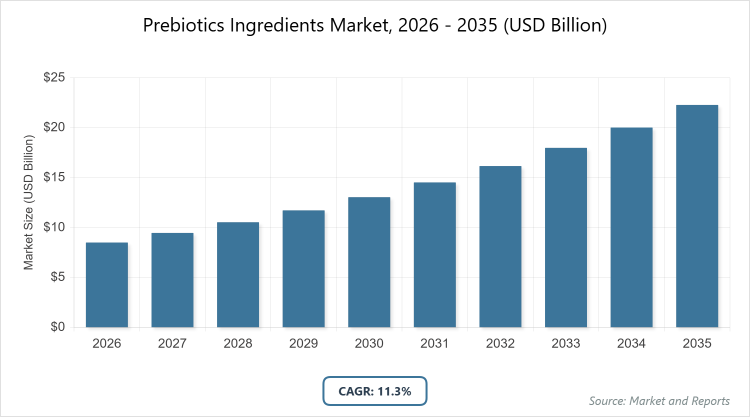
According to MarketnReports, the global Prebiotics Ingredients market size was estimated at USD 8.5 billion in 2025 and is expected to reach USD 25 billion by 2035, growing at a CAGR of 11.3% from 2026 to 2035. Prebiotics Ingredients Market is driven by growing consumer awareness of gut health and demand for functional foods.
What is Prebiotics Ingredients? An Industry Overview
Prebiotics ingredients are non-digestible food compounds, primarily fibers like inulin and oligosaccharides, that selectively stimulate the growth and activity of beneficial gut bacteria, promoting digestive health, immunity, and overall wellness when consumed. The market definition encompasses natural and synthetic prebiotics used in food, beverages, supplements, and animal feed to enhance microbiome balance, supporting applications in human and animal nutrition while addressing trends in preventive healthcare, clean-label products, and sustainable sourcing to meet regulatory standards and consumer preferences for health-enhancing additives.
What are the Key Insights of Prebiotics Ingredients Market?
- The global Prebiotics Ingredients market was valued at USD 8.5 billion in 2025 and is projected to reach USD 25 billion by 2035.
- The global Prebiotics Ingredients market is expected to grow at a CAGR of 11.3% during the forecast period 2026-2035.
- The Prebiotics Ingredients market is driven by rising health consciousness, probiotic synergies, and functional food trends.
- The inulin subsegment dominates the type segment with a 35% share due to its versatility in food formulations and proven gut health benefits.
- The food & beverages subsegment dominates the application segment with a 50% share owing to widespread incorporation in dairy, cereals, and snacks for nutritional enhancement.
- The human subsegment dominates the end-user segment with a 80% share because of increasing focus on personal health and wellness products.
- Europe dominates the global Prebiotics Ingredients market with a 35% share attributed to strong regulatory support for functional foods and high consumer awareness in countries like Germany and France.
What are the Market Dynamics of Prebiotics Ingredients?
Growth Drivers
The prebiotics ingredients market is fueled by escalating consumer interest in gut health, with over 70% of global consumers seeking digestive wellness products, driving demand for prebiotics in functional foods like yogurt and cereals that promote microbiome balance. Technological advancements in extraction methods, such as enzymatic hydrolysis for oligosaccharides, improve yield and purity, enabling cost-effective production and integration into diverse applications, appealing to manufacturers. Government initiatives, like EU’s health claims regulations for prebiotics, encourage innovation, while rising e-commerce facilitates access to supplements, boosting sales by 25% annually in developed regions.
Restraints
High production costs for natural prebiotics, derived from sources like chicory root, increase product prices by 20-30%, limiting affordability in emerging markets where synthetic alternatives face consumer skepticism. Regulatory challenges in health claim approvals, varying by region like FDA’s stringent evidence requirements, delay market entry and marketing. Supply chain vulnerabilities, such as seasonal crop dependencies for inulin, lead to price fluctuations and shortages, impacting consistent availability for manufacturers.
Opportunities
The synergy with probiotics in synbiotic products offers opportunities for innovation in personalized nutrition, with the global probiotics market complementing prebiotics to capture a combined value exceeding USD 100 billion by 2030. Emerging markets in Asia-Pacific present growth through rising middle-class demand for health supplements, where localized sourcing of ingredients like resistant starch from rice can reduce costs. Partnerships with food tech firms for prebiotic-enriched beverages can tap into the functional drinks sector, leveraging clean-label trends for premium positioning.
Challenges
Ensuring stability of prebiotics in processed foods, as heat and acidity can degrade fibers like FOS, requires formulation expertise that increases R&D costs. Consumer confusion over prebiotics vs. probiotics demands education, while fake products in unregulated markets erode trust. Environmental concerns over sourcing, such as water-intensive chicory cultivation, push for sustainable practices, adding complexity to supply chains.
Prebiotics Ingredients Market: Report Scope
| Report Attributes | Report Details |
| Report Name | Prebiotics Ingredients Market |
| Market Size 2025 | USD 8.5 Billion |
| Market Forecast 2035 | USD 25 Billion |
| Growth Rate | CAGR of 11.3% |
| Report Pages | 220 |
| Key Companies Covered | Beneo, DuPont, Cargill, Kerry Group, Ingredion, Tate & Lyle, and Others |
| Segments Covered | By Type, By Application, By End-User, and By Region |
| Regions Covered | North America, Europe, Asia Pacific (APAC), Latin America, and The Middle East and Africa (MEA) |
| Base Year | 2025 |
| Historical Year | 2020 – 2024 |
| Forecast Year | 2026 – 2035 |
| Customization Scope | Avail customized purchase options to meet your exact research needs. |
The Prebiotics Ingredients market is segmented by type, application, end-user, and region.
Based on Type Segment: The inulin segment is the most dominant, holding a 35% market share, as it is widely sourced from natural plants like chicory and offers excellent solubility in foods, driven by its prebiotic efficacy in stimulating bifidobacteria. This dominance drives market growth by enabling versatile use in dairy and bakery products. The fructo-oligosaccharides (FOS) segment is the second most dominant with a 25% share, valued for its sweetness and low calorie profile, which propels the market through applications in sugar-reduced items.
Based on Application Segment: The food & beverages segment is the most dominant, capturing a 50% share, due to rising demand for fortified products like yogurts and cereals. Its dominance accelerates market growth by integrating prebiotics into daily diets. The dietary supplements segment ranks second with a 30% share, where capsules and powders target specific health needs, driving the market with personalized wellness.
Based on End-User Segment: The human segment is the most dominant, with a 80% share, attributed to growing focus on preventive health. This leads market growth by expanding consumer products. The animal segment is second with a 20% share, used in feed for livestock gut health, propelling growth through agricultural applications.
What are the Recent Developments in Prebiotics Ingredients Market?
- In 2025, Beneo launched a new rice-based prebiotic with enhanced stability for baked goods.
- DuPont expanded its FOS production facility in Europe to meet rising demand for infant nutrition.
- Cargill partnered with a probiotic firm for synbiotic supplements targeting gut immunity.
- Kerry Group introduced organic inulin from sustainable sources for clean-label beverages.
- Ingredion acquired a startup for novel XOS production, focusing on plant-based foods.
What is the Regional Analysis of Prebiotics Ingredients Market?
- Europe to dominate the global market
Europe holds a 35% share in the Prebiotics Ingredients market, driven by health-focused regulations. Germany dominates, with companies like Beneo leading in functional foods, supported by EFSA approvals.
North America maintains a strong position in the Prebiotics Ingredients market, fueled by wellness trends. The United States leads, with DuPont and Cargill innovating supplements for digestive health.
Asia Pacific is the fastest-growing region for Prebiotics Ingredients, propelled by population health demands. China dominates, with rising middle-class adoption in dairy and feed.
Latin America is emerging in the Prebiotics Ingredients market, focusing on natural sources. Brazil leads, incorporating prebiotics in beverages amid health awareness.
The Middle East and Africa show potential in Prebiotics Ingredients, driven by import growth. The UAE is a key player, using for premium nutrition products.
Who are the Key Market Players and Strategies in Prebiotics Ingredients?
Beneo focuses on sustainable sourcing, launching rice-based prebiotics for stability.
DuPont emphasizes production expansions, partnering for synbiotics.
Cargill pursues collaborations, innovating for gut health supplements.
Kerry Group prioritizes organic lines, targeting clean-label markets.
Ingredion acquires for novel XOS, expanding plant-based offerings.
Tate & Lyle develops low-sugar FOS, focusing on beverage integrations.
What are the Market Trends in Prebiotics Ingredients?
- Increasing demand for plant-based and organic prebiotics.
- Growth in synbiotic products combining pre and probiotics.
- Expansion of prebiotics in infant and animal nutrition.
- Focus on sustainable sourcing and clean-label claims.
- Rise of personalized prebiotic supplements via e-commerce.
- Integration in functional beverages and snacks.
What are the Market Segments and their Subsegment Covered in the Prebiotics Ingredients Report?
By Type
-
- Inulin
- Fructo-Oligosaccharides (FOS)
- Galacto-Oligosaccharides (GOS)
- Mannan-Oligosaccharides (MOS)
- Xylo-Oligosaccharides (XOS)
- Isomalto-Oligosaccharides (IMO)
- Polydextrose
- Lactulose
- Resistant Starch
- Beta-Glucan
- Others
By Application
-
- Food & Beverages
- Dietary Supplements
- Animal Feed
- Pharmaceuticals
- Infant Nutrition
- Personal Care
- Others
By End-User
-
- Human
- Animal
- Others
By Region
-
- North America
- U.S.
- Canada
- Europe
- UK
- Germany
- France
- Rest of Europe
- Asia Pacific
- China
- India
- Japan
- Rest of Asia Pacific
- Latin America
- Brazil
- Mexico
- Rest of Latin America
- Middle East & Africa
- UAE
- South Africa
- Rest of Middle East & Africa
- North America
Frequently Asked Questions
Prebiotics Ingredients are non-digestible fibers that promote beneficial gut bacteria for health benefits.
Key factors include gut health awareness, functional food demand, and regulatory support.
The market is projected to grow from USD 9.5 billion in 2026 to USD 25 billion by 2035.
The market is expected to grow at a CAGR of 11.3% during 2026-2035.
Europe will contribute notably, holding a 35% share due to regulatory health claims.
Major players include Beneo, DuPont, Cargill, Kerry Group, Ingredion, and Tate & Lyle.
The report provides market size, trends, segmentation, regional insights, key players, and forecasts.
Stages include raw material extraction, processing, formulation, distribution, and retail.
Trends favor synbiotics and organic sources, with consumers preferring gut-health focused products.
Health claim regulations and sustainability drive natural sourcing.