
Powerhouse Protein Market Size, Share and Trends 2026 to 2035
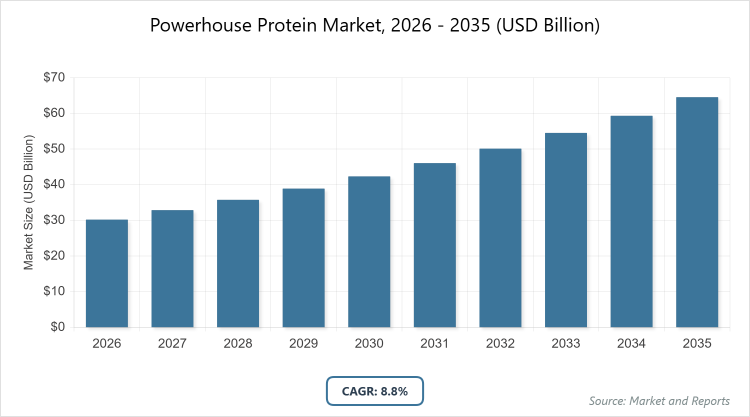
According to MarketnReports, the global Powerhouse Protein market size was estimated at USD 30.22 billion in 2025 and is expected to reach USD 70.24 billion by 2035, growing at a CAGR of 8.8% from 2026 to 2035. Powerhouse Protein Market is driven by increasing health consciousness and rising demand for fitness-oriented nutrition.
What are the Key Insights of the Powerhouse Protein Market?
- The global Powerhouse Protein market was valued at USD 30.22 billion in 2025 and is projected to reach USD 70.24 billion by 2035.
- The market is expected to grow at a CAGR of 8.8% during the forecast period from 2026 to 2035.
- The market is driven by rising health awareness, expanding fitness culture, and demand for plant-based alternatives.
- The whey protein subsegment dominates the type segment with a 45% share due to its high bioavailability and effectiveness in muscle recovery and growth.
- The pea protein subsegment is the second dominant in the type segment with a 25% share, driven by its appeal to vegan consumers and sustainability benefits.
- The sports nutrition subsegment dominates the application segment with a 50% share because it caters to athletes and fitness enthusiasts seeking performance enhancement.
- North America dominates the regional segment with a 40% share owing to strong fitness trends, high disposable incomes, and widespread availability of products.
What is the Industry Overview of Powerhouse Protein?
The Powerhouse Protein market encompasses a wide range of nutritional products designed to deliver high-quality protein for health, fitness, and wellness purposes. It includes supplements derived from animal, plant, and microbial sources, formulated to support muscle building, weight management, and overall dietary needs. Market definition refers to Powerhouse Protein as concentrated forms of protein available in powders, bars, shakes, and other formats that provide essential amino acids beyond regular food intake, targeting consumers focused on active lifestyles, recovery, and preventive health. This industry bridges the gap between traditional nutrition and specialized dietary requirements, evolving with consumer preferences for clean, sustainable, and functional ingredients.
What are the Market Dynamics Influencing Powerhouse Protein?
Growth Drivers
The primary growth drivers in the Powerhouse Protein market include escalating global awareness of health and fitness, fueled by social media, wellness campaigns, and a surge in gym memberships. Increasing incidences of lifestyle-related issues like obesity and muscle loss have prompted consumers to adopt protein-rich diets for weight control and muscle maintenance. Advancements in product formulation, such as improved taste and digestibility, along with the rise of e-commerce platforms, have made these supplements more accessible. Additionally, the integration of protein into everyday foods and beverages expands market reach beyond athletes to general consumers seeking balanced nutrition.
Restraints
Key restraints impacting the Powerhouse Protein market involve high production costs associated with sourcing premium ingredients and maintaining quality standards, which can lead to elevated product prices and limit affordability in emerging economies. Regulatory hurdles, including stringent labeling requirements and safety approvals for novel proteins, pose challenges for market entry and innovation. Concerns over potential side effects, such as digestive issues from overconsumption, and the prevalence of counterfeit products erode consumer trust. Supply chain disruptions, particularly for plant-based sources affected by climate variability, further constrain consistent availability and growth.
Opportunities
Opportunities in the Powerhouse Protein market are abundant with the growing demand for personalized nutrition, enabled by AI-driven apps that tailor protein intake to individual needs like age, activity level, and health goals. Expansion into untapped regions, such as Asia-Pacific and Latin America, where rising middle-class populations are embracing Western fitness trends, presents significant potential. Innovation in sustainable sourcing, like precision fermentation for animal-free proteins, aligns with environmental concerns and attracts eco-conscious consumers. Partnerships with food tech companies to develop hybrid products combining protein with superfoods or probiotics can create new revenue streams.
Challenges
Challenges facing the Powerhouse Protein market include intense competition from alternative nutrition sources, such as whole foods or meal replacements, which some consumers prefer over supplements for perceived natural benefits. Volatility in raw material prices, especially for dairy-based proteins influenced by global trade fluctuations, affects profitability. Educating consumers on proper usage to avoid misuse or dependency remains a hurdle, as misinformation can lead to negative perceptions. Adapting to diverse cultural dietary preferences and addressing allergen concerns, like lactose intolerance, require ongoing R&D to ensure broad market acceptance.
Powerhouse Protein Market: Report Scope
| Report Attributes | Report Details |
| Report Name | Powerhouse Protein Market |
| Market Size 2025 | USD 30.22 Billion |
| Market Forecast 2035 | USD 70.24 Billion |
| Growth Rate | CAGR of 8.8% |
| Report Pages | 220 |
| Key Companies Covered | Glanbia PLC, Abbott Laboratories, MusclePharm, Quest Nutrition, CytoSport Inc., and Others |
| Segments Covered | By Type, By Application, By End-User, and By Region |
| Regions Covered | North America, Europe, Asia Pacific (APAC), Latin America, and The Middle East and Africa (MEA) |
| Base Year | 2025 |
| Historical Year | 2020 – 2024 |
| Forecast Year | 2026 – 2035 |
| Customization Scope | Avail customized purchase options to meet your exact research needs. |
How is the Market Segmentation Structured for Powerhouse Protein?
The Powerhouse Protein market is segmented by type, application, end-user, and region.
Based on Type Segment, whey protein emerges as the most dominant subsegment due to its complete amino acid profile, rapid absorption, and proven efficacy in supporting muscle synthesis and recovery, which drives market growth by appealing to a broad audience from professional athletes to casual fitness users. Casein protein ranks as the second most dominant, valued for its slow-release properties that provide sustained nutrition, aiding in overnight muscle repair and appetite control, thereby contributing to market expansion through its role in weight management and long-term health regimens.
Based on Application Segment, sports nutrition stands out as the most dominant subsegment, propelled by the increasing participation in athletic activities and the need for performance-enhancing supplements that boost endurance and strength, fueling overall market momentum. Functional foods follow as the second dominant, integrating protein into everyday consumables like snacks and beverages to meet nutritional gaps, which helps drive the market by making protein accessible to non-athletic consumers focused on general wellness.
Based on End-User Segment, athletes represent the most dominant subsegment, driven by their high demand for specialized protein to optimize training outcomes and recovery, significantly propelling market growth through targeted product innovations. Recreational users are the second dominant, seeking convenient protein options to support active lifestyles without intense training, contributing to market development by broadening the consumer base and encouraging mainstream adoption.
What are the Recent Developments in Powerhouse Protein?
- In January 2026, Veracity launched Metabolic Power Protein, a plant-based supplement aimed at muscle development and metabolic health, expanding options for wellness-focused consumers.
- In January 2026, Ambrosia introduced a ready-to-mix protein powder using Solar Foods’ innovative protein source, marking entry into sustainable nutrition in the US market.
- In May 2025, Danone unveiled a new protein shake under the Oikos brand, targeting weight-loss drug users and gaining rapid consumer traction.
- In November 2023, Valio launched Valio Eila MPC 65, a lactose-free milk protein concentrate, enhancing options for healthier, better-tasting products.
- In October 2023, Tyson Foods partnered with Protix to venture into insect protein, aiming to diversify offerings in the nutrition category.
- In May 2023, NewFish collaborated with Socius Ingredients to commercialize microalgae proteins for the US nutrition market.
- In February 2023, Starco Brands acquired Soylent, a complete nutrition brand, to strengthen its position in plant-based protein solutions.
- In March 2025, Optimum Nutrition teamed with Royal Challengers Bengaluru for a fitness awareness campaign in India.
- In May 2025, Just One Protein brand launched mung bean protein powder at Whole Foods, emphasizing sustainability.
- In March 2025, Bon Vivant rebranded to Verley and introduced FermWhey, an animal-free whey protein line.
- In October 2024, REBBL released 26g Protein Shakes at Target, featuring certified plant protein blends.
Which Region Dominates the Global Powerhouse Protein Market?
- North America to dominate the global market.
North America leads the Powerhouse Protein market with a dominant share, primarily driven by the United States as the top country, where robust fitness culture, high consumer spending on health products, and advanced distribution networks fuel demand. The region’s emphasis on sports nutrition and innovative plant-based options, coupled with widespread gym memberships and e-commerce growth, supports sustained expansion. Canada contributes through its focus on sustainable sourcing, like pea protein production, while Mexico benefits from increasing urbanization and adoption of Western dietary trends.
Europe holds a significant position in the Powerhouse Protein market, with Germany as the dominating country, bolstered by strong regulatory support for clean-label products and a health-conscious population. The UK’s vibrant fitness scene and France’s interest in functional foods drive regional growth, while innovations in dairy alternatives and vegan proteins address diverse consumer needs. Overall, Europe’s market thrives on premium product offerings, eco-friendly initiatives, and collaborations between manufacturers and retailers.
Asia Pacific is the fastest-growing region in the Powerhouse Protein market, led by China as the dominant country, where rising middle-class incomes and urbanization spur demand for nutritional supplements. India’s expanding sports nutrition sector and Japan’s focus on elderly health further accelerate growth, with plant-based proteins gaining traction amid vegan trends. The region’s market is propelled by e-commerce penetration, government health campaigns, and affordable local production.
Latin America shows promising growth in the Powerhouse Protein market, with Brazil dominating due to its large population and increasing fitness awareness. Mexico’s proximity to North American supply chains and Argentina’s agricultural resources support regional development, focusing on affordable whey and soy options. Challenges like economic variability are offset by rising disposable incomes and health trends.
Middle East and Africa represent an emerging segment in the Powerhouse Protein market, with South Africa leading through its growing urban fitness culture and access to imported products. The UAE’s wellness tourism and Saudi Arabia’s health initiatives drive demand, though limited local production poses challenges. Opportunities lie in halal-certified proteins and partnerships for distribution expansion.
Who are the Key Market Players in Powerhouse Protein?
- Glanbia PLC focuses on innovation in whey and plant-based proteins, leveraging acquisitions like Flavor Producers to expand flavor profiles and sustainable sourcing; strategies include R&D for clean-label products and global distribution partnerships to capture emerging markets.
- Abbott Laboratories emphasizes nutritional science, developing targeted supplements for sports and medical nutrition; key strategies involve clinical research collaborations and e-commerce expansion to reach health-conscious consumers directly.
- MusclePharm prioritizes performance-driven formulations, such as ready-to-drink proteins; strategies include athlete endorsements and digital marketing to build brand loyalty among fitness enthusiasts.
- Quest Nutrition specializes in low-carb, high-protein bars and powders; approaches encompass flavor innovation and retail partnerships to appeal to weight management segments.
- CytoSport Inc. invests in muscle recovery products like Muscle Milk; tactics involve sustainability initiatives and product diversification into plant-based lines for broader appeal.
- Iovate Health Sciences International Inc. drives growth through branded supplements like Hydroxycut; strategies feature influencer collaborations and international expansion to tap into wellness trends.
- The Nature’s Bounty Co. focuses on natural, vitamin-enriched proteins; methods include supply chain optimization and online subscription models for recurring revenue.
- GNC Holdings LLC leverages retail presence for personalized nutrition advice; strategies encompass private-label development and health education campaigns to retain customers.
- Herbalife International of America Inc. promotes meal replacement shakes; approaches involve direct selling networks and community wellness programs to foster global reach.
- Nestlé S.A. innovates in functional proteins like Milo Pro; tactics include acquisitions such as Vital Proteins and AI-driven personalization for consumer engagement.
What are the Market Trends Shaping Powerhouse Protein?
- Rising demand for plant-based proteins due to veganism and sustainability concerns.
- Increasing adoption of personalized nutrition through AI and apps.
- Growth in functional formats like ready-to-drink shakes and gummies.
- Focus on clean-label and natural ingredients to meet consumer transparency needs.
- Expansion of e-commerce and direct-to-consumer sales channels.
- Integration of protein with superfoods and probiotics for added health benefits.
- Surge in protein-enriched everyday foods beyond traditional supplements.
- Emphasis on sustainable sourcing, including precision fermentation.
- Targeting aging populations with proteins for muscle maintenance.
- Collaborations with influencers and sports teams for marketing.
What Market Segments and Subsegments are Covered in the Powerhouse Protein Report?
By Type
- Whey Protein
- Casein Protein
- Soy Protein
- Pea Protein
- Hemp Protein
- Rice Protein
- Egg Protein
- Collagen Protein
- Milk Protein
- Beef Protein
- Others
By Application
- Sports Nutrition
- Additional Nutrition
- Medicinal Nutrition
- Functional Foods
- Weight Management
- Infant Nutrition
- Animal Feed
- Cosmetics
- Pharmaceuticals
- Dietary Supplements
- Others
By End-User
- Athletes
- Recreational Users
- Lifestyle Users
- Bodybuilders
- Elderly Population
- Hospitals
- Fitness Centers
- Online Consumers
- Retail Consumers
- Institutional Users
- Others
By Region
- North America
- U.S.
- Canada
- Europe
- UK
- Germany
- France
- Rest of Europe
- Asia Pacific
- China
- India
- Japan
- Rest of Asia Pacific
- Latin America
- Brazil
- Mexico
- Rest of Latin America
- Middle East & Africa
- UAE
- South Africa
- Rest of Middle East & Africa
Chapter 1. Preface
1.1 Report Description and Scope1.2 Research Scope1.3 Research Methodology1.3.1 Market Research Type1.3.2 Market Research MethodologyChapter 2. Executive Summary
2.1 Global Powerhouse Protein Market, (2026 - 2035) (USD Billion)2.2 Global Powerhouse Protein Market: SnapshotChapter 3. Global Powerhouse Protein Market - Industry Analysis
3.1 Powerhouse Protein Market: Market Dynamics3.2 Market Drivers3.2.1 The Powerhouse Protein market is driven by rising fitness awareness, lifestyle disease concerns, improved formulations, e-commerce accessibility, and the integration of protein into everyday foods and beverages.3.3 Market Restraints3.3.1 The market is restrained by high production costs, regulatory hurdles, side-effect concerns, counterfeit products, and supply chain disruptions—especially for plant-based proteins.3.4 Market Opportunities3.4.1 Key opportunities include AI-driven personalized nutrition, expansion in emerging markets, sustainable protein innovations like precision fermentation, and partnerships for hybrid functional products.3.5 Market Challenges3.5.1 The market faces challenges from competition with natural foods, raw material price volatility, consumer education gaps, cultural dietary differences, and allergen-related R&D demands.3.6 Porter’s Five Forces Analysis3.7 Market Attractiveness Analysis3.7.1 Market Attractiveness Analysis By Type3.7.2 Market Attractiveness Analysis By Application3.7.3 Market Attractiveness Analysis By End-UserChapter 4. Global Powerhouse Protein Market- Competitive Landscape
4.1 Company Market Share Analysis4.1.1 Global Powerhouse Protein Market: Company Market Share, 20254.2 Strategic Development4.2.1 Acquisitions & mergers4.2.2 New Product launches4.2.3 Agreements, partnerships, collaborations, and joint ventures4.2.4 Research and development and regional expansion4.3 Price Trend AnalysisChapter 5. Global Powerhouse Protein Market - Type Analysis
5.1 Global Powerhouse Protein Market Overview: Type5.1.1 Global Powerhouse Protein Market share, By Type, 2025 and 20355.2 Whey Protein5.2.1 Global Powerhouse Protein Market by Whey Protein, 2026 - 2035 (USD Billion)5.3 Casein Protein5.3.1 Global Powerhouse Protein Market by Casein Protein, 2026 - 2035 (USD Billion)5.4 Soy Protein5.4.1 Global Powerhouse Protein Market by Soy Protein, 2026 - 2035 (USD Billion)5.5 Pea Protein5.5.1 Global Powerhouse Protein Market by Pea Protein, 2026 - 2035 (USD Billion)5.6 Hemp Protein5.6.1 Global Powerhouse Protein Market by Hemp Protein, 2026 - 2035 (USD Billion)5.7 Rice Protein5.7.1 Global Powerhouse Protein Market by Rice Protein, 2026 - 2035 (USD Billion)5.8 Egg Protein5.8.1 Global Powerhouse Protein Market by Egg Protein, 2026 - 2035 (USD Billion)5.9 Collagen Protein5.9.1 Global Powerhouse Protein Market by Collagen Protein, 2026 - 2035 (USD Billion)5.10 Milk Protein5.10.1 Global Powerhouse Protein Market by Milk Protein, 2026 - 2035 (USD Billion)5.11 Beef Protein5.11.1 Global Powerhouse Protein Market by Beef Protein, 2026 - 2035 (USD Billion)Chapter 6. Global Powerhouse Protein Market - Application Analysis
6.1 Global Powerhouse Protein Market Overview: Application6.1.1 Global Powerhouse Protein Market Share, By Application, 2025 and 20356.2 Sports Nutrition6.2.1 Global Powerhouse Protein Market by Sports Nutrition, 2026 - 2035 (USD Billion)6.3 Additional Nutrition6.3.1 Global Powerhouse Protein Market by Additional Nutrition, 2026 - 2035 (USD Billion)6.4 Medicinal Nutrition6.4.1 Global Powerhouse Protein Market by Medicinal Nutrition, 2026 - 2035 (USD Billion)6.5 Functional Foods6.5.1 Global Powerhouse Protein Market by Functional Foods, 2026 - 2035 (USD Billion)6.6 Weight Management6.6.1 Global Powerhouse Protein Market by Weight Management, 2026 - 2035 (USD Billion)6.7 Infant Nutrition6.7.1 Global Powerhouse Protein Market by Infant Nutrition, 2026 - 2035 (USD Billion)6.8 Animal Feed6.8.1 Global Powerhouse Protein Market by Animal Feed, 2026 - 2035 (USD Billion)6.9 Cosmetics6.9.1 Global Powerhouse Protein Market by Cosmetics, 2026 - 2035 (USD Billion)6.10 Pharmaceuticals6.10.1 Global Powerhouse Protein Market by Pharmaceuticals, 2026 - 2035 (USD Billion)6.11 Dietary Supplements6.11.1 Global Powerhouse Protein Market by Dietary Supplements, 2026 - 2035 (USD Billion)Chapter 7. Global Powerhouse Protein Market - End-User Analysis
7.1 Global Powerhouse Protein Market Overview: End-User7.1.1 Global Powerhouse Protein Market Share, By End-User, 2025 and 20357.2 Athletes7.2.1 Global Powerhouse Protein Market by Athletes, 2026 - 2035 (USD Billion)7.3 Recreational Users7.3.1 Global Powerhouse Protein Market by Recreational Users, 2026 - 2035 (USD Billion)7.4 Lifestyle Users7.4.1 Global Powerhouse Protein Market by Lifestyle Users, 2026 - 2035 (USD Billion)7.5 Bodybuilders7.5.1 Global Powerhouse Protein Market by Bodybuilders, 2026 - 2035 (USD Billion)7.6 Elderly Population7.6.1 Global Powerhouse Protein Market by Elderly Population, 2026 - 2035 (USD Billion)7.7 Hospitals7.7.1 Global Powerhouse Protein Market by Hospitals, 2026 - 2035 (USD Billion)7.8 Fitness Centers7.8.1 Global Powerhouse Protein Market by Fitness Centers, 2026 - 2035 (USD Billion)7.9 Online Consumers7.9.1 Global Powerhouse Protein Market by Online Consumers, 2026 - 2035 (USD Billion)7.10 Retail Consumers7.10.1 Global Powerhouse Protein Market by Retail Consumers, 2026 - 2035 (USD Billion)7.11 Institutional Users7.11.1 Global Powerhouse Protein Market by Institutional Users, 2026 - 2035 (USD Billion)Chapter 8. Powerhouse Protein Market - Regional Analysis
8.1 Global Powerhouse Protein Market Regional Overview8.2 Global Powerhouse Protein Market Share, by Region, 2025 & 2035 (USD Billion)8.3 North America8.3.1 North America Powerhouse Protein Market, 2026 - 2035 (USD Billion)8.3.1.1 North America Powerhouse Protein Market, by Country, 2026 - 2035 (USD Billion)8.3.2 North America Powerhouse Protein Market, by Type, 2026 - 20358.3.2.1 North America Powerhouse Protein Market, by Type, 2026 - 2035 (USD Billion)8.3.3 North America Powerhouse Protein Market, by Application, 2026 - 20358.3.3.1 North America Powerhouse Protein Market, by Application, 2026 - 2035 (USD Billion)8.3.4 North America Powerhouse Protein Market, by End-User, 2026 - 20358.3.4.1 North America Powerhouse Protein Market, by End-User, 2026 - 2035 (USD Billion)8.4 Europe8.4.1 Europe Powerhouse Protein Market, 2026 - 2035 (USD Billion)8.4.1.1 Europe Powerhouse Protein Market, by Country, 2026 - 2035 (USD Billion)8.4.2 Europe Powerhouse Protein Market, by Type, 2026 - 20358.4.2.1 Europe Powerhouse Protein Market, by Type, 2026 - 2035 (USD Billion)8.4.3 Europe Powerhouse Protein Market, by Application, 2026 - 20358.4.3.1 Europe Powerhouse Protein Market, by Application, 2026 - 2035 (USD Billion)8.4.4 Europe Powerhouse Protein Market, by End-User, 2026 - 20358.4.4.1 Europe Powerhouse Protein Market, by End-User, 2026 - 2035 (USD Billion)8.5 Asia Pacific8.5.1 Asia Pacific Powerhouse Protein Market, 2026 - 2035 (USD Billion)8.5.1.1 Asia Pacific Powerhouse Protein Market, by Country, 2026 - 2035 (USD Billion)8.5.2 Asia Pacific Powerhouse Protein Market, by Type, 2026 - 20358.5.2.1 Asia Pacific Powerhouse Protein Market, by Type, 2026 - 2035 (USD Billion)8.5.3 Asia Pacific Powerhouse Protein Market, by Application, 2026 - 20358.5.3.1 Asia Pacific Powerhouse Protein Market, by Application, 2026 - 2035 (USD Billion)8.5.4 Asia Pacific Powerhouse Protein Market, by End-User, 2026 - 20358.5.4.1 Asia Pacific Powerhouse Protein Market, by End-User, 2026 - 2035 (USD Billion)8.6 Latin America8.6.1 Latin America Powerhouse Protein Market, 2026 - 2035 (USD Billion)8.6.1.1 Latin America Powerhouse Protein Market, by Country, 2026 - 2035 (USD Billion)8.6.2 Latin America Powerhouse Protein Market, by Type, 2026 - 20358.6.2.1 Latin America Powerhouse Protein Market, by Type, 2026 - 2035 (USD Billion)8.6.3 Latin America Powerhouse Protein Market, by Application, 2026 - 20358.6.3.1 Latin America Powerhouse Protein Market, by Application, 2026 - 2035 (USD Billion)8.6.4 Latin America Powerhouse Protein Market, by End-User, 2026 - 20358.6.4.1 Latin America Powerhouse Protein Market, by End-User, 2026 - 2035 (USD Billion)8.7 The Middle-East and Africa8.7.1 The Middle-East and Africa Powerhouse Protein Market, 2026 - 2035 (USD Billion)8.7.1.1 The Middle-East and Africa Powerhouse Protein Market, by Country, 2026 - 2035 (USD Billion)8.7.2 The Middle-East and Africa Powerhouse Protein Market, by Type, 2026 - 20358.7.2.1 The Middle-East and Africa Powerhouse Protein Market, by Type, 2026 - 2035 (USD Billion)8.7.3 The Middle-East and Africa Powerhouse Protein Market, by Application, 2026 - 20358.7.3.1 The Middle-East and Africa Powerhouse Protein Market, by Application, 2026 - 2035 (USD Billion)8.7.4 The Middle-East and Africa Powerhouse Protein Market, by End-User, 2026 - 20358.7.4.1 The Middle-East and Africa Powerhouse Protein Market, by End-User, 2026 - 2035 (USD Billion)Chapter 9. Company Profiles
9.1 Glanbia PLC9.1.1 Overview9.1.2 Financials9.1.3 Product Portfolio9.1.4 Business Strategy9.1.5 Recent Developments9.2 Abbott Laboratories9.2.1 Overview9.2.2 Financials9.2.3 Product Portfolio9.2.4 Business Strategy9.2.5 Recent Developments9.3 MusclePharm9.3.1 Overview9.3.2 Financials9.3.3 Product Portfolio9.3.4 Business Strategy9.3.5 Recent Developments9.4 Quest Nutrition9.4.1 Overview9.4.2 Financials9.4.3 Product Portfolio9.4.4 Business Strategy9.4.5 Recent Developments9.5 CytoSport Inc.9.5.1 Overview9.5.2 Financials9.5.3 Product Portfolio9.5.4 Business Strategy9.5.5 Recent Developments
Frequently Asked Questions
Powerhouse Protein refers to high-quality, concentrated protein supplements derived from various sources like animal, plant, or microbial origins, designed to enhance dietary protein intake for muscle support, recovery, and overall health.
Key factors include rising health awareness, fitness trends, demand for plant-based options, product innovations, and e-commerce expansion, alongside challenges like regulatory hurdles and supply chain issues.
The market is projected to grow from USD 30.22 billion in 2025 to USD 70.24 billion by 2035.
The CAGR is expected to be 8.8% from 2026 to 2035.
North America will contribute notably, holding around 40% of the market share due to strong fitness culture and innovation.
Major players include Glanbia PLC, Abbott Laboratories, MusclePharm, Quest Nutrition, and Nestlé S.A., among others.
The report offers comprehensive analysis including market size, trends, segmentation, regional insights, key players, and forecasts.
Stages include raw material sourcing, processing and formulation, manufacturing, distribution, retail, and end-consumer usage.
Trends show a shift towards plant-based, personalized, and sustainable products, with consumers preferring clean-label and convenient formats.
Regulatory approvals for novel proteins and environmental concerns driving sustainable sourcing are key influencers.