
Portable Generator Market Size, Share, and Trends 2026 to 2035
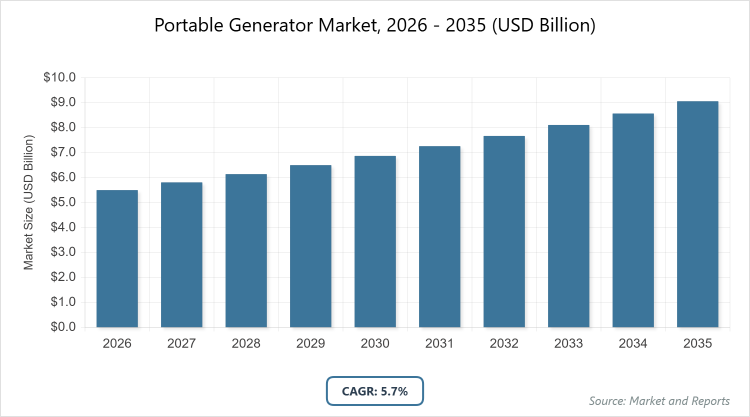
The global Portable Generator Market size was estimated at USD 5.5 Billion in 2025 and is expected to reach USD 9.1 Billion by 2035, growing at a CAGR of 5.7% from 2026 to 2035. The portable generator market is primarily driven by the increasing frequency of power outages caused by extreme weather events and aging grid infrastructure, alongside a rising demand for reliable backup power in the residential and construction sectors.
What Are the Essential Metrics and Dominance Patterns in the Portable Generator Market?
Key Insights
- Market Value in 2026: USD 5.5 billion; Market Value in 2035: USD 9.1 billion.
- CAGR from 2026 to 2035: 5.7%.
- Dominated Subsegment in Fuel Type: Gasoline, holding over 42% share due to its affordability and versatility.
- Dominated Subsegment in Power Rating: Low Power (below 20kW), preferred for residential and small-scale uses.
- Dominated Subsegment in Application: Emergency, driven by backup needs during outages.
- Dominated Subsegment in End-Use: Residential, fueled by household power reliability demands.
- Dominated Region: Asia Pacific, capturing around 32-34% market share.
Industry Overview
The portable generator market encompasses the design, manufacturing, distribution, and sale of compact, mobile power generation units that provide temporary electricity in scenarios where grid power is unavailable or unreliable. These devices convert mechanical energy from fuels like gasoline, diesel, or gas into electrical energy through an internal combustion engine coupled with an alternator, making them essential for backup power during outages, outdoor activities, construction sites, and emergency situations. Portable generators vary in size, power output, and fuel types to cater to residential, commercial, and industrial needs, offering flexibility for short-term power requirements without the need for permanent installation.
They serve as a bridge between traditional grid dependency and emerging renewable solutions, addressing power demands in remote locations, recreational events, and critical operations where mobility and quick deployment are key. This market intersects with energy infrastructure, environmental regulations, and technological advancements aimed at improving efficiency, reducing emissions, and enhancing user safety features like automatic shutdowns for carbon monoxide detection.
What are the Market Dynamics?
Growth Drivers
The portable generator market is propelled by the escalating demand for reliable backup power solutions amid frequent power outages caused by natural disasters such as hurricanes, floods, and wildfires, which disrupt grid infrastructure and necessitate immediate electricity for homes, businesses, and critical facilities like hospitals and data centers. Rapid industrialization and urbanization in emerging economies, coupled with inadequate grid systems in rural areas, further fuel adoption, as portable generators ensure uninterrupted operations for construction sites, oil and gas exploration, and small to medium enterprises requiring power for tools and equipment. Technological innovations, including dual-fuel capabilities, remote monitoring, and integration with smart controls, enhance efficiency and user convenience, while rising investments in renewable energy transitions indirectly boost demand for hybrid models that complement solar or wind setups during low-output periods. Additionally, the growing popularity of outdoor recreational activities like camping and tailgating drives consumer interest in compact, low-noise units, supported by economic development and population growth that heighten overall energy consumption.
Restraints
Stringent environmental regulations targeting carbon emissions and noise pollution pose significant hurdles to the portable generator market, as compliance requires costly modifications like advanced exhaust systems and sound attenuators, potentially deterring price-sensitive consumers and manufacturers. Volatility in fuel prices, influenced by geopolitical tensions and supply chain disruptions, increases operational costs and reduces affordability, particularly in remote or developing regions where fuel availability is inconsistent. Competition from alternative power sources, such as solar panels, battery storage systems, and microgrids, which offer cleaner and more sustainable options with lower long-term maintenance, diverts market share away from traditional fuel-based generators. High initial manufacturing and installation complexities, including safety concerns like carbon monoxide production and the need for regular upkeep, further limit widespread adoption among residential users who may opt for simpler or grid-reliant solutions.
Opportunities
The portable generator market presents ample opportunities through the development of eco-friendly and hybrid models that utilize biofuels, natural gas, propane, or solar integration, aligning with global sustainability goals and attracting environmentally conscious consumers in residential and commercial sectors. Expansion into emerging markets with unreliable grids, such as rural areas in Asia Pacific and Africa, offers growth potential by providing affordable, reliable power for agriculture, small businesses, and disaster-prone communities, supported by government initiatives for energy access. Innovations in low-emission, fuel-efficient technologies, including automatic transfer switches and smart app controls for remote operation, can capture new segments like recreational users and industrial applications requiring versatile, high-performance units. Partnerships between manufacturers and energy firms to introduce zero-emission solutions, along with rising demand for generators in data centers and e-commerce logistics amid digital transformation, further open avenues for market penetration and product diversification.
Challenges
The portable generator market faces challenges from the rapid advancement of alternative energy technologies like battery storage and renewable systems, which provide emission-free, low-maintenance options that could overshadow traditional generators in environmentally regulated regions. Safety and health concerns, including carbon monoxide poisoning risks and noisy operations, necessitate ongoing investments in features like detectors and silencers, increasing production costs and complicating user education. Grid infrastructure improvements in developing countries, backed by government funding, reduce the dependency on portable solutions for everyday power needs, while fuel supply issues in remote locations exacerbate logistical hurdles. Economic uncertainties, such as inflation and supply chain disruptions, impact raw material availability and pricing, making it difficult for manufacturers to maintain competitive edges without compromising quality or innovation.
Portable Generator Market: Report Scope
| Report Attributes | Report Details |
| Report Name | Portable Generator Market |
| Market Size 2025 | USD 5.5 Billion |
| Market Forecast 2035 | USD 9.1 Billion |
| Growth Rate | CAGR of 5.7% |
| Report Pages | 215 |
| Key Companies Covered |
Generac Power Systems, Inc., Cummins Inc., Caterpillar Inc., American Honda Motor Corp., Briggs & Stratton Corporation, Kohler Co., Atlas Copco, and Champion Power Equipment. |
| Segments Covered | By Fuel Type, By Power Rating, By Application, By End-User, By Region |
| Regions Covered | Asia Pacific, North America, Europe, Latin America, The Middle East and Africa |
| Base Year | 2025 |
| Historical Year | 2020 – 2024 |
| Forecast Year | 2026 – 2035 |
| Customization Scope | Avail customized purchase options to meet your exact research needs. |
What is the Market Segmentation?
Fuel Type Segmentation
The fuel type segmentation in the portable generator market includes gasoline, diesel, gaseous, and others, with gasoline emerging as the most dominant segment due to its widespread availability, ease of use, and cost-effectiveness, making it ideal for residential and recreational applications where quick startup and portability are prioritized, thereby driving market growth through high consumer adoption in outage-prone areas and outdoor activities; the second most dominant is diesel, valued for its fuel efficiency, durability under heavy loads, and longer runtime, which supports industrial and commercial uses in remote sites like construction and mining, helping to propel the overall market by ensuring reliable power for extended operations where gasoline might falter in efficiency.
Power Rating Segmentation
Power rating segmentation categorizes portable generators into low power (below 20kW), medium power (21-370kW), and high power (above 370kW), where low power stands as the most dominant due to its affordability, compactness, and suitability for essential residential and small business needs like powering appliances during blackouts or events, driving market expansion by catering to the largest consumer base focused on cost and mobility; medium power ranks as the second most dominant, offering balanced output for commercial and industrial applications such as construction tools and backup for mid-sized facilities, contributing to market growth through its versatility in remote and continuous use scenarios that require more than basic power without the bulk of high-end models.
Application Segmentation
In application segmentation, portable generators are divided into emergency, prime/continuous, and others, with emergency being the most dominant as it addresses immediate backup during power outages from natural disasters or grid failures, dominating through its critical role in maintaining safety and operations in homes and businesses, thus fueling market demand amid increasing weather-related disruptions; prime/continuous follows as the second most dominant, essential for ongoing power in construction, oil and gas, and remote sites where grid access is limited, aiding market propulsion by supporting industries that rely on sustained electricity for productivity and efficiency.
End-Use Segmentation
End-use segmentation encompasses residential, commercial, industrial, and others, with residential as the most dominant segment owing to rising urbanization, frequent outages, and recreational needs like camping, where compact units provide reliable home backup and portability, driving the market by tapping into widespread consumer demand for energy security; industrial emerges as the second most dominant, driven by needs in manufacturing, mining, and data centers for uninterrupted operations, bolstering market growth through adoption of robust, fuel-efficient models that minimize downtime in high-stake environments.
What are the Recent Developments?
- In May 2023, Generac Power Systems introduced the GP7500E Dual Fuel portable generator, offering 9,400 starting watts and 7,500 running watts, designed to handle household loads and power tools efficiently on either gasoline or propane, enhancing versatility for residential and recreational users amid growing demand for flexible fuel options.
- In October 2022, Cummins Inc. launched the Onan Power Stations, a battery-powered series aimed at sustainable applications like camping, RV use, and electronics charging, marking a shift toward zero-emission solutions to address environmental concerns and expand into eco-conscious markets.
- In May 2022, Generac Power Systems unveiled the Powermate 7500 Watt and 4500 Watt Dual Fuel Portable Generators, operable on gasoline or compressed natural gas, targeting campgrounds, picnics, and home chores to provide clean, efficient power alternatives that reduce emissions and improve user convenience.
- In January 2024, Champion Power Equipment released a 22 kW Home Standby generator with fully automatic operation, catering to residential power needs during outages and integrating smart features for seamless backup, reflecting the trend toward automated, reliable home energy solutions.
- In April 2023, Cummins Inc. partnered with Tata Motors to develop low- to zero-emission technology products in India, supporting the Green Hydrogen Mission and net-zero goals by advancing hydrogen-fueled generators for sustainable industrial applications.
- In July 2020, Honda Power Equipment incorporated the CO-MINDER advanced carbon monoxide detector system across its portable generator lineup, enabling automatic shutdown to prevent hazardous CO levels, prioritizing user safety and compliance with regulations in residential and outdoor settings.
- In March 2021, Generac Power Systems redesigned its Powermate portable generators with ten new modules to meet diverse homeowner demands, simplifying usage and enhancing performance for everyday backup and recreational purposes.
What is the Regional Analysis?
In North America, the portable generator market experiences robust growth driven by frequent natural disasters like hurricanes and wildfires, coupled with high energy consumption and aging grid infrastructure, particularly in the United States as the dominating country where demand for backup power in residential and commercial sectors is amplified by extreme weather events and initiatives for clean energy adoption, leading to increased sales of eco-friendly models; Canada contributes through rising energy demands and government support for alternative sources, fostering opportunities in both urban and remote areas. Asia Pacific dominates the global portable generator market with rapid industrialization, population growth, and unreliable grids in emerging economies, where China stands as the dominating country due to its massive manufacturing base, steel exports, and renewable energy expansions that necessitate reliable backup for industrial and residential uses amid frequent blackouts; India follows closely with investments in power infrastructure and rural electrification, while Japan and Indonesia benefit from natural gas availability and disaster-prone geographies, collectively driving the region’s leadership through economic development and sustainability focuses.
Europe’s portable generator market is shaped by grid instability, unpredictable weather, and stringent environmental regulations promoting low-emission models, with Germany as the dominating country owing to its emphasis on energy security, outages in rural areas, and preference for sustainable technologies like gaseous generators; the United Kingdom exhibits high growth from power disruptions and eco-friendly innovations, while France and Italy support through construction and industrial needs, overall advancing the market via regulatory compliance and clean energy transitions. Latin America’s portable generator market grows amid inadequate infrastructure and natural calamities, with Brazil as the dominating country fueled by economic development, remote mining operations, and demand for backup in urban centers during floods or outages; Mexico contributes through oil and gas sectors and manufacturing, while Argentina benefits from agricultural applications, creating a regional dynamic focused on affordable, versatile units for emerging industrial and residential needs.
The Middle East and Africa region sees expansion due to poor grid access in African countries and backup requirements in Gulf nations, with South Africa as the dominating country driven by energy shortages, mining activities, and investments in remote power solutions; Saudi Arabia grows through economic diversification and natural gas usage, while the UAE and Israel support via construction and high-tech industries, emphasizing reliable generators for harsh environments and sustainability initiatives.
Who are the Key Market Players and Their Strategies?
- Generac Power Systems, Inc. focuses on research and development for innovative backup and recreational power solutions, including dual-fuel generators to enhance versatility and reduce emissions, while expanding product lines through launches like the GP7500E to capture residential and commercial markets.
- Cummins Inc. emphasizes sustainable zero-emission technologies via brands like Accelera, partnering with firms like Tata Motors for green hydrogen products and launching battery-powered stations to align with environmental regulations and expand into eco-friendly segments.
- Caterpillar Inc. prioritizes durability and performance for construction and emergency applications, investing in reliable engines and expanding generator ranges for extreme conditions to maintain leadership in industrial sectors.
- American Honda Motor Corp. integrates advanced safety features like CO detectors and focuses on compact, efficient models for outdoor and residential use, leveraging its automotive expertise to improve fuel efficiency and user convenience.
- Briggs & Stratton Corporation diversifies its outdoor power equipment portfolio with innovative, user-friendly generators, aiming at homeowner needs through redesigns and multipurpose modules to simplify operations and boost market share.
- Kohler Co. (including Kohler-SDMO) develops high-quality, fuel-efficient units with smart controls, targeting commercial and industrial reliability while complying with emission standards to strengthen global presence.
- Atlas Copco expands portable generator offerings for continuous operation in harsh environments, focusing on high-capacity models and collaborations to serve construction and mining industries effectively.
- Champion Power Equipment introduces automatic standby generators for home use, emphasizing affordability and automation to appeal to residential consumers seeking seamless backup during outages.
What Emerging Patterns Are Observed in the Portable Generator Market?
Market Trends
- Increasing adoption of dual-fuel and hybrid generators that switch between gasoline, propane, or natural gas for flexibility and reduced emissions.
- Shift toward eco-friendly models incorporating biofuels, solar integration, and low-noise technologies to meet environmental regulations.
- Growth in smart features like remote monitoring, app controls, and automatic transfer switches for enhanced user convenience and safety.
- Rising demand for compact, low-power units in residential sectors driven by urbanization and frequent weather-related outages.
- Expansion of gaseous generators for their fuel efficiency and cleaner burning in commercial and industrial applications.
- Focus on carbon monoxide detection and automatic shutdown systems to address safety concerns and regulatory compliance.
- Surge in recreational applications for camping and events, boosting portable, battery-powered alternatives.
- Technological advancements in fuel efficiency and durability for remote operations in construction and oil/gas sectors.
What Categories Are Included in the Portable Generator Market Report?
Market Segments Covered in the Report
Fuel Type
- Gasoline
- Diesel
- Gaseous
- Others
Power Rating
- Low Power (Below 20kW)
- Medium Power (21-370kW)
- High Power (Above 370kW)
Application
- Emergency
- Prime/Continuous
- Others
End-Use
- Residential
- Commercial
- Industrial
- Others
By Region
-
- North America
- U.S.
- Canada
- Europe
- UK
- Germany
- France
- Rest of Europe
- Asia Pacific
- China
- India
- Japan
- Rest of Asia Pacific
- Latin America
- Brazil
- Mexico
- Rest of Latin America
- Middle East & Africa
-
- UAE
- South Africa
- Rest of Middle East & Africa
-
- North America
Chapter 1. Preface
Chapter 2. Executive Summary
Chapter 3. Global Portable Generator Market Market - Industry Analysis
Chapter 4. Global Portable Generator Market Market- Competitive Landscape
Chapter 5. Global Portable Generator Market Market - Fuel Type Analysis
Chapter 6. Global Portable Generator Market Market - Power Rating Analysis
Chapter 7. Global Portable Generator Market Market - Application Analysis
Chapter 8. Global Portable Generator Market Market - End-Use Analysis
Chapter 9. Portable Generator Market Market - Regional Analysis
Chapter 10. Company Profiles
Frequently Asked Questions
The portable generator market refers to the industry involved in producing and distributing mobile power units that generate electricity for temporary use in homes, businesses, and remote sites during outages or where grid power is unavailable.
Key factors include rising power outages from natural disasters, demand for backup in residential and industrial sectors, technological advancements in eco-friendly models, and expansion in emerging markets with unreliable grids, tempered by environmental regulations and alternative energy competition.
The market is projected to grow from USD 5.5 billion in 2026 to USD 9.1 billion by 2035.
The CAGR is expected to be 5.7% from 2026 to 2035.
Asia Pacific will contribute notably, holding around 32-34% share, driven by industrialization and grid challenges in countries like China and India.
Major players include Generac Power Systems, Inc., Cummins Inc., Caterpillar Inc., American Honda Motor Corp., Briggs & Stratton Corporation, Kohler Co., Atlas Copco, and Champion Power Equipment.
The report provides comprehensive insights into market size, trends, segmentation, regional analysis, key players, growth drivers, restraints, opportunities, challenges, and forecasts to guide strategic decisions.
The value chain includes raw material sourcing (fuels and components), manufacturing and assembly, distribution and logistics, sales through retailers and online channels, and after-sales services like maintenance and repairs.
Trends are shifting toward sustainable, low-emission models with smart features, while consumers prefer versatile dual-fuel options, compact designs for residential use, and safety enhancements like CO detectors.
Stringent emission and noise regulations are pushing manufacturers toward cleaner fuels and technologies, while climate change awareness boosts demand for eco-friendly alternatives, potentially restraining traditional models but opening opportunities for innovation.