
Polyvinyl Alcohol Market Size, Share and Trends 2026 to 2035
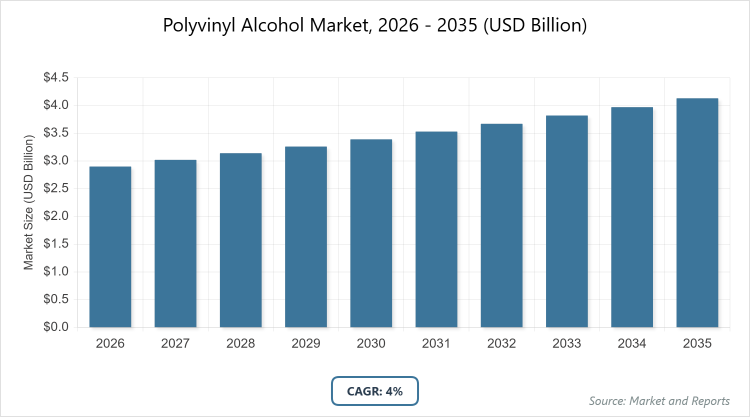
According to MarketnReports, the global Polyvinyl Alcohol Market size was estimated at USD 2.9 Billion in 2025 and is expected to reach USD 4.3 Billion by 2035, growing at a CAGR of 4.0% from 2026 to 2035. Polyvinyl Alcohol Market is driven by increasing demand for biodegradable packaging solutions across various industries.
What is the Industry Overview of Polyvinyl Alcohol?
The Polyvinyl Alcohol (PVA) market encompasses a versatile, water-soluble synthetic polymer derived from polyvinyl acetate through hydrolysis, widely recognized for its biocompatibility, non-toxicity, and film-forming properties. Market definition refers to the production, distribution, and consumption of PVA in forms such as powders, films, and solutions, serving as a critical material in applications ranging from adhesives and textiles to packaging and pharmaceuticals, where it acts as a binder, emulsifier, or protective coating to enhance product durability and environmental sustainability.
What are the Key Insights into Polyvinyl Alcohol Market?
- The global Polyvinyl Alcohol market was valued at USD 2.9 billion in 2025 and is projected to reach USD 4.3 billion by 2035.
- The market is expected to grow at a CAGR of 4.0% during the forecast period from 2026 to 2035.
- The market is driven by rising adoption in eco-friendly packaging and growth in the textile and construction sectors.
- In the grade segment, partially hydrolyzed dominates with a 55% share due to its versatile solubility in both cold and hot water, making it ideal for textiles and adhesives applications.
- In the application segment, polymerization aids dominate with a 30% share owing to PVA's role in stabilizing emulsions during vinyl acetate polymerization, which supports efficient production in the chemical industry.
- In the end-use industry segment, packaging dominates with a 32% share because of PVA's water-soluble films used in detergent pods and food wrapping, driven by consumer demand for convenient and sustainable options.
- Asia-Pacific dominates the market with a 55% share attributed to robust manufacturing hubs in China and India, low production costs, and high demand from textile and packaging industries.
What are the Market Dynamics of Polyvinyl Alcohol?
Growth Drivers
The primary growth drivers for the Polyvinyl Alcohol market include the escalating demand for sustainable and biodegradable materials in packaging, particularly water-soluble films for single-use products like detergent pods and agrochemicals, which align with global environmental regulations and consumer preferences for eco-friendly alternatives. Additionally, the expansion of the textile industry in emerging economies leverages PVA's sizing properties to improve yarn strength and weaving efficiency, while advancements in pharmaceutical applications, such as drug delivery systems, further propel market growth through PVA's biocompatibility and controlled release capabilities.
Restraints
Key restraints impacting the Polyvinyl Alcohol market involve fluctuations in raw material prices, particularly vinyl acetate monomer derived from petrochemicals, which can increase production costs and squeeze profit margins for manufacturers. Moreover, the sensitivity of PVA to moisture poses challenges in storage and transportation, potentially leading to degradation and limiting its adoption in humid environments or long-supply-chain scenarios without specialized packaging.
Opportunities
Opportunities in the Polyvinyl Alcohol market arise from the increasing focus on bio-based PVA variants produced from renewable sources, which could capture premium pricing in green markets and comply with stringent sustainability mandates in regions like Europe and North America. Emerging applications in 3D printing and biomedical engineering, where PVA's solubility enables support structures and tissue scaffolds, present untapped potential for innovation and market diversification.
Challenges
Challenges facing the Polyvinyl Alcohol market include competition from alternative polymers like polyethylene oxide or starch-based materials that offer similar properties at potentially lower costs, pressuring PVA producers to differentiate through enhanced performance features. Furthermore, regulatory hurdles related to food-contact approvals and environmental impact assessments can delay product launches and require substantial investment in compliance testing.
Polyvinyl Alcohol Market Report Scope
| Report Attributes | Report Details |
| Report Name | Polyvinyl Alcohol Market |
| Market Size 2025 | USD 2.9 Billion |
| Market Forecast 2035 | USD 4.3 Billion |
| Growth Rate | CAGR of 4.0% |
| Report Pages | 220 |
| Key Companies Covered | Kuraray Co., Ltd., Sekisui Chemical Co., Ltd., Anhui Wanwei Group Co., Ltd., Mitsubishi Chemical Corporation, Sinopec Sichuan Vinylon Works, Denka Company Limited, Chang Chun Group, Merck KGaA, Wacker Chemie AG, Nippon Gohsei, and Others |
| Segments Covered | By Grade, By Application, By End-Use Industry, and By Region |
| Regions Covered | North America, Europe, Asia Pacific (APAC), Latin America, and The Middle East and Africa (MEA) |
| Base Year | 2025 |
| Historical Year | 2020 - 2024 |
| Forecast Year | 2026 - 2035 |
| Customization Scope | Avail customized purchase options to meet your exact research needs. |
How is the Market Segmentation of Polyvinyl Alcohol?
The Polyvinyl Alcohol Market is segmented by grade, application, end-use industry, and region. All the segments have been analyzed based on present and future trends and the market is estimated from 2026 to 2035.
Based on Grade Segment, The partially hydrolyzed grade emerges as the most dominant, holding approximately 55% market share, followed by fully hydrolyzed as the second most dominant with around 37%. Partially hydrolyzed PVA dominates due to its balanced solubility in cold and hot water, enabling versatile use in textiles for warp sizing and in adhesives for strong bonding without full dissolution, which drives market growth by improving production efficiency and product quality in high-volume industries; fully hydrolyzed, while secondary, excels in applications requiring high water resistance like detergent films, contributing to market expansion through its role in sustainable packaging innovations that reduce plastic waste.
Based on Application Segment, Polymerization aids stand out as the most dominant application with a 30% share, while textiles follow as the second most dominant at about 25%. Polymerization aids dominate because PVA stabilizes emulsions in vinyl acetate production, ensuring consistent quality and yield in chemical manufacturing, thereby driving the market by supporting downstream polymer industries essential for global supply chains; textiles, as the secondary leader, benefit from PVA's ability to enhance yarn integrity during weaving, promoting market growth via cost-effective processing in large-scale apparel production.
Based on End-Use Industry Segment, Packaging is the most dominant end-use industry, capturing 32% of the market, with construction as the second most dominant at roughly 20%. Packaging leads owing to PVA's water-soluble films ideal for eco-friendly detergent and food wrappers, which propel market growth by meeting rising demands for biodegradable solutions that minimize environmental impact; construction, in second place, utilizes PVA in cement additives for improved workability and adhesion, fostering market advancement through enhanced durability in infrastructure projects amid global urbanization trends.
What are the Recent Developments in Polyvinyl Alcohol Market?
- In April 2025, Mitsubishi Chemical Group Corporation secured ISCC PLUS certification for its polyvinyl alcohol products at the Okayama plant, emphasizing sustainable sourcing and production practices to meet growing demands for eco-certified materials in packaging and textiles.
- In February 2023, Kuraray conducted a Life Cycle Assessment (LCA) for its polyvinyl alcohol products including Poval, PVB, and SentryGlas, performed by Sphera Solutions, to highlight environmental impacts and support marketing efforts toward sustainability-focused clients.
- In February 2023, Mitsubishi Chemical Corporation announced the construction of a new facility at its Okayama Plant to boost production capacity for specialty PVA brands GOHSENX and Nichigo G-Polymer, aiming to address rising demand in advanced applications like electronics and pharmaceuticals.
- In August 2022, Sekisui Specialty Chemicals initiated preliminary studies to expand its Polyvinyl Alcohol delivery capabilities, focusing on improving supply chain efficiency for downstream customers in the detergent and adhesive sectors.
- In November 2021, Kuraray Poval established a new sales organization in Iberia to enhance marketing and distribution of PVOH and related products, strengthening its presence in the European market for packaging and industrial applications.
How is the Regional Analysis of Polyvinyl Alcohol?
Asia-Pacific to dominate the global market.
Asia-Pacific holds the largest share in the global Polyvinyl Alcohol market, driven by extensive manufacturing infrastructure in China, which dominates the region as the leading country due to its vast production capacity, low-cost raw materials, and high domestic demand from textiles and packaging industries, fostering rapid industrialization and export growth.
North America follows as a significant market, with the United States as the dominating country, benefiting from advanced technological innovations in pharmaceutical and food packaging applications, supported by stringent environmental regulations that promote PVA's biodegradable properties.
Europe exhibits steady growth, led by Germany as the key country, where emphasis on sustainable materials in construction and automotive sectors, coupled with strong R&D investments, drives adoption of high-performance PVA variants.
Latin America shows emerging potential, with Brazil dominating regionally through expanding agrochemical and textile uses, aided by increasing foreign investments and local resource availability.
The Middle East and Africa represent a smaller but growing segment, with South Africa as a notable player, propelled by rising construction activities and packaging demands in developing economies.
Who are the Key Market Players in Polyvinyl Alcohol?
Kuraray Co., Ltd. Kuraray focuses on innovation in specialty PVA grades, including bio-based variants, through strategic R&D investments and partnerships to enhance product sustainability and expand into high-value applications like electronics and medical devices.
Sekisui Chemical Co., Ltd. Sekisui employs vertical integration and capacity expansions to optimize supply chains, emphasizing water-soluble films for detergent packaging while pursuing eco-certifications to strengthen its competitive position in global markets.
Anhui Wanwei Group Co., Ltd. Anhui Wanwei leverages cost-effective production in China, adopting advanced hydrolysis technologies to improve product quality and target export growth in textiles and adhesives.
Mitsubishi Chemical Corporation Mitsubishi prioritizes sustainability through ISCC certifications and facility upgrades, focusing on specialty brands like GOHSENX for niche markets in pharmaceuticals and advanced materials.
Sinopec Sichuan Vinylon Works Sinopec utilizes integrated petrochemical operations to ensure raw material stability, implementing efficiency improvements to meet rising domestic demand in construction and packaging.
Denka Company Limited Denka invests in R&D for low-foaming and high-purity PVA, forming alliances with downstream industries to customize solutions for electronics and industrial coatings.
Chang Chun Group Chang Chun emphasizes export-oriented strategies, enhancing production scales and quality controls to penetrate international markets in paper and textile sizing.
Merck KGaA Merck concentrates on pharmaceutical-grade PVA, pursuing regulatory compliances and collaborations for drug delivery innovations to capitalize on healthcare sector growth.
Wacker Chemie AG Wacker adopts green chemistry approaches, developing biodegradable PVA for packaging while expanding European operations to align with regional sustainability goals.
Nippon Gohsei Nippon Gohsei focuses on high-barrier films, investing in technology upgrades to serve food packaging and electronics, with a strategy centered on quality differentiation.
What are the Market Trends in Polyvinyl Alcohol?
- Increasing adoption of bio-based PVA derived from renewable sources to meet sustainability demands and reduce reliance on petrochemicals.
- Growing use of water-soluble PVA films in single-dose packaging for detergents and agrochemicals, driven by convenience and environmental benefits.
- Advancements in PVA composites for 3D printing and biomedical applications, enhancing solubility for temporary supports and tissue engineering.
- Rising integration of PVA in construction additives to improve cement workability and adhesion amid global infrastructure development.
- Expansion of PVA in electronics for protective coatings and adhesives, supported by miniaturization trends in devices.
What Market Segments and their Subsegments are Covered in the Polyvinyl Alcohol Report?
- By Grade
-
- Fully Hydrolyzed
- Partially Hydrolyzed
- Sub-Partially Hydrolyzed
- Low Foaming Grades
- Tac Grades
- Fine Particle Grades
- Water-Soluble Films
- Powder Form
- Industrial Grade
- Pharmaceutical Grade
- Others
- By Application
- Adhesives
- Polymerization Aids
- Textiles
- Paper Sizing
- Ceramics
- Construction Materials
- Pharmaceuticals
- Leather Binders
- Electronics
- Food Packaging
- Others
- By End-Use Industry
- Packaging
- Textile
- Paper
- Electronics
- Automotive
- Construction
- Pharmaceuticals
- Food & Beverage
- Personal Care
- Printing
- Others
- By Region
- North America
- U.S.
- Canada
- Europe
- UK
- Germany
- France
- Rest of Europe
- Asia Pacific
- China
- India
- Japan
- Rest of Asia Pacific
- Latin America
- Brazil
- Mexico
- Rest of Latin America
- Middle East & Africa
- UAE
- South Africa
- Rest of Middle East & Africa
- North America
Frequently Asked Questions
The Polyvinyl Alcohol market refers to the global industry involved in the production and application of PVA, a synthetic polymer known for its water solubility and used in packaging, textiles, and adhesives.
Key factors include rising demand for sustainable packaging, expansion in textiles and construction, advancements in bio-based PVA, and regulatory support for eco-friendly materials.
The market is projected to grow from USD 2.9 billion in 2025 to USD 4.3 billion by 2035.
The CAGR is expected to be 4.0% during 2026-2035.
Asia-Pacific will contribute notably, holding 55% of the market value due to strong manufacturing and demand in China and India.
Major players include Kuraray Co., Ltd., Sekisui Chemical Co., Ltd., Anhui Wanwei Group Co., Ltd., Mitsubishi Chemical Corporation, and Sinopec Sichuan Vinylon Works.
The report provides comprehensive analysis including market size, trends, segmentation, regional insights, key players, and forecasts from 2026 to 2035.
Stages include raw material sourcing (vinyl acetate), polymerization and hydrolysis manufacturing, distribution, application integration, and end-use consumption.
Trends show a shift toward bio-based and water-soluble PVA, with consumers preferring sustainable, biodegradable options in packaging and textiles.
Stringent regulations on plastic waste and certifications like ISCC PLUS promote PVA's adoption as an eco-friendly alternative, while environmental concerns drive innovation in biodegradable variants.