
Pneumonia Therapeutics Market Size, Share and Trends 2026 to 2035
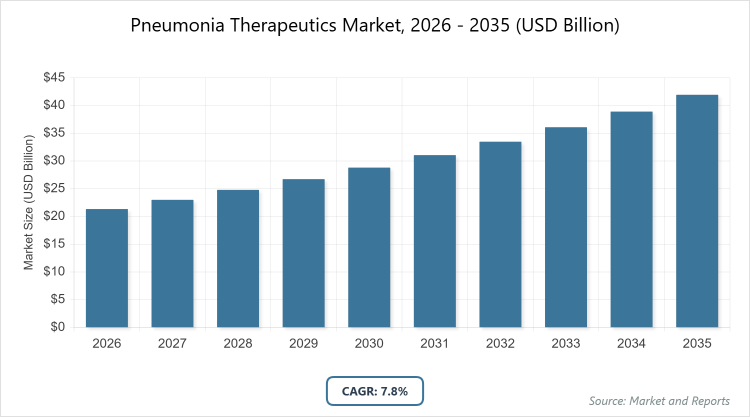
According to MarketnReports, the global Pneumonia Therapeutics market size was estimated at USD 21.33 billion in 2025 and is expected to reach USD 45.20 billion by 2035, growing at a CAGR of 7.8% from 2026 to 2035. Increasing prevalence of respiratory infections and advancements in vaccine development.
What are the Key Insights into the Pneumonia Therapeutics Market?
- The global Pneumonia Therapeutics market was valued at USD 21.33 billion in 2025 and is projected to reach USD 45.20 billion by 2035.
- The market is expected to grow at a CAGR of 7.8% during the forecast period.
- The market is driven by rising antibiotic resistance and increasing demand for effective vaccines.
- In the drug class segment, vaccines dominate with 54% share due to their preventive efficacy and widespread immunization programs reducing disease incidence.
- In the infection type segment, community-acquired pneumonia dominates with 60% share as it is the most prevalent form affecting outpatient populations.
- In the distribution channel segment, hospital pharmacies dominate with 45% share owing to the need for inpatient administration of intravenous therapies.
- North America dominates the regional market with 35% share because of advanced healthcare infrastructure and high R&D investments in novel treatments.
What is the Pneumonia Therapeutics Market?
Industry Overview
The pneumonia therapeutics market encompasses pharmaceutical products and treatments designed to manage and cure pneumonia, an inflammatory lung condition often caused by bacterial, viral, or fungal infections, including antibiotics, antivirals, antifungals, and vaccines aimed at both treatment and prevention. This market involves the development, manufacturing, and distribution of these therapies to address various pneumonia types such as community-acquired, hospital-acquired, and ventilator-associated, focusing on reducing mortality rates through targeted antimicrobial agents and immunization strategies. Market definition includes all drugs and vaccines used for pneumonia management, emphasizing innovation in drug-resistant strains, personalized medicine, and global health initiatives to combat infectious diseases while integrating diagnostic advancements for precise treatment selection.
What are the Market Dynamics Shaping the Pneumonia Therapeutics Market?
Growth Drivers
The growth drivers in the pneumonia therapeutics market are primarily propelled by the escalating global burden of respiratory infections, exacerbated by aging populations and rising comorbidities like diabetes and COPD, which increase susceptibility to pneumonia and demand advanced treatments. Innovations in vaccine technology, such as conjugate vaccines targeting multiple serotypes, enhance prevention efficacy and reduce hospitalization rates, supported by government immunization programs. The emergence of antibiotic-resistant pathogens drives R&D investments in novel antimicrobials and combination therapies, while improved diagnostics enable targeted treatments. Additionally, expanding healthcare access in emerging economies through public-private partnerships boosts market penetration, fostering overall expansion.
Restraints
Restraints in the pneumonia therapeutics market include the rapid development of antimicrobial resistance, which limits the effectiveness of existing antibiotics and necessitates costly R&D for new drugs, delaying market entry. High treatment costs, particularly for advanced vaccines and biologics, restrict accessibility in low-income regions, while stringent regulatory approvals prolong development timelines. Vaccine hesitancy and supply chain disruptions affect immunization coverage, and the complexity of diagnosing pneumonia subtypes leads to inappropriate therapy use. Moreover, competition from generic drugs erodes profit margins for branded products, hindering investment in innovation.
Opportunities
Opportunities in the pneumonia therapeutics market arise from advancements in mRNA and gene therapies targeting drug-resistant strains, offering novel mechanisms to combat infections with minimal resistance development. Expanding vaccination programs in developing regions, supported by WHO initiatives, create demand for affordable, multi-valent vaccines. The integration of AI in diagnostics for rapid pathogen identification enables personalized medicine, while collaborations between pharma companies and biotech firms accelerate pipeline development. Furthermore, growing focus on outpatient treatments through oral formulations reduces healthcare burdens, opening avenues for market growth in ambulatory care settings.
Challenges
Challenges in the pneumonia therapeutics market center on addressing antimicrobial resistance through sustainable R&D, as overuse of antibiotics accelerates pathogen evolution, requiring continuous innovation. Ensuring equitable access to vaccines and treatments in underserved areas demands overcoming logistical and economic barriers. Regulatory variations across regions complicate global approvals, while educating healthcare providers on updated guidelines is essential to optimize therapy. Additionally, managing co-infections in vulnerable populations like the elderly poses clinical complexities, impacting treatment outcomes.
Pneumonia Therapeutics Market: Report Scope
| Report Attributes | Report Details |
| Report Name | Pneumonia Therapeutics Market |
| Market Size 2025 | USD 21.33 Billion |
| Market Forecast 2035 | USD 45.20 Billion |
| Growth Rate | CAGR of 7.8% |
| Report Pages | 220 |
| Key Companies Covered |
Pfizer, GlaxoSmithKline, Merck, AstraZeneca, Sanofi, Novartis, and Others |
| Segments Covered | By Drug Class, By Infection Type, By Distribution Channel, and By Region |
| Regions Covered | North America, Europe, Asia Pacific (APAC), Latin America, and The Middle East and Africa (MEA) |
| Base Year | 2025 |
| Historical Year | 2020 – 2024 |
| Forecast Year | 2026 – 2035 |
| Customization Scope | Avail customized purchase options to meet your exact research needs. |
How is the Market Segmentation Structured in the Pneumonia Therapeutics Market?
The Pneumonia Therapeutics market is segmented by drug class, infection type, distribution channel, and region.
Based on Drug Class Segment, vaccines are the most dominant subsegment, followed by antibacterial drugs as the second most dominant. Vaccines dominate due to their role in preventing pneumonia through widespread immunization, reducing disease burden and healthcare costs, which drives the market by shifting focus from treatment to prevention amid rising resistance issues; antibacterial drugs follow for their essential use in acute bacterial infections, propelling growth through ongoing developments in novel agents to combat resistant strains.
Based on the Infection Type Segment, community-acquired pneumonia is the most dominant subsegment, followed by hospital-acquired pneumonia as the second most dominant. Community-acquired pneumonia leads as it affects a larger outpatient population, driving demand for accessible therapies and vaccines, which accelerates market expansion by emphasizing early intervention; hospital-acquired pneumonia gains importance in inpatient settings, fueling growth through specialized antimicrobials for resistant nosocomial infections.
Based on the Distribution Channel Segment, hospital pharmacies are the most dominant subsegment, followed by retail pharmacies as the second most dominant. Hospital pharmacies dominate owing to the administration of intravenous and specialized treatments in clinical settings, enhancing market penetration for acute care drugs; retail pharmacies support through outpatient dispensing, driving accessibility for preventive and follow-up therapies.
What are the Recent Developments in the Pneumonia Therapeutics Market?
- In November 2025, researchers at the Icahn School of Medicine at Mount Sinai reported early success with a new mRNA therapy producing bacteria-killing peptibodies for drug-resistant pneumonia in preclinical models.
- In December 2025, a Northwestern University study linked lung microbiome dynamics to pneumonia recovery, suggesting microbial communities influence treatment outcomes.
- In November 2025, the American Thoracic Society published updated guidelines on antibiotics and steroids for adult pneumonia, recommending tailored durations and ultrasound diagnostics.
- In October 2025, Merck’s V116 adult pneumococcal vaccine received FDA approval, targeting serotypes specific to adult disease.
How does Regional Analysis Impact the Pneumonia Therapeutics Market?
- North America is expected to dominate the global market.
North America leads the pneumonia therapeutics market, driven by advanced healthcare systems, high R&D funding, and robust vaccination programs; the United States dominates as the key country, with major pharma innovations and regulatory support enhancing access to novel treatments.
Europe demonstrates strong growth in the pneumonia therapeutics market, supported by stringent regulations and universal healthcare; Germany emerges as the dominating country, leveraging its pharmaceutical industry for antibiotic stewardship and vaccine development.
Asia Pacific is rapidly expanding in the pneumonia therapeutics market, propelled by population density and increasing healthcare investments; China dominates as the key country, with government initiatives addressing high infection rates through local manufacturing.
Latin America shows emerging potential in the pneumonia therapeutics market, aided by improving infrastructure; Brazil stands out as the dominating country, focusing on vaccination campaigns to combat community-acquired cases.
The Middle East and Africa represent nascent growth in the pneumonia therapeutics market, driven by international aid; South Africa emerges as a key player, with efforts in antimicrobial resistance management.
Who are the Key Market Players in the Pneumonia Therapeutics Market?
- Pfizer focuses on vaccine innovations like Prevnar, expanding serotype coverage through R&D and global partnerships to dominate prevention markets.
- GlaxoSmithKline employs strategies in antibiotic development and vaccines like Synflorix, prioritizing resistance management and emerging market access.
- Merck leverages approvals like V116 vaccine, emphasizing adult-specific therapies and collaborations for distribution in high-burden regions.
- AstraZeneca pursues biologics and combination therapies, investing in mRNA platforms to address resistant strains.
- Sanofi adopts a focus on pediatric vaccines and antivirals, enhancing supply chains for equitable global access.
- Novartis concentrates on novel antimicrobials, utilizing AI for drug discovery to combat hospital-acquired infections.
What are the Market Trends in the Pneumonia Therapeutics Market?
- Increasing focus on mRNA and gene therapies for resistant pneumonia.
- Rise in personalized medicine through AI-driven diagnostics.
- Expansion of adult-specific pneumococcal vaccines.
- Shift toward shorter antibiotic courses per updated guidelines.
- Growing emphasis on the microbiome’s role in treatment outcomes.
- Advancements in alternative approaches like bacteriophages.
- Integration of ultrasound for rapid pneumonia diagnosis.
What Market Segments and their Subsegments are Covered in the Pneumonia Therapeutics Report?
By Drug Class
- Antibacterial Drugs
- Antiviral Drugs
- Antifungal Drugs
- Vaccines
- Others
By Infection Type
- Community-Acquired Pneumonia
- Hospital-Acquired Pneumonia
- Ventilator-Associated Pneumonia
- Others
By Distribution Channel
- Hospital Pharmacies
- Retail Pharmacies
- Online Pharmacies
- Others
By Region
- North America
- U.S.
- Canada
- Europe
- UK
- Germany
- France
- Rest of Europe
- Asia Pacific
- China
- India
- Japan
- Rest of Asia Pacific
- Latin America
- Brazil
- Mexico
- Rest of Latin America
- Middle East & Africa
- UAE
- South Africa
- Rest of Middle East & Africa
Frequently Asked Questions
Pneumonia therapeutics include drugs and vaccines for treating and preventing lung inflammation caused by infections, focusing on antimicrobials and immunizations.
Key factors include antibiotic resistance, vaccine innovations, aging populations, and regulatory advancements.
The pneumonia therapeutics market is projected to grow from USD 21.33 billion in 2025 to USD 45.20 billion by 2035.
The market is expected to grow at a CAGR of 7.8% from 2026 to 2035.
North America will contribute notably, holding around 35% market share due to advanced infrastructure.
Major players include Pfizer, GlaxoSmithKline, Merck, AstraZeneca, Sanofi, and Novartis, driving growth through innovations.
The report provides analysis on size, trends, segmentation, regions, players, and forecasts from 2026 to 2035.
Stages include R&D, clinical trials, manufacturing, distribution, and patient administration.
Trends evolve toward novel therapies and shorter treatments, with preferences for preventive vaccines.
Factors include FDA approvals, antibiotic stewardship, and climate impacts on infection rates.