
Pneumatic Tools Market Size, Share and Trends 2026 to 2035
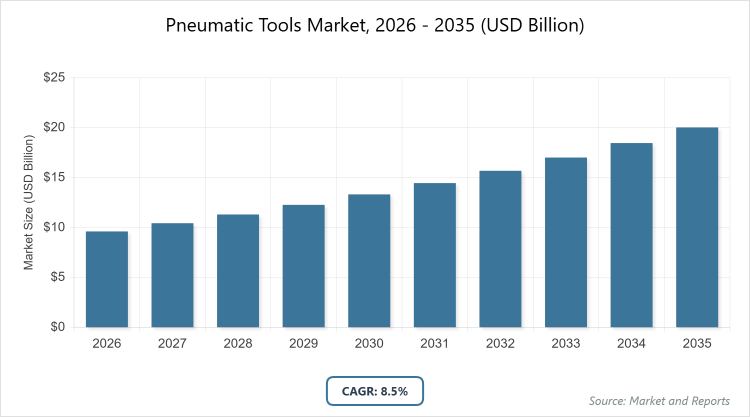
According to MarketnReports, the global Pneumatic Tools market size was estimated at USD 9.61 billion in 2025 and is expected to reach USD 21.63 billion by 2035, growing at a CAGR of 8.5% from 2026 to 2035. Pneumatic Tools Market is driven by rising industrial automation and expansion in automotive and construction sectors.
What are the Key Insights of the Pneumatic Tools Market?
- The global pneumatic tools market was valued at USD 9.61 billion in 2025 and is projected to reach USD 21.63 billion by 2035.
- The market is expected to grow at a CAGR of 8.5% during the forecast period.
- The market is driven by increasing demand for efficient assembly and fabrication tools in automotive manufacturing and construction activities.
- In the tool type segment, drills dominate with a 28% share, followed by grinders at 22%.
- Drills dominate due to their versatility in precision tasks across multiple industries, enabling faster operations and reducing manual labor, while grinders lead in material removal applications for their high-speed performance and durability in heavy-duty environments.
- In the application segment, assembly dominates with a 35% share, followed by material removal at 25%.
- Assembly leads because of its critical role in high-volume production lines, improving efficiency and consistency, whereas material removal is prominent for its use in surface preparation and shaping, driving productivity in manufacturing.
- In the end-user segment, manufacturing dominates with a 40% share, followed by automotive at 30%.
- Manufacturing dominates owing to widespread adoption in automated processes for cost-effective operations, and automotive follows due to the need for reliable tools in vehicle assembly and repair.
- Asia Pacific dominates the regional market with a 39% share.
- Asia Pacific leads due to rapid industrialization, booming automotive production in countries like China and India, and increasing investments in infrastructure projects.
What is the Pneumatic Tools Market Overview?
The pneumatic tools market encompasses a wide range of power tools that operate using compressed air as their primary energy source, offering advantages such as high power-to-weight ratios, durability in harsh environments, and lower operational costs compared to electric or hydraulic alternatives. Market definition includes handheld and stationary devices used for tasks like drilling, grinding, fastening, and material removal across various industries, excluding purely electric or battery-powered tools.
What are the Market Dynamics in the Pneumatic Tools Market?
Growth Drivers
The primary growth drivers for the pneumatic tools market include the surge in industrial automation across manufacturing and automotive sectors, where these tools provide reliable, high-torque performance without the risk of electrical hazards. Advancements in air compressor technology have enhanced tool efficiency, reducing energy consumption and operational downtime, which appeals to cost-conscious industries. Additionally, the expansion of construction activities in emerging economies, coupled with the tools’ ability to handle heavy-duty tasks in dusty or wet environments, fuels demand. The shift toward lightweight, ergonomic designs also improves worker safety and productivity, further propelling market expansion.
Restraints
Key restraints in the pneumatic tools market stem from the high initial setup costs associated with air compressors and piping systems, which can deter small-scale operations or DIY users. Competition from cordless electric tools, which offer greater portability without the need for air supply infrastructure, poses a significant challenge, especially in remote or mobile applications. Maintenance requirements, such as regular lubrication and air filtration to prevent tool wear, add to ongoing expenses. Moreover, fluctuations in raw material prices for components like steel and aluminum impact manufacturing costs, potentially leading to higher end-user prices and slower adoption in price-sensitive markets.
Opportunities
Opportunities in the pneumatic tools market are abundant with the integration of IoT and smart sensors for predictive maintenance, allowing real-time monitoring to minimize downtime and extend tool life. Emerging markets in Asia Pacific and Latin America present growth potential due to increasing infrastructure development and industrialization, where affordable pneumatic solutions can penetrate underserved sectors. Innovations in oil-free and noise-reduced tools address environmental and regulatory concerns, opening doors to eco-conscious industries like electronics and food processing. Partnerships with air compressor manufacturers for bundled systems could streamline adoption, while customization for niche applications, such as aerospace precision work, offers premium pricing opportunities.
Challenges
Challenges facing the pneumatic tools market include stringent environmental regulations on noise and emissions from air compressors, which require costly redesigns and compliance measures. The dependency on a stable compressed air supply can limit usage in areas with unreliable power grids or in portable scenarios, hindering market penetration in rural or off-grid sites. Skilled labor shortages in operating and maintaining these tools add training costs for end-users. Additionally, supply chain disruptions, particularly for imported components, can delay production and increase lead times, affecting market responsiveness to demand spikes in volatile industries like oil and gas.
Pneumatic Tools Market: Report Scope
| Report Attributes | Report Details |
| Report Name | Pneumatic Tools Market |
| Market Size 2025 | USD 9.61 Billion |
| Market Forecast 2035 | USD 21.63 Billion |
| Growth Rate | CAGR of 8.5% |
| Report Pages | 220 |
| Key Companies Covered |
Atlas Copco, Ingersoll Rand, Stanley Black & Decker, Makita, Bosch, and Others |
| Segments Covered | By Tool Type, By Application, By End-User, and By Region |
| Regions Covered | North America, Europe, Asia Pacific (APAC), Latin America, and The Middle East and Africa (MEA) |
| Base Year | 2025 |
| Historical Year | 2020 – 2024 |
| Forecast Year | 2026 – 2035 |
| Customization Scope | Avail customized purchase options to meet your exact research needs. |
How is the Pneumatic Tools Market Segmented?
The Pneumatic Tools market is segmented by tool type, application, end-user, and region.
Based on Tool Type Segment, drills emerge as the most dominant subsegment, commanding a significant market share due to their essential role in precision drilling and fastening operations across diverse industries. Their dominance stems from high reliability in repetitive tasks, lower heat generation compared to electric alternatives, and compatibility with automated systems, which collectively drive market growth by enhancing production efficiency and reducing operational errors. Grinders rank as the second most dominant, valued for their robustness in surface preparation and deburring; this subsegment propels the market forward through its application in heavy-duty material removal, enabling faster turnaround times in manufacturing and construction, thus supporting overall industry productivity.
Based on Application Segment, assembly stands out as the most dominant, holding the largest share owing to its critical function in high-speed production lines where pneumatic tools ensure consistent torque and speed without overheating. This dominance drives the market by facilitating scalable manufacturing processes, particularly in automotive and electronics, leading to cost savings and improved product quality. Material removal follows as the second dominant, driven by the tools’ effectiveness in grinding and sanding tasks; it contributes to market expansion by enabling precise surface treatments that enhance durability and aesthetics in end products, thereby meeting rising demands for quality in construction and aerospace sectors.
Based on End-User Segment, manufacturing is the most dominant, capturing the highest share because of the tools’ integration into automated assembly and fabrication lines, offering durability and efficiency in high-volume environments. This leadership accelerates market growth by optimizing workflows, minimizing downtime, and supporting lean manufacturing practices. Automotive ranks second, propelled by the need for reliable tools in vehicle production and maintenance; it drives the market through innovations in tool design that improve precision and safety, aligning with the industry’s push toward electrification and advanced materials.
What are the Recent Developments in the Pneumatic Tools Market?
- In May 2025, Makita launched new 18V LXT framing nailers, designed to deliver pneumatic-like power without air hoses, targeting construction professionals for enhanced mobility and efficiency.
- In October 2025, Atlas Copco acquired SUTO iTEC, a specialist in compressed air monitoring, to strengthen its portfolio in measurement and optimization solutions for pneumatic systems.
- In November 2025, Festo introduced the VTUX modular valve terminal, a compact platform for industrial automation, improving performance and productivity in pneumatic applications.
- In February 2025, Milton acquired Arrow Pneumatics, expanding its offerings in air preparation and pneumatic components to better serve industrial users.
- In July 2025, Bürkert launched the SideCONTROL series, featuring enhanced precision, predictive maintenance, and easy integration for automation systems.
What is the Regional Analysis of the Pneumatic Tools Market?
Asia Pacific to dominate the global market
Asia Pacific dominates the pneumatic tools market, driven by rapid industrialization and massive infrastructure investments in countries like China, India, and Japan. China stands out as the leading country, with its vast manufacturing base and automotive production hubs fueling demand for efficient assembly tools. The region’s low labor costs combined with a shift toward automation enhance tool adoption, while government initiatives for smart factories further boost growth.
North America holds a significant share, supported by advanced manufacturing sectors and a strong focus on innovation in aerospace and automotive industries. The United States leads, with its emphasis on high-tech tools for precision engineering and the presence of key players investing in R&D. Regulatory standards for worker safety and energy efficiency drive the adoption of ergonomic, low-noise pneumatic solutions.
Europe exhibits steady growth, propelled by stringent environmental regulations and a mature industrial landscape in automotive and machinery production. Germany dominates, renowned for its engineering expertise and exports of high-quality tools, with an increasing integration of IoT for smart manufacturing enhancing market dynamics.
Latin America is emerging, with growth tied to expanding construction and mining activities amid economic recovery. Brazil leads, benefiting from infrastructure projects and oil & gas exploration, where durable pneumatic tools are essential for harsh environments.
The Middle East and Africa show potential, driven by oil & gas and construction booms. Saudi Arabia dominates in MEA, with Vision 2030 initiatives spurring diversification into manufacturing, increasing the need for reliable tools in energy and building sectors.
Who are the Key Market Players in the Pneumatic Tools Market?
- Atlas Copco focuses on sustainable innovations and acquisitions, such as the 2025 purchase of Trident Pneumatics, to expand its compressed air solutions and strengthen market presence in emerging regions like India.
- Ingersoll Rand emphasizes product diversification and energy-efficient designs, with strategies including partnerships for IoT-integrated tools to enhance predictive maintenance and capture share in industrial automation.
- Stanley Black & Decker pursues aggressive R&D for ergonomic tools, leveraging acquisitions like Milwaukee’s expansions to target construction and DIY segments, driving growth through brand synergy.
- Makita Corporation invests in hybrid power technologies, launching cordless-compatible pneumatic alternatives in 2025 to bridge gaps in portability, aiming at professional users in automotive and building trades.
- Bosch prioritizes digital transformation, integrating smart sensors in tools for real-time monitoring, with strategies focused on European compliance and global supply chain optimization for premium segments.
- Chicago Pneumatic Tool Company targets heavy-duty applications through durable product lines, employing direct sales and training programs to build loyalty in mining and oil & gas industries.
- Milwaukee Electric Tool Corporation accelerates innovation via acquisitions, like Arrow Pneumatics in 2025, to bolster air preparation offerings and penetrate industrial markets with high-performance solutions.
- ATS ELGI Limited concentrates on affordable, localized manufacturing in Asia, with strategies involving collaborations for customized tools to meet automotive demands in developing economies.
- RalliWolf Industries Ltd. focuses on export growth and quality certifications, developing lightweight tools to appeal to construction sectors in MEA and Latin America.
- Texas Pneumatic Tools, Inc. specializes in niche explosion-proof tools for hazardous environments, with strategies centered on regulatory compliance and partnerships in energy sectors.
What are the Market Trends in the Pneumatic Tools Market?
- Integration of IoT and smart sensors for predictive maintenance and real-time performance tracking.
- Shift toward oil-free and noise-reduced designs to comply with environmental regulations.
- Growing adoption of lightweight, ergonomic tools to enhance worker safety and reduce fatigue.
- Rise in hybrid systems combining pneumatic power with digital controls for automation.
- Increasing focus on energy-efficient compressors to lower operational costs.
- Expansion of portable, handheld tools for mobile applications in construction.
- Emphasis on sustainable materials and recyclable components in tool manufacturing.
- Development of anti-vibration technologies to minimize health risks.
- Surge in customized tools for niche industries like aerospace.
- Adoption of AI-driven analytics for optimizing tool usage.
What Market Segments and their Subsegments are Covered in the Report?
By Tool Type
- Impact Wrenches
- Ratchet Wrenches
- Hammers
- Sanders
- Grinders
- Screwdrivers
- Drills
- Polishers
- Nail Guns
- Saws
- Others
By Application
- Assembly
- Material Removal
- Fastening
- Finishing
- Cutting
- Painting
- Riveting
- Sanding
- Drilling
- Polishing
- Others
By End-User
- Automotive
- Construction
- Manufacturing
- Aerospace & Defense
- Oil & Gas
- Electronics
- Mining
- Shipbuilding
- Power & Utilities
- Residential/DIY
- Others
By Region
- North America
- U.S.
- Canada
- Europe
- UK
- Germany
- France
- Rest of Europe
- Asia Pacific
- China
- India
- Japan
- Rest of Asia Pacific
- Latin America
- Brazil
- Mexico
- Rest of Latin America
- Middle East & Africa
- UAE
- South Africa
- Rest of Middle East & Africa
Frequently Asked Questions
Pneumatic tools are power devices that utilize compressed air to perform tasks such as drilling, grinding, and fastening, offering high torque and durability for industrial applications.
Key factors include industrial automation, construction expansion, technological advancements in tool efficiency, and rising demand in emerging markets.
The market is projected to grow from USD 10.42 billion in 2026 to USD 21.63 billion by 2035.
The CAGR is expected to be 8.5% over the forecast period.
Asia Pacific will contribute notably, driven by industrialization in China and India.
Major players include Atlas Copco, Ingersoll Rand, Stanley Black & Decker, Makita, and Bosch.
The report provides in-depth analysis of market size, trends, segments, regional insights, key players, and forecasts.
Stages include raw material sourcing, component manufacturing, tool assembly, distribution, and end-user application.
Trends lean toward smart, eco-friendly tools, with preferences for ergonomic designs and energy efficiency.
Regulations on noise, emissions, and worker safety are pushing innovations in low-noise and oil-free tools.