
Plasma Therapy Market Size, Share and Trends 2026 to 2035
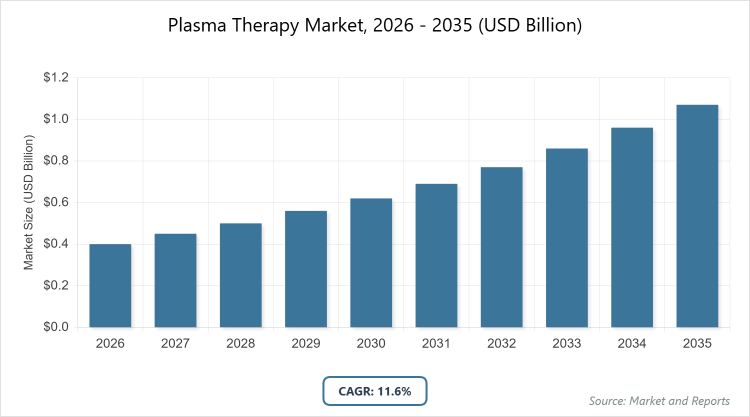
According to MarketnReports, the global Plasma Therapy market size was estimated at USD 0.4 billion in 2025 and is expected to reach USD 1.2 billion by 2035, growing at a CAGR of 11.6% from 2026 to 2035. The plasma therapy market is driven by rising demand for regenerative medicine and minimally invasive treatments in orthopedics and aesthetics.
What are the Key Insights into Plasma Therapy?
- The global Plasma Therapy market was valued at USD 0.4 billion in 2025 and is projected to reach USD 1.2 billion by 2035.
- The market is expected to grow at a CAGR of 11.6% during the forecast period from 2026 to 2035.
- The market is driven by rising chronic diseases, aesthetic procedure demand, advancements in regenerative medicine, and post-pandemic focus on immune therapies.
- In the type segment, pure PRP dominates with a 40% share due to its high concentration of growth factors, making it ideal for orthopedic and aesthetic applications with proven efficacy.
- In the application segment, orthopedics dominates with a 35% share as it accelerates healing in joint injuries and arthritis, supported by clinical evidence.
- In the end-user segment, hospitals & clinics dominate with a 50% share owing to high-volume procedures and integrated care facilities.
- North America dominates the regional market with a 40% share, driven by advanced healthcare infrastructure, high R&D investments, and regulatory support from the FDA.
What is the Industry Overview of Plasma Therapy?
The Plasma Therapy market involves therapeutic techniques utilizing blood plasma or its derivatives to promote healing, reduce inflammation, and treat various conditions through components like platelets, antibodies, and growth factors derived from autologous or allogeneic sources. Market definition includes treatments such as platelet-rich plasma (PRP) injections for tissue repair, convalescent plasma for infectious diseases, and hyperimmune globulin for immune modulation, applied in regenerative medicine, immunology, and aesthetics, emphasizing minimally invasive procedures, personalized care, and biocompatibility while addressing challenges in standardization, efficacy validation, and regulatory approvals for safe clinical deployment.
What are the Market Dynamics of Plasma Therapy?
Growth Drivers
The Plasma Therapy market is propelled by the increasing prevalence of musculoskeletal disorders and sports injuries, where PRP injections promote natural healing through growth factors, reducing recovery times and avoiding invasive surgeries, appealing to active populations and athletes. Advancements in centrifugation techniques and kit standardization enhance treatment consistency and accessibility, driving adoption in dermatology for skin rejuvenation and hair restoration. Rising awareness of minimally invasive therapies, coupled with aging demographics seeking non-pharmacological options for chronic pain, boosts demand. Strategic collaborations between biotech firms and clinics, along with expanding insurance coverage for regenerative treatments, further accelerate market growth.
Restraints
High treatment costs, often not covered by insurance for aesthetic applications, limit accessibility in price-sensitive regions, where patients opt for conventional therapies. Variability in plasma quality and lack of standardized protocols lead to inconsistent outcomes, eroding physician confidence. Regulatory hurdles for allogeneic plasma, requiring rigorous safety testing for pathogens, delay approvals and increase expenses. Concerns over potential side effects like infection or allergic reactions, particularly with animal-derived components, restrict widespread use.
Opportunities
Opportunities emerge from integrating plasma therapy with stem cell treatments for enhanced regenerative effects in orthopedics and wound care, attracting investments in combination products. Expansion into emerging markets with rising healthcare spending offers potential for affordable autologous kits tailored to local needs. AI-driven analysis for personalized plasma composition can optimize efficacy, while telemedicine for post-treatment monitoring opens remote care niches. Government funding for immunology research post-COVID presents avenues for hyperimmune plasma development.
Challenges
Challenges include ethical sourcing of plasma, with donor shortages and contamination risks requiring stringent screening. Evolving fraud in counterfeit plasma products erodes trust, necessitating robust supply chain tracking. Talent gaps in specialized centrifugation and injection techniques hinder adoption in rural areas. Geopolitical factors affecting blood product trade add volatility, while environmental concerns over disposable kits demand sustainable alternatives.
Plasma Therapy Market: Report Scope
| Report Attributes | Report Details |
| Report Name | Plasma Therapy Market |
| Market Size 2025 | USD 0.4 Billion |
| Market Forecast 2035 | USD 1.2 Billion |
| Growth Rate | CAGR of 11.6% |
| Report Pages | 220 |
| Key Companies Covered | Terumo BCT, Arthrex, Inc., Grifols S.A., CSL Behring, Biotest AG, Octapharma AG, Kedrion S.p.A., LFB SA, and Others |
| Segments Covered | By Type, By Application, By End-User, and By Region |
| Regions Covered | North America, Europe, Asia Pacific (APAC), Latin America, and The Middle East and Africa (MEA) |
| Base Year | 2025 |
| Historical Year | 2020 – 2024 |
| Forecast Year | 2026 – 2035 |
| Customization Scope | Avail customized purchase options to meet your exact research needs. |
What is the Market Segmentation of Plasma Therapy?
The Plasma Therapy market is segmented by type, application, end-user, and region.
By Type. Pure PRP is the most dominant subsegment, holding approximately 40% market share, due to its concentrated growth factors without leukocytes, minimizing inflammation in sensitive applications. This dominance drives the market by enabling effective, low-risk treatments in aesthetics and orthopedics, increasing patient satisfaction. Leukocyte-rich PRP ranks as the second most dominant, with around 25% share, offering enhanced antimicrobial properties, propelling growth through applications in wound healing and sports medicine.
By Application. Orthopedics emerges as the most dominant subsegment, capturing about 35% share, primarily because it accelerates tendon and ligament repair. This leads to market growth by reducing surgical needs and improving mobility in aging populations. Dermatology & aesthetics follows as the second most dominant, with roughly 30% share, for skin rejuvenation, driving the market via cosmetic demand and non-invasive appeal.
By End-User. Hospitals & clinics represent the most dominant subsegment at about 50% share, driven by integrated diagnostic and treatment facilities. This dominance accelerates market expansion through high-volume procedures and compliance. Research institutes rank second most dominant, holding around 20% share for clinical trials, contributing to growth via evidence-based advancements.
What are the Recent Developments in Plasma Therapy?
- In August 2025, a study published in the Journal of Orthopaedics demonstrated PRP’s efficacy in knee osteoarthritis, reducing pain by 40% over six months.
- In June 2025, Arthrex launched a new PRP kit with improved centrifugation for higher platelet yield, targeting sports medicine.
- In April 2025, Terumo BCT expanded its plasma collection centers in Europe to meet demand for convalescent plasma research.
- In February 2025, Grifols partnered with a biotech firm for hyperimmune globulin development against emerging viruses.
- In January 2025, CSL Behring received FDA approval for a new fractionated plasma product for immunology applications.
What is the Regional Analysis of Plasma Therapy?
- North America is expected to dominate the global market.
North America holds the largest share at approximately 40%, with the United States as the dominating country, due to advanced healthcare systems, high R&D funding, and FDA support for regenerative therapies. This region’s growth is fueled by rising sports injuries and aesthetic procedures, positioning it as a leader in PRP innovations. High consumer spending on cosmetic treatments boosts dermatology applications. Canada’s universal healthcare includes coverage for oncology adjuncts, supporting broader adoption of biotech hubs in Boston and San Francisco foster clinical trials and partnerships. Regulatory fast-tracking for combination therapies like Tecentriq Hybreza accelerates market entry.
Europe follows with steady growth, propelled by GDPR-compliant data handling and emphasis on patient safety, where Germany dominates through efficient healthcare and companies like Merck. The region’s expansion benefits from EU funding for oncology and dermatology, supporting cross-border adoption in aging populations. The UK’s NHS invests in subcutaneous biologics for cost savings. Multilingual platforms cater to diverse markets like France and Italy. Emphasis on ethical sourcing pushes synthetic enzyme development. Collaborative networks under EMA streamline approvals across member states.
Asia Pacific is the fastest-growing region, exhibiting a high CAGR, with India leading due to government health schemes and rising cosmetic awareness. This area’s potential is enhanced by cost-effective production, expanding insurance, and investments in biotech across China and Japan. China’s aging population increases demand for dermatological procedures. Japan’s precision medicine initiatives integrate hyaluronidase in targeted therapies. Southeast Asian nations like Singapore adopt medical tourism aesthetics. Rapid urbanization drives private clinic growth.
Latin America demonstrates moderate progress, dominated by Brazil’s growing private healthcare and aesthetic sectors, supported by foreign investments, though challenged by economic variability. Mexico benefits from proximity to North America, facilitating technology transfer for oncology applications. Government programs in Argentina promote training in aesthetic medicine. The rise of private clinics in Colombia creates niches for filler reversal services. However, reimbursement limitations slow institutional adoption. Emerging medical tourism in Costa Rica demands high-quality, affordable options.
The Middle East and Africa remain emerging, with the United Arab Emirates leading through medical tourism and smart health initiatives, limited by infrastructure but promising via diversification. Saudi Arabia’s Vision 2030 funds aesthetic and oncology centers. South Africa’s private hospitals adopt for cosmetic procedures. Technology partnerships with European firms build local expertise in Egypt. However, data scarcity in rural areas hinders comprehensive usage. Investments in mobile clinics address accessibility issues in the region.
What are the Key Market Players in Plasma Therapy?
- Terumo BCT. Terumo focuses on plasma collection systems, investing in automation for efficient PRP preparation.
- Arthrex, Inc. specializes in PRP kits for orthopedics, pursuing clinical studies to expand indications.
- Grifols S.A. Grifols emphasizes fractionated plasma, strategizing on hyperimmune products for immunology.
- CSL Behring. CSL develops plasma-derived therapies, focusing on regulatory approvals for new formulations.
- Biotest AG. Biotest invests in convalescent plasma, partnering for viral disease treatments.
- Octapharma AG. Octapharma targets wound healing, expanding through global distribution networks.
- Kedrion S.p.A. Kedrion offers immunoglobulin products, emphasizing R&D for plasma efficiency.
- LFB SA. LFB focuses on French market expansion, investing in biotech for recombinant alternatives.
What are the Market Trends in Plasma Therapy?
- Increasing use of PRP in combination with stem cells for enhanced regeneration.
- Rise of autologous plasma in minimally invasive aesthetics.
- Adoption of recombinant hyaluronidase for filler reversal.
- Growth in convalescent plasma for infectious disease management.
- Focus on bioengineered plasma for reduced immunogenicity.
- Expansion of hyperimmune globulin for targeted immunotherapies.
What Market Segments and Subsegments are Covered in the Plasma Therapy Report?
By Type
- Pure PRP
- Leukocyte-Rich PRP
- Pure Platelet-Rich Fibrin
- Leukocyte-Rich Fibrin
- Convalescent Plasma
- Hyperimmune Globulin
- Autologous Plasma
- Allogeneic Plasma
- Fractionated Plasma
- Recombinant Plasma Products
- Others
By Application
- Orthopedics
- Dermatology & Aesthetics
- Dental
- Cardiac Muscle Injury
- Nerve Injury
- Chronic Wounds
- Immunology
- Oncology
- Ophthalmology
- Gynecology
- Others
By End-User
- Hospitals & Clinics
- Research Institutes
- Ambulatory Surgical Centers
- Diagnostic Laboratories
- Specialty Clinics
- Academic Institutions
- Pharmaceutical Companies
- Biotechnology Firms
- Sports Medicine Centers
- Cosmetic Centers
- Others
By Region
-
- North America
- U.S.
- Canada
- Europe
- UK
- Germany
- France
- Rest of Europe
- Asia Pacific
- China
- India
- Japan
- Rest of Asia Pacific
- Latin America
- Brazil
- Mexico
- Rest of Latin America
- Middle East & Africa
- UAE
- South Africa
- Rest of Middle East & Africa
- North America
Frequently Asked Questions
Plasma Therapy involves using blood plasma or derivatives for healing, immune modulation, and aesthetic treatments through growth factors and antibodies.
Key factors include regenerative medicine advancements, aesthetic demand, chronic disease rise, and post-pandemic immunology focus.
The market is projected to grow from USD 0.4 billion in 2025 to USD 1.2 billion by 2035.
The CAGR is expected to be 11.6%.
North America will contribute notably, holding around 40% share due to advanced healthcare and R&D.
Major players include Terumo BCT, Arthrex, Grifols S.A., CSL Behring, and Biotest AG.
The report provides detailed analysis of size, trends, segments, regional outlook, key players, and forecasts.
Stages include plasma collection, processing, formulation, clinical testing, distribution, and application.
Trends evolve toward combination therapies and recombinant products, with preferences for minimally invasive, natural treatments.
Regulatory approvals for safety and environmental concerns over blood sourcing influence supply and innovation.