
Plant-Based Authenticity Market Size, Share and Trends 2026 to 2035
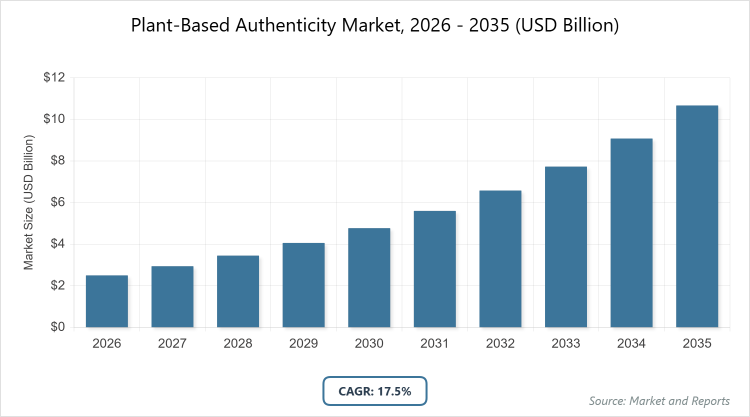
According to MarketnReports, the global Plant-Based Authenticity market size was estimated at USD 2.5 billion in 2025 and is expected to reach USD 12.5 billion by 2035, growing at a CAGR of 17.5% from 2026 to 2035. Plant-Based Authenticity Market is driven by rising consumer demand for transparent supply chains and verified plant-based claims amid growing veganism and sustainability concerns.
What are the Key Insights of the Plant-Based Authenticity Market?
- The global Plant-Based Authenticity market was valued at USD 2.5 billion in 2025 and is projected to reach USD 12.5 billion by 2035.
- The market is anticipated to grow at a CAGR of 17.5% during the forecast period from 2026 to 2035.
- The market is driven by increasing regulatory pressures for product transparency, rising incidences of food fraud, and growing adoption of advanced verification technologies.
- In the Type segment, DNA Testing dominates with a 35% share due to its high accuracy in verifying plant origins and detecting adulterations, which builds consumer trust and complies with international standards.
- In the Application segment, Food and Beverages holds the leading position with 45% market share, driven by the surge in plant-based food consumption and the need to authenticate ingredients like alternative proteins to prevent mislabeling.
- In the End-User segment, Manufacturers command 40% of the market, as they invest heavily in authenticity solutions to ensure supply chain integrity and meet certification requirements for global exports.
- North America dominates the regional landscape with a 38% share, attributed to stringent FDA regulations, high consumer awareness about ethical sourcing, and the presence of leading technology providers in the region.
What is the Industry Overview of the Plant-Based Authenticity Market?
The Plant-Based Authenticity market encompasses technologies, services, and solutions designed to verify the genuineness of plant-based products, ensuring they are free from animal-derived ingredients, genetically modified organisms (GMOs), or contaminants. This market addresses the growing need for transparency in supply chains, particularly in industries shifting toward sustainable and ethical alternatives. Market definition: Plant-Based Authenticity refers to the ecosystem of analytical methods, certification processes, and digital tools used to authenticate the plant-origin claims of products, combating fraud and enhancing consumer confidence in vegan, organic, and eco-friendly labels. It plays a crucial role in supporting the broader plant-based economy by enabling traceability from farm to shelf, fostering trust among stakeholders in a era where environmental and health consciousness drives purchasing decisions.
What are the Market Dynamics in the Plant-Based Authenticity Market?
Growth Drivers
The primary growth drivers in the Plant-Based Authenticity market stem from escalating consumer preferences for ethical and sustainable products, which necessitate robust verification mechanisms to substantiate claims. Regulatory bodies worldwide, such as the European Food Safety Authority (EFSA) and the U.S. Food and Drug Administration (FDA), are imposing stricter guidelines on labeling and traceability, compelling companies to adopt advanced authenticity solutions. Technological advancements, including AI-integrated spectroscopy and blockchain, are reducing costs and improving accuracy, thus accelerating market adoption. Additionally, the rise in veganism and plant-based diets, fueled by health awareness and environmental concerns, amplifies the demand for authenticated products to avoid adulteration risks. Corporate sustainability initiatives and partnerships with certification organizations further propel growth by integrating authenticity into core business strategies.
Restraints
Restraints in the Plant-Based Authenticity market include high implementation costs for sophisticated testing equipment and services, which can be prohibitive for small and medium-sized enterprises (SMEs) in developing regions. Limited standardization across global supply chains leads to inconsistencies in verification protocols, hindering seamless international trade. Technical challenges, such as the complexity of analyzing diverse plant matrices, can result in false positives or negatives, eroding trust in authenticity methods. Moreover, a shortage of skilled professionals in analytical sciences exacerbates operational bottlenecks. Economic volatility and supply chain disruptions, like those seen in raw material shortages, also restrain market expansion by increasing overall verification expenses.
Opportunities
Opportunities abound in the Plant-Based Authenticity market with the expansion of e-commerce platforms, where digital traceability tools like QR codes and NFTs can enhance online consumer verification. Emerging markets in Asia-Pacific present untapped potential due to rapid urbanization and rising middle-class demand for premium, authenticated plant-based goods. Innovations in portable testing devices offer prospects for on-site authenticity checks, catering to field-level applications in agriculture. Collaborations between tech firms and food giants could lead to integrated platforms combining IoT with authenticity data for real-time monitoring. Furthermore, the integration of authenticity solutions with ESG (Environmental, Social, and Governance) reporting creates avenues for differentiation in competitive landscapes.
Challenges
Challenges facing the Plant-Based Authenticity market involve navigating evolving regulatory landscapes, which vary significantly by region and can lead to compliance complexities for multinational operations. Counterfeit technologies and fraudulent certifications pose risks, undermining market credibility and requiring constant vigilance. Data privacy concerns with blockchain and digital tools may deter adoption in privacy-sensitive regions. Supply chain opacity in remote sourcing areas complicates comprehensive authenticity verification. Lastly, educating consumers and stakeholders about the value of authenticity remains a hurdle, as low awareness can limit market penetration.
Plant-Based Authenticity Market: Report Scope
| Report Attributes | Report Details |
| Report Name | Plant-Based Authenticity Market |
| Market Size 2025 | USD 2.5 Billion |
| Market Forecast 2035 | USD 12.5 Billion |
| Growth Rate | CAGR of 17.5% |
| Report Pages | 212 |
| Key Companies Covered | Eurofins Scientific, SGS Group, Authentix Inc., Bureau Veritas, Intertek Group, and Others |
| Segments Covered | By Type, By Application, By End-User, and By Region |
| Regions Covered | North America, Europe, Asia Pacific (APAC), Latin America, and The Middle East and Africa (MEA) |
| Base Year | 2025 |
| Historical Year | 2020 – 2024 |
| Forecast Year | 2026 – 2035 |
| Customization Scope | Avail customized purchase options to meet your exact research needs. |
How is the Plant-Based Authenticity Market Segmented?
The Plant-Based Authenticity market is segmented by type, application, end-user, and region.
Based on Type Segment, DNA Testing emerges as the most dominant subsegment, capturing 35% of the market, primarily because of its precision in identifying genetic markers unique to plant species, which effectively detects adulterations and ensures compliance with non-GMO standards, thereby driving market growth through enhanced reliability in high-stakes industries like food exports. The second most dominant is Spectroscopy, with a 25% share, valued for its non-destructive, rapid analysis capabilities that allow real-time quality checks, contributing to market expansion by reducing testing times and costs for large-scale manufacturers.
Based on Application Segment, Food and Beverages stands out as the most dominant, holding 45% market share, owing to the explosive growth in plant-based alternatives like meat substitutes and dairy analogs, where authenticity verification prevents mislabeling and builds brand loyalty, fueling overall market momentum. Cosmetics and Personal Care follows as the second dominant with 20%, driven by consumer scrutiny over natural ingredients, enabling market growth through certifications that appeal to eco-conscious buyers and support premium pricing.
Based on End-User Segment, Manufacturers dominate with 40% of the market, as they prioritize authenticity to safeguard reputations and meet global trade requirements, directly propelling market development by integrating verification into production processes. Certification Bodies rank second with 25%, benefiting from regulatory mandates that increase demand for third-party validations, thus accelerating market growth via standardized trust-building mechanisms.
What are the Recent Developments in the Plant-Based Authenticity Market?
- In January 2026, Eurofins Scientific launched a new AI-powered DNA testing platform for plant-based food authentication, enhancing detection accuracy by 30% and partnering with major retailers to expand its global footprint.
- February 2026 saw Authentix Inc. acquire a blockchain startup, integrating traceability solutions for cosmetics, which aims to reduce fraud by 40% in supply chains and attract investments from sustainability-focused funds.
- In March 2026, SGS Group introduced portable spectroscopy devices for on-field plant authenticity checks, targeting agricultural end-users and projecting a 25% increase in adoption rates in emerging markets.
How is the Regional Analysis of the Plant-Based Authenticity Market Conducted?
- North America to dominate the global market.
North America leads the Plant-Based Authenticity market with a 38% share, driven by advanced technological infrastructure and stringent regulations from bodies like the FDA and USDA, which mandate rigorous testing for plant-based claims. The United States dominates within the region, accounting for over 60% of North American revenue, due to high consumer awareness, a booming vegan market, and the presence of key players innovating in DNA and blockchain technologies. Canada contributes significantly through its focus on organic certifications, supporting growth amid rising exports of authenticated plant products.
Europe holds a substantial position with 30% market share, fueled by EU directives on food safety and sustainability, such as the Green Deal, which emphasize authenticity in plant-based goods. Germany stands out as the dominating country, representing about 35% of Europe’s market, thanks to its strong R&D ecosystem and consumer demand for transparent labeling in cosmetics and food sectors. The UK and France follow, with investments in spectroscopy and certification services enhancing regional competitiveness.
Asia Pacific (APAC) is the fastest-growing region at 25% share, propelled by urbanization and increasing adoption of plant-based diets in populous nations. China dominates with over 40% of APAC’s market, driven by government initiatives against food fraud and rapid expansion in e-commerce platforms requiring authenticity verification. India and Japan contribute through advancements in herbal medicine authentication and regulatory reforms, fostering opportunities in textiles and pharmaceuticals.
Latin America captures 4% of the global market, with growth centered on agricultural exports needing authenticity for international compliance. Brazil leads as the dominating country, holding 50% of the region’s share, due to its vast plant-based resources like soy and biofuels, where traceability tools combat deforestation-linked fraud. Mexico supports this through cosmetics applications, though challenges like infrastructure gaps limit faster expansion.
The Middle East and Africa (MEA) accounts for 3% share, emerging slowly with focus on halal and organic certifications for plant-based products. South Africa dominates with 40% of MEA’s market, driven by investments in analytical instruments for food exports to Europe. The UAE contributes via luxury cosmetics authenticity, but overall growth is restrained by economic disparities and limited technological access.
Who are the Key Market Players in the Plant-Based Authenticity Market?
- Eurofins Scientific: This player employs strategies like mergers with tech firms to enhance DNA testing capabilities, focusing on R&D investments to develop AI-driven platforms that improve accuracy and expand into new applications such as pharmaceuticals.
- SGS Group: SGS leverages global partnerships with regulatory bodies to offer comprehensive certification services, emphasizing sustainability audits and portable devices to capture market share in emerging regions through cost-effective solutions.
- Authentix Inc.: Authentix focuses on blockchain integrations for supply chain traceability, adopting acquisition strategies to incorporate innovative startups and target high-growth sectors like food and cosmetics for fraud prevention.
- Bureau Veritas: This company prioritizes digital transformation with quality assurance software, forming alliances with manufacturers to provide end-to-end authenticity solutions that ensure compliance and drive customer loyalty.
- Intertek Group: Intertek’s strategies include expanding laboratory networks and investing in spectroscopy technologies, aiming to dominate end-user segments by offering rapid testing services that reduce operational downtimes.
What are the Market Trends in the Plant-Based Authenticity Market?
- Adoption of AI and machine learning for predictive authenticity analysis is rising, enabling proactive fraud detection in complex supply chains.
- Blockchain technology is gaining traction for immutable traceability, particularly in food exports to ensure end-to-end verification.
- Portable and on-site testing devices are trending, allowing real-time checks in remote agricultural settings to enhance efficiency.
- Integration with ESG frameworks is becoming standard, as companies link authenticity to sustainability reporting for investor appeal.
- Consumer-facing apps for scanning product authenticity via QR codes are emerging, boosting direct engagement and trust.
What Market Segments and Their Subsegments are Covered in the Plant-Based Authenticity Report?
By Type
- DNA Testing
- Isotope Analysis
- Spectroscopy
- Chromatography
- Blockchain Traceability
- Certification Services
- Labeling Solutions
- Supply Chain Auditing
- Quality Assurance Software
- Analytical Instruments
- Others
By Application
- Food and Beverages
- Cosmetics and Personal Care
- Pharmaceuticals
- Textiles
- Dietary Supplements
- Animal Feed
- Packaging Materials
- Biofuels
- Nutraceuticals
- Herbal Medicines
- Others
By End-User
- Manufacturers
- Retailers
- Certification Bodies
- Laboratories
- Consumers
- Regulatory Agencies
- Supply Chain Operators
- Research Institutions
- E-commerce Platforms
- Importers/Exporters
- Others
By Region
- North America
- U.S.
- Canada
- Europe
- UK
- Germany
- France
- Rest of Europe
- Asia Pacific
- China
- India
- Japan
- Rest of Asia Pacific
- Latin America
- Brazil
- Mexico
- Rest of Latin America
- Middle East & Africa
- UAE
- South Africa
- Rest of Middle East & Africa
Frequently Asked Questions
Plant-Based Authenticity refers to the verification processes and technologies used to confirm that products claiming to be plant-based are genuinely derived from plants, free from animal ingredients or adulterants, ensuring transparency and trust in the supply chain.
Key factors include regulatory advancements, technological innovations in testing methods, rising consumer demand for ethical products, and increasing incidences of supply chain fraud, all contributing to sustained market expansion.
The market is projected to grow from approximately USD 2.5 billion in 2025 to USD 12.5 billion by 2035.
The CAGR is expected to be 17.5% over the forecast period.
North America will contribute notably, driven by robust regulations and high adoption rates of advanced authenticity technologies.
Major players include Eurofins Scientific, SGS Group, Authentix Inc., Bureau Veritas, and Intertek Group, which innovate and expand through strategic partnerships and R&D.
The report provides comprehensive insights into market size, trends, segmentation, regional analysis, key players, and forecasts, aiding stakeholders in strategic decision-making.
Stages include raw material sourcing verification, manufacturing process auditing, testing and certification, distribution traceability, and end-consumer validation through labeling and digital tools.
Trends are shifting toward digital traceability and AI-driven testing, while consumers prefer transparent, ethically verified products, influencing preferences for blockchain-enabled authenticity.
Regulatory factors like FDA and EU labeling laws enforce stricter verifications, while environmental concerns over sustainability drive demand for authenticated eco-friendly plant-based products.