
Pipeline Transportation Market Size, Share and Trends 2026 to 2035
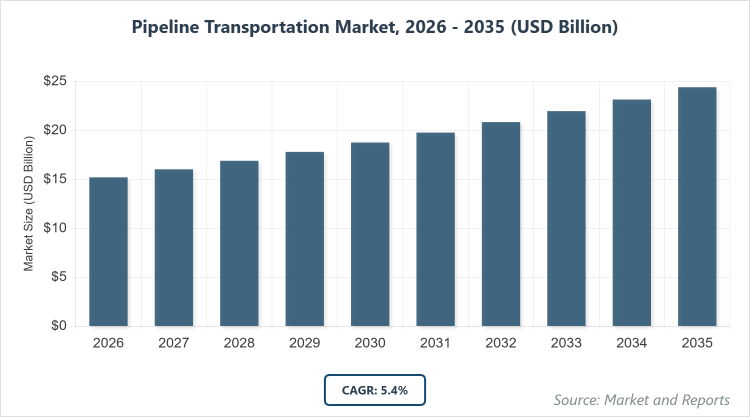
According to MarketnReports, the global Pipeline Transportation market size was estimated at USD 15.2 billion in 2025 and is expected to reach USD 25.8 billion by 2035, growing at a CAGR of 5.4% from 2026 to 2035. Pipeline Transportation Market is driven by the increasing global demand for efficient energy and resource distribution.
What is Pipeline Transportation? An Industry Overview
Pipeline transportation involves the use of underground or overland conduits to move liquids, gases, or slurries over long distances, offering a safe, cost-effective, and environmentally efficient alternative to road or rail transport for commodities like oil, natural gas, chemicals, and water. The market definition includes the infrastructure, technologies, and services for designing, constructing, operating, and maintaining pipelines, encompassing materials like steel or plastic, monitoring systems for leak detection, and regulatory compliance to ensure secure flow, minimize losses, and support energy security while addressing environmental concerns in a global supply chain context.
What are the Key Insights of Pipeline Transportation Market?
- The global Pipeline Transportation market was valued at USD 15.2 billion in 2025 and is projected to reach USD 25.8 billion by 2035.
- The global Pipeline Transportation market is expected to grow at a CAGR of 5.4% during the forecast period 2026-2035.
- The Pipeline Transportation market is driven by expanding energy infrastructure and rising crude oil and natural gas production.
- The gas pipelines subsegment dominates the type segment with a 45% share due to increasing natural gas demand for cleaner energy transitions.
- The onshore transportation subsegment dominates the application segment with a 70% share owing to cost advantages and extensive land-based networks.
- The oil & gas industry subsegment dominates the end-user segment with a 60% share because of high-volume commodity transport needs.
- North America dominates the global Pipeline Transportation market with a 35% share attributed to vast shale gas resources and extensive pipeline networks in the U.S.
What are the Market Dynamics of Pipeline Transportation?
Growth Drivers
The pipeline transportation market is propelled by the surge in global energy demand, with natural gas consumption expected to rise by 40% by 2050 according to IEA, driving investments in gas pipelines for efficient, low-emission distribution. Technological advancements in smart monitoring systems, such as AI-based leak detection reducing incidents by 30%, enhance safety and operational efficiency, attracting regulatory approvals. Government initiatives for energy security, like the U.S. Infrastructure Investment and Jobs Act allocating billions for pipeline upgrades, further boost expansion, enabling cross-border trade and supporting economic growth in resource-rich regions.
Restraints
Environmental concerns and regulatory opposition to new pipelines, such as protests against projects like Keystone XL, delay approvals and increase costs through extended environmental impact assessments. High capital requirements for pipeline construction, often exceeding USD 1 billion per major project, limit entry for smaller firms and strain budgets in volatile oil markets. Aging infrastructure in developed regions requires costly maintenance, while geopolitical tensions disrupt cross-border projects, leading to underutilization and financial losses.
Opportunities
The transition to renewable gases like hydrogen offers opportunities for repurposing existing pipelines, with projections of hydrogen demand reaching 80 million tons by 2030, creating new markets for corrosion-resistant materials. Emerging economies in Africa, with untapped oil reserves, present growth through infrastructure development supported by foreign investments. Partnerships for digital twins and IoT integration can optimize operations, reducing downtime by 20% and opening service-based revenue models for monitoring and predictive maintenance.
Challenges
Ensuring pipeline integrity against corrosion and natural disasters requires advanced materials and monitoring, increasing operational complexity and costs. Public opposition and land acquisition issues in densely populated areas delay projects, while cyber threats to control systems pose security risks, necessitating robust defenses. Volatility in commodity prices affects investment returns, while the shift to renewables challenges traditional oil and gas pipelines, demanding diversification strategies.
Pipeline Transportation Market: Report Scope
| Report Attributes | Report Details |
| Report Name | Pipeline Transportation Market |
| Market Size 2025 | USD 15.2 Billion |
| Market Forecast 2035 | USD 25.8 Billion |
| Growth Rate | CAGR of 5.4% |
| Report Pages | 220 |
| Key Companies Covered | Enbridge, TC Energy, Kinder Morgan, Shell, Chevron, Transneft, and Others |
| Segments Covered | By Type, By Application, By End-User, and By Region |
| Regions Covered | North America, Europe, Asia Pacific (APAC), Latin America, and The Middle East and Africa (MEA) |
| Base Year | 2025 |
| Historical Year | 2020 – 2024 |
| Forecast Year | 2026 – 2035 |
| Customization Scope | Avail customized purchase options to meet your exact research needs. |
The Pipeline Transportation market is segmented by type, application, end-user, and region.
Based on Type Segment: The gas pipelines segment is the most dominant, holding a 45% market share, as it supports the clean energy transition with efficient natural gas transport, driven by its lower carbon footprint compared to oil. This dominance drives market growth by facilitating global LNG trade. The oil pipelines segment is the second most dominant with a 40% share, essential for crude distribution, which propels the market through energy supply stability.
Based on Application Segment: The onshore transportation segment is the most dominant, capturing a 70% share, due to lower construction costs and extensive networks for domestic supply. Its dominance accelerates market growth by enabling cost-effective resource movement. The offshore transportation segment ranks second with a 20% share, used for deep-sea oil, driving the market with exploration in new fields.
Based on End-User Segment: The oil & gas industry segment is the most dominant, with a 60% share, attributed to high-volume needs for energy commodities. This leads market growth by supporting global trade. The chemical industry segment is second with a 20% share, requiring specialized pipelines, propelling growth through industrial demands.
What are the Recent Developments in Pipeline Transportation Market?
- In 2025, Enbridge expanded its Line 3 oil pipeline, increasing capacity by 370,000 barrels per day for U.S. supply.
- TC Energy launched a new gas pipeline project in Mexico, enhancing cross-border energy trade.
- Kinder Morgan acquired a chemical pipeline network, diversifying its portfolio.
- Pipeline Technology Conference highlighted AI for leak detection, with multiple firms adopting.
- Shell invested in hydrogen-ready pipelines for green energy transition.
What is the Regional Analysis of Pipeline Transportation Market?
- North America to dominate the global market
North America holds a 35% share in the Pipeline Transportation market, driven by shale boom. The United States dominates, with Enbridge and Kinder Morgan expanding networks for oil exports.
Europe maintains a position in the Pipeline Transportation market, fueled by diversification. Russia leads in gas, but Germany shifts to LNG imports amid energy transitions.
Asia Pacific captures growth in the Pipeline Transportation market, propelled by demand. China dominates, with massive gas imports via pipelines from Russia.
Latin America is emerging in the Pipeline Transportation market, focusing on oil. Brazil leads, expanding for offshore fields.
The Middle East and Africa show potential in the Pipeline Transportation market, driven by exports. Saudi Arabia is a key player, with Aramco’s oil pipelines.
Who are the Key Market Players and Strategies in Pipeline Transportation?
Enbridge focuses on capacity expansions, investing in oil and gas lines.
TC Energy emphasizes cross-border projects, diversifying energy trade.
Kinder Morgan pursues acquisitions, broadening chemical transport.
Shell invests in hydrogen adaptations, targeting green transitions.
Chevron develops offshore pipelines, focusing on exploration.
Transneft specializes in Russian gas, expanding Eurasian networks.
What are the Market Trends in Pipeline Transportation?
- Shift toward hydrogen and renewable gas pipelines.
- Adoption of AI for monitoring and leak detection.
- Growth in cross-border energy trade infrastructure.
- Focus on sustainable materials for construction.
- Expansion of digital twins for operations.
- Integration with smart grid technologies.
What are the Market Segments and their Subsegment Covered in the Pipeline Transportation Report?
By Type
-
- Oil Pipelines
- Gas Pipelines
- Chemical Pipelines
- Water Pipelines
- Slurry Pipelines
- Others
By Application
-
- Onshore Transportation
- Offshore Transportation
- Cross-Border Transportation
- Intrastate Transportation
- Others
By End-User
-
- Oil & Gas Industry
- Chemical Industry
- Water & Wastewater Management
- Mining Industry
- Others
By Region
-
- North America
- U.S.
- Canada
- Europe
- UK
- Germany
- France
- Rest of Europe
- Asia Pacific
- China
- India
- Japan
- Rest of Asia Pacific
- Latin America
- Brazil
- Mexico
- Rest of Latin America
- Middle East & Africa
- UAE
- South Africa
- Rest of Middle East & Africa
- North America
Frequently Asked Questions
Pipeline Transportation is the movement of liquids or gases through conduits for efficient, long-distance distribution.
Key factors include energy demand, infrastructure investments, and renewable transitions.
The market is projected to grow from USD 16 billion in 2026 to USD 25.8 billion by 2035.
The market is expected to grow at a CAGR of 5.4% during 2026-2035.
North America will contribute notably, holding a 35% share due to shale resources.
Major players include Enbridge, TC Energy, Kinder Morgan, Shell, Chevron, and Transneft.
The report provides market size, trends, segmentation, regional insights, key players, and forecasts.
Stages include planning, construction, operation, maintenance, and decommissioning.
Trends favor green pipelines and AI monitoring, with preferences for sustainable energy transport.
Emission regulations and safety standards drive green adaptations.