
Pet Supplement Market Size, Share and Trends 2026 to 2035
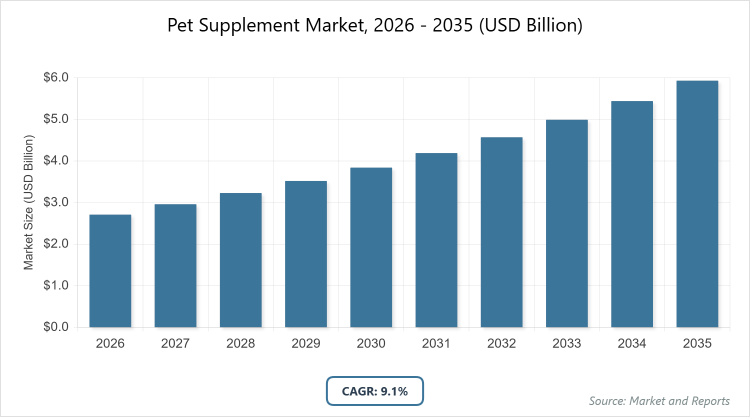
According to MarketnReports, the global pet supplement market size was estimated at USD 2.71 billion in 2025 and is expected to reach USD 6.5 billion by 2035, growing at a CAGR of 9.1% from 2026 to 2035. Rising pet humanization and demand for health-specific formulations.
What are the Key Insights into Pet Supplement Market?
- Global pet supplement market size was USD 2.71 billion in 2025 and is projected to reach USD 6.5 billion by 2035.
- The market is anticipated to grow at a CAGR of 9.1% from 2026 to 2035.
- The market is driven by pet humanization trends, rising health awareness among owners, and innovations in functional ingredients.
- The vitamins & minerals segment dominates the product type with around 35% share, owing to its essential role in daily nutrition and preventive care for deficiencies.
- The dogs segment leads the application with approximately 60% market share, due to higher ownership rates and diverse supplement needs for breeds and ages.
- The online retail segment is dominant in distribution channel with about 40% share, as it offers convenience, variety, and subscription models for recurring purchases.
- North America dominates the regional market with around 35% share, driven by high pet ownership, premium product demand, and strong e-commerce in the United States.
What is the Pet Supplement?
Industry Overview
The pet supplement market involves the production, distribution, and sale of nutritional products designed to enhance the health, wellness, and longevity of companion animals, including vitamins, minerals, probiotics, omega-3s, and specialized formulas for joint, skin, digestive, and immune support, catering to pet owners seeking to address specific health concerns or provide preventive care similar to human supplements, often formulated for dogs, cats, and other pets with natural or organic ingredients for safety and efficacy. This industry focuses on science-backed solutions that integrate with pet food diets, supported by veterinary recommendations and e-commerce platforms for easy access, while emphasizing regulatory compliance for quality and labeling.
Market definition encompasses all non-medicated dietary supplements intended for pets to improve overall health or target conditions, excluding prescription medications or basic pet food, and it reflects the growing trend of pet humanization amid increasing pet ownership and awareness of animal wellness.
What are the Market Dynamics Affecting Pet Supplement?
Growth Drivers
The growth drivers in the pet supplement market are primarily fueled by the global rise in pet ownership and humanization trends, where owners treat pets as family members, leading to increased spending on health-enhancing supplements like joint and immune boosters to extend lifespan and improve quality of life, particularly in urban areas with aging pet populations. This is supported by advancements in natural and organic formulations, incorporating ingredients like CBD, turmeric, and probiotics, which appeal to health-conscious consumers seeking clean-label products backed by veterinary research. Furthermore, the expansion of e-commerce and subscription services facilitates easy access and personalized recommendations, driving market adoption through convenience and targeted marketing in competitive retail landscapes.
Restraints
Restraints in the pet supplement market include stringent regulatory requirements for labeling and efficacy claims, which vary by region and require costly clinical trials, delaying product launches and increasing development expenses for manufacturers. High competition from pet food with added supplements reduces demand for standalone products, particularly in price-sensitive markets. Additionally, concerns over product safety and counterfeit items in online channels erode consumer trust, limiting growth in unregulated regions.
Opportunities
Opportunities in the pet supplement market lie in the integration of functional ingredients for niche needs, such as calming aids for anxious pets or senior formulas for mobility, appealing to millennial owners prioritizing wellness through innovative delivery like chews or powders. The rise of sustainable sourcing and eco-friendly packaging attracts environmentally conscious consumers, enabling premium pricing. Moreover, untapped markets in Asia-Pacific offer potential for localized products through partnerships, capitalizing on rising pet adoption.
Challenges
Challenges in the pet supplement market involve ensuring product efficacy across diverse pet breeds and ages, requiring extensive R&D that elevates costs and timelines. Supply chain vulnerabilities for natural ingredients, influenced by climate change, create pricing instability. Additionally, educating consumers on benefits amid misinformation poses marketing hurdles, necessitating transparent labeling to build trust.
Pet Supplement Market: Report Scope
| Report Attributes | Report Details |
| Report Name | Pet Supplement Market |
| Market Size 2025 | USD 2.71 Billion |
| Market Forecast 2035 | USD 6.5 Billion |
| Growth Rate | CAGR of 9.1% |
| Report Pages | 220 |
| Key Companies Covered |
Mars Petcare, Nestlé Purina Petcare, Spectrum Brands, Hill’s Pet Nutrition, Virbac, and Others |
| Segments Covered | By Product Type, By Application, By Distribution Channel, and By Region |
| Regions Covered | North America, Europe, Asia Pacific (APAC), Latin America, and The Middle East and Africa (MEA) |
| Base Year | 2025 |
| Historical Year | 2020 – 2024 |
| Forecast Year | 2026 – 2035 |
| Customization Scope | Avail customized purchase options to meet your exact research needs. |
How is the Pet Supplement Market Segmented?
The Pet Supplement market is segmented by product type, application, distribution channel, and region.
Based on Product Type Segment, the vitamins & minerals subsegment is the most dominant, holding around 35% share, due to its foundational role in addressing nutritional gaps and supporting overall health, which drives the market by encouraging daily use and preventive care among pet owners. The joint health supplements subsegment is the second most dominant, with approximately 25% share, as it targets common issues in aging pets, contributing to market growth by improving mobility and quality of life.
Based on Application Segment, the dogs subsegment is the most dominant, capturing about 60% share, attributed to higher global dog ownership and breed-specific needs, which propels the market by boosting demand for tailored supplements. The cats subsegment is the second most dominant, with around 25% share, owing to increasing cat adoptions, helping to drive the market through specialized formulations for feline health.
Based on the Distribution Channel Segment, the online retail subsegment is the most dominant, with roughly 40% share, facilitated by convenience and variety, driving the market by enabling subscriptions and reviews for informed purchases. The veterinary clinics subsegment is the second most dominant, holding about 30% share, propelled by professional recommendations, which contribute to market expansion by ensuring trusted product access.
What are the Recent Developments in Pet Supplement Market?
- In July 2025, Mars Petcare launched a new probiotic supplement line for digestive health, targeting online sales with subscription options.
- In April 2025, Nestlé Purina acquired a natural supplement startup to expand its organic offerings for joint and skin care.
- In February 2025, Hill’s Pet Nutrition introduced CBD-infused calming supplements, complying with new FDA guidelines for pet wellness.
- In December 2024, Spectrum Brands partnered with e-commerce platforms to boost its omega-3 supplement sales through personalized recommendations.
How Does Regional Analysis Impact Pet Supplement Market?
- North America to dominate the global market.
North America leads the pet supplement market with a significant share, driven by high pet ownership rates and premium product demand; the United States dominates this region, where humanization trends and e-commerce fuel innovations in functional supplements, contributing to growth through veterinary endorsements and marketing.
Europe follows with steady progress, benefiting from regulatory standards and organic preferences; Germany is the dominating country, leveraging strong animal welfare laws for natural supplements, supporting market expansion via retail chains.
Asia Pacific emerges as the fastest-growing region, propelled by urbanization and rising incomes; China dominates here, with increasing pet adoptions driving demand for affordable vitamins, fostering growth through local manufacturing.
Latin America shows moderate development, influenced by tourism and middle-class growth; Brazil is the dominating country, where e-commerce boosts joint health products, aiding the market through cultural shifts.
The Middle East and Africa represent emerging opportunities, boosted by expatriate influences; the UAE dominates, with luxury pet care adopting immune supplements, propelling growth via urban lifestyles.
Who are the Key Market Players in Pet Supplement?
- Mars Petcare focuses on science-backed supplements for digestive and joint health, employing acquisitions and R&D for natural ingredients to lead in global markets.
- Nestlé Purina Petcare specializes in veterinary-formulated products, utilizing brand loyalty and online platforms for personalized nutrition solutions.
- Spectrum Brands (United Pet Group) offers affordable multivitamins, adopting e-commerce strategies and sustainability for category expansion.
- Hill’s Pet Nutrition targets prescription-like supplements, with strategies involving clinical trials and vet partnerships for credibility.
- Virbac emphasizes animal health supplements, employing innovation in probiotics and global distributions for niche segments.
What are the Market Trends Shaping Pet Supplements?
- Rise in natural and organic ingredients for clean-label products.
- Growth in functional supplements for specific health issues like joints and digestion.
- Expansion of online sales and subscription models for convenience.
- Integration of CBD and herbal formulations for calming effects.
- Focus on sustainable sourcing and eco-friendly packaging.
- Increase in personalized supplements based on pet breed and age.
What Market Segments and Subsegments are Covered in the Pet Supplement Report?
By Product Type
- Vitamins & Minerals
- Joint Health Supplements
- Digestive Health Supplements
- Skin & Coat Supplements
- Immune Health Supplements
- Eye Health Supplements
- Dental Health Supplements
- Calming Supplements
- Multivitamins
- Omega-3 Fatty Acids
- Others
By Application
- Dogs
- Cats
- Birds
- Fish
- Small Mammals
- Horses
- Reptiles
- Rodents
- Exotic Pets
- Livestock Pets
- Others
By Distribution Channel
- Online Retail
- Veterinary Clinics
- Pet Stores
- Supermarkets/Hypermarkets
- Pharmacies
- Direct-to-Consumer
- Specialty Stores
- E-commerce Platforms
- Subscription Services
- Mass Merchandisers
- Others
By Region
- North America
- U.S.
- Canada
- Europe
- UK
- Germany
- France
- Rest of Europe
- Asia Pacific
- China
- India
- Japan
- Rest of Asia Pacific
- Latin America
- Brazil
- Mexico
- Rest of Latin America
- Middle East & Africa
- UAE
- South Africa
- Rest of Middle East & Africa
Chapter 1. Preface
Chapter 2. Executive Summary
Chapter 3. Global Pet Supplement Market - Industry Analysis
Chapter 4. Global Pet Supplement Market- Competitive Landscape
Chapter 5. Global Pet Supplement Market - Product Type Analysis
Chapter 6. Global Pet Supplement Market - Application Analysis
Chapter 7. Global Pet Supplement Market - Distribution Channel Analysis
Chapter 8. Pet Supplement Market - Regional Analysis
Chapter 9. Company Profiles
Frequently Asked Questions
Pet supplements are nutritional products designed to support the health and wellness of companion animals, including vitamins, minerals, and functional ingredients for specific needs like joint or digestive support.
Key factors include pet humanization, health awareness, innovations in natural formulations, and e-commerce expansion.
The pet supplement market is projected to grow from approximately USD 2.96 billion in 2026 to USD 6.5 billion by 2035.
The CAGR value is expected to be 9.1% during 2026-2035.
North America will contribute notably, driven by high ownership and premium demand.
Major players include Mars Petcare, Nestlé Purina Petcare, Spectrum Brands, Hill's Pet Nutrition, and Virbac.
The report provides comprehensive analysis on size, trends, segments, regions, players, and forecasts from 2026 to 2035.
Stages include ingredient sourcing, formulation, manufacturing, packaging, distribution, retail, and consumer use.
Trends are shifting toward natural, functional products, with preferences for personalized and sustainable options.
Regulatory factors include labeling standards, while environmental factors involve sustainable sourcing demands.