
Peanut Butter Market Size, Share and Trends 2026 to 2035
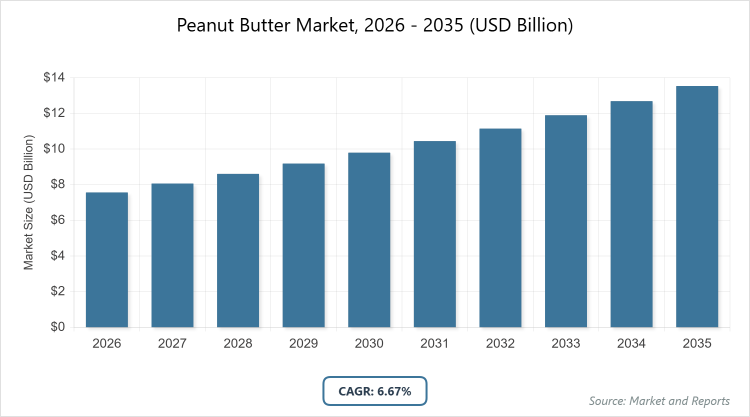
According to MarketnReports, the global Peanut Butter market size was estimated at USD 7.57 billion in 2025 and is expected to reach USD 15.4 billion by 2035, growing at a CAGR of 6.67% from 2026 to 2035. Peanut Butter Market is driven by increasing consumer preference for healthy, protein-rich spreads and natural ingredients.
What is the Industry Overview of the Peanut Butter Market?
The Peanut Butter Market encompasses the production, distribution, and consumption of spreads made from ground roasted peanuts, available in various textures and formulations, serving as a versatile ingredient for snacks, bakery items, and direct consumption while offering nutritional benefits like protein and healthy fats. This market caters to health-conscious consumers seeking clean-label, plant-based options, with innovations in flavors and organic variants enhancing appeal across food service and retail channels.
It addresses evolving dietary trends, including veganism and low-sugar preferences, by providing convenient, nutrient-dense products that align with wellness lifestyles. The market definition includes all peanut-based spreads, excluding non-peanut nut butters, driven by sustainable sourcing, packaging advancements, and global trade dynamics ensuring accessibility and quality for diverse applications in households and industries.
What are the Key Insights into the Peanut Butter Market?
- The global Peanut Butter Market size was estimated at USD 7.57 Billion in 2025 and is expected to reach USD 15.4 Billion by 2035.
- Growing at a CAGR of 6.67% from 2026 to 2035.
- The Peanut Butter Market is driven by increasing consumer preference for healthy, protein-rich spreads, natural and organic variants, and versatile applications in snacks and bakery products.
- Dominated subsegment in Type: Smooth Peanut Butter with 50.3% share, because of its ease of spreading, uniform texture, and widespread use in culinary applications, appealing to a broad consumer base.
- Dominated subsegment in Application: Direct Consumption & Culinary Purpose with 45% share, because of its convenience as a quick snack or spread, driving everyday household usage.
- Dominated subsegment in Distribution Channel: Supermarkets & Hypermarkets with 40% share, because of their extensive product variety, accessibility, and promotional activities attracting bulk buyers.
- Dominated region: North America with 51% share, because of high consumption in the United States, strong brand presence, and preference for peanut butter as a staple food item.
What are the Market Dynamics of the Peanut Butter Market?
Growth Drivers
The growth drivers for the Peanut Butter Market include rising health consciousness among consumers, who seek protein-rich, plant-based foods with natural ingredients, boosting demand for organic and low-sugar variants that align with wellness trends and dietary preferences like veganism. Innovations in product formulations, such as flavored and fortified peanut butters, expand applications in snacks, bakery, and desserts, attracting younger demographics and driving market diversification.
Expanding retail channels, including online platforms, enhance accessibility, enabling global reach and convenience for busy lifestyles. Sustainable sourcing and clean-label claims appeal to eco-aware buyers, supported by certifications that build trust. Increasing urbanization and disposable incomes in emerging markets fuel consumption, while corporate expansions through acquisitions and new launches sustain momentum.
Restraints
Restraints in the Peanut Butter Market stem from fluctuating peanut prices due to weather dependencies and supply chain disruptions, increasing production costs and affecting affordability in price-sensitive regions. Health concerns over allergies limit market penetration, requiring allergen-free alternatives that raise R&D expenses. Competition from other nut butters and spreads dilutes share, as consumers explore diverse options.
Regulatory variations on labeling and additives across countries complicate international trade, elevating compliance costs. Economic downturns reduce discretionary spending on premium variants, while counterfeit products erode brand trust in developing markets.
Opportunities
Opportunities in the Peanut Butter Market arise from the surge in plant-based diets, enabling innovations like fortified products with added nutrients for targeted health benefits, attracting partnerships with wellness brands. Expansion into emerging markets with localized flavors taps untapped demand, supported by e-commerce growth for direct-to-consumer models.
Sustainable practices, such as eco-friendly packaging and ethical sourcing, qualify for premium pricing and appeal to green consumers. Collaborations with food tech for low-calorie or functional variants open niches in sports nutrition. Government nutrition programs in developing regions promote fortified peanut butter for malnutrition, fostering large-scale contracts.
Challenges
Challenges in the Peanut Butter Market include managing supply volatility from climate impacts on peanut crops, necessitating diversified sourcing that increases logistics costs. Addressing allergy risks requires stringent manufacturing protocols, complicating production and limiting inclusivity.
Intense competition demands continuous innovation, straining R&D budgets for smaller players. Navigating diverse regulations on GMOs and additives adds operational hurdles. Consumer shifts towards healthier alternatives challenge traditional high-sugar variants, requiring reformulations amid cost pressures.
Peanut Butter Market: Report Scope
| Report Attributes | Report Details |
| Report Name | Peanut Butter Market |
| Market Size 2025 | USD 7.57 Billion |
| Market Forecast 2035 | USD 15.4 Billion |
| Growth Rate | CAGR of 6.67% |
| Report Pages | 235 |
| Key Companies Covered |
The J.M. Smucker Company, Hormel Foods Corporation, Kraft Heinz Company, Conagra Brands, Inc., Unilever Plc, The Hershey Company, Post Holdings, Inc., Associated British Foods plc, Dr. Oetker, Kellogg Company, and Others |
| Segments Covered | By Type, By Application, By Distribution Channel, and By Region |
| Regions Covered | North America, Europe, Asia Pacific (APAC), Latin America, and The Middle East and Africa (MEA) |
| Base Year | 2025 |
| Historical Year | 2020 – 2024 |
| Forecast Year | 2026 – 2035 |
| Customization Scope | Avail customized purchase options to meet your exact research needs. |
The Peanut Butter market is segmented by type, application, distribution channel, and region.
Based on Type Segment. The most dominant segment is Smooth Peanut Butter, which holds the largest market share due to its creamy texture, ease of use in spreads and recipes, and broad appeal to families and children; this dominance drives the market by facilitating versatile applications in daily consumption, boosting sales volume, and encouraging product innovations like flavored versions that expand consumer base. The second most dominant segment is Crunchy Peanut Butter, favored for its added texture and perceived naturalness; it contributes to market growth by targeting texture-preferring consumers, enhancing snack variety, and supporting premium pricing in specialty markets.
Based on Application Segment. The most dominant segment is Direct Consumption & Culinary Purpose, leading due to its convenience as a quick spread or ingredient in home cooking; this drives market expansion by aligning with busy lifestyles, increasing household penetration, and promoting everyday usage that sustains steady demand. The second most dominant segment is Bakery & Confectionery, driven by ingredient versatility in baked goods; it propels growth by integrating into processed foods, enabling flavor innovations, and attracting food manufacturers for product differentiation.
Based on Distribution Channel Segment. The most dominant segment is Supermarkets & Hypermarkets, commanding the majority share owing to their wide assortment and promotional displays; this dominance fuels market growth by providing accessibility, facilitating bulk purchases, and driving impulse buys through in-store marketing. The second most dominant segment is Online Retail, growing rapidly with e-commerce trends; it aids expansion by offering convenience, variety, and direct delivery, targeting tech-savvy consumers and expanding reach in urban areas.
What are the Recent Developments in the Peanut Butter Market?
- In January 2025, Mars introduced M&M’S Peanut Butter Ice Cream Cookie Sandwich, combining M&M’S with peanut butter ice cream, targeting indulgence seekers on National Peanut Butter Day.
- In February 2025, The Hershey Company launched Reese’s Peanut Butter Cups Sugar Cookie, expanding flavored offerings to capitalize on seasonal demand.
- In April 2025, ITC Limited acquired Sresta Natural Bioproducts to strengthen its organic peanut butter portfolio, enhancing presence in health-focused segments.
How Does Regional Analysis Impact the Peanut Butter Market?
- North America to dominate the global market.
North America, valued at USD 3.86 billion in 2025 and projected to reach USD 7.85 billion by 2035 at a CAGR of 7.3%, dominates with over 51% revenue share due to high per capita consumption, strong brand loyalty, and cultural staple status in diets, supported by extensive retail networks and marketing; Canada contributes through health trends, but the United States as the dominating country leads with innovations from companies like J.M. Smucker, driving flavored and natural variants amid wellness awareness.
Europe exhibits steady growth, fueled by rising plant-based diets and clean-label preferences, with regulations favoring natural ingredients; the United Kingdom as the dominating country advances through premium organic offerings and supermarket expansions.
Asia Pacific is rapidly expanding, driven by urbanization and western dietary influences, with increasing protein awareness; India dominates with local brands like Pintola, leveraging affordable, flavored products for growing middle-class consumers.
Latin America shows emerging potential, supported by nut-based snack trends; Brazil leads with Amul expansions, targeting bakery applications.
The Middle East and Africa are gradually developing, influenced by health initiatives; South Africa dominates through fortified products addressing nutrition gaps.
Who are the Key Market Players in the Peanut Butter Market?
The J.M. Smucker Company. The J.M. Smucker Company focuses on brand diversification, with strategies including natural and reduced-sugar variants to meet health trends.
Hormel Foods Corporation. Hormel Foods Corporation emphasizes premium Skippy lines, strategizing through flavor innovations and e-commerce expansions.
Kraft Heinz Company. Kraft Heinz Company invests in sustainable sourcing, employing strategies for organic products and global supply chain optimizations.
Conagra Brands, Inc. Conagra Brands, Inc. targets Peter Pan classics, with strategies involving marketing campaigns for family appeal.
Unilever Plc. Unilever Plc promotes clean-label options, strategizing via acquisitions for market entry in emerging regions.
The Hershey Company. The Hershey Company integrates Reese’s flavors, employing strategies for confectionery crossovers.
Post Holdings, Inc. Post Holdings, Inc. focuses on Better Oats synergies, with strategies in fortified breakfast items.
Associated British Foods plc. Associated British Foods plc emphasizes Twinings infusions, strategizing through health-focused spreads.
Dr. Oetker. Dr. Oetker targets European markets, with strategies in bakery integrations.
Kellogg Company. Kellogg Company explores nut-based cereals, employing strategies for snack bars.
What are the Market Trends in the Peanut Butter Market?
- Rising demand for organic and natural variants amid health consciousness.
- Innovation in flavored and low-sugar products for diverse preferences.
- Growth in online retail channels for convenience.
- Expansion of plant-based and vegan options.
- Sustainable sourcing and eco-friendly packaging.
What Market Segments and their Subsegments are Covered in the Peanut Butter Report?
By Type
-
- Smooth Peanut Butter
- Crunchy Peanut Butter
- Organic Peanut Butter
- Flavored Peanut Butter
- Reduced Fat Peanut Butter
- Low Sodium Peanut Butter
- No Sugar Peanut Butter
- Powdered Peanut Butter
- Natural Peanut Butter
- Specialty Peanut Butter
- Others
By Application
-
- Direct Consumption & Culinary Purpose
- Bakery & Confectionery
- Snacks
- Spreads & Dips
- Desserts & Ice-Creams
- Sweet & Savory Snacks
- Others
By Distribution Channel
-
- Supermarkets & Hypermarkets
- Convenience Stores
- Specialty Stores
- Online Retail
- Others
By Region
-
- North America
- U.S.
- Canada
- Europe
- UK
- Germany
- France
- Rest of Europe
- Asia Pacific
- China
- India
- Japan
- Rest of Asia Pacific
- Latin America
- Brazil
- Mexico
- Rest of Latin America
- Middle East & Africa
- UAE
- South Africa
- Rest of Middle East & Africa
- North America
Chapter 1. Preface
Chapter 2. Executive Summary
Chapter 3. Global Peanut Butter Market - Industry Analysis
Chapter 4. Global Peanut Butter Market- Competitive Landscape
Chapter 5. Global Peanut Butter Market - Type Analysis
Chapter 6. Global Peanut Butter Market - Application Analysis
Chapter 7. Global Peanut Butter Market - Distribution Channel Analysis
Chapter 8. Peanut Butter Market - Regional Analysis
Chapter 9. Company Profiles
Frequently Asked Questions
Peanut butter is a spread made from ground roasted peanuts, offering protein-rich nutrition in various textures for consumption as snacks or ingredients.
Key factors include health trends, flavor innovations, online retail growth, and sustainable sourcing.
The market is projected to grow from USD 8.075 billion in 2026 to USD 15.4 billion by 2035.
The CAGR is expected to be 6.67% during 2026-2035.
North America will contribute notably, holding 51% share, driven by consumption in the United States.
Major players include The J.M. Smucker Company, Hormel Foods Corporation, Kraft Heinz Company, Conagra Brands, Inc., Unilever Plc, and The Hershey Company, among others.
The report provides comprehensive analysis including market size, forecasts, segmentation, dynamics, regional insights, key players, trends, and strategic recommendations.
The value chain includes peanut sourcing, roasting and grinding, formulation and packaging, distribution, and retail sales.
Trends favor natural and flavored variants, with preferences shifting to low-sugar, organic options.
Regulations on labeling and allergens drive clean-label products, while sustainability promotes ethical sourcing.