
Palm Kernel Oil and Coconut Oil Based Natural Fatty Acids Market Size and Forecast 2026 to 2035
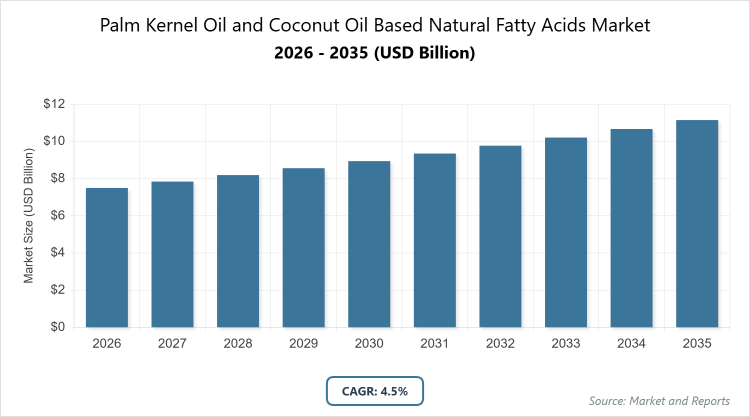
According to MarketnReports, the global Palm Kernel Oil and Coconut Oil Based Natural Fatty Acids market size was estimated at USD 7.50 billion in 2025 and is expected to reach USD 11.46 billion by 2035, growing at a CAGR of 4.5% from 2026 to 2035. Palm Kernel Oil and Coconut Oil Based Natural Fatty Acids Market is driven by the growing demand for bio-based and sustainable ingredients in personal care, detergents, and industrial applications.
What are the Key Insights of the Palm Kernel Oil and Coconut Oil Based Natural Fatty Acids Market?
- The global Palm Kernel Oil and Coconut Oil Based Natural Fatty Acids market is projected to grow at a CAGR of 4.5% during the forecast period from 2026 to 2035.
- The market value is expected to increase from approximately USD 7.50 billion in 2025 to USD 11.46 billion by 2035.
- In the application segment, the personal care products subsegment dominates, followed by food and beverages.
- In the type segment, the fatty acids subsegment dominates, followed by fatty alcohols.
- In the source segment, the palm kernel oil subsegment dominates, followed by coconut oil.
- In the end use segment, the household subsegment dominates, followed by commercial.
- The Asia-Pacific region dominates the global market.
What is the Industry Overview of the Palm Kernel Oil and Coconut Oil Based Natural Fatty Acids Market?
The Palm Kernel Oil and Coconut Oil Based Natural Fatty Acids market encompasses natural fatty acids derived from palm kernel oil and coconut oil, which are highly saturated fats containing oleochemicals such as lauric acid, myristic acid, caprylic acid, and capric acid. These acids serve as versatile raw materials in various industries, including detergents, personal care, cosmetics, food processing, pharmaceuticals, and industrial applications, owing to their cost-effectiveness, widespread availability in tropical regions, and beneficial properties that enhance product stability, foaming, and emulsification while promoting sustainability through renewable and biodegradable characteristics.
What are the Market Dynamics in the Palm Kernel Oil and Coconut Oil Based Natural Fatty Acids Market?
Growth Drivers
Massive product use in personal care and cosmetic items boosts global market trends, as natural fatty acids from palm kernel oil and coconut oil are renewable and biodegradable, driving market expansion through large-scale adoption of stearic fatty acids, polyunsaturated acids, distilled fatty acids, and stearic acids, with escalating use of personal care and cosmetic products along with the thriving fashion sector creating a strong foundation, while surging preference for bio-based and eco-friendly products in the personal care sector enhances growth, rising use of herbal items favorably impacts the market, increasing awareness of advantages from natural ingredient-based personal care items sketches a profitable roadmap, and new product launches and accreditations, such as sustainable certifications, are likely to change the market phase.
Restraints
Fluctuating raw material prices can create hurdles in industry growth globally over the forecast period, as oscillation in raw material costs and dynamic pricing adversely impact expansion in upcoming years by increasing production uncertainties and affecting profit margins for manufacturers and end-users alike.
Opportunities
Beneficial product features open new growth avenues over forecasting years, since the product has an elongated shelf life, non-toxic effects, and use in end-use sectors like rubber, plastics, personal care, and detergents, leading to remarkable growth by enabling innovation in sustainable formulations and expanding applications in emerging markets.
Challenges
Supply chain disruptions and fluctuating import and export goods charges pose big challenges, as disruptions in supply chain activities and increased import/export duties will prove challenging by hindering timely availability of raw materials and raising operational costs for global players.
Table Code (Report Scope)
Palm Kernel Oil and Coconut Oil Based Natural Fatty Acids Market: Report Scope
| Report Attributes | Report Details |
| Report Name | Palm Kernel Oil and Coconut Oil Based Natural Fatty Acids Market |
| Market Size 2025 | USD 7.50 Billion |
| Market Forecast 2035 | USD 11.46 Billion |
| Growth Rate | CAGR of 4.5% |
| Report Pages | 222 |
| Key Companies Covered |
Emery Oleochemicals Group, KLK Oleo, Pacific Oleochemicals Sdn. Bhd., United Coconut Chemicals Inc., Wilmar International Ltd., Univar USA Inc., Musim Mas Group, Vantage Specialty Chemicals Inc., Procter & Gamble Company, Twin Rivers Technologies Inc., Oleon NV, VVF LLC, and Kao Corporation. |
| Segments Covered | By Type, By Source, By Application, By End Use, and By Region. |
| Regions Covered | North America, Europe, Asia Pacific (APAC), Latin America, The Middle East and Africa (MEA) |
| Base Year | 2025 |
| Historical Year | 2020 – 2024 |
| Forecast Year | 2026 – 2035 |
| Customization Scope | Avail customized purchase options to meet your exact research needs. |
What is the Market Segmentation Analysis for the Palm Kernel Oil and Coconut Oil Based Natural Fatty Acids Market?
The Palm Kernel Oil and Coconut Oil Based Natural Fatty Acids market is segmented by type, source, application, end use, and region.
By Type
The market is bifurcated into fatty acids, fatty alcohols, glycerin, soap, and surfactants, where the fatty acids segment dominates owing to its widespread application in oleochemicals for detergents, lubricants, and personal care formulations, propelled by its cost-effectiveness and versatility in creating high-performance products that meet the rising demand for bio-based alternatives, thereby driving overall market expansion through efficient production processes and broad industrial adoption, and the fatty alcohols segment ranks as the second most dominant, supported by its role in emulsifiers and thickeners for cosmetics and pharmaceuticals, aiding market growth by enabling innovations in product stability and sensory attributes.
By Source
The market is split into palm kernel oil and coconut oil, with the palm kernel oil segment holding the largest share primarily because of its high saturation levels, abundant availability in major producing regions, and lower production costs compared to alternatives, which drives the market by facilitating large-scale manufacturing of fatty acids for diverse applications like detergents and personal care, ensuring supply chain efficiency and price competitiveness, whereas the coconut oil segment is the second most dominant, driven by its premium positioning in natural and organic products due to unique lauric acid content that offers antimicrobial benefits, contributing to market advancement through niche demands in health-focused and sustainable sectors.
By Application
The market is segmented into personal care products, food and beverages, pharmaceuticals, animal feed, and industrial applications, with the personal care products segment being the most dominant due to the high demand for natural, biodegradable ingredients in cosmetics, soaps, and skincare items that provide superior foaming and emulsifying properties, driving the market by catering to consumer preferences for eco-friendly and herbal-based products that enhance skin health and sustainability, while the food and beverages segment is the second most dominant, fueled by the use of these fatty acids as emulsifiers and stabilizers in processed foods and drinks, contributing to market growth through improved product shelf life and texture in the expanding food processing industry.
By End Use
The market is categorized into household, commercial, and industrial, where the household segment dominates as a result of everyday consumer demand for personal care items, cleaning agents, and food products incorporating these natural fatty acids for their safety and efficacy, propelling market growth by aligning with trends toward home-use sustainable goods that improve daily life quality and environmental impact, and the commercial segment is the second most dominant, bolstered by applications in hospitality, retail, and service industries for bulk detergents and cosmetics, fostering market development through economies of scale and customized formulations.
What are the Recent Developments in the Palm Kernel Oil and Coconut Oil Based Natural Fatty Acids Market?
- In March 2023, KTC Edibles Limited, a UK-based firm manufacturing and distributing edible oils, acquired accreditation for its Hard Palm Kernel Oil product, certified as RSPO sustainable segregated, which enhances supply chain transparency and appeals to environmentally conscious consumers and businesses.
What is the Regional Analysis of the Palm Kernel Oil and Coconut Oil Based Natural Fatty Acids Market?
Asia-Pacific to dominate the market
The Asia-Pacific region dominates the global market, historically accounting for a significant revenue share due to the thriving oleochemical sector, presence of key manufacturers, easy availability of arable land for palm and coconut cultivation, and a mix of small and large vendors, with China and India as the dominating countries driving growth through massive production capacities, export-oriented economies, and increasing domestic demand for personal care and industrial products that leverage cost-effective raw materials, further supported by government initiatives for sustainable agriculture and rising consumer awareness of natural ingredients.
Europe is set to record the fastest CAGR in the coming years, driven by rising demand for personal care items and stringent regulations promoting bio-based and eco-friendly products, with France and the UK as dominating countries due to their advanced cosmetic industries, strong focus on sustainability certifications, and high consumer spending on premium natural products, while Italy and Switzerland contribute through specialized manufacturing and innovation in pharmaceuticals and food applications, overall fostering regional growth amid environmental consciousness and market expansions.
North America exhibits steady growth in the market, fueled by increasing adoption of natural fatty acids in personal care, food processing, and industrial sectors, with the United States as the dominating country owing to its large consumer base, robust R&D investments, and emphasis on sustainable sourcing, supported by Canada and Mexico through cross-border trade and agricultural resources for palm and coconut derivatives, driving the region forward with trends toward clean-label products and regulatory support for biodegradable materials.
The Middle East & Africa region shows potential for expansion due to growing industrial applications and emerging personal care markets, with South Africa and the UAE as dominating countries leveraging their strategic trade positions, increasing urbanization, and investments in oleochemical processing, while Saudi Arabia and Egypt contribute through raw material imports and local manufacturing initiatives, propelling regional development amid challenges like supply chain variability but benefiting from opportunities in sustainable and halal-certified products.
Latin America contributes to the global market through abundant natural resources for coconut oil production and rising export activities, with Brazil as the dominating country due to its vast agricultural lands, established palm oil industry, and growing demand in food and cosmetics, supported by Argentina through complementary processing capabilities, driving the region with a focus on bio-based economies and international partnerships that enhance market penetration and sustainability practices.
Who are the Key Market Players and Their Strategies in the Palm Kernel Oil and Coconut Oil Based Natural Fatty Acids Market?
- Emery Oleochemicals Group employs strategies such as mergers and acquisitions, new product launches, and research & development to expand its portfolio of sustainable oleochemicals.
- KLK Oleo focuses on partnerships, joint ventures, and regional expansions to strengthen its supply chain in Asia-Pacific.
- Pacific Oleochemicals Sdn. Bhd. utilizes agreements and collaborations to enhance production capacities and market reach.
- United Coconut Chemicals Inc. invests in R&D and sustainable sourcing to meet global demand for natural derivatives.
- Wilmar International Ltd. pursues mergers, acquisitions, and new product developments for diversified applications.
- Univar USA Inc. emphasizes distribution partnerships and regional growth to improve accessibility.
- Musim Mas Group adopts joint ventures and sustainability certifications to boost eco-friendly offerings.
- Vantage Specialty Chemicals Inc. engages in R&D and collaborations for innovative specialty chemicals.
- Procter & Gamble Company leverages new product launches and global expansions for consumer goods integration.
- Twin Rivers Technologies Inc. focuses on agreements and process optimizations for efficient manufacturing.
- Oleon NV pursues partnerships and R&D for bio-based solutions in Europe.
- VVF LLC employs acquisitions and sustainability strategies to enhance market positioning.
- Kao Corporation invests in innovations, collaborations, and regional expansions for personal care dominance.
What are the Market Trends in the Palm Kernel Oil and Coconut Oil Based Natural Fatty Acids Market?
- Increasing demand for detergents and cleaning agents globally, driven by hygiene awareness.
- Growing preference for natural, sustainable, bio-based, and eco-friendly products across industries.
- Rising use of herbal items and heightened consumer awareness of benefits from natural ingredient-based personal care products.
- Expansion in personal care, food processing, and industrial applications due to versatile properties like biodegradability and non-toxicity.
- Shift toward renewable resources and sustainable certifications like RSPO to address environmental concerns.
What Market Segments are Covered in the Report for the Palm Kernel Oil and Coconut Oil Based Natural Fatty Acids Market?
By Type
- Fatty Acids
- Fatty Alcohols
- Glycerin
- Soap
- Surfactants
By Source
- Palm Kernel Oil
- Coconut Oil
By Application
- Personal Care Products
- Food and Beverages
- Pharmaceuticals
- Animal Feed
- Industrial Applications
By End Use
- Household
- Commercial
- Industrial
By Region
-
- North America
- U.S.
- Canada
- Europe
- UK
- Germany
- France
- Rest of Europe
- Asia Pacific
- China
- India
- Japan
- Rest of Asia Pacific
- Latin America
- Brazil
- Mexico
- Rest of Latin America
- Middle East & Africa
- UAE
- South Africa
- Rest of Middle East & Africa
- North America
Frequently Asked Questions
Palm Kernel Oil and Coconut Oil Based Natural Fatty Acids are oleochemicals derived from the highly saturated fats of palm kernel oil and coconut oil, including compounds like lauric acid, myristic acid, caprylic acid, and capric acid, used in applications such as detergents, personal care products, and food processing for their biodegradable and renewable properties.
Key factors include rising demand in personal care and industrial sectors, preference for bio-based and eco-friendly products, beneficial features like extended shelf life and non-toxicity, new product launches, sustainable accreditations, and growth in emerging markets, offset by raw material price fluctuations and supply chain disruptions.
The market is projected to grow from approximately USD 7.50 billion in 2026 to USD 11.46 billion by 2035.
The CAGR is expected to be 4.5% during 2026-2035.
The Asia-Pacific region will contribute notably, dominating with significant revenue share driven by key manufacturers in China and India.
Major players include Emery Oleochemicals Group, KLK Oleo, Pacific Oleochemicals Sdn. Bhd., United Coconut Chemicals Inc., Wilmar International Ltd., Univar USA Inc., Musim Mas Group, Vantage Specialty Chemicals Inc., Procter & Gamble Company, Twin Rivers Technologies Inc., Oleon NV, VVF LLC, and Kao Corporation.
The report offers comprehensive analysis including market size, forecasts, segmentation, dynamics, regional insights, key players, trends, and strategic recommendations for stakeholders.
The value chain stages include raw material sourcing from palm and coconut plantations, extraction and refining of oils into fatty acids and derivatives, manufacturing of types like surfactants and soaps, distribution to end-use sectors, and final consumption in household, commercial, and industrial applications.
Market trends are evolving toward increased demand for sustainable and natural products, with consumers preferring eco-friendly, bio-based, and herbal items in personal care and detergents, driven by awareness of environmental benefits and health advantages.
Regulatory factors include certifications like RSPO for sustainable sourcing, while environmental factors involve emphasis on biodegradable and renewable materials to reduce carbon footprints, alongside regulations promoting bio-based alternatives in regions like Europe, impacting growth by encouraging compliance and innovation.