
Paint Packaging Market Size, Share and Trends 2026 to 2035
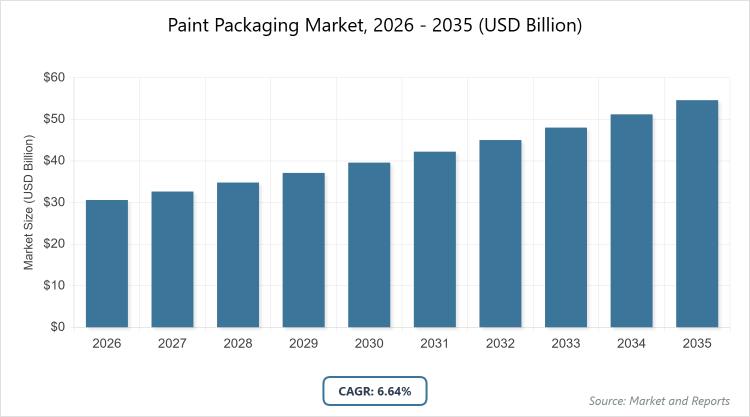
According to MarketnReports, the global Paint Packaging Market size was estimated at USD 30.62 billion in 2025 and is expected to reach USD 58.23 billion by 2035, growing at a CAGR of 6.64% from 2026 to 2035. Paint Packaging Market is driven by rising demand in construction and automotive sectors alongside sustainable packaging innovations.What are the Key Insights of Paint Packaging Market?
- The global Paint Packaging Market was valued at USD 30.62 billion in 2025 and is projected to reach USD 58.23 billion by 2035.
- The Paint Packaging Market is anticipated to grow at a CAGR of 6.64% during the forecast period from 2026 to 2035.
- The Paint Packaging Market is driven by increasing construction activities, demand for sustainable materials, and growth in automotive coatings.
- The metal material segment dominates with a 36% share due to its durability, corrosion resistance, and recyclability, ideal for protecting paints from environmental factors.
- The plastic material segment is the second most dominant owing to its lightweight nature and cost-effectiveness, enabling easier transportation and handling.
- The cans product type segment dominates with a 50% share as it provides secure, leak-proof storage for various paint volumes, standard in the industry.
- The pails product type segment is the second most dominant for larger quantities, offering robustness for industrial use.
- The architectural paints end-use segment dominates with a 60% share driven by residential and commercial construction booms requiring decorative coatings.
- Asia Pacific dominates the Paint Packaging Market with a 45% share driven by rapid urbanization, infrastructure investments, and high paint consumption in China and India.
What is the Industry Overview of Paint Packaging Market?
The Paint Packaging Market encompasses containers and materials designed to store, transport, and dispense paints and coatings, ensuring product integrity, safety, and user convenience while complying with environmental regulations. Market definition includes metal cans, plastic pails, glass bottles, and flexible pouches made from materials like aluminum, PET, and paperboard, tailored for architectural, industrial, and specialty applications to prevent leakage, corrosion, and contamination, supporting industries such as construction, automotive, and marine where durable, recyclable, and innovative designs enhance shelf life and reduce waste.
What are the Market Dynamics of Paint Packaging Market?
Growth Drivers
The surge in global construction and infrastructure projects, particularly in emerging economies, boosts demand for architectural paints, necessitating robust packaging to ensure product quality during storage and transit. Rising consumer preference for eco-friendly and low-VOC paints drives innovation in sustainable materials like recyclable metals and biodegradable plastics, aligning with environmental regulations and enhancing market appeal. Additionally, the automotive industry's growth, with increasing vehicle production and refinishing needs, propels the use of specialized coatings, further supported by e-commerce expansion requiring durable, lightweight packaging for efficient shipping.
Restraints
Fluctuating raw material prices, such as steel and polymers, increase production costs and challenge profitability for manufacturers in price-sensitive markets. Stringent environmental regulations on plastic usage and VOC emissions restrict traditional packaging options, requiring costly R&D for compliant alternatives. Moreover, supply chain disruptions from geopolitical tensions affect material availability, delaying deliveries and impacting market stability.
Opportunities
Advancements in smart packaging, incorporating QR codes and tamper-evident features, offer differentiation and improved consumer engagement in DIY segments. Emerging markets in Asia-Pacific and Latin America provide expansion potential through localized production and partnerships, capitalizing on urbanization trends. The shift toward circular economy practices encourages development of reusable and refillable containers, attracting investments in green technologies.
Challenges
Intense competition from alternative materials like composites pressures traditional segments, demanding continuous innovation to maintain market share. Achieving compliance with diverse regional standards for food-contact safety in packaging coatings adds complexity and costs. Balancing sustainability with performance, such as barrier properties against moisture, remains a technical hurdle amid rising eco-demands.
Paint Packaging Market: Report Scope
| Report Attributes | Report Details |
| Report Name | Paint Packaging Market |
| Market Size 2025 | USD 30.62 Billion |
| Market Forecast 2035 | USD 58.23 Billion |
| Growth Rate | CAGR of 6.64% |
| Report Pages | 220 |
| Key Companies Covered |
Kian Joo Can Factory Berhad, Mold-Tek Packaging Limited, Sonoco Products Company, The Sherwin-Williams Company, Axalta Coating Systems, Huber Packaging Group GmbH, Ball Corporation, Smurfit Kappa, Mondi Plc, BASF, and Others. |
| Segments Covered | By Material, By Product Type, By End-Use, and By Region. |
| Regions Covered | North America, Europe, Asia Pacific (APAC), Latin America, and The Middle East and Africa (MEA) |
| Base Year | 2025 |
| Historical Year | 2020 - 2024 |
| Forecast Year | 2026 - 2035 |
| Customization Scope | Avail customized purchase options to meet your exact research needs. |
What is the Market Segmentation of Paint Packaging Market?
The Paint Packaging Market is segmented by material, product type, end-use, and region.By Material Segment: The metal segment dominates due to its superior strength and recyclability, essential for long-term paint preservation, driving the market by meeting industrial durability needs and supporting eco-friendly initiatives. The plastic segment is the second most dominant, offering versatility and reduced weight, contributing to growth through cost savings in logistics and appeal in consumer markets.
By Product Type Segment: The cans segment leads as it ensures airtight sealing and ease of use, propelling market expansion by standardizing packaging for efficient distribution in construction and automotive sectors. The pails segment follows as the second dominant, suitable for bulk storage, fostering growth via applications in large-scale industrial projects.
By End-Use Segment: The architectural paints segment holds dominance with widespread use in building and renovation, accelerating market demand by addressing aesthetic and protective needs in residential areas. The industrial coatings segment ranks second, driven by manufacturing requirements, boosting the market with specialized protective solutions.
What are the Recent Developments in Paint Packaging Market?
- In February 2025, PPG launched non-BPA PPG HOBA Pro 2848 internal coatings for aluminum bottles, expanding sustainable options for beverage and paint applications.
- In February 2025, Actega introduced barrier coatings for sustainable packaging, enhancing recyclability in food and paint sectors.
- In October 2024, DYRUP paint by PPG launched bag-in-a-box packaging made from 75% recyclable materials, promoting eco-friendly solutions.
- In September 2024, Vibrantz Technologies opened a facility for Pearls sustainable tinting, advancing efficient coloring for water-based paints.
- In August 2024, Stahl acquired Weilburger Graphics, strengthening its packaging coatings portfolio.
What is the Regional Analysis of Paint Packaging Market?
Asia Pacific to dominate the global market.Asia Pacific commands the largest share, led by China with explosive construction growth, urbanization, and government infrastructure investments driving high paint consumption and innovative packaging demand.
North America follows with steady demand, dominated by the US through emphasis on eco-friendly low-VOC paints and sustainable containers amid environmental consciousness.
Europe shows robust growth, with Germany pioneering advanced coatings and recyclable materials under EU sustainability directives.
Latin America expands moderately, with Brazil focusing on industrial and decorative paints amid economic development.
The Middle East and Africa region grows through UAE's infrastructure projects and increasing adoption of protective coatings.
What are the Key Market Players and Strategies of Paint Packaging Market?
Kian Joo Can Factory Berhad focuses on exporting metal cans and PET bottles across ASEAN, leveraging regional plants for cost-effective production and expanding into eco-friendly formats.
Mold-Tek Packaging Limited specializes in injection-molded containers with in-mold labeling, pursuing ISO certifications and stock exchange listings to enhance credibility and market reach.
Sonoco Products Company diversifies protective and consumer packaging, operating globally to serve multiple industries with paperboard and rigid containers.
The Sherwin-Williams Company introduces lightweight recyclable plastics for low-VOC paints, utilizing vast distribution networks for professional and retail segments.
Axalta Coating Systems offers high-performance coatings for automotive and industrial uses, branding like Cromax to target OEM and refinishing markets.
Huber Packaging Group GmbH emphasizes sustainable metal packaging, investing in tamper-evident features for European markets.
Ball Corporation innovates aluminum cans, partnering for recyclable solutions in beverage and paint sectors.
Smurfit Kappa develops paper-based and flexible packaging, focusing on circular economy principles for construction applications.
Mondi Plc advances bag-in-box and pouches, collaborating on bio-based materials for environmental compliance.
BASF launches eco-packaging with Nippon Paint, integrating barrier additives for sustainable industrial solutions.
What are the Market Trends of Paint Packaging Market?
- Shift to sustainable and eco-friendly materials like recyclable and biodegradable options.
- Adoption of lightweight solutions using composites to reduce transportation costs.
- Integration of smart features such as QR codes and NFC tags for consumer engagement.
- Rise in flexible formats like pouches and bag-in-box for portability.
- Demand for water-based and low-VOC compatible packaging with strong barriers.
- Custom and aesthetic designs enhancing brand appeal.
- Digital printing for personalized packaging.
- Growth in DIY and home improvement driving user-friendly containers.
- Tamper-proof and spill-proof innovations for safety.
- Increased use of metal and composite cans for durability.
What are the Market Segments and their Subsegment Covered in the Paint Packaging Market Report?
By Material- Metal
- Plastic
- Glass
- Paper & Paperboard
- Composites
- Aluminum
- Tinplate
- PET
- HDPE
- PP
- Others
- Cans
- Pails
- Drums
- Bottles
- Pouches
- Tubes
- Bag-in-Box
- Aerosol Cans
- Jars
- Buckets
- Others
- Architectural Paints
- Industrial Coatings
- Automotive Paints
- Marine Coatings
- Wood Finishes
- Protective Coatings
- Decorative Paints
- Powder Coatings
- Specialty Coatings
- General Industrial
- Others
By Region
- North America
- U.S.
- Canada
- Europe
- UK
- Germany
- France
- Rest of Europe
- Asia Pacific
- China
- India
- Japan
- Rest of Asia Pacific
- Latin America
- Brazil
- Mexico
- Rest of Latin America
- Middle East & Africa
- UAE
- South Africa
- Rest of Middle East & Africa
Frequently Asked Questions
Paint Packaging Market involves containers and materials for storing and dispensing paints, ensuring protection and sustainability.
Construction growth, sustainability trends, and automotive demand will influence growth.
The market is projected to reach USD 58.23 billion by 2035.
The CAGR is expected to be 6.64%.
Asia Pacific will contribute notably due to urbanization and infrastructure.
Major players include Kian Joo Can Factory Berhad, Mold-Tek Packaging Limited, and Sonoco Products Company.
The report provides size, trends, segments, players, and forecasts.
Stages include raw material sourcing, manufacturing, design, distribution, and recycling.
Trends favor eco-friendly and smart packaging, with preferences for lightweight, recyclable options.
Regulations on plastics and VOCs push sustainable innovations.