
Orthopedic Prosthetic Devices Market Size, Share and Trends 2026 to 2035
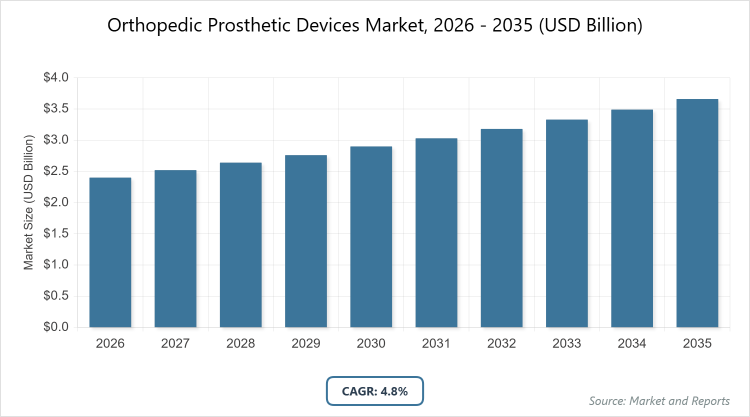
According to MarketnReports, the global orthopedic prosthetic devices market size was estimated at USD 2.4 billion in 2025 and is expected to reach USD 3.8 billion by 2035, growing at a CAGR of 4.8% from 2026 to 2035. Rising incidences of amputations and advancements in bionic technologies.
What are the Key Insights into Orthopedic Prosthetic Devices Market?
- Global orthopedic prosthetic devices market size was USD 2.4 billion in 2025 and is projected to reach USD 3.8 billion by 2035.
- The market is anticipated to grow at a CAGR of 4.8% from 2026 to 2035.
- The market is driven by increasing amputations from diabetes and trauma, technological innovations in 3D printing, and rising demand for advanced bionic prosthetics.
- The lower extremity prosthetics segment dominates the product type with around 50% share, owing to higher incidence of lower limb amputations from vascular diseases and accidents, providing essential mobility solutions.
- The electric powered segment leads the technology with approximately 47% market share, due to its advanced control systems offering natural movement and user-friendly interfaces for daily activities.
- The hospitals segment is dominant in end-user with about 40% share, as it serves as primary centers for surgical fittings and rehabilitation, ensuring integrated care.
- North America dominates the regional market with around 35% share, driven by advanced healthcare infrastructure, high R&D investments, and favorable reimbursement policies in the United States.
What is the Orthopedic Prosthetic Devices?
Industry Overview
The orthopedic prosthetic devices market encompasses the design, manufacturing, and distribution of artificial limbs and supportive apparatuses that replace or enhance missing or impaired body parts, primarily focusing on lower and upper extremities like hips, knees, ankles, and shoulders, utilizing materials such as carbon fiber, titanium, and advanced polymers for improved functionality, comfort, and durability in applications ranging from trauma recovery to congenital defects, often incorporating technologies like myoelectric control, 3D printing, and sensors for natural movement and integration with the human body. This industry caters to patients requiring rehabilitation through customized solutions that promote mobility, independence, and quality of life, supported by collaborations between engineers, clinicians, and manufacturers for innovation in bionic and robotic prosthetics.
Market definition includes all devices intended for orthopedic replacement or support, excluding orthotics like braces or insoles, and it reflects the growing emphasis on personalized, tech-enabled solutions amid aging populations and medical advancements.
What are the Market Dynamics Affecting Orthopedic Prosthetic Devices?
Growth Drivers
The growth drivers in the orthopedic prosthetic devices market are primarily propelled by the rising prevalence of chronic conditions like diabetes and obesity, leading to increased amputations, with over 185,000 annual cases in the US alone, necessitating advanced prosthetics for mobility restoration and quality of life improvement through innovations in lightweight materials and sensor technologies that enhance user comfort and functionality. This is complemented by aging populations globally, where geriatric individuals require durable, customizable devices for joint replacements and limb support, supported by healthcare investments in rehabilitation. Furthermore, technological advancements such as 3D printing for personalized fittings reduce costs by 20-30% and production time, fostering adoption in emerging markets for affordable solutions.
Restraints
Restraints in the orthopedic prosthetic devices market include high costs of advanced bionic and robotic prosthetics, often exceeding USD 50,000, limiting accessibility in low-income regions and for uninsured patients, thereby restricting market penetration despite clinical benefits. Regulatory delays for approval of new technologies, requiring extensive clinical trials, hinder innovation timelines. Additionally, reimbursement variations across countries create financial barriers, with inadequate coverage in developing areas slowing adoption.
Opportunities
Opportunities in the orthopedic prosthetic devices market stem from the integration of AI and IoT for smart prosthetics that provide real-time feedback and adaptive control, appealing to younger amputees seeking enhanced functionality, while partnerships with tech firms accelerate development. The expansion into emerging markets offers potential for affordable, 3D-printed devices tailored to local needs, supported by government health initiatives. Moreover, sustainable materials like biodegradable polymers attract eco-conscious consumers, enabling premium pricing in developed regions.
Challenges
Challenges in the orthopedic prosthetic devices market involve achieving biocompatibility and long-term durability in diverse climates, requiring rigorous testing that elevates R&D costs. Supply chain dependencies for rare materials like titanium create volatility, especially amid geopolitical tensions. Additionally, patient adaptation issues, such as phantom pain or fitting discomfort, demand ongoing innovation in ergonomics, complicating market entry for new players.
Orthopedic Prosthetic Devices Market: Report Scope
| Report Attributes | Report Details |
| Report Name | Orthopedic Prosthetic Devices Market |
| Market Size 2025 | USD 2.4 Billion |
| Market Forecast 2035 | USD 3.8 Billion |
| Growth Rate | CAGR of 4.8% |
| Report Pages | 220 |
| Key Companies Covered |
Ottobock SE & Co. KGaA, Ossur Corporate, Blatchford Group, Zimmer Biomet Holdings Inc., Steeper Inc., and Others |
| Segments Covered | By Product Type, By Technology, By End-User, and By Region |
| Regions Covered | North America, Europe, Asia Pacific (APAC), Latin America, and The Middle East and Africa (MEA) |
| Base Year | 2025 |
| Historical Year | 2020 – 2024 |
| Forecast Year | 2026 – 2035 |
| Customization Scope | Avail customized purchase options to meet your exact research needs. |
How is the Orthopedic Prosthetic Devices Market Segmented?
The Orthopedic Prosthetic Devices market is segmented by product type, technology, end-user, and region.
Based on Product Type Segment, the lower extremity prosthetics subsegment is the most dominant, holding around 50% share, due to its critical role in mobility restoration for common amputations, which drives the market by addressing high demand from diabetes and trauma cases with advanced designs for better gait. The upper extremity prosthetics subsegment is the second most dominant, with approximately 30% share, as it enhances daily functions for arm loss, contributing to market growth through myoelectric innovations for precise control.
Based on the Technology Segment, the electric powered subsegment is the most dominant, capturing about 47% share, attributed to its user-controlled movements via sensors, which propels the market by improving independence and adoption in rehabilitation. The conventional subsegment is the second most dominant, with around 25% share, owing to its affordability, helping to drive the market in cost-sensitive regions.
Based on the end-user segment, the hospitals subsegment is the most dominant, with roughly 40% share, facilitated by surgical expertise and post-op care, driving the market by ensuring proper fittings and patient education. The prosthetic clinics subsegment is the second most dominant, holding about 30% share, propelled by specialized customizations, which contribute to market expansion through focused services.
What are the Recent Developments in Orthopedic Prosthetic Devices Market?
- In 2025, Aspen Medical Products acquired Advanced Orthopaedics, expanding its bracing and prosthetic portfolio for global reach.
- In 2024, Stryker developed a lightweight composite limb, reducing weight by 22% for better user comfort.
- In 2023, Medtronic launched pediatric designs with adjustable features for growing children, increasing accessibility.
- In 2022, Hanger Inc. partnered with rehabilitation centers, expanding service coverage by 18% in underserved areas.
How Does Regional Analysis Impact Orthopedic Prosthetic Devices Market?
- North America to dominate the global market.
North America leads the orthopedic prosthetic devices market with a substantial share, driven by advanced healthcare and high amputation rates from diabetes; the United States dominates this region, with robust R&D and reimbursement policies supporting innovation, contributing to growth through access to cutting-edge bionic devices.
Europe follows closely, benefiting from strong welfare systems and aging populations; Germany stands out as the dominating country, leveraging engineering expertise for high-quality prosthetics, supporting market expansion via EU funding for research.
Asia Pacific emerges as the fastest-growing region, propelled by rising healthcare investments; China dominates here, with manufacturing advancements lowering costs, driving growth through affordable access in populous areas.
Latin America shows steady progress, influenced by improving medical facilities; Brazil is the dominating country, where trauma cases drive demand, aiding development via local production.
The Middle East and Africa represent emerging opportunities, boosted by international aid; the UAE dominates, with modern hospitals adopting advanced prosthetics, propelling growth through expatriate healthcare.
Who are the Key Market Players in Orthopedic Prosthetic Devices?
- Ottobock SE & Co. KGaA focuses on bionic prosthetics with sensor technology, employing R&D for user-centric designs and global partnerships for distribution.
- Ossur Corporate specializes in lightweight carbon fiber limbs, utilizing athlete endorsements and innovations in socket comfort for active users.
- Blatchford Group offers modular systems, adopting 3D printing for customization and sustainability initiatives to reduce waste.
- Zimmer Biomet Holdings Inc. integrates robotics in joint prosthetics, with strategies involving clinical trials and acquisitions for tech enhancements.
- Steeper Inc. targets upper extremity devices, employing AI for control systems and collaborations for pediatric solutions.
What are the Market Trends Shaping Orthopedic Prosthetic Devices?
- Adoption of 3D printing for customized, cost-effective prosthetics.
- Integration of AI and sensors for smart, adaptive devices.
- Growth in lightweight composites for reduced user fatigue.
- Rise in myoelectric and bionic technologies for natural movement.
- Focus on sustainable materials and recycling programs.
- Expansion of pediatric and sports-specific prosthetics.
- Increase in osseointegration for better stability and comfort.
What Market Segments and Subsegments are Covered in the Orthopedic Prosthetic Devices Report?
By Product Type
- Upper Extremity Prosthetics
- Lower Extremity Prosthetics
- Liners
- Sockets
- Modular Components
- Hip Prosthetics
- Knee Prosthetics
- Ankle Prosthetics
- Shoulder Prosthetics
- Elbow Prosthetics
- Others
By Technology
- Conventional
- Electric Powered
- Hybrid Orthopedic Prosthetics
- Myoelectric Prosthetics
- 3D Printed Prosthetics
- Bionic Prosthetics
- Osseointegration Prosthetics
- Robotic Prosthetics
- Smart Sensor-Integrated
- AI-Enhanced Prosthetics
- Others
By End-User
- Hospitals
- Prosthetic Clinics
- Rehabilitation Centers
- Ambulatory Surgical Centers
- Home Care Settings
- Research Institutes
- Specialty Clinics
- Government Facilities
- Academic Institutions
- Diagnostic Centers
- Others
By Region
- North America
- U.S.
- Canada
- Europe
- UK
- Germany
- France
- Rest of Europe
- Asia Pacific
- China
- India
- Japan
- Rest of Asia Pacific
- Latin America
- Brazil
- Mexico
- Rest of Latin America
- Middle East & Africa
- UAE
- South Africa
- Rest of Middle East & Africa
Frequently Asked Questions
Orthopedic prosthetic devices are artificial limbs or supports that replace or enhance missing body parts, aiding mobility and function for amputees or those with impairments.
Key factors include aging populations, rising amputations from chronic diseases, technological advancements in bionics, and increasing healthcare investments.
The orthopedic prosthetic devices market is projected to grow from approximately USD 2.5 billion in 2026 to USD 3.8 billion by 2035.
The CAGR value is expected to be 4.8% during 2026-2035.
North America will contribute notably, driven by advanced healthcare and R&D.
Major players include Ottobock SE & Co. KGaA, Ossur Corporate, Blatchford Group, Zimmer Biomet Holdings Inc., and Steeper Inc.
The report provides comprehensive insights on market size, trends, segments, regional analysis, key players, and forecasts from 2026 to 2035.
Stages include raw material sourcing, design and manufacturing, testing and certification, distribution, fitting and rehabilitation, and after-sales support.
Trends are shifting toward smart, 3D-printed devices, with preferences for lightweight, customizable prosthetics enhancing user comfort and functionality.
Regulatory factors include FDA approvals for safety, while environmental factors involve sustainable materials to reduce waste in production.