
Open Source Intelligence (OSINT) Market Size, Share and Trends 2026 to 2035
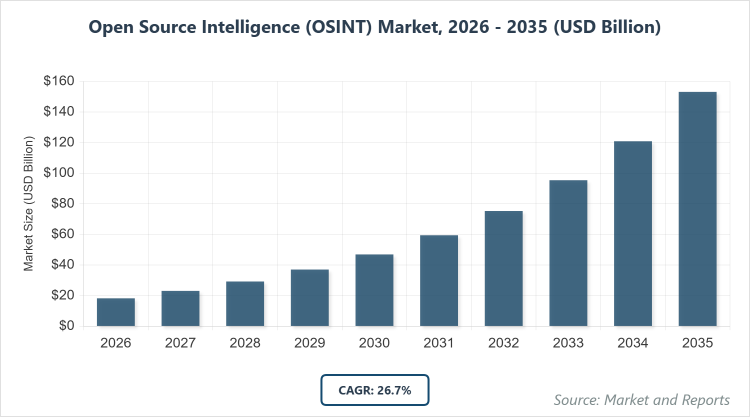
According to MarketnReports, the global open source intelligence (OSINT) market size was estimated at USD 18.2 billion in 2025 and is expected to reach USD 133.6 billion by 2035, growing at a CAGR of 26.7% from 2026 to 2035. Driven by increasing cyber threats and demand for real-time data analytics.
What are the Key Insights into Open Source Intelligence (OSINT) Market?
- Global open source intelligence (OSINT) market size was USD 18.2 billion in 2025 and is projected to reach USD 133.6 billion by 2035.
- The market is anticipated to grow at a CAGR of 26.7% from 2026 to 2035.
- The market is driven by rising cybersecurity threats, adoption of AI for data analysis, and increasing demand for competitive intelligence.
- The social media analytics segment dominates the technique with around 35% share, owing to the vast amount of user-generated data for real-time insights and sentiment tracking.
- The cloud segment leads the deployment type with approximately 60% market share, due to its scalability, cost-efficiency, and ease of integration for remote access.
- The military & defense intelligence agencies segment is dominant in end-use with about 30% share, as it leverages OSINT for threat assessment and strategic planning in secure environments.
- North America dominates the regional market with around 35% share, driven by advanced technological infrastructure, high R&D investments, and strong government focus on cybersecurity in the United States.
What is the Open Source Intelligence (OSINT)?
Industry Overview
The open source intelligence (OSINT) market involves the collection, analysis, and dissemination of publicly available information from sources like social media, news, websites, and databases to support decision-making in security, business, and government sectors, utilizing tools for data scraping, sentiment analysis, and geospatial mapping to generate actionable insights for threat detection, market research, and competitive intelligence, while emphasizing ethical practices and privacy compliance in an era of big data and digital footprints. This industry integrates AI, machine learning, and cloud platforms for efficient processing of vast unstructured data, catering to users requiring non-classified intelligence for strategic advantages.
Market definition encompasses all software, services, and platforms dedicated to OSINT gathering and analysis, excluding classified or proprietary intelligence methods, and it reflects the growing reliance on digital sources for cost-effective, timely information amid global connectivity.
What are the Market Dynamics Affecting Open Source Intelligence (OSINT)?
Growth Drivers
The growth drivers in the open source intelligence market are primarily fueled by the exponential increase in digital data from social media, news outlets, and public records, enabling organizations to harness AI and machine learning for automated analysis that provides real-time insights into threats, market trends, and competitive landscapes, particularly in cybersecurity where OSINT helps detect vulnerabilities before exploitation, reducing response times by up to 50% in incident management. This is supported by government initiatives for national security and counter-terrorism, where OSINT complements classified intelligence for cost-effective monitoring, as seen in programs like the U.S. ODNI’s focus on open data.
Furthermore, the rise of corporate intelligence needs in global business environments drives adoption for risk assessment and due diligence, fostering expansion through data-driven decision-making.
Restraints
Restraints in the open source intelligence market include data privacy regulations like GDPR and CCPA, which limit the collection and processing of public information, requiring costly compliance measures that hinder scalability for small providers. The abundance of misinformation and deepfakes in open sources poses accuracy challenges, necessitating advanced verification tools that increase operational expenses. Additionally, high initial investments for AI platforms restrict entry for startups in competitive landscapes.
Opportunities
Opportunities in the open source intelligence market arise from the integration of blockchain for secure data sharing and verification, enabling trusted OSINT platforms for collaborative intelligence in defense and finance sectors. The expansion of 5G and IoT generates more real-time data sources, offering avenues for mobile OSINT apps in law enforcement. Moreover, emerging markets in Africa present potential for affordable, localized tools through partnerships, capitalizing on digital growth for security applications.
Challenges
Challenges in the open source intelligence market involve ethical concerns over privacy invasion from extensive data scraping, requiring balanced frameworks to avoid backlash and legal issues. Rapid evolution of online platforms changes data availability, demanding constant tool updates that strain resources. Additionally, cybersecurity threats to OSINT tools themselves pose risks, necessitating robust protections for sensitive analyses.
Open Source Intelligence (OSINT) Market: Report Scope
| Report Attributes | Report Details |
| Report Name | Open Source Intelligence (OSINT) Market |
| Market Size 2025 | USD 18.2 Billion |
| Market Forecast 2035 | USD 133.6 Billion |
| Growth Rate | CAGR of 26.7% |
| Report Pages | 220 |
| Key Companies Covered |
Palantir Technologies, Thales Group, Verint Systems, Recorded Future, Babelstreet, and Others |
| Segments Covered | By Technique, By Deployment Type, By End-Use, and By Region |
| Regions Covered | North America, Europe, Asia Pacific (APAC), Latin America, and The Middle East and Africa (MEA) |
| Base Year | 2025 |
| Historical Year | 2020 – 2024 |
| Forecast Year | 2026 – 2035 |
| Customization Scope | Avail customized purchase options to meet your exact research needs. |
How is the Open Source Intelligence (OSINT) Market Segmented?
The Open Source Intelligence (OSINT) market is segmented by technique, deployment type, end-use, and region.
Based on the Technique Segment, the social media analytics subsegment is the most dominant, holding around 35% share, due to its ability to process vast user-generated content for sentiment and trend insights, which drives the market by enabling proactive threat detection and market research in real-time. The security analytics subsegment is the second most dominant, with approximately 25% share, as it focuses on vulnerability identification, contributing to market growth through enhanced cybersecurity applications.
Based on the Deployment Type Segment, the cloud subsegment is the most dominant, capturing about 60% share, attributed to its scalability and remote access for collaborative intelligence, which propels the market by reducing costs for global operations. The on-premises subsegment is the second most dominant, with around 30% share, owing to data security needs in sensitive sectors, helping to drive the market through compliance in defense.
Based on End-Use Segment, the military & defense intelligence agencies subsegment is the most dominant, with a roughly 30% share, facilitated by strategic OSINT for national security, driving the market by integrating with classified data for comprehensive analysis. The private businesses subsegment is the second most dominant, holding about 25% share, propelled by competitive intelligence needs, which contribute to market expansion through business decision-making.
What are the Recent Developments in Open Source Intelligence (OSINT) Market?
- In November 2025, Palantir Technologies acquired a cybersecurity startup to enhance its OSINT platform with AI-driven threat detection for government clients.
- In October 2025, Thales Group launched a new geospatial analytics tool for real-time monitoring, targeting defense and law enforcement sectors.
- In June 2025, Recorded Future partnered with a major tech firm to integrate blockchain for secure OSINT data sharing in financial services.
- In April 2025, Verint Systems introduced advanced social media analytics features with deepfake detection, complying with new privacy regulations.
How Does Regional Analysis Impact Open Source Intelligence (OSINT) Market?
- North America to dominate the global market.
North America leads the open source intelligence market with around 35% share, driven by advanced tech infrastructure and high cybersecurity investments; the United States dominates this region, where government agencies like the ODNI and private firms leverage OSINT for national security, contributing to growth through R&D and policy support.
Europe follows with steady expansion, benefiting from stringent data regulations; Germany is the dominating country, leveraging its tech hubs for industrial OSINT in manufacturing, supporting market progress via EU privacy laws.
Asia Pacific emerges as the fastest-growing region, propelled by digitalization; China dominates here, with state-backed surveillance driving OSINT tools, fostering growth through massive data volumes.
Latin America shows moderate development, influenced by economic growth; Brazil is the dominating country, where cybersecurity needs boost OSINT for businesses, aiding expansion via regional partnerships.
The Middle East and Africa represent emerging opportunities, boosted by security concerns; the UAE dominates, with investments in smart cities integrating OSINT for defense, propelling growth through innovation hubs.
Who are the Key Market Players in Open Source Intelligence (OSINT)?
- Palantir Technologies focuses on AI-integrated platforms for big data OSINT, employing government contracts and acquisitions for enhanced analytics capabilities.
- Thales Group specializes in geospatial and security OSINT, utilizing R&D in AI for defense applications and global partnerships for market expansion.
- Verint Systems offers social media monitoring tools, adopting deep learning for sentiment analysis and compliance features for regulated sectors.
- Recorded Future targets threat intelligence, with strategies involving machine learning for predictive insights and collaborations for data enrichment.
- Babelstreet provides multilingual OSINT, employing location-based analytics and integrations for law enforcement and corporate users.
What are the Market Trends Shaping Open Source Intelligence (OSINT)?
- Integration of AI and ML for automated data analysis and threat prediction.
- Growth in social media and video analytics for real-time insights.
- Adoption of blockchain for secure and verifiable data sharing.
- Rise in cloud deployment for scalable, collaborative OSINT platforms.
- Focus on ethical OSINT with privacy-compliant tools.
- Expansion of geospatial and image analytics for location-based intelligence.
- Increase in hybrid models combining OSINT with proprietary data.
What Market Segments and Subsegments are Covered in the Open Source Intelligence (OSINT) Report?
By Technique
- Text Analytics
- Video Analytics
- Social Media Analytics
- Geospatial Analytics
- Security Analytics
- Image Analytics
- Big Data Analytics
- Sentiment Analysis
- Web Scraping
- Network Intelligence
- Others
By Deployment Type
- Cloud
- On-Premises
- Hybrid
- SaaS
- Managed Services
- Others
By End-Use
- Government Intelligence Agencies
- Military & Defense Intelligence Agencies
- Cybersecurity Organizations
- Law Enforcement Agencies
- Private Businesses
- Financial Services
- Media & Entertainment
- Healthcare
- Transportation & Logistics
- Energy & Utilities
- Others
By Region
- North America
- U.S.
- Canada
- Europe
- UK
- Germany
- France
- Rest of Europe
- Asia Pacific
- China
- India
- Japan
- Rest of Asia Pacific
- Latin America
- Brazil
- Mexico
- Rest of Latin America
- Middle East & Africa
- UAE
- South Africa
- Rest of Middle East & Africa
Chapter 1. Preface
Chapter 2. Executive Summary
Chapter 3. Global Open Source Intelligence (OSINT) Market - Industry Analysis
Chapter 4. Global Open Source Intelligence (OSINT) Market- Competitive Landscape
Chapter 5. Global Open Source Intelligence (OSINT) Market - Technique Analysis
Chapter 6. Global Open Source Intelligence (OSINT) Market - Deployment Type Analysis
Chapter 7. Global Open Source Intelligence (OSINT) Market - End-Use Analysis
Chapter 8. Open Source Intelligence (OSINT) Market - Regional Analysis
Chapter 9. Company Profiles
Frequently Asked Questions
Open source intelligence (OSINT) refers to the collection and analysis of publicly available information from sources like social media, news, and databases for decision-making in security and business.
Key factors include cyber threat proliferation, AI advancements, regulatory compliance, and demand for competitive intelligence.
The open source intelligence (OSINT) market is projected to grow from approximately USD 22 billion in 2026 to USD 133.6 billion by 2035.
The CAGR value is expected to be 26.7% during 2026-2035.
North America will contribute notably, driven by technological leadership and security investments.
Major players include Palantir Technologies, Thales Group, Verint Systems, Recorded Future, and Babelstreet.
The report provides comprehensive analysis on size, trends, segments, regions, players, and forecasts from 2026 to 2035.
Stages include data collection, processing and analysis, insight generation, reporting, and application in decision-making.
Trends are evolving toward AI-driven automation and ethical data use, with preferences for cloud-based, real-time platforms.
Regulatory factors include data privacy laws like GDPR, while environmental factors involve sustainable data centers for cloud OSINT.