
Online Pharmacy Market Size, Share and Trends 2026 to 2035
According to MarketnReports, the global online pharmacy market size was estimated at USD 120 billion in 2025 and is expected to reach USD 440 billion by 2035, growing at a CAGR of 14% from 2026 to 2035. Online Pharmacy Market is driven by increasing digital health adoption and convenience in medication delivery.
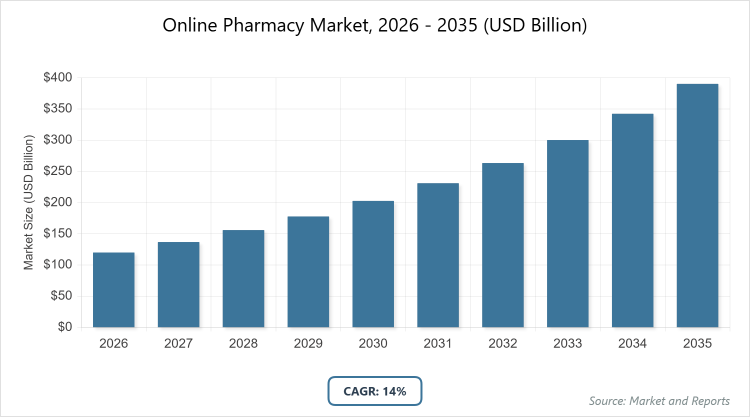
What are the Key Insights of the Online Pharmacy Market?
- The global online pharmacy market size was estimated at USD 120 billion in 2025 and is expected to reach USD 440 billion by 2035.
- The global online pharmacy market is expected to grow at a CAGR of 14% from 2026 to 2035.
- The online pharmacy market is driven by rising internet penetration, increasing chronic disease prevalence, and consumer preference for convenient home delivery of medications.
- Prescription drugs dominate the drug type segment with a 60% share due to the growing adoption of e-prescriptions and telehealth services that facilitate secure access to controlled medications.
- Medications dominate the product segment with a 75% share as they form the core of online pharmacy offerings, supported by high demand for chronic illness treatments and efficient supply chains.
- North America dominates the regional segment with a 40% share owing to advanced digital infrastructure, high smartphone usage, and supportive regulations for online healthcare services.
What is the Online Pharmacy Industry Overview?
The online pharmacy market encompasses digital platforms that facilitate the purchase and delivery of prescription and over-the-counter medications, health products, and wellness items directly to consumers via websites or mobile applications. This market integrates e-commerce with healthcare services, allowing users to upload prescriptions, consult pharmacists virtually, and receive home deliveries, thereby enhancing accessibility and convenience. It includes a range of stakeholders from large retail chains to independent digital pharmacies, focusing on streamlining medication access while adhering to regulatory standards for safety and authenticity. The market definition refers to the virtual retailing of pharmaceutical products, excluding physical brick-and-mortar stores, and emphasizes secure transactions, e-prescriptions, and integration with telehealth services to meet evolving consumer needs for efficient healthcare solutions.
What are the Market Dynamics of the Online Pharmacy Market?
Growth Drivers
The primary growth drivers for the online pharmacy market include the surge in digital health adoption, fueled by widespread internet access and smartphone penetration, which enables convenient medication ordering and home delivery. The COVID-19 pandemic accelerated this shift by promoting contactless services, while the rising prevalence of chronic diseases like diabetes and hypertension increases demand for regular prescription refills through digital platforms. Additionally, advancements in e-prescription technologies and partnerships between pharmacies and telehealth providers enhance efficiency, reduce costs, and improve patient adherence, driving sustained market expansion.
Restraints
Key restraints in the online pharmacy market involve stringent regulatory frameworks and concerns over counterfeit medications, which can undermine consumer trust and limit market penetration in certain regions. Limited access to high-speed internet in rural areas restricts adoption, while data privacy issues and cybersecurity threats pose risks to sensitive health information. Furthermore, resistance from traditional brick-and-mortar pharmacies and varying international laws on cross-border sales create operational challenges, potentially slowing growth despite increasing demand for digital healthcare solutions.
Opportunities
Opportunities in the online pharmacy market arise from the integration of artificial intelligence and machine learning for personalized medication recommendations and predictive inventory management, enhancing user experience and operational efficiency. Expanding into emerging markets with growing middle-class populations and improving digital infrastructure offers untapped potential, while collaborations with insurance providers for seamless claims processing can boost accessibility. Moreover, the rise of wellness and preventive health trends opens avenues for diversifying product offerings beyond prescriptions to include supplements and health monitoring devices.
Challenges
Challenges facing the online pharmacy market include navigating complex regulatory environments that vary by country, which can delay market entry and increase compliance costs. Ensuring the authenticity and quality of medications to combat counterfeit drugs requires robust verification systems, while building consumer trust in digital platforms demands secure payment gateways and reliable delivery logistics. Additionally, competition from established retail giants and the need for continuous technological upgrades to handle data privacy concerns present ongoing hurdles for sustained growth.
Online Pharmacy Market: Report Scope
| Report Attributes | Report Details |
| Report Name | Online Pharmacy Market |
| Market Size 2025 | USD 120 Billion |
| Market Forecast 2035 | USD 440 Billion |
| Growth Rate | CAGR of 14% |
| Report Pages | 220 |
| Key Companies Covered | Amazon Pharmacy, CVS Health, Walgreens Boots Alliance, Walmart, Cigna Healthcare, and Others |
| Segments Covered | By Drug Type, By Platform, By Product, and By Region |
| Regions Covered | North America, Europe, Asia Pacific (APAC), Latin America, and The Middle East and Africa (MEA) |
| Base Year | 2025 |
| Historical Year | 2020 – 2024 |
| Forecast Year | 2026 – 2035 |
| Customization Scope | Avail customized purchase options to meet your exact research needs. |
What is the Market Segmentation of the Online Pharmacy Market?
The online pharmacy market is segmented by drug type, platform, product, and region.
Based on Drug Type Segment. Prescription drugs emerge as the most dominant subsegment, holding approximately 60% market share, driven by the increasing use of e-prescriptions and telehealth integrations that ensure secure and compliant access to essential medications for chronic conditions. This dominance stems from regulatory advancements allowing digital fulfillment of controlled substances, which significantly boosts market growth by improving patient convenience and adherence rates. The second most dominant is over-the-counter (OTC) drugs, with around 30% share, as they cater to immediate health needs without prescriptions, leveraging easy online browsing and quick delivery to drive impulse purchases and overall market expansion through broader consumer accessibility.
Based on Platform Segment. App-based platforms dominate with a 55% share, attributed to their user-friendly interfaces, real-time notifications, and seamless integration with mobile health apps, which enhance customer engagement and loyalty, thereby propelling market growth through higher repeat orders. Web-based platforms follow as the second dominant, capturing 35% share, due to their compatibility with desktops for detailed research and bulk purchases, supporting market expansion by attracting older demographics and facilitating complex transactions like insurance verifications.
Based on Product Segment. Medications lead as the dominant subsegment with 75% share, fueled by the core demand for prescription and OTC drugs, which drives market growth through efficient supply chains and digital fulfillment optimizing access to treatments. Health wellness and nutrition products rank second with 15% share, growing due to rising preventive health trends, contributing to market expansion by diversifying offerings and encouraging bundled purchases for holistic consumer health management.
What are the Recent Developments in the Online Pharmacy Market?
- In 2024, Amazon Pharmacy expanded same-day prescription delivery to Los Angeles and New York City, utilizing AI for faster processing, with plans to extend to 12 additional cities by year-end, enhancing accessibility and market penetration.
- In 2023, SHOP APOTHEKE EUROPE partnered with Galenica to form MediService Ltd in Switzerland, strengthening their online pharmacy presence and improving service integration for European consumers.
- In 2025, PlatinumRx raised $6 million in Series A funding to focus on affordable chronic-disease medications, enabling expansion of their online platform and AI-driven cost-reduction strategies.
What is the Regional Analysis of the Online Pharmacy Market?
North America to dominate the global market.
North America holds the largest share in the online pharmacy market, driven by advanced digital infrastructure, high internet penetration, and supportive regulations, with the United States as the dominating country due to major players like Amazon Pharmacy and widespread adoption of telehealth services.
Europe follows with significant growth, bolstered by e-prescription integrations and increasing digital health awareness, where Germany leads as the dominating country through established platforms like DocMorris and stringent quality controls.
Asia Pacific is the fastest-growing region, fueled by rising smartphone usage and expanding e-commerce, with India as the dominating country owing to platforms like PharmEasy and government initiatives promoting digital healthcare access.
Latin America shows emerging potential with improving internet access and demand for convenient medication delivery, led by Brazil as the dominating country through local expansions and partnerships with global e-pharmacy providers.
The Middle East and Africa exhibit gradual adoption, constrained by regulatory hurdles but growing through mobile health innovations, with South Africa dominating due to increasing online platforms and urban digital connectivity.
What are the Key Market Players and Strategies in the Online Pharmacy Market?
- Amazon Pharmacy. Amazon Pharmacy employs strategies focused on leveraging AI for same-day delivery expansions and integrating with Prime memberships to enhance customer loyalty, while partnering with healthcare providers for seamless e-prescriptions to drive market share growth.
- CVS Health. CVS Health emphasizes omnichannel integration, combining online platforms with in-store pickups and telehealth services, alongside investments in digital tools for personalized health recommendations to strengthen its competitive position.
- Walgreens Boots Alliance. Walgreens Boots Alliance pursues global expansion through acquisitions and digital innovations like mobile apps for prescription management, focusing on customer-centric strategies to improve accessibility and retention.
- Walmart. Walmart integrates online pharmacy with its e-commerce ecosystem, offering low-cost generics and same-day delivery powered by AI, targeting value-driven consumers to expand its market footprint.
- Cigna Healthcare. Cigna Healthcare focuses on insurance-integrated platforms for streamlined claims and home delivery, utilizing data analytics to personalize medication adherence programs and enhance patient outcomes.
What are the Market Trends in the Online Pharmacy Market?
- Integration of AI and machine learning for personalized medication recommendations and inventory management.
- Expansion of same-day and on-demand delivery services to enhance consumer convenience.
- Growing adoption of telepharmacy for virtual consultations and e-prescriptions.
- Rise in partnerships between online pharmacies and telehealth providers.
- Increased focus on data privacy and cybersecurity to build consumer trust.
- Diversification into wellness and preventive health products beyond traditional medications.
- Emphasis on sustainable packaging and eco-friendly delivery options.
What are the Market Segments and their Subsegments Covered in the Online Pharmacy Report?
By Drug Type
- Analgesics
- Antibiotics
- Antivirals
- Cardiovascular Drugs
- Dermatological Products
- Gastrointestinal Agents
- Neurological Drugs
- Respiratory Agents
- Hormonal Agents
- Anti-Inflammatory Drugs
- Others
By Platform
- App-based
- Web-based
- Hybrid
- Mobile Applications
- Desktop Platforms
- E-commerce Websites
- Telepharmacy Apps
- Online Portals
- Digital Health Platforms
- Virtual Consultations
- Others
By Product
- Medications
- Health Wellness and Nutrition
- Personal Care and Essentials
- Skincare Products
- Vitamins and Supplements
- Beauty Products
- Medical Devices
- Home Diagnostics
- Over-the-Counter Remedies
- Prescription Fulfillments
- Others
By Region
- North America
- U.S.
- Canada
- Europe
- UK
- Germany
- France
- Rest of Europe
- Asia Pacific
- China
- India
- Japan
- Rest of Asia Pacific
- Latin America
- Brazil
- Mexico
- Rest of Latin America
- Middle East & Africa
- UAE
- South Africa
- Rest of Middle East & Africa
Frequently Asked Questions
Online pharmacies are digital platforms that enable the purchase, prescription fulfillment, and delivery of medications and health products via websites or apps, ensuring convenient access to healthcare while complying with regulatory standards.
Key factors include rising internet penetration, increasing chronic disease prevalence, adoption of telehealth, regulatory support for e-prescriptions, and consumer demand for home delivery convenience.
The market is projected to grow from USD 140 billion in 2026 to USD 440 billion by 2035.
The CAGR is expected to be 14% during 2026-2035.
North America will contribute notably, driven by advanced infrastructure and high adoption rates.
Major players include Amazon Pharmacy, CVS Health, Walgreens Boots Alliance, Walmart, and Cigna Healthcare.
The report provides comprehensive analysis including market size, trends, segmentation, regional insights, key players, and forecasts from 2026 to 2035.
Stages include procurement of medications, digital platform development, prescription verification, order processing, logistics and delivery, and post-sale customer support.
Trends show a shift towards AI-personalized services, same-day deliveries, and wellness products, with consumers preferring mobile apps for convenience and privacy.
Factors include varying international regulations on prescription sales, data privacy laws like GDPR, and environmental concerns pushing for sustainable packaging in deliveries.