
Oil And Gas Analytics Market Size, Share and Trends 2026 to 2035
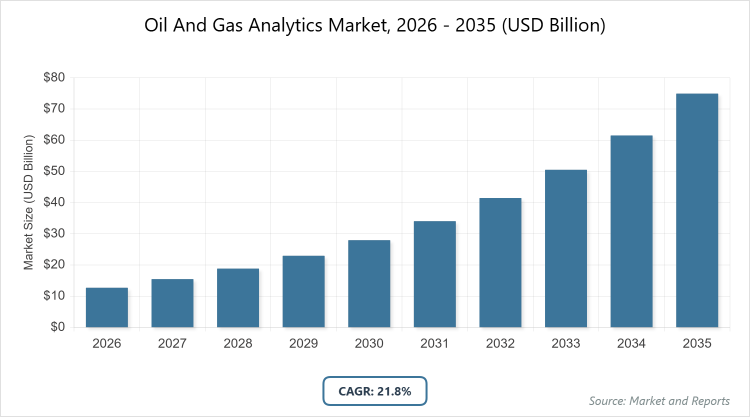
According to MarketnReports, the global Oil And Gas Analytics market size was estimated at USD 12.7 billion in 2025 and is expected to reach USD 91.25 billion by 2035, growing at a CAGR of 21.8% from 2026 to 2035. The Oil And Gas Analytics Market is driven by the increasing adoption of AI and big data for operational efficiency in the energy sector.
What are the Key Insights into Oil And Gas Analytics?
- The global Oil And Gas Analytics market was valued at USD 12.7 billion in 2025 and is projected to reach USD 91.25 billion by 2035.
- The market is expected to grow at a CAGR of 21.8% during the forecast period from 2026 to 2035.
- The market is driven by digital transformation, big data adoption, AI for predictive maintenance, and the need for operational efficiency amid volatile energy prices.
- In the type segment, predictive analytics dominates with a 40% share due to its ability to forecast equipment failures and optimize production, reducing downtime in high-cost operations.
- In the application segment, upstream operations dominate with a 45% share as it enables drilling optimization and reservoir management through data insights, critical for exploration efficiency.
- In the end-user segment, oil companies dominate with a 50% share owing to large-scale implementations for asset management and cost control in integrated operations.
- North America dominates the regional market with a 35% share, driven by the shale gas boom, advanced tech infrastructure, and high R&D investments in the US.
What is the Industry Overview of Oil And Gas Analytics?
The Oil And Gas Analytics market encompasses data-driven solutions that leverage advanced technologies like AI, machine learning, and big data to optimize operations across exploration, production, refining, and distribution in the energy industry, enabling predictive maintenance, risk assessment, and decision-making for enhanced efficiency and cost reduction. Market definition includes software and services that analyze vast datasets from sensors, drilling logs, and supply chains to provide actionable insights, focusing on real-time monitoring, asset management, and sustainability while addressing challenges in data integration, cybersecurity, and regulatory compliance for transforming traditional oil and gas operations into intelligent, agile systems.
What are the Market Dynamics of Oil And Gas Analytics?
Growth Drivers
The Oil And Gas Analytics market is propelled by the industry’s shift toward digitalization, where advanced analytics tools process massive datasets from IoT sensors and seismic surveys to predict reservoir performance and optimize drilling, reducing exploration costs by up to 20% and improving recovery rates in mature fields. Rising energy demand and volatile oil prices necessitate efficient operations, driving adoption of AI for supply chain forecasting and risk mitigation. Government regulations for emissions reduction encourage analytics for sustainability tracking, while partnerships between energy firms and tech companies accelerate innovation. Increasing focus on remote operations post-pandemic further boosts demand for real-time data platforms.
Restraints
High implementation costs for analytics platforms, including data integration and skilled personnel, limit adoption in small operators and developing regions, where legacy systems hinder seamless upgrades. Data privacy and cybersecurity concerns in handling sensitive operational data pose risks of breaches, eroding trust under regulations like GDPR. Fragmented data sources across upstream, midstream, and downstream create silos, reducing analytics accuracy. Volatility in oil prices affects investment in non-core technologies, while talent shortages in data science for energy-specific applications slow progress.
Opportunities
Opportunities emerge from integrating AI and machine learning for prescriptive analytics, enabling automated decision-making in real-time drilling and maintenance, attracting investments from major oil firms seeking competitive edges. Expansion into renewable energy analytics for hybrid operations offers growth as the industry diversifies. Partnerships with cloud providers for scalable solutions can lower barriers for SMEs. The rise of edge computing for remote sites opens niches in offshore and arctic explorations, while blockchain for secure data sharing enhances collaboration in joint ventures.
Challenges
Challenges include ensuring data quality from diverse sources like sensors and logs, requiring robust cleaning to avoid erroneous insights in high-stakes decisions. Rapid technological evolution demands continuous updates, straining IT infrastructures. Regulatory variations across countries complicate global deployments, while ethical concerns over AI bias in resource allocation pose risks. Geopolitical tensions disrupt supply chains for analytics hardware, adding uncertainty.
Oil And Gas Analytics Market: Report Scope
| Report Attributes | Report Details |
| Report Name | Oil And Gas Analytics Market |
| Market Size 2025 | USD 12.7 Billion |
| Market Forecast 2035 | USD 91.25 Billion |
| Growth Rate | CAGR of 21.8% |
| Report Pages | 220 |
| Key Companies Covered | Schlumberger Limited, Halliburton Company, IBM Corporation, SAP SE, Oracle Corporation, Accenture, Microsoft Corporation, Cisco Systems, Inc., and Others |
| Segments Covered | By Type, By Application, By End-User, and By Region |
| Regions Covered | North America, Europe, Asia Pacific (APAC), Latin America, and The Middle East and Africa (MEA) |
| Base Year | 2025 |
| Historical Year | 2020 – 2024 |
| Forecast Year | 2026 – 2035 |
| Customization Scope | Avail customized purchase options to meet your exact research needs. |
What is the Market Segmentation of Oil And Gas Analytics?
The Oil And Gas Analytics market is segmented by type, application, end-user, and region.
By Type. Predictive analytics is the most dominant subsegment, holding approximately 40% market share, due to its forecasting capabilities for equipment failures and production trends. This dominance drives the market by minimizing downtime and costs in volatile operations, enhancing profitability. Prescriptive analytics ranks as the second most dominant, with around 30% share, offering actionable recommendations, propelling growth through optimized decision-making in complex scenarios.
By Application. Upstream operations emerge as the most dominant subsegment, capturing about 45% share, primarily because it optimizes exploration and production through data-driven insights. This leads to market growth by improving recovery rates and reducing risks in high-capital activities. Midstream operations follow as the second most dominant, with roughly 25% share, for pipeline monitoring, driving the market via efficient transport and safety.
By End-User. Oil companies represent the most dominant subsegment at about 50% share, driven by integrated operations needing comprehensive analytics. This dominance accelerates market expansion through large-scale implementations for efficiency. Service providers rank second most dominant, holding around 20% share, offering outsourced analytics, contributing to growth via specialized expertise.
What are the Recent Developments in Oil And Gas Analytics?
- In January 2025, Schlumberger launched an AI platform for real-time drilling analytics, reducing non-productive time by 15%.
- In December 2024, Halliburton partnered with a cloud firm for big data solutions in reservoir management.
- In November 2024, IBM Watson released an update for predictive maintenance in refineries.
- In October 2024, SAP expanded its analytics suite for supply chain optimization in midstream.
- In September 2024, Oracle introduced blockchain-integrated analytics for secure data sharing in joint ventures.
What is the Regional Analysis of Oil And Gas Analytics?
- North America is expected to dominate the global market.
North America holds the largest share at approximately 35%, with the United States as the dominating country, due to shale gas revolution and high tech investments. This region’s growth is fueled by advanced analytics adoption for unconventional resources, positioning it as an innovation leader. Canada’s oil sands operations use analytics for efficiency. Government subsidies support digital transformation. The region’s focus on emissions tracking drives sustainability analytics. Collaborations with tech giants like IBM enhance solutions. Regulatory frameworks like SEC promote transparent reporting.
Europe follows with steady growth, driven by energy transition policies and offshore expertise, where Norway dominates through companies like Equinor. The region’s expansion benefits from EU funding for digital oilfields. The UK’s North Sea fields adopt for mature asset optimization. France’s TotalEnergies invests in AI. Germany and the Netherlands focus on midstream logistics. Emphasis on green energy pushes analytics for renewable integration. Collaborative platforms under EMA standardize data sharing.
Asia Pacific is the fastest-growing region, with China leading due to increasing energy demand and digital initiatives. This area’s potential is enhanced by low-cost data solutions in India. Japan’s resource imports drive supply chain analytics. South Korea’s refineries adopt for processing efficiency. Southeast Asian nations like Indonesia use for upstream exploration. Rapid industrialization increases downstream demand. Government programs in Vietnam promote tech adoption.
Latin America demonstrates moderate progress, dominated by Brazil’s pre-salt fields, supported by foreign investments though challenged by volatility. Mexico benefits from energy reforms for upstream analytics. Government digital plans in Argentina promote reservoir management. Chile’s mining crossover uses similar tech. However, political instability affects investments. Emerging partnerships in Colombia build expertise.
The Middle East and Africa remain emerging, with Saudi Arabia leading through Vision 2030 digitalization, limited by infrastructure but promising via oil giants. UAE’s ADNOC invests in AI for production. South Africa’s Sasol adopts for refining. Technology transfers from European partners build capabilities in Egypt. However, data scarcity in remote areas hinders comprehensive usage. Investments in offshore Nigeria drive exploration analytics.
What are the Key Market Players in Oil And Gas Analytics?
- Schlumberger Limited. Schlumberger focuses on AI-driven platforms, expanding through partnerships for upstream optimization.
- Halliburton Company. Halliburton emphasizes big data for drilling, investing in cloud analytics.
- IBM Corporation. IBM leverages Watson for predictive insights, targeting midstream efficiency.
- SAP SE. SAP offers ERP-integrated analytics, strategizing on supply chain modules.
- Oracle Corporation. Oracle pursues blockchain for secure data, expanding in downstream refining.
- Accenture. Accenture provides consulting-led solutions, focusing on digital transformation.
- Microsoft Corporation. Microsoft invests in Azure for IoT analytics, partnering with energy firms.
- Cisco Systems, Inc. Cisco offers secure networks for data transfer, emphasizing cybersecurity.
What are the Market Trends in Oil And Gas Analytics?
- Increasing AI for predictive maintenance.
- Rise of cloud-based analytics platforms.
- Adoption of big data for reservoir optimization.
- Focus on cybersecurity in data management.
- Growth in edge computing for remote operations.
- Integration with blockchain for supply chain transparency.
What Market Segments and Subsegments are Covered in the Oil And Gas Analytics Report?
By Type
- Descriptive Analytics
- Predictive Analytics
- Prescriptive Analytics
- Diagnostic Analytics
- Real-Time Analytics
- Big Data Analytics
- AI & Machine Learning Analytics
- Cloud-Based Analytics
- Edge Analytics
- Blockchain Analytics
- Others
By Application
- Upstream Operations
- Midstream Operations
- Downstream Operations
- Exploration & Production Optimization
- Supply Chain Management
- Asset Maintenance
- Risk Management
- Drilling Optimization
- Reservoir Management
- Refining & Processing
- Others
By End-User
- Oil Companies
- Gas Companies
- Service Providers
- Independent Operators
- National Oil Companies
- Integrated Oil Companies
- Drilling Contractors
- Pipeline Operators
- Refineries
- Exploration Firms
- Others
By Region
-
- North America
- U.S.
- Canada
- Europe
- UK
- Germany
- France
- Rest of Europe
- Asia Pacific
- China
- India
- Japan
- Rest of Asia Pacific
- Latin America
- Brazil
- Mexico
- Rest of Latin America
- Middle East & Africa
- UAE
- South Africa
- Rest of Middle East & Africa
- North America
Frequently Asked Questions
Oil And Gas Analytics are data-driven solutions using AI and big data to optimize operations in exploration, production, and distribution for efficiency and cost reduction.
Key factors include digital transformation, AI adoption, volatile energy prices, and sustainability demands.
The market is projected to grow from USD 12.7 billion in 2025 to USD 91.25 billion by 2035.
The CAGR is expected to be 21.8%.
North America will contribute notably, holding around 35% share due to shale and tech investments.
Major players include Schlumberger Limited, Halliburton Company, IBM Corporation, SAP SE, and Oracle Corporation.
The report provides detailed analysis of size, trends, segments, regional outlook, key players, and forecasts.
Stages include data collection, processing, analysis, integration, deployment, and maintenance.
Trends evolve toward AI and cloud analytics, with preferences for real-time, predictive solutions.
Emissions regulations and data privacy laws influence analytics for sustainability and compliance.