
Offshore Wind Energy Market Size, Share and Trends 2026 to 2035
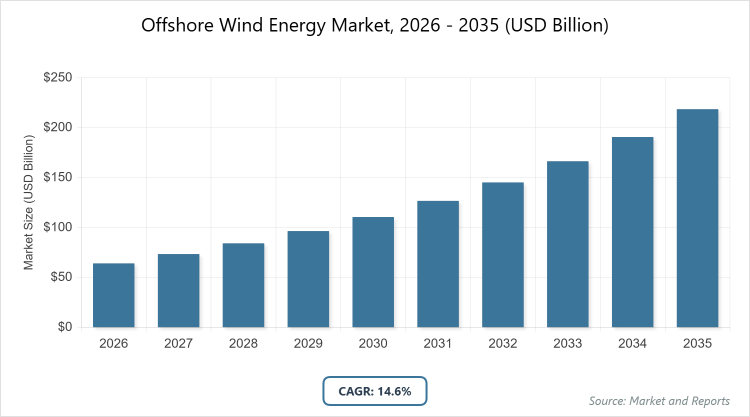
According to MarketnReports, the global Offshore Wind Energy market size was estimated at USD 64.1 billion in 2025 and is expected to reach USD 250.3 billion by 2035, growing at a CAGR of 14.6% from 2026 to 2035. Government policies promoting renewable energy and decarbonization efforts.
Key Insights
- The global offshore wind energy market size was valued at USD 64.1 billion in 2025 and is projected to reach USD 250.3 billion by 2035.
- The market is anticipated to grow at a CAGR of 14.6% during the forecast period from 2026 to 2035.
- The market is driven by supportive government policies, technological advancements, and increasing demand for clean energy.
- Fixed foundation dominates the type segment with a 70% share due to its established technology and suitability for shallow waters where most current projects are located.
- Shallow water dominates the application segment with a 60% share because it allows for easier installation and lower costs compared to deeper sites.
- Utilities dominate the end-use segment with a 80% share owing to large-scale grid integration and renewable energy mandates.
- Europe dominates the regional segment with a 45% share attributable to strong policy support, mature supply chains, and leading countries like the UK and Germany.
What is the Offshore Wind Energy Market?
The offshore wind energy market encompasses the development, installation, and operation of wind turbines located in marine environments to harness wind power for electricity generation, offering advantages like stronger and more consistent winds compared to onshore sites. This market includes technologies for fixed and floating foundations, turbines, and supporting infrastructure that enable large-scale renewable energy production. The market definition focuses on wind farms situated offshore, excluding onshore or hybrid systems, and emphasizes innovations in turbine size, efficiency, and integration with grids to support global transitions toward sustainable energy sources amid climate change concerns.
Market Dynamics
Growth Drivers
The growth drivers in the offshore wind energy market are anchored by escalating global commitments to net-zero emissions, with governments implementing subsidies, tax incentives, and renewable portfolio standards that accelerate project approvals and investments. Technological progress in larger turbines and floating platforms reduces levelized costs of energy, making offshore wind competitive with fossil fuels. Rising energy demand in coastal regions, coupled with the sector’s potential to create jobs and stimulate economic growth, further propels expansion as nations diversify energy sources to enhance security and sustainability.
Restraints
Restraints in the offshore wind energy market include high upfront capital requirements for infrastructure like subsea cables and specialized vessels, which deter investments in emerging markets with limited financing options. Supply chain bottlenecks, exacerbated by raw material shortages and manufacturing constraints, lead to project delays and cost overruns. Additionally, environmental concerns over marine ecosystems and avian impacts necessitate lengthy permitting processes, slowing deployment in sensitive areas.
Opportunities
Opportunities in the offshore wind energy market stem from the integration with emerging technologies like green hydrogen production, where excess wind power can be converted to fuel for hard-to-decarbonize sectors. Expansion into untapped deep-water sites via floating foundations opens new geographic frontiers, particularly in Asia Pacific. Public-private partnerships and international collaborations can leverage expertise to reduce risks and costs, fostering innovation in hybrid systems with energy storage.
Challenges
Challenges in the offshore wind energy market involve navigating complex regulatory landscapes, where differing maritime laws and grid connection policies across countries complicate cross-border projects. Harsh marine conditions increase maintenance costs and downtime, requiring robust designs resilient to extreme weather. Moreover, workforce shortages in specialized skills like installation and operations demand training investments to sustain growth.
Offshore Wind Energy Market: Report Scope
| Report Attributes | Report Details |
| Report Name | Offshore Wind Energy Market |
| Market Size 2025 | USD 64.1 Billion |
| Market Forecast 2035 | USD 250.3 Billion |
| Growth Rate | CAGR of 14.6% |
| Report Pages | 220 |
| Key Companies Covered |
Ørsted, Vestas, Siemens Gamesa, General Electric, Nordex SE, and Others |
| Segments Covered | By Type, By Application, By End-Use, and By Region |
| Regions Covered | North America, Europe, Asia Pacific (APAC), Latin America, and The Middle East and Africa (MEA) |
| Base Year | 2025 |
| Historical Year | 2020 – 2024 |
| Forecast Year | 2026 – 2035 |
| Customization Scope | Avail customized purchase options to meet your exact research needs. |
Market Segmentation
The Offshore Wind Energy market is segmented by type, application, end-use, and region.
Based on Type Segment, Fixed foundation is the most dominant subsegment, holding 70% market share, followed by floating foundation at around 20%. Fixed foundation leads due to its proven reliability, lower installation costs, and applicability in shallow coastal waters where wind resources are abundant and accessible, which drives market growth by enabling faster project deployment and attracting investments in established regions.
Based on Application Segment, Shallow water is the most dominant subsegment with 60% share, followed by transitional water at 25%. Shallow water dominates because it minimizes technical complexities and costs associated with deeper installations, thereby propelling overall market expansion through higher feasibility for near-shore projects that integrate easily with existing grids.
Based on the End-Use Segment, Utilities is the most dominant subsegment at 80%, followed by independent power producers at 10%. Utilities lead owing to their role in large-scale energy procurement and compliance with renewable targets, which fuels market growth by securing long-term power purchase agreements that stabilize revenues.
Recent Developments
- In October 2025, Ørsted partnered with Eversource to advance floating wind technology in the U.S. Northeast, aiming to deploy 1 GW by 2030 amid policy shifts.
- In December 2025, Vestas secured a 500 MW turbine order for a UK project, incorporating advanced blade designs for enhanced efficiency in harsh conditions.
- In January 2026, Siemens Gamesa launched a 15 MW turbine prototype, targeting deep-water applications to reduce costs per MWh.
Europe to Dominate the Global Market
- Europe is poised to dominate the global offshore wind energy market
Europe as the dominant country, with over 14 GW installed capacity and projects like Dogger Bank adding 3.6 GW, driven by CfD auctions and North Sea wind resources.
Germany contributes significantly, focusing on Baltic and North Sea expansions with 8 GW operational, supported by EEG reforms for grid stability.
North America grows through federal incentives, with the U.S. as key, despite pauses, via East Coast leases targeting 30 GW by 2030.
Asia Pacific accelerates, led by China with 30 GW installed, emphasizing floating tech for deep waters in the South China Sea.
Latin America and the Middle East & Africa emerge, with Brazil and the UAE piloting projects for energy diversification.
Key Market Players and Strategies
- Ørsted pursues vertical integration and green hydrogen synergies to optimize costs and expand in Asia Pacific.
- Vestas invests in larger turbines and digital monitoring for predictive maintenance, enhancing reliability.
- Siemens Gamesa focuses on modular designs and supply chain localization to reduce lead times.
- General Electric leverages Haliade-X platforms for high-wind sites, targeting U.S. recovery.
- Nordex SE emphasizes cost-effective solutions and partnerships for emerging markets.
Market Trends
- Acceleration of floating wind deployments for deep-water access.
- Integration with energy storage and hydrogen production.
- Policy reforms to stabilize auctions amid cost pressures.
- Supply chain diversification to mitigate shortages.
- Focus on repowering aging assets for efficiency gains.
Market Segments and their Subsegments Covered in the Report
By Type
- Fixed Foundation
- Floating Foundation
- Monopile
- Jacket
- Gravity Base
- Tripod
- Spar-Buoy
- Tension-Leg Platform
- Semi-Submersible
- Others
- Others
By Application
- Shallow Water
- Transitional Water
- Deep Water
- Commercial
- Industrial
- Utility
- Residential
- Others
- Others
By End-Use
- Utilities
- Independent Power Producers
- Government
- Commercial & Industrial
- Others
- Others
By Region
- North America
- U.S.
- Canada
- Europe
- UK
- Germany
- France
- Rest of Europe
- Asia Pacific
- China
- India
- Japan
- Rest of Asia Pacific
- Latin America
- Brazil
- Mexico
- Rest of Latin America
- Middle East & Africa
- UAE
- South Africa
- Rest of Middle East & Africa
Chapter 1. Preface
Chapter 2. Executive Summary
Chapter 3. Global Offshore Wind Energy Market - Industry Analysis
Chapter 4. Global Offshore Wind Energy Market- Competitive Landscape
Chapter 5. Global Offshore Wind Energy Market - Type Analysis
Chapter 6. Global Offshore Wind Energy Market - Application Analysis
Chapter 7. Global Offshore Wind Energy Market - End-Use Analysis
Chapter 8. Offshore Wind Energy Market - Regional Analysis
Chapter 9. Company Profiles
Frequently Asked Questions
Offshore wind energy involves harnessing wind power from turbines installed in marine environments to generate electricity.
Key factors include policy support, technological advancements, and decarbonization goals.
The market is projected to grow from approximately USD 73.5 billion in 2026 to USD 250.3 billion by 2035.
The CAGR is expected to be 14.6% during the forecast period.
Europe will contribute the most, driven by strong policies and infrastructure.
Major players include Ørsted, Vestas, Siemens Gamesa, General Electric, and Nordex SE.
The report provides analysis of size, trends, segments, regions, and forecasts.
Stages include development, manufacturing, installation, operation, and decommissioning.
Trends favor floating tech and integration, with preferences for sustainable energy.
Supportive policies and emission targets drive growth, while permitting delays pose challenges.