
Mushroom Packaging Market Size, Share and Trends 2026 to 2035
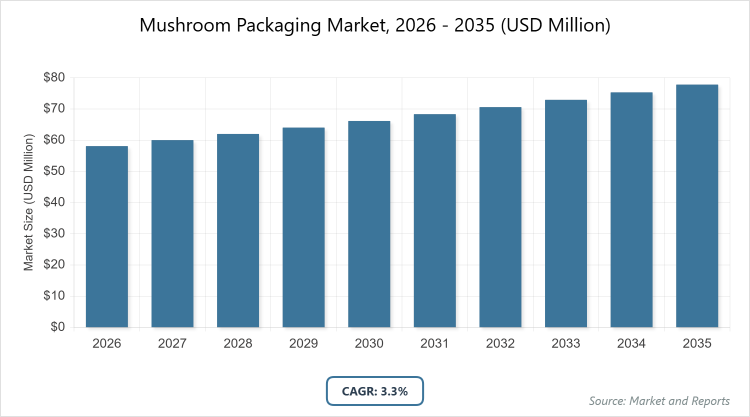
According to MarketnReports, the global Mushroom Packaging market size was estimated at USD 58.1 million in 2025 and is expected to reach USD 80.5 million by 2035, growing at a CAGR of 3.3% from 2026 to 2035. Mushroom Packaging Market is driven by increasing demand for sustainable and biodegradable packaging solutions.
What are the Key Insights of the Mushroom Packaging Market?
- Global Mushroom Packaging market valued at USD 58.1 million in 2025 and projected to reach USD 80.5 million by 2035.
- CAGR of 3.3% from 2026 to 2035.
- Market is driven by rising environmental awareness and regulatory initiatives promoting eco-friendly alternatives to traditional plastics.
- Dominant application subsegment: Cushioning with 42.7% share, dominated due to its superior shock absorption, lightweight nature, and flexibility in protecting fragile goods during transportation.
- Dominant end-use industry subsegment: Cosmetics & Personal Care with 37.1% share, dominated because of surging e-commerce growth, consumer preference for sustainable beauty products, and the need for protective yet compostable packaging.
- Dominant region: North America leading the global market, dominated due to strong consumer preference for low-toxicity and natural packaging options, along with established sustainability protocols and corporate commitments.
What is the Industry Overview of the Mushroom Packaging Market?
The mushroom packaging industry revolves around innovative, biodegradable packaging solutions made from mycelium, the vegetative part of fungi, combined with agricultural waste to form durable, compostable materials. This market addresses the growing need for sustainable alternatives to petroleum-based plastics and foams, offering products that decompose naturally without harming the environment. Mushroom packaging is defined as eco-friendly protective materials grown from mushroom roots, providing cushioning, insulation, and structural support for various goods. It aligns with global shifts toward circular economies, reducing plastic pollution and supporting zero-waste initiatives, while being versatile across multiple sectors due to its customizable shapes, low production costs, and minimal energy requirements in manufacturing.
What are the Market Dynamics in the Mushroom Packaging Market?
Growth Drivers
The primary growth drivers in the mushroom packaging market include heightened global awareness of environmental sustainability and the urgent need to replace single-use plastics with biodegradable options. Regulatory pressures from governments worldwide, such as bans on non-recyclable materials and incentives for green innovations, are accelerating adoption. Technological advancements in mycelium cultivation have enhanced material properties like durability and moisture resistance, making it competitive with traditional foams. Consumer demand for renewable, low-toxicity packaging is rising, particularly in e-commerce and consumer goods, where brands seek to meet sustainability goals and improve their eco-image. Additionally, the cost-effectiveness of mushroom packaging, derived from abundant agricultural byproducts, supports scalability and appeals to cost-conscious industries.
Restraints
Restraints in the mushroom packaging market stem from challenges in scaling production, including limited infrastructure for large-scale mycelium cultivation and dependency on consistent agricultural waste supplies. Quality control and traceability in the supply chain pose issues, as variations in raw materials can affect product performance. Consumer unfamiliarity with mycelium-based products requires extensive education and marketing efforts, slowing market penetration. Evolving regulations demand compliance with diverse standards across regions, increasing operational complexities and costs for manufacturers. Furthermore, initial investment in research and development for improving mechanical properties remains a barrier for smaller players.
Opportunities
Opportunities abound in the mushroom packaging market through expansion into high-growth sectors like electronics and cosmetics, where tailored, protective designs can replace harmful foams. Partnerships between material innovators and industry leaders enable co-development of customized solutions, fostering innovation. Government policies in emerging economies, such as subsidies for biodegradable materials, open new markets in Asia-Pacific. Technological enhancements, including coatings for better resilience, can broaden applications to moisture-sensitive products. The rise of e-commerce amplifies demand for lightweight, compostable shipping materials, while corporate sustainability pledges create avenues for long-term contracts and market expansion.
Challenges
Challenges facing the mushroom packaging market include overcoming supply chain vulnerabilities, such as sourcing high-quality mycelium and ensuring consistent production volumes to meet industrial demands. Achieving parity with traditional materials in terms of strength and shelf-life requires ongoing R&D, which can be resource-intensive. Market education is crucial to shift perceptions from novelty to reliable alternative, addressing skepticism about performance. Navigating regional regulatory landscapes, with varying compostability certifications, adds compliance burdens. Economic fluctuations impacting agricultural inputs could raise costs, while competition from other bioplastics demands differentiation through unique environmental benefits.
Mushroom Packaging Market: Report Scope
| Report Attributes | Report Details |
| Report Name | Mushroom Packaging Market |
| Market Size 2025 | USD 58.1 Million |
| Market Forecast 2035 | USD 80.5 Million |
| Growth Rate | CAGR of 3.3% |
| Report Pages | 216 |
| Key Companies Covered | Ecovative Design LLC, Sealed Air Corporation, Magical Mushroom Company, Interpack, Thermo Packer, Merck Forest, Costa Group, CMP Mushroom, Shroom Labs, Paradise Packaging Company, Steelcase, and Others |
| Segments Covered | By Application, By End-Use Industry, and By Region |
| Regions Covered | North America, Europe, Asia Pacific (APAC), Latin America, and The Middle East and Africa (MEA) |
| Base Year | 2025 |
| Historical Year | 2020 – 2024 |
| Forecast Year | 2026 – 2035 |
| Customization Scope | Avail customized purchase options to meet your exact research needs. |
What is the Market Segmentation of the Mushroom Packaging Market?
The Mushroom Packaging market is segmented by application, end-use industry, and region.
Based on Application Segment, the market is divided into cushioning, bracing, and void fill. The most dominant segment is cushioning, holding a 42.7% share, due to its exceptional ability to absorb shocks and protect delicate items during transit, which drives market growth by meeting the needs of logistics-heavy industries like e-commerce and electronics. The second most dominant is bracing, which supports structural integrity in packaging, aiding market expansion by providing customizable solutions for irregularly shaped products and enhancing overall supply chain efficiency.
Based on End-Use Industry Segment, the market includes electronics & electricals, wine shippers, cosmetics & personal care, homecare, and automotive components. The most dominant is cosmetics & personal care with 37.1% share, leading because of the sector’s rapid e-commerce growth and consumer demand for eco-friendly beauty packaging, driving the market through increased adoption of compostable materials that align with brand sustainability narratives. The second most dominant is electronics & electricals at 36.4%, contributing to growth by replacing polystyrene foams in device protection, reducing carbon footprints, and supporting regulatory compliance in tech manufacturing.
What are the Recent Developments in the Mushroom Packaging Market?
- In June 2025, Magical Mushroom Company introduced a mycelium-based packaging solution designed to replace polystyrene and cardboard, aiming to eliminate plastic waste in various industries through its biodegradable properties.
- In May 2025, Ecovative innovated by transforming mycelium into a versatile sustainable material that not only serves as packaging but also enriches soil upon decomposition, contributing to reduced environmental pollution and enhanced circular economy practices.
How is the Regional Analysis of the Mushroom Packaging Market?
- North America to dominate the global market.
North America leads the mushroom packaging market, driven by robust consumer preferences for natural and low-toxicity materials, coupled with stringent environmental regulations promoting sustainable practices. The United States dominates this region with a CAGR of 1.2%, benefiting from advanced innovation ecosystems, corporate sustainability commitments, and widespread adoption in electronics and cosmetics sectors, which bolster market growth through eco-friendly initiatives and reduced carbon footprints.
Asia Pacific exhibits the fastest growth, fueled by rising environmental awareness and government policies addressing plastic pollution. India dominates with a CAGR of 5.9%, propelled by consumer shifts toward sustainable products, supportive regulations like plastic bans, and expanding e-commerce, while China follows at 4.1% CAGR, driven by restrictions on single-use plastics and increasing demand for biodegradable alternatives in manufacturing.
Europe emphasizes biodegradable adoption, with regulations like the Packaging Waste Directive accelerating market penetration. The United Kingdom dominates at a 1.1% CAGR, supported by government efforts to combat plastic toxicity and promote green labeling, alongside strong consumer demand for compostable options in personal care and homecare industries.
Latin America shows moderate growth, influenced by emerging sustainability trends and regulatory frameworks. Brazil leads, benefiting from increasing awareness of eco-friendly packaging and investments in bio-based materials, though challenges in infrastructure limit broader adoption.
The Middle East and Africa (MEA) experiences nascent development, with potential in urbanizing areas. South Africa dominates, driven by environmental consciousness and initiatives to reduce waste, though overall growth is constrained by supply chain issues and lower awareness levels.
Who are the Key Market Players in the Mushroom Packaging Market?
Ecovative Design LLC focuses on innovating mycelium-based materials for sustainable applications, employing strategies like product diversification and partnerships to enhance durability and expand into electronics and fashion sectors, thereby driving market leadership through technological advancements.
Sealed Air Corporation leverages its expertise in protective packaging by integrating mushroom-based solutions, adopting merger and acquisition strategies to access resources and upgrade facilities, aiming to meet customer demands for eco-friendly options and scale production efficiently.
Magical Mushroom Company emphasizes replacing traditional plastics with mycelium innovations, utilizing product launches and co-development initiatives to address waste reduction, positioning itself as a key player by targeting industries like logistics and consumer goods.
Interpack pursues operational expansions and customization strategies, focusing on tailored designs for end-users in cosmetics and automotive, enhancing market presence through quality control and sustainable supply chain practices.
Thermo Packer implements facility upgrades and innovation in thermal-resistant mycelium packaging, targeting wine shippers and homecare sectors to capitalize on demand for compostable materials and regulatory compliance.
Merck Forest adopts collaborative strategies with agricultural partners for raw material sourcing, emphasizing traceability and quality to support growth in biodegradable packaging for personal care products.
Costa Group focuses on scaling cultivation processes and mergers for resource optimization, driving strategies toward cost-effective production and market penetration in Asia-Pacific regions.
CMP Mushroom employs R&D investments to improve material resilience, targeting automotive components and electronics with strategies centered on performance benchmarking and sustainability certifications.
Shroom Labs leverages technological co-developments for enhanced mycelium composites, aiming at void fill applications through innovative strategies that address moisture resistance and broaden industrial adoption.
Paradise Packaging Company pursues market expansion via partnerships and product innovation, focusing on bracing solutions for e-commerce to meet growing demands for lightweight, eco-friendly packaging.
Steelcase integrates mushroom packaging into furniture and office solutions, adopting sustainability-driven strategies like low-carbon initiatives and supply chain optimizations to lead in homecare segments.
What are the Market Trends in the Mushroom Packaging Market?
- Shift toward circular economy models emphasizing biodegradable and compostable alternatives to reduce plastic waste.
- Increasing integration of technological advancements in mycelium for improved mechanical resilience and moisture resistance.
- Rising consumer focus on low-toxicity, renewable packaging options in personal care and electronics industries.
- Growth in e-commerce driving demand for protective, sustainable materials in cosmetics and consumer goods.
- Regulatory pushes for green labeling and sustainable supply chains across global markets.
- Expansion of partnerships for tailored packaging designs and scalable production innovations.
What Market Segments and Subsegments are Covered in the Mushroom Packaging Report?
By Application
- Cushioning
- Bracing
- Void Fill
By End-Use Industry
- Electronics & Electricals
- Wine Shippers
- Cosmetics & Personal Care
- Homecare
- Automotive Components
By Region
- North America
- U.S.
- Canada
- Europe
- UK
- Germany
- France
- Rest of Europe
- Asia Pacific
- China
- India
- Japan
- Rest of Asia Pacific
- Latin America
- Brazil
- Mexico
- Rest of Latin America
- Middle East & Africa
- UAE
- South Africa
- Rest of Middle East & Africa
Chapter 1. Preface
1.1 Report Description and Scope1.2 Research Scope1.3 Research Methodology1.3.1 Market Research Type1.3.2 Market Research MethodologyChapter 2. Executive Summary
2.1 Global Mushroom Packaging Market, (2026 - 2035) (USD Million)2.2 Global Mushroom Packaging Market: SnapshotChapter 3. Global Mushroom Packaging Market - Industry Analysis
3.1 Mushroom Packaging Market: Market Dynamics3.2 Market Drivers3.2.1 The mushroom packaging market is driven by rising sustainability awareness, strict regulations against single-use plastics, advancements in mycelium technology, growing demand for eco-friendly packaging in e-commerce and consumer goods, and the cost-effective use of abundant agricultural waste materials.3.3 Market Restraints3.3.1 The mushroom packaging market is restrained by scalability challenges, inconsistent raw material supply and quality control, low consumer awareness, complex regulatory compliance across regions, and high initial R&D and infrastructure investment requirements.3.4 Market Opportunities3.4.1 The mushroom packaging market offers strong opportunities through expansion into electronics and cosmetics, strategic industry partnerships, supportive government policies in emerging economies, technological enhancements for wider applications, rapid e-commerce growth, and rising corporate sustainability commitments.3.5 Market Challenges3.5.1 The mushroom packaging market faces challenges from supply chain vulnerabilities, the need for continuous R&D to match traditional material performance, low market awareness, complex regional compostability regulations, cost volatility of agricultural inputs, and intense competition from alternative bioplastics.3.6 Porter’s Five Forces Analysis3.7 Market Attractiveness Analysis3.7.1 Market Attractiveness Analysis By Application3.7.2 Market Attractiveness Analysis By End-Use IndustryChapter 4. Global Mushroom Packaging Market- Competitive Landscape
4.1 Company Market Share Analysis4.1.1 Global Mushroom Packaging Market: Company Market Share, 20254.2 Strategic Development4.2.1 Acquisitions & mergers4.2.2 New Product launches4.2.3 Agreements, partnerships, collaborations, and joint ventures4.2.4 Research and development and regional expansion4.3 Price Trend AnalysisChapter 5. Global Mushroom Packaging Market - Application Analysis
5.1 Global Mushroom Packaging Market Overview: Application5.1.1 Global Mushroom Packaging Market share, By Application, 2025 and 20355.2 Cushioning5.2.1 Global Mushroom Packaging Market by Cushioning, 2026 - 2035 (USD Million)5.3 Bracing5.3.1 Global Mushroom Packaging Market by Bracing, 2026 - 2035 (USD Million)5.4 Void Fill5.4.1 Global Mushroom Packaging Market by Void Fill, 2026 - 2035 (USD Million)5.5 Others5.5.1 Global Mushroom Packaging Market by Others, 2026 - 2035 (USD Million)Chapter 6. Global Mushroom Packaging Market - End-Use Industry Analysis
6.1 Global Mushroom Packaging Market Overview: End-Use Industry6.1.1 Global Mushroom Packaging Market Share, By End-Use Industry, 2025 and 20356.2 Electronics & Electricals6.2.1 Global Mushroom Packaging Market by Electronics & Electricals, 2026 - 2035 (USD Million)6.3 Wine Shippers6.3.1 Global Mushroom Packaging Market by Wine Shippers, 2026 - 2035 (USD Million)6.4 Cosmetics & Personal Care6.4.1 Global Mushroom Packaging Market by Cosmetics & Personal Care, 2026 - 2035 (USD Million)6.5 Homecare6.5.1 Global Mushroom Packaging Market by Homecare, 2026 - 2035 (USD Million)6.6 Automotive Components6.6.1 Global Mushroom Packaging Market by Automotive Components, 2026 - 2035 (USD Million)6.7 Others6.7.1 Global Mushroom Packaging Market by Others, 2026 - 2035 (USD Million)Chapter 7. Mushroom Packaging Market - Regional Analysis
7.1 Global Mushroom Packaging Market Regional Overview7.2 Global Mushroom Packaging Market Share, by Region, 2025 & 2035 (USD Million)7.3 North America7.3.1 North America Mushroom Packaging Market, 2026 - 2035 (USD Million)7.3.1.1 North America Mushroom Packaging Market, by Country, 2026 - 2035 (USD Million)7.3.2 North America Mushroom Packaging Market, by Application, 2026 - 20357.3.2.1 North America Mushroom Packaging Market, by Application, 2026 - 2035 (USD Million)7.3.3 North America Mushroom Packaging Market, by End-Use Industry, 2026 - 20357.3.3.1 North America Mushroom Packaging Market, by End-Use Industry, 2026 - 2035 (USD Million)7.4 Europe7.4.1 Europe Mushroom Packaging Market, 2026 - 2035 (USD Million)7.4.1.1 Europe Mushroom Packaging Market, by Country, 2026 - 2035 (USD Million)7.4.2 Europe Mushroom Packaging Market, by Application, 2026 - 20357.4.2.1 Europe Mushroom Packaging Market, by Application, 2026 - 2035 (USD Million)7.4.3 Europe Mushroom Packaging Market, by End-Use Industry, 2026 - 20357.4.3.1 Europe Mushroom Packaging Market, by End-Use Industry, 2026 - 2035 (USD Million)7.5 Asia Pacific7.5.1 Asia Pacific Mushroom Packaging Market, 2026 - 2035 (USD Million)7.5.1.1 Asia Pacific Mushroom Packaging Market, by Country, 2026 - 2035 (USD Million)7.5.2 Asia Pacific Mushroom Packaging Market, by Application, 2026 - 20357.5.2.1 Asia Pacific Mushroom Packaging Market, by Application, 2026 - 2035 (USD Million)7.5.3 Asia Pacific Mushroom Packaging Market, by End-Use Industry, 2026 - 20357.5.3.1 Asia Pacific Mushroom Packaging Market, by End-Use Industry, 2026 - 2035 (USD Million)7.6 Latin America7.6.1 Latin America Mushroom Packaging Market, 2026 - 2035 (USD Million)7.6.1.1 Latin America Mushroom Packaging Market, by Country, 2026 - 2035 (USD Million)7.6.2 Latin America Mushroom Packaging Market, by Application, 2026 - 20357.6.2.1 Latin America Mushroom Packaging Market, by Application, 2026 - 2035 (USD Million)7.6.3 Latin America Mushroom Packaging Market, by End-Use Industry, 2026 - 20357.6.3.1 Latin America Mushroom Packaging Market, by End-Use Industry, 2026 - 2035 (USD Million)7.7 The Middle-East and Africa7.7.1 The Middle-East and Africa Mushroom Packaging Market, 2026 - 2035 (USD Million)7.7.1.1 The Middle-East and Africa Mushroom Packaging Market, by Country, 2026 - 2035 (USD Million)7.7.2 The Middle-East and Africa Mushroom Packaging Market, by Application, 2026 - 20357.7.2.1 The Middle-East and Africa Mushroom Packaging Market, by Application, 2026 - 2035 (USD Million)7.7.3 The Middle-East and Africa Mushroom Packaging Market, by End-Use Industry, 2026 - 20357.7.3.1 The Middle-East and Africa Mushroom Packaging Market, by End-Use Industry, 2026 - 2035 (USD Million)Chapter 8. Company Profiles
8.1 Ecovative Design LLC8.1.1 Overview8.1.2 Financials8.1.3 Product Portfolio8.1.4 Business Strategy8.1.5 Recent Developments8.2 Sealed Air Corporation8.2.1 Overview8.2.2 Financials8.2.3 Product Portfolio8.2.4 Business Strategy8.2.5 Recent Developments8.3 Magical Mushroom Company8.3.1 Overview8.3.2 Financials8.3.3 Product Portfolio8.3.4 Business Strategy8.3.5 Recent Developments8.4 Interpack8.4.1 Overview8.4.2 Financials8.4.3 Product Portfolio8.4.4 Business Strategy8.4.5 Recent Developments8.5 Thermo Packer8.5.1 Overview8.5.2 Financials8.5.3 Product Portfolio8.5.4 Business Strategy8.5.5 Recent Developments8.6 Merck Forest8.6.1 Overview8.6.2 Financials8.6.3 Product Portfolio8.6.4 Business Strategy8.6.5 Recent Developments8.7 Costa Group8.7.1 Overview8.7.2 Financials8.7.3 Product Portfolio8.7.4 Business Strategy8.7.5 Recent Developments8.8 CMP Mushroom8.8.1 Overview8.8.2 Financials8.8.3 Product Portfolio8.8.4 Business Strategy8.8.5 Recent Developments8.9 Shroom Labs8.9.1 Overview8.9.2 Financials8.9.3 Product Portfolio8.9.4 Business Strategy8.9.5 Recent Developments8.10 Paradise Packaging Company8.10.1 Overview8.10.2 Financials8.10.3 Product Portfolio8.10.4 Business Strategy8.10.5 Recent Developments8.11 Steelcase8.11.1 Overview8.11.2 Financials8.11.3 Product Portfolio8.11.4 Business Strategy8.11.5 Recent Developments
Frequently Asked Questions
Mushroom packaging refers to biodegradable and compostable materials made from mycelium, the root structure of mushrooms, combined with agricultural waste to create protective, eco-friendly alternatives to traditional plastics and foams.
Key factors include rising environmental awareness, regulatory bans on plastics, technological advancements in mycelium materials, consumer demand for sustainable products, and expansion in e-commerce and electronics sectors.
The market is projected to grow from approximately USD 58.1 million in 2025 to USD 80.5 million by 2035, based on the overall forecast trajectory.
The CAGR is expected to be around 3.3% during 2026-2035.
North America will contribute notably, driven by strong sustainability initiatives and high adoption rates.
Major players include Ecovative Design LLC, Sealed Air Corporation, Magical Mushroom Company, Interpack, and Thermo Packer.
The report provides comprehensive analysis, including market size, trends, segmentation, regional outlook, key players, drivers, restraints, opportunities, and forecasts.
Stages include sourcing and cultivation of mycelium, processing into composite materials, manufacturing and customization of packaging forms, distribution to end-use industries, and end-of-life composting.
Trends are shifting toward circular economy practices and biodegradable innovations, with consumers preferring low-toxicity, renewable options that align with sustainability goals in packaging.
Factors include government bans on single-use plastics, incentives for eco-friendly materials, compostability standards, and environmental regulations promoting reduced carbon footprints and waste management.