
MRI Contrast Agents Market Size, Share and Trends 2026 to 2035
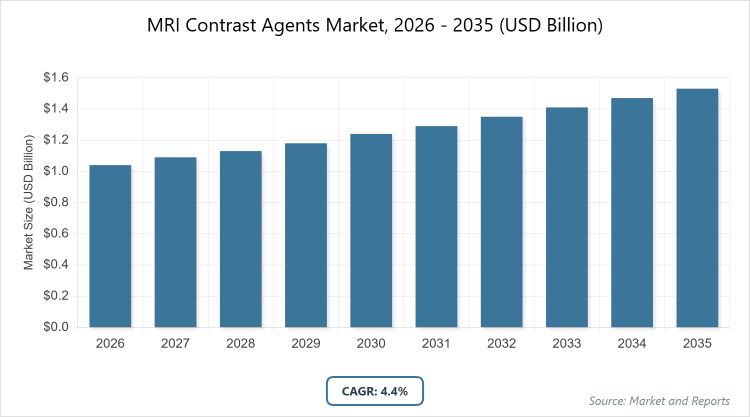
According to MarketnReports, the global MRI Contrast Agents Market size was estimated at USD 1.04 billion in 2025 and is expected to reach USD 1.59 billion by 2035, growing at a CAGR of 4.4% from 2026 to 2035. MRI Contrast Agents Market is driven by the increasing prevalence of chronic diseases and rising demand for advanced diagnostic imaging.
What are the Key Insights into the MRI Contrast Agents Market?
- The global MRI contrast agents market was valued at USD 1.04 billion in 2025 and is projected to reach USD 1.59 billion by 2035.
- The market is expected to grow at a CAGR of 4.4% from 2026 to 2035.
- The market is driven by rising chronic disease prevalence, increasing MRI procedure volumes, and advancements in safer contrast formulations.
- Paramagnetic contrast agents dominate the product segment with approximately 47% share due to their high efficacy in enhancing signal intensity and widespread use in clinical diagnostics.
- Hospitals lead the end-user segment with around 58% share owing to high patient throughput and advanced imaging infrastructure.
- North America holds the largest regional share at about 40% attributed to robust healthcare systems, high adoption of advanced technologies, and significant prevalence of diseases requiring MRI scans.
What is the Industry Overview of the MRI Contrast Agents Market?
The MRI contrast agents market encompasses substances used to enhance the visibility of internal body structures in magnetic resonance imaging scans, improving diagnostic accuracy for various medical conditions. Market definition refers to the global industry involved in the development, production, distribution, and utilization of these agents, which include paramagnetic and superparamagnetic compounds administered intravenously to highlight differences in tissues, organs, and blood vessels. This market serves healthcare providers by enabling better detection of abnormalities such as tumors, inflammation, and vascular issues, while addressing evolving needs for safer, more effective formulations amid technological advancements in imaging equipment and growing emphasis on early disease diagnosis.
What are the Market Dynamics of the MRI Contrast Agents Market?
Growth Drivers
The growth of the MRI contrast agents market is propelled by the escalating global burden of chronic diseases such as cancer, neurological disorders, and cardiovascular conditions, which necessitate precise diagnostic imaging for effective treatment planning. Advancements in MRI technology, including higher-field-strength scanners, have increased the demand for compatible contrast agents that provide superior image quality and tissue differentiation. Additionally, rising healthcare expenditures, expanding access to diagnostic services in emerging economies, and supportive government initiatives for early disease detection further fuel market expansion. Innovations in agent formulations, such as macrocyclic structures that minimize toxicity risks, along with the integration of AI for optimized dosing, contribute to sustained growth by enhancing safety and efficiency in clinical applications.
Restraints
Market growth faces hurdles from safety concerns related to gadolinium-based agents, including risks of nephrogenic systemic fibrosis and long-term gadolinium deposition in the brain and other tissues, leading to regulatory scrutiny and physician reluctance. High costs associated with MRI scans and contrast agents limit accessibility in developing regions, where alternative imaging modalities like ultrasound or non-contrast MRI are preferred for their affordability and safety. Supply chain vulnerabilities for rare earth elements like gadolinium, coupled with stringent approval processes for new agents, also impede innovation and market entry. Moreover, the lingering impact of global health disruptions, such as reduced elective procedures during pandemics, has temporarily slowed procedure volumes and agent utilization.
Opportunities
Opportunities abound in the development of non-gadolinium alternatives, such as manganese-based and iron oxide agents, which address safety concerns and open new avenues for patients with renal impairments. Emerging markets in Asia-Pacific and Latin America present growth potential through increasing investments in healthcare infrastructure and rising awareness of advanced diagnostics. Collaborations between pharmaceutical companies and imaging technology firms can accelerate the creation of targeted, organ-specific agents integrated with AI-driven analytics for personalized medicine. Additionally, expanding applications in pediatric and oncology imaging, along with regulatory incentives for safer formulations, offer pathways for market players to capture untapped segments and drive long-term revenue.
Challenges
Challenges include navigating complex regulatory landscapes across regions, where varying standards for agent safety and efficacy can delay product launches and increase development costs. Competition from non-invasive, contrast-free imaging techniques powered by advanced software poses a threat to traditional agent demand. Environmental concerns over gadolinium waste and its ecological impact require sustainable manufacturing practices, adding operational complexities. Furthermore, a consolidated market with few dominant players limits competition, while the need for continuous education on agent risks and benefits among healthcare professionals remains critical to maintaining trust and adoption rates.
MRI Contrast Agents Market: Report Scope
| Report Attributes | Report Details |
| Report Name | MRI Contrast Agents Market |
| Market Size 2025 | USD 1.04 Billion |
| Market Forecast 2035 | USD 1.59 Billion |
| Growth Rate | CAGR of 4.4% |
| Report Pages | 220 |
| Key Companies Covered |
Bayer AG, GE Healthcare LLC, Guerbet GmbH, Bracco Imaging SpA, Miltenyi Biotec B.V. & Co. Kg, and Others |
| Segments Covered | By Product, By Application, By End-User, and By Region |
| Regions Covered | North America, Europe, Asia Pacific (APAC), Latin America, and The Middle East and Africa (MEA) |
| Base Year | 2025 |
| Historical Year | 2020 - 2024 |
| Forecast Year | 2026 - 2035 |
| Customization Scope | Avail customized purchase options to meet your exact research needs. |
How is the Market Segmentation of the MRI Contrast Agents Market?
The MRI Contrast Agents Market is segmented by product, application, end-user, and region.
By Product Segment: The paramagnetic contrast agents segment is the most dominant, holding approximately 47% market share, followed by superparamagnetic agents as the second most dominant. Paramagnetic agents dominate due to their superior relaxivity properties that significantly enhance MRI signal contrast, making them essential for detailed visualization in neurology and oncology; this drives the market by enabling accurate diagnosis and monitoring of complex conditions, while superparamagnetic agents support niche applications like liver imaging, contributing to overall growth through specialized diagnostic capabilities.
By Application Segment: Neurology applications lead as the most dominant segment with around 40% share, with oncology as the second most dominant. Neurology's dominance stems from the high incidence of brain and spinal disorders requiring precise imaging for detection and treatment planning, propelling market growth via increased procedure volumes; oncology follows, driven by the need for tumor characterization and staging, which boosts demand for agents that improve lesion visibility and support cancer management strategies.
By End-User Segment: Hospitals represent the most dominant end-user with about 58% share, while diagnostic imaging centers are the second most dominant. Hospitals dominate owing to their comprehensive facilities handling high volumes of inpatient and emergency scans, fueling market expansion through integrated care delivery; diagnostic centers contribute as specialized outpatient hubs, enhancing accessibility and efficiency in routine diagnostics, thereby supporting broader market penetration.
What are the Recent Developments in the MRI Contrast Agents Market?
- In October 2024, GE HealthCare announced positive Phase I clinical trial results for a manganese-based MRI contrast agent, aiming to provide a safer alternative to gadolinium for improved diagnostic imaging in patients with renal concerns.
- In December 2024, Bracco Diagnostics Inc. received FDA approval for an expanded indication of ProHance® for use in neonates, enhancing pediatric imaging options and addressing safety in vulnerable populations.
- In July 2020, Bayer AG obtained FDA approval for Gadavist® in cardiac MRI applications, expanding its utility in cardiovascular diagnostics and supporting better detection of ischemic heart disease.
- In November 2020, GE Healthcare secured FDA approval for Clariscan™ and launched it at the European Congress of Radiology, broadening its portfolio of macrocyclic gadolinium-based agents for enhanced safety profiles.
- In August 2020, Bracco Imaging acquired Blue Earth Diagnostics, strengthening its position in precision medicine and oncology imaging through innovative contrast solutions.
How is the Regional Analysis of the MRI Contrast Agents Market?
North America to dominate the global market.North America leads the MRI contrast agents market, driven by advanced healthcare infrastructure, high prevalence of chronic diseases, and substantial investments in diagnostic technologies; the United States dominates within the region with over 90% share, attributed to widespread MRI scanner availability (around 40 per million population) and favorable reimbursement policies that encourage contrast-enhanced procedures.
Europe follows as a key market, supported by robust regulatory frameworks and increasing adoption of safer macrocyclic agents; Germany holds a prominent position with strong growth, fueled by high scanner density (35 per million) and government initiatives for cancer screening, contributing to steady demand for neurology and oncology applications.
Asia-Pacific exhibits the fastest growth, propelled by expanding healthcare access and rising disease burdens in populous nations; China dominates the region, benefiting from its role as a major raw material supplier and rapid infrastructure development, with India contributing through cost-reduction efforts like subsidized scans, enhancing market penetration in emerging economies.
Latin America shows moderate expansion, driven by improving diagnostic facilities and awareness; Brazil leads, supported by public-private partnerships and increasing MRI installations, addressing needs in cardiovascular and musculoskeletal imaging amid growing urbanization.
The Middle East and Africa represent emerging opportunities, with growth hampered by infrastructure limitations but boosted by investments in key countries; South Africa and the UAE dominate, leveraging oil revenues and tourism-driven healthcare advancements to adopt advanced agents for oncology and neurology.
Who are the Key Market Players in the MRI Contrast Agents Market?
Bayer AG. Bayer AG employs strategies focused on innovation and regulatory approvals, such as expanding indications for Gadavist® in cardiac MRI, to strengthen its market position and address safety concerns through macrocyclic formulations, driving growth in neurology and oncology segments.
GE Healthcare LLC. GE Healthcare LLC prioritizes product launches and investments in manufacturing, like the approval of Clariscan™ and capacity expansions, to enhance supply chain reliability and cater to global demand for safer gadolinium alternatives.
Guerbet GmbH. Guerbet GmbH leverages partnerships, such as with InterSystems for digital management solutions, to integrate contrast agents with IT systems, improving workflow efficiency and expanding its footprint in diagnostic centers.
Bracco Imaging SpA. Bracco Imaging SpA pursues acquisitions like Blue Earth Diagnostics and FDA expansions for ProHance®, aiming to diversify into precision medicine and pediatric applications for sustained competitive advantage.
Miltenyi Biotec B.V. & Co. Kg. Miltenyi Biotec focuses on niche research-oriented agents and collaborations to advance superparamagnetic technologies, targeting academic and pharmaceutical end-users for specialized imaging needs.
What are the Market Trends in the MRI Contrast Agents Market?
- Shift toward macrocyclic gadolinium-based agents over linear ones to reduce retention risks and improve patient safety.
- Increasing development of non-gadolinium alternatives like manganese-based agents for patients with kidney issues.
- Integration of AI and machine learning for personalized dosing and enhanced image analysis.
- Growing adoption in emerging markets driven by government initiatives for affordable MRI scans.
- Rising focus on environmental sustainability in agent production and waste management.
- Expansion of applications in pediatric and cardiac imaging with tailored formulations.
- Preference for organ-specific and blood pool agents for targeted diagnostics.
What Market Segments and their Subsegments are Covered in the MRI Contrast Agents Market Report?
By Product- Gadolinium-Based Contrast Agents
- Manganese-Based Contrast Agents
- Iron Oxide-Based Contrast Agents
- Extracellular Fluid Agents
- Organ-Specific Agents
- Blood Pool Contrast Agents
- Macrocyclic Agents
- Linear Agents
- High-Relaxivity Agents
- Low-Relaxivity Agents
- Others
- Neurology
- Oncology
- Cardiovascular
- Musculoskeletal
- Gastrointestinal
- Hepatology
- Nephrology
- Breast Imaging
- Vascular Imaging
- Pediatric Imaging
- Others
- Hospitals
- Diagnostic Imaging Centers
- Ambulatory Surgical Centers
- Research Institutes
- Clinics
- Academic Institutions
- Pharmaceutical Companies
- Specialty Clinics
- Cancer Centers
- Cardiac Centers
- Others
By Region
- North America
- U.S.
- Canada
- Europe
- UK
- Germany
- France
- Rest of Europe
- Asia Pacific
- China
- India
- Japan
- Rest of Asia Pacific
- Latin America
- Brazil
- Mexico
- Rest of Latin America
- Middle East & Africa
- UAE
- South Africa
- Rest of Middle East & Africa
Frequently Asked Questions
The MRI contrast agents market involves the production and distribution of substances that enhance MRI scan images for better diagnostic accuracy in medical imaging.
Key factors include rising chronic disease prevalence, advancements in imaging technology, safety improvements in agents, and expanding healthcare access in emerging regions.
The market is projected to grow from approximately USD 1.08 billion in 2026 to USD 1.59 billion by 2035.
The CAGR is expected to be 4.4% during the forecast period.
North America will contribute notably, driven by advanced infrastructure and high disease incidence.
Major players include Bayer AG, GE Healthcare LLC, Guerbet GmbH, Bracco Imaging SpA, and Miltenyi Biotec B.V. & Co. Kg.
The report provides comprehensive analysis including size, trends, segments, regional insights, key players, and forecasts.
Stages include raw material sourcing, manufacturing, distribution, regulatory approval, and end-use in healthcare settings.
Trends lean toward safer macrocyclic agents, non-gadolinium options, and AI integration, with preferences for low-toxicity formulations.
Regulatory scrutiny on gadolinium safety and environmental concerns over waste disposal are key factors influencing growth and innovation.