
Global Mosquito Repellent Market Size, Share and Forecast 2026 to 2035
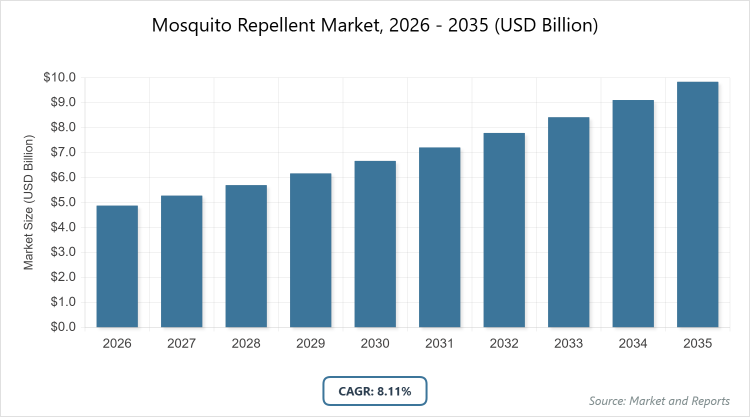
According to our latest research, the global mosquito repellent market is projected to grow from USD 4.88 billion in 2026 to USD 9.85 billion by 2035, growing at a CAGR is estimated at 8.11% during 2026-2035. The Mosquito Repellent Market is primarily driven by the rising incidence of vector-borne diseases and changing climatic patterns, which facilitate expanded mosquito breeding grounds and compel consumers toward safe, plant-based, and long-lasting personal protection solutions.
What are the Key Insights into the Mosquito Repellent Market?
- Global market value projected to reach USD 9.85 billion by 2035 from USD 4.88 billion in 2026 (extrapolated using 8.11% CAGR from 2031 forecast).
- Compound Annual Growth Rate (CAGR) estimated at 8.11% during 2026-2035.
- Spray/Aerosols dominate the type segment.
- Supermarkets/Hypermarkets dominate the distribution channel segment.
- Asia Pacific dominates the regional market.
What is the Mosquito Repellent Market?
Industry Overview
The mosquito repellent market encompasses products designed to protect individuals from mosquito bites, including sprays, creams, coils, vaporisers, mats, and wearables formulated with active ingredients like DEET, picaridin, or natural oils such as citronella and eucalyptus to repel mosquitoes and prevent vector-borne diseases like dengue, malaria, and Zika. These repellents are available in synthetic and natural variants, catering to personal care, household, and outdoor applications through retail channels like supermarkets, online stores, and pharmacies.
The market focuses on efficacy, safety, and user convenience, driven by global health concerns over mosquito-borne illnesses, urbanisation, increasing exposure risks, and innovations in long-lasting, skin-friendly formulations. It integrates sustainability trends with eco-friendly, plant-based options to address environmental concerns, while regulatory compliance ensures product safety and claims validation in a sector bridging consumer goods, healthcare, and pest control.
What are the Market Dynamics in the Mosquito Repellent Market?
Growth Drivers
The mosquito repellent market is driven by the increasing prevalence of mosquito-borne diseases such as dengue, malaria, and Zika, which heighten public health awareness and demand for effective protection, alongside rising preference for natural and organic repellents made from plant-based ingredients like citronella and eucalyptus that appeal to health-conscious consumers avoiding synthetic chemicals. Government initiatives and public health campaigns in endemic regions promote repellent use, while innovations in product formats, such as wearables, long-lasting sprays, and vaporizers with advanced actives like Metrofluthrin, enhance efficacy and convenience. Higher disposable incomes in emerging markets enable premium product purchases, supported by social media influences and celebrity endorsements that boost brand visibility and consumer adoption.
Restraints
Restraints include the proliferation of counterfeit products that undermine trust and efficacy, health and safety concerns over synthetic chemicals like DEET causing skin irritation or toxicity, and stringent regulations on active ingredients that increase compliance costs and limit formulations. Consumer shifts toward traditional remedies in rural areas reduce demand for commercial repellents, while efficacy gaps in natural products, offering shorter protection times, deter users in high-risk zones. Supply chain issues for raw materials like essential oils add to production volatility.
Opportunities
Opportunities lie in the growth of natural formulations with 9.55% CAGR, innovations in vaporizers and wearables, e-commerce expansion for direct sales, premium positioning for kids’ segments at 8.53% CAGR, and government procurements in endemic regions for public distribution programs.
Challenges
Challenges encompass efficacy gaps in natural products providing shorter protection, regulatory compliance costs for safety testing, budget constraints in public health initiatives limiting widespread distribution, and counterfeit proliferation in the Asia Pacific and South America, eroding market trust and sales.
Mosquito Repellent Market: Report Scope
| Report Attributes | Report Details |
| Report Name | Mosquito Repellent Market |
| Market Size 2025 | USD 4.88 Billion |
| Market Forecast 2035 | USD 9.85 Billion |
| Growth Rate | CAGR of 8.11% |
| Report Pages | 220 |
| Key Companies Covered | Godrej Consumer Products Ltd, Dabur India Ltd, Spectrum Brands Holdings Inc., Reckitt Benckiser Group plc, S.C. Johnson & Son, Inc |
| Segments Covered | By Type, By Distribution Channel, By Region |
| Regions Covered | North America, Europe, Asia Pacific (APAC), Latin America, The Middle East and Africa (MEA) |
| Base Year | 2025 |
| Historical Year | 2020 – 2024 |
| Forecast Year | 2026 – 2035 |
| Customization Scope | Avail customized purchase options to meet your exact research needs. |
What is the Market Segmentation Analysis for the Mosquito Repellent Market?
The mosquito repellent market is segmented by type, distribution channel, and region.
By type segment, spray/aerosols emerge as the most dominant subsegment, followed by creams, lotions, and roll-ons as the second most dominant. Spray/aerosols lead with a 46.25% revenue share, owing to their ease of application, quick-drying formula, and effective coverage for outdoor activities in high-risk areas, driven by consumer preference for convenient, non-greasy repellents; this dominance drives the market by enabling mass production efficiencies, attracting innovations in long-lasting actives, and facilitating retail accessibility that boosts volume sales, thereby expanding penetration in endemic regions and generating revenue through premium variants with natural ingredients. Creams, lotions, and roll-ons, as the second dominant, offer targeted skin protection, contributing to growth via child-friendly and moisturising formulations.
By distribution channel segment, Supermarkets/hypermarkets are the most dominant subsegment in the distribution channel segment, followed by online retail channels as the second most dominant. Supermarkets/hypermarkets dominate with a 45.62% value share, due to their wide accessibility, in-store promotions, and consumer trust for essential health products in urban and rural areas; this position propels the market by facilitating impulse buys, enabling brand visibility through shelf space, and supporting bulk purchases that drive volume growth, thus increasing market reach and profitability through partnerships with retailers. Online retail channels, with a 9.55% CAGR, contribute through convenience and product variety for tech-savvy consumers.
What are the Recent Developments in the Mosquito Repellent Market?
- In March 2025, Thermacell Repellents, Inc. introduced the E65 Rechargeable Mosquito Repeller priced at USD 39.99, offering a 20-foot protection zone with a 6.5-hour battery life, enhancing outdoor convenience for consumers in endemic areas.
- In November 2024, Nippo launched ‘Swooper’, a new mosquito repellent with Metrofluthrin active ingredient and sandalwood fragrance in India, targeting household use with improved efficacy.
- In July 2024, Godrej Consumer Products incorporated ‘Renofluthrin’ into its insecticide products, providing longer protection times to address consumer needs for effective home repellents.
What is the Regional Analysis of the Mosquito Repellent Market?
- Asia Pacific to dominate the market
Asia Pacific dominates the mosquito repellent market with a 54.72% revenue share, driven by high disease prevalence, population density, and government health campaigns; India leads as the dominating country with 285,296 dengue cases in 2024, through affordable products like coils and creams from local players like Godrej, supported by rural outreach and e-commerce growth, while China contributes via management in southern provinces with innovative vaporizers for urban households.
North America maintains strong growth with premium natural repellents, where the United States leads through brands like SC Johnson, focusing on DEET-free options amid outdoor lifestyle trends and Zika concerns.
Europe shows steady expansion with emphasis on eco-friendly formulations, led by the UK through regulatory compliance and retail chains offering plant-based sprays.
Who are the Key Market Players and Strategies in the Mosquito Repellent Market?
- Godrej Consumer Products Ltd focuses on innovation with actives like Renofluthrin and local marketing in India for household repellents.
- Dabur India Ltd emphasizes natural formulations like Odomos cream, expanding through e-commerce and rural distribution.
- Spectrum Brands Holdings Inc. pursues premium wearables like Thermacell, targeting North American outdoor markets with rechargeable tech.
- Reckitt Benckiser Group plc invests in global brands like OFF!, leveraging endorsements and R&D for long-lasting efficacy.
- S.C. Johnson & Son, Inc. adopts sustainability strategies, promoting DEET-free lines through retail partnerships.
What are the Market Trends in the Mosquito Repellent Market?
- Increasing preference for natural, organic, and plant-based repellents with 9.55% CAGR.
- Innovation in product formats like wearables, mats, coils, and long-lasting vaporisers at 9.14% CAGR.
- Government initiatives and public health campaigns promoting repellent use.
- Influence of social media and celebrity endorsements boosts brand awareness.
- Higher disposable incomes enable premium and eco-friendly product purchases.
What Market Segments are Covered in the Report in Vertical format?
By Type
- Spray/Aerosols
- Creams
- Lotions, and Roll-ons
- Liquid Vaporizers
- Coils
- Mats
- Others
By Distribution Channel
- Supermarkets/Hypermarkets
- Online Retail Channels
- Independent Stores
- Others
By Region
- North America
- U.S.
- Canada
- Europe
- UK
- Germany
- France
- Rest of Europe
- Asia Pacific
- China
- India
- Japan
- Rest of Asia Pacific
- Latin America
- Brazil
- Mexico
- Rest of Latin America
- Middle East & Africa
- UAE
- South Africa
- Rest of Middle East & Africa
Chapter 1. Preface
Chapter 2. Executive Summary
Chapter 3. Global Mosquito Repellent Market - Industry Analysis
Chapter 4. Global Mosquito Repellent Market- Competitive Landscape
Chapter 5. Global Mosquito Repellent Market - Type Analysis
Chapter 6. Global Mosquito Repellent Market - Distribution Channel Analysis
Chapter 7. Mosquito Repellent Market - Regional Analysis
Chapter 8. Company Profiles
Frequently Asked Questions
Mosquito repellents are products like sprays, creams, and vaporizers that deter mosquitoes from biting, using actives such as DEET or natural oils to prevent disease transmission.
Key factors include increasing mosquito-borne diseases, preference for natural repellents, product innovations, government initiatives, social media influences, and higher disposable incomes.
The market is projected to grow from USD 4.88 billion in 2026 to USD 9.85 billion by 2035.
The CAGR is estimated at 8.11% during 2026-2035.
Asia Pacific will contribute notably, with 54.72% revenue share due to disease prevalence and population density.
Major players include Godrej Consumer Products Ltd, Dabur India Ltd, Spectrum Brands Holdings Inc., Reckitt Benckiser Group plc, S.C. Johnson & Son, Inc.
The report provides comprehensive insights into market size, forecasts, segmentation, regional analysis, key players, trends, dynamics, and developments.
The value chain includes raw material sourcing (actives like DEET or oils), formulation and manufacturing, packaging, distribution through retail/online, and consumer use with marketing.
Trends are evolving toward natural formulations and innovative formats, with consumers preferring eco-friendly, long-lasting products influenced by health awareness and endorsements.
Regulatory factors include safety approvals for actives and labeling requirements, while environmental factors involve sustainability concerns over chemical impacts and packaging waste.