
Military Vehicle Electrification Market Size, Share and Trends 2026 to 2035
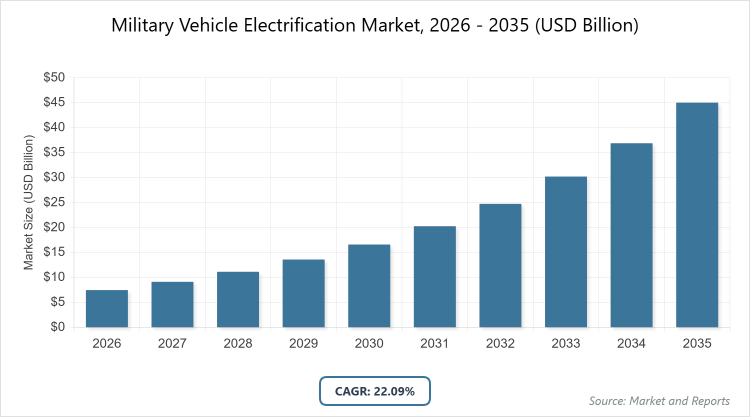
According to MarketnReports, the global Military Vehicle Electrification market size was estimated at USD 7.47 billion in 2025 and is expected to reach USD 54.98 billion by 2035, growing at a CAGR of 22.09% from 2026 to 2035. Military Vehicle Electrification Market is driven by the need for enhanced operational efficiency, reduced fuel dependency, and stealth capabilities in modern warfare.
What is Military Vehicle Electrification? An Industry Overview
Military vehicle electrification refers to the integration of electric propulsion systems, including hybrid and fully electric technologies, into defense vehicles to enhance performance, reduce emissions, and improve stealth operations. The market definition encompasses the development and deployment of electrified systems such as batteries, electric motors, power electronics, and energy management solutions for combat, support, and unmanned platforms. This industry addresses the evolving demands of modern militaries for sustainable, efficient, and resilient mobility solutions, driven by advancements in battery technology and the strategic imperative to minimize logistical vulnerabilities in contested environments.
What are the Key Insights of Military Vehicle Electrification Market?
- The global Military Vehicle Electrification market was valued at USD 7.47 billion in 2025 and is projected to reach USD 54.98 billion by 2035.
- The global Military Vehicle Electrification market is expected to grow at a CAGR of 22.09% during the forecast period 2026-2035.
- The Military Vehicle Electrification market is driven by increasing defense budgets, advancements in battery technologies, and the push for reduced operational costs and emissions.
- The hybrid subsegment dominates the technology segment with a 60% share due to its balance of performance and feasibility in transitional military applications.
- The combat vehicles subsegment dominates the platform segment with a 45% share owing to high demand for enhanced mobility and stealth in frontline operations.
- The energy storage subsegment dominates the system segment with a 30% share because of the critical role of advanced batteries in powering electrified vehicles.
- North America dominates the global Military Vehicle Electrification market with a 35% share attributed to substantial U.S. defense investments and technological leadership.
What are the Market Dynamics of Military Vehicle Electrification?
Growth Drivers
The military vehicle electrification market is propelled by escalating global defense expenditures aimed at modernizing fleets with sustainable technologies, reducing reliance on fossil fuels, and enhancing mission endurance through efficient energy use. Advancements in high-density batteries and power electronics enable vehicles to operate silently, improving stealth and survivability in urban and asymmetric warfare scenarios. Additionally, international commitments to carbon reduction and energy security encourage the adoption of hybrid and electric systems, fostering innovation and collaboration between defense contractors and tech firms to meet evolving tactical requirements.
Restraints
High development and integration costs for advanced electrification systems, including ruggedized batteries and thermal management, pose significant barriers, particularly for budget-constrained militaries in developing regions. Technical challenges such as limited battery range in extreme environments and vulnerability to electromagnetic interference can hinder deployment. Furthermore, the lack of standardized infrastructure for charging and maintenance in field operations complicates logistics, slowing widespread adoption despite strategic benefits.
Opportunities
Emerging opportunities arise from the integration of AI and autonomous systems with electrified platforms, enabling unmanned vehicles for reconnaissance and logistics with minimal human risk. Expanding partnerships between governments and private sectors in battery recycling and supply chain resilience can mitigate material shortages. Moreover, the growing focus on multi-domain operations opens avenues for electrified vehicles in hybrid warfare, offering enhanced power export for directed energy weapons and electronic warfare systems.
Challenges
Ensuring system reliability in harsh conditions, such as extreme temperatures and rugged terrains, remains a key challenge, requiring ongoing R&D in durable components. Geopolitical tensions and supply chain disruptions for critical materials like lithium pose risks to production timelines. Additionally, balancing weight, power, and armor in electrified designs demands innovative engineering to maintain vehicle agility without compromising protection.
Military Vehicle Electrification Market: Report Scope
| Report Attributes | Report Details |
| Report Name | Military Vehicle Electrification Market |
| Market Size 2025 | USD 7.47 Billion |
| Market Forecast 2035 | USD 54.98 Billion |
| Growth Rate | CAGR of 22.09% |
| Report Pages | 220 |
| Key Companies Covered |
BAE Systems, General Dynamics, Oshkosh Corporation, GM Defense, Leonardo S.p.A., QinetiQ, and Others |
| Segments Covered | By Technology, By Platform, By System, and By Region |
| Regions Covered | North America, Europe, Asia Pacific (APAC), Latin America, and The Middle East and Africa (MEA) |
| Base Year | 2025 |
| Historical Year | 2020 – 2024 |
| Forecast Year | 2026 – 2035 |
| Customization Scope | Avail customized purchase options to meet your exact research needs. |
The Military Vehicle Electrification market is segmented by technology, platform, system, and region.
Based on Technology Segment: The hybrid segment is the most dominant, holding a 60% market share, as it provides a practical transition from traditional engines, offering fuel efficiency and extended range while maintaining operational flexibility. This dominance drives market growth by enabling militaries to upgrade existing fleets cost-effectively. The fully electric segment is the second most dominant with a 25% share, gaining traction for zero-emission operations in specific roles, propelling the market through advancements in battery tech for silent missions.
Based on Platform Segment: The combat vehicles segment is the most dominant, capturing a 45% share, due to the need for enhanced stealth and power in high-threat environments, supported by programs like hybrid tanks. Its dominance accelerates market growth by prioritizing frontline electrification. The unmanned armored vehicles segment ranks second with a 30% share, benefiting from autonomy and remote operations, driving the market with reduced risk to personnel.
Based on System Segment: The energy storage segment is the most dominant, with a 30% share, attributed to the pivotal role of batteries in enabling electrification, driven by innovations in high-density cells. This leads market growth by improving endurance and reliability. The power generation segment is second with a 25% share, essential for hybrid systems, propelling growth through efficient energy conversion.
What are the Recent Developments in Military Vehicle Electrification Market?
- In September 2025, Parker Hannifin Corporation acquired Curtis Instruments, Inc., enhancing its capabilities in advanced control systems for next-generation military electrification solutions.
- In August 2025, CRG Defense secured a USD 2 million U.S. Army contract to prototype a lightweight electric motor/generator for hybrid-electric military vehicles.
- In July 2025, NanoGraf received large-scale orders for its silicon batteries tailored for military applications, including potential electric vehicle integrations.
- In February 2025, ST Engineering unveiled a Hybrid-Electric 35-ton Armored Fighting Vehicle with AI-driven integrations for enhanced situational awareness.
- In January 2025, the U.S. Army advanced its electric light reconnaissance vehicle (eLRV) prototyping to assess capabilities for silent operations.
What is the Regional Analysis of Military Vehicle Electrification Market?
- North America to dominate the global market
North America leads the military vehicle electrification market with a 35% share, bolstered by the U.S. Department of Defense’s substantial investments in modernization programs like the M1E3 Abrams hybrid upgrade and Ultium battery integrations. The United States dominates the region, with initiatives in California and Michigan driving R&D through collaborations with companies like GM Defense, focusing on reducing fuel logistics and enhancing stealth for multi-domain operations amid rising geopolitical tensions.
Europe holds a prominent position in the military vehicle electrification market, driven by EU defense funds allocating billions for green technologies under the ReArm Europe framework. Germany is the dominant country, advancing hybrid platforms through firms like Rheinmetall and Krauss-Maffei Wegmann, integrating low-emission systems to meet NATO sustainability goals and improve energy independence in Eastern European deployments.
Asia-Pacific is the fastest-growing region for military vehicle electrification, fueled by escalating territorial disputes and rapid military expansions. China dominates, investing heavily in electric unmanned vehicles and battery tech to support its power projection in the South China Sea, leveraging domestic supply chains for cost-effective scaling.
Latin America is emerging in the military vehicle electrification market, with a focus on border security and disaster response. Brazil leads, adopting hybrid logistics vehicles through partnerships with international firms to enhance operational efficiency in the Amazon region, supported by regional defense pacts.
The Middle East and Africa exhibit potential in military vehicle electrification, prioritizing desert-adapted technologies. Israel is a key player, developing advanced energy storage for unmanned platforms via companies like Elbit Systems, improving endurance in arid conflicts while attracting global investments.
Who are the Key Market Players and Strategies in Military Vehicle Electrification?
BAE Systems focuses on hybrid propulsion integrations, partnering with governments for armored vehicle upgrades to enhance stealth and efficiency.
General Dynamics emphasizes modular electric systems, investing in R&D for combat platforms to reduce fuel consumption and improve mission range.
Oshkosh Corporation prioritizes unmanned electrified vehicles, collaborating on U.S. Army programs for low-velocity airdrop capabilities with Arctic adaptations.
GM Defense leverages Ultium battery technology, forming alliances to hybridize tactical fleets for reduced logistics and silent operations.
Leonardo S.p.A. pursues fully electric unmanned solutions, expanding European projects for autonomous reconnaissance with AI integrations.
QinetiQ specializes in power management systems, developing exportable power for directed energy weapons in electrified platforms.
What are the Market Trends in Military Vehicle Electrification?
- Increasing adoption of hybrid systems for transitional electrification in combat vehicles.
- Advancements in solid-state batteries for improved range and durability in extreme conditions.
- Integration of AI for optimized energy management and autonomous operations.
- Focus on reducing fuel logistics through onboard power generation capabilities.
- Growing emphasis on stealth and silent mobility for urban warfare scenarios.
- Expansion of electrification to unmanned and support vehicles for risk reduction.
What are the Market Segments and their Subsegment Covered in the Military Vehicle Electrification Report?
By Technology
-
- Hybrid
- Fully Electric
- Plug-in Hybrid
- Fuel Cell Electric
- Series Hybrid
- Parallel Hybrid
- Mild Hybrid
- Extended Range Electric
- Battery Electric
- Hydrogen Fuel Cell
- Others
By Platform
-
- Combat Vehicles
- Support Vehicles
- Unmanned Armored Vehicles
- Infantry Fighting Vehicles
- Main Battle Tanks
- Armored Personnel Carriers
- Logistics Vehicles
- Reconnaissance Vehicles
- Amphibious Vehicles
- Light Utility Vehicles
- Others
By System
-
- Power Generation
- Energy Storage
- Cooling Systems
- Traction Drive Systems
- Power Conversion
- Transmission System
- Battery Management Systems
- Electric Motors
- Inverters
- Chargers
- Others
Frequently Asked Questions
Military Vehicle Electrification involves incorporating electric and hybrid propulsion systems into defense vehicles to improve efficiency, stealth, and sustainability.
Key factors include defense modernization programs, battery technology advancements, geopolitical tensions, and sustainability mandates.
The market value will grow from USD 9.12 billion in 2026 to USD 54.98 billion in 2035.
The market will achieve a compound annual growth rate (CAGR) of 22.09% during 2026-2035.
North America will contribute notably, holding a 35% share due to U.S. defense investments.
Major players include BAE Systems, General Dynamics, Oshkosh Corporation, GM Defense, Leonardo S.p.A., and QinetiQ.
The report offers comprehensive insights into market size, trends, segmentation, regional analysis, key players, and forecasts.
Stages include component manufacturing, system integration, vehicle assembly, testing, and deployment.