
Microbial Fermentation Technology Market Size, Share and Trends 2026 to 2035
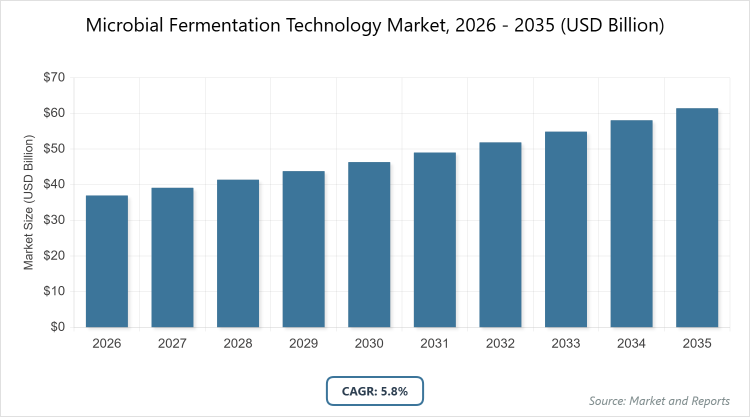
According to MarketnReports, the global Microbial Fermentation Technology Market size was estimated at USD 37 Billion in 2025 and is expected to reach USD 65 Billion by 2035, growing at a CAGR of 5.8% from 2026 to 2035. Microbial Fermentation Technology Market is driven by increasing demand for biologics and sustainable production methods.
What is the Industry Overview of the Microbial Fermentation Technology Market?
The microbial fermentation technology market encompasses the use of microorganisms such as bacteria, yeast, and fungi to produce a wide range of valuable products through controlled biological processes. This market involves the application of fermentation techniques in industrial settings to manufacture pharmaceuticals, food ingredients, biofuels, and other bio-based materials, leveraging the natural metabolic capabilities of microbes to convert substrates into desired outputs. Market definition refers to the global ecosystem of technologies, equipment, and services that enable the scaling of microbial fermentation from laboratory to commercial production, including upstream processes like strain development and downstream purification, catering to industries seeking efficient, eco-friendly alternatives to chemical synthesis.
What are the Key Insights into the Microbial Fermentation Technology Market?
- Market size valued at USD 37 Billion in 2025 and projected to reach USD 65 Billion by 2035.
- CAGR of 5.8% during the forecast period from 2026 to 2035.
- Market is driven by rising demand for biologics, advancements in synthetic biology, and shift towards sustainable manufacturing.
- Antibiotics dominate the product type segment with 35% share due to high demand in pharmaceuticals for treating infections and established production scalability; pharmaceuticals dominate the application segment with 40% share owing to the critical role in drug development and biologics production; biopharmaceutical companies dominate the end-user segment with 50% share because of their heavy reliance on fermentation for monoclonal antibodies and vaccines.
- North America dominates with 38% share due to advanced biotechnology infrastructure, strong R&D investments, and presence of leading companies.
What are the Market Dynamics of the Microbial Fermentation Technology Market?
Growth Drivers
The primary growth drivers in the microbial fermentation technology market include the surging demand for biologics and personalized medicines, which rely heavily on microbial platforms for efficient production of complex molecules like monoclonal antibodies and recombinant proteins. Advancements in genetic engineering and synthetic biology have enabled the optimization of microbial strains, reducing production costs and improving yields, thereby attracting investments from pharmaceutical giants. Additionally, the global push towards sustainability is propelling the adoption of fermentation for bio-based alternatives to petrochemicals, such as biofuels and bioplastics, supported by government incentives and regulations favoring green technologies. This convergence of health, environmental, and technological factors is fostering robust market expansion across diverse industries.
Restraints
Significant restraints in the microbial fermentation technology market stem from high initial capital investments required for setting up advanced fermentation facilities, including bioreactors and downstream processing equipment, which can deter small and medium enterprises from entering the market. Regulatory hurdles and stringent quality control standards, particularly in pharmaceuticals, prolong approval timelines and increase compliance costs, potentially slowing innovation. Moreover, contamination risks during large-scale fermentation processes pose operational challenges, leading to batch failures and financial losses. Supply chain disruptions for raw materials like substrates and nutrients further exacerbate these issues, especially in regions with limited biotech infrastructure.
Opportunities
Opportunities abound in the microbial fermentation technology market with the rise of precision fermentation, which allows for the production of novel ingredients like alternative proteins and rare compounds, tapping into the growing plant-based and functional food sectors. Emerging markets in Asia-Pacific offer untapped potential due to expanding pharmaceutical manufacturing and government support for biotech hubs. Integration of AI and machine learning in strain optimization and process monitoring presents avenues for efficiency gains and cost reductions. Additionally, collaborations between academia and industry for developing next-generation microbes could unlock applications in environmental bioremediation and sustainable agriculture, broadening the market’s scope.
Challenges
Challenges in the microbial fermentation technology market include scalability issues when transitioning from lab-scale to industrial production, where maintaining consistent yields and product quality becomes complex due to variables like oxygen transfer and pH control. Intellectual property concerns around genetically modified organisms hinder knowledge sharing and innovation. Volatility in raw material prices, coupled with energy-intensive processes, impacts profitability. Furthermore, skilled workforce shortages in bioprocessing and fermentation engineering limit operational capabilities in developing regions, necessitating ongoing training and talent acquisition efforts.
Microbial Fermentation Technology Market: Report Scope
| Report Attributes | Report Details |
| Report Name | Microbial Fermentation Technology Market |
| Market Size 2025 | USD 37 Billion |
| Market Forecast 2035 | USD 65 Billion |
| Growth Rate | CAGR of 5.8% |
| Report Pages | 220 |
| Key Companies Covered |
Novozymes A/S, Lonza Group AG, Koninklijke DSM N.V., Biocon Limited, Ajinomoto Co., Inc., and Others |
| Segments Covered | By Product Type, By Application, By End-User, and By Region |
| Regions Covered | North America, Europe, Asia Pacific (APAC), Latin America, and The Middle East and Africa (MEA) |
| Base Year | 2025 |
| Historical Year | 2020 – 2024 |
| Forecast Year | 2026 – 2035 |
| Customization Scope | Avail customized purchase options to meet your exact research needs. |
What is the Market Segmentation of the Microbial Fermentation Technology Market?
The Microbial Fermentation Technology Market is segmented by product type, application, end-user, and region. All the segments have been analyzed based on present and future trends and the market is estimated from 2026 to 2035.
Based on Product Type Segment, antibiotics emerge as the most dominant subsegment with a 35% share, driven by their essential role in combating bacterial infections and the well-established, cost-effective fermentation processes using microbes like Streptomyces; this dominance helps drive the market by ensuring a steady supply of affordable pharmaceuticals amid rising global health concerns. The second most dominant is enzymes with a 25% share, valued for their versatility in industrial applications such as food processing and biofuels, where microbial fermentation enables high-purity production at scale, contributing to market growth through efficiency improvements and sustainability in manufacturing.
Based on Application Segment, pharmaceuticals stand out as the most dominant with a 40% share, propelled by the increasing need for biologics like vaccines and insulin produced via microbial routes, which drives the market by addressing chronic diseases and pandemics through rapid, scalable drug development. The second most dominant is food and beverages with a 30% share, where fermentation is key for producing probiotics, flavors, and alternative proteins, fostering market expansion by aligning with consumer trends towards health-conscious and plant-based products.
Based on End-User Segment, biopharmaceutical companies are the most dominant with a 50% share, as they heavily invest in fermentation for advanced therapeutics like monoclonal antibodies, driving the market through innovation in personalized medicine and large-scale production capabilities. The second most dominant is food & beverage manufacturers with a 20% share, utilizing microbial processes for efficient ingredient production, which propels market growth by meeting demands for sustainable and functional foods.
What are the Recent Developments in the Microbial Fermentation Technology Market?
- In 2024, Novozymes announced the acquisition of a precision fermentation startup to enhance its enzyme portfolio, focusing on sustainable food ingredients and expanding production capacity in Europe.
- In 2025, Lonza partnered with a leading biopharma firm to develop advanced microbial strains for antibody production, investing in AI-driven optimization to reduce development timelines by 30%.
- In 2024, Ginkgo Bioworks launched a new platform for custom microbe engineering, securing funding for biofuel applications and collaborating with energy companies for pilot-scale testing.
What is the Regional Analysis of the Microbial Fermentation Technology Market?
North America to dominate the global market.
North America leads the microbial fermentation technology market with a 38% share, primarily driven by the United States as the dominating country, where robust R&D ecosystems, presence of biotech hubs like Boston and San Francisco, and substantial funding from entities like the NIH fuel innovations in pharmaceuticals and biofuels, supported by favorable policies for biomanufacturing.
Europe holds a significant position with a 25% share, with Germany as the dominating country, benefiting from strong industrial biotech sectors, collaborations through initiatives like Horizon Europe, and emphasis on sustainable chemicals, enabling advancements in enzymes and organic acids production.
Asia-Pacific is the fastest-growing region with a 30% share, led by China as the dominating country, where rapid pharmaceutical expansion, government investments in biotech parks, and low-cost manufacturing drive adoption in food and pharma applications, positioning it for future dominance.
Latin America accounts for a 4% share, with Brazil as the dominating country, leveraging its agricultural base for biofuel fermentation, though growth is tempered by infrastructure challenges, yet opportunities arise from bioeconomy initiatives.
The Middle East and Africa represent a 3% share, with South Africa as the dominating country, focusing on academic research and emerging pharma production, constrained by limited investments but gaining from international partnerships in vaccine development.
Who are the Key Market Players in the Microbial Fermentation Technology Market?
Novozymes A/S. Novozymes employs strategies focused on innovation in enzyme solutions through R&D investments and acquisitions, enhancing microbial strains for industrial applications to maintain leadership in sustainable biotechnology.
Lonza Group AG. Lonza’s strategies include expanding contract manufacturing services and partnering with biopharma firms for custom fermentation processes, leveraging advanced bioreactors to support high-volume biologics production.
Koninklijke DSM N.V. DSM pursues sustainability-driven strategies, such as developing bio-based materials via fermentation and collaborating on precision nutrition, aiming to reduce environmental impact while growing in food and pharma sectors.
Biocon Limited. Biocon’s approach involves cost-effective biosimilar development using microbial platforms, with investments in Indian manufacturing hubs to capture emerging market demands in affordable therapeutics.
Ajinomoto Co., Inc. Ajinomoto focuses on amino acid production strategies through strain optimization and global supply chain enhancements, targeting food and pharmaceutical applications for steady revenue growth.
Evonik Industries AG. Evonik’s strategies emphasize specialty chemicals via fermentation, including acquisitions for biotech capabilities and R&D in sustainable polymers to diversify its portfolio.
Chr. Hansen Holding A/S. Chr. Hansen implements probiotic innovation strategies, partnering for food fermentation advancements and expanding into health supplements to capitalize on consumer wellness trends.
Ginkgo Bioworks. Ginkgo’s strategies revolve around synthetic biology platforms for custom microbes, securing venture funding and collaborations for applications in biofuels and flavors.
Amyris, Inc. Amyris focuses on fermentation for clean beauty and biofuels, with strategies including licensing technologies and scaling production through joint ventures.
BioVectra Inc. BioVectra’s strategies include CMO services for complex APIs, investing in facility expansions to meet pharmaceutical demands with high-quality microbial processes.
What are the Market Trends in the Microbial Fermentation Technology Market?
- Integration of AI and machine learning for strain engineering to accelerate development and improve yields.
- Shift towards precision fermentation for alternative proteins and sustainable ingredients in food sectors.
- Growing adoption of continuous fermentation processes to enhance efficiency and reduce costs.
- Increased focus on cell-free systems for faster production without live microbes.
- Expansion of applications in biofuels and bioplastics amid sustainability drives.
- Rise in partnerships between startups and established firms for innovative microbial platforms.
- Emphasis on regulatory compliance for genetically modified organisms in pharma.
- Development of modular bioreactors for flexible, small-scale production.
- Surge in investments for Asia-Pacific manufacturing hubs.
- Evolution towards multi-product fermentation facilities for diversified outputs.
What Market Segments and their Subsegments are Covered in the Microbial Fermentation Technology Report?
- Product Type
- Antibiotics
- Amino Acids
- Enzymes
- Organic Acids
- Vitamins
- Biopolymers
- Biofuels
- Industrial Chemicals
- Hormones
- Vaccines
- Others
- Application
- Pharmaceuticals
- Food and Beverages
- Biofuels
- Animal Feed
- Cosmetics
- Textiles
- Agriculture
- Chemicals
- Nutraceuticals
- Environmental
- Others
End-User
-
- Biopharmaceutical Companies
- Food & Beverage Manufacturers
- CMOs
- Academic Institutions
- Chemical Companies
- Agricultural Firms
- Cosmetic Companies
- Energy Companies
- Research Labs
- Healthcare Providers
- Others
- By Region
- North America
- U.S.
- Canada
- Europe
- UK
- Germany
- France
- Rest of Europe
- Asia Pacific
- China
- India
- Japan
- Rest of Asia Pacific
- Latin America
- Brazil
- Mexico
- Rest of Latin America
- Middle East & Africa
- UAE
- South Africa
- Rest of Middle East & Africa
- North America
Chapter 1. Preface
Chapter 2. Executive Summary
Chapter 3. Global Microbial Fermentation Technology Market - Industry Analysis
Chapter 4. Global Microbial Fermentation Technology Market- Competitive Landscape
Chapter 5. Global Microbial Fermentation Technology Market - Product Type Analysis
Chapter 6. Global Microbial Fermentation Technology Market - Application Analysis
Chapter 7. Global Microbial Fermentation Technology Market - End-User Analysis
Chapter 8. Microbial Fermentation Technology Market - Regional Analysis
Chapter 9. Company Profiles
Frequently Asked Questions
The microbial fermentation technology market involves the industrial application of microorganisms to produce products like pharmaceuticals, enzymes, and biofuels through controlled fermentation processes.
Key factors include rising demand for biologics, advancements in synthetic biology, sustainability initiatives, and increasing investments in biotech infrastructure.
The market is valued at USD 37 Billion in 2025 and projected to reach USD 65 Billion by 2035.
The CAGR is expected to be 5.8% during 2026-2035.
North America will contribute notably, holding a 38% share due to its advanced biotech ecosystem.
Major players include Novozymes A/S, Lonza Group AG, Koninklijke DSM N.V., Biocon Limited, and Ajinomoto Co., Inc.
The report provides comprehensive analysis including market size, trends, segmentation, regional insights, key players, and forecasts.
Stages include strain development, upstream fermentation, downstream purification, product formulation, and distribution.
Trends are shifting towards sustainable bio-based products, with consumers preferring eco-friendly ingredients in food and pharmaceuticals.
Factors include stringent FDA approvals for GMOs, environmental regulations promoting green manufacturing, and incentives for reducing carbon footprints.