
Medicare Advantage Market Size, Share and Trends 2026 to 2035
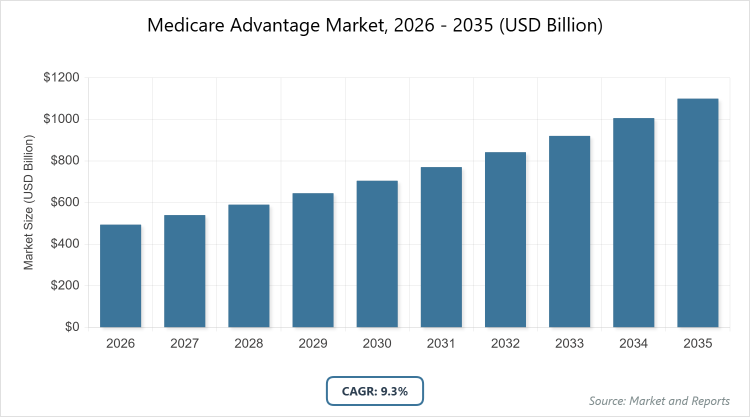
According to MarketnReports, the global Medicare Advantage Market size was estimated at USD 494 billion in 2025 and is expected to reach USD 1200 billion by 2035, growing at a CAGR of 9.3% from 2026 to 2035. Medicare Advantage Market is driven by the aging population and increasing preference for comprehensive private health plans over traditional Medicare.
What are the Key Insights into the Medicare Advantage Market?
- The global Medicare Advantage market size was valued at USD 494 billion in 2025 and is projected to reach USD 1200 billion by 2035.
- The market is expected to grow at a CAGR of 9.3% during the forecast period from 2026 to 2035.
- The market is driven by rising enrollment due to an aging population, favorable government policies, and demand for supplemental benefits like dental and vision coverage.
- In the plan type segment, HMO dominates with a 59% share due to its cost-effective managed care structure and widespread availability, making it attractive for beneficiaries seeking lower premiums.
- In the application segment, individual plans dominate with a 80% share because they cater directly to personal needs of seniors, offering flexibility and comprehensive coverage without employer involvement.
- In the end-user segment, senior citizens dominate with a 90% share owing to Medicare eligibility primarily for those aged 65 and older, driving demand for tailored health management.
- North America dominates the regional market with a 100% share, as Medicare Advantage is a U.S.-centric program with high enrollment driven by robust regulatory support and private insurer participation.
What is the Industry Overview of the Medicare Advantage Market?
The Medicare Advantage market refers to private health insurance plans approved by Medicare that provide an alternative to traditional Medicare coverage, offering Part A (hospital insurance) and Part B (medical insurance) benefits, often with additional perks like prescription drug coverage, dental, vision, and wellness programs. This market involves insurers contracting with the Centers for Medicare & Medicaid Services (CMS) to deliver these benefits, emphasizing managed care models that aim to control costs while enhancing care coordination and preventive services. Market definition encompasses the ecosystem of health plans that bundle Medicare benefits with supplemental offerings, targeting eligible beneficiaries seeking more predictable out-of-pocket costs and integrated care, thereby shifting the landscape from fee-for-service to value-based models in senior healthcare.
What are the Market Dynamics in the Medicare Advantage Market?
Growth Drivers
The Medicare Advantage market is experiencing robust growth driven by the rapidly aging global population, particularly in the U.S., where the number of individuals aged 65 and older is projected to increase significantly, boosting demand for comprehensive health plans that offer more than traditional Medicare. Government initiatives, such as enhanced funding and regulatory support from CMS, encourage private insurers to innovate with value-based care models, leading to improved outcomes and cost efficiencies that attract more enrollees. The inclusion of supplemental benefits like prescription drugs, dental, vision, and telehealth services provides added value, making these plans preferable for beneficiaries seeking all-in-one coverage with capped out-of-pocket expenses. Technological advancements in data analytics and AI for personalized care management further propel growth by enabling better risk assessment and preventive healthcare, reducing overall costs and enhancing member satisfaction.
Restraints
Restraints in the Medicare Advantage market include increasing regulatory scrutiny and payment adjustments by CMS, such as risk adjustment model changes and star rating modifications, which compress profit margins for insurers and lead to reduced benefit offerings or market exits in less profitable areas. Rising healthcare utilization and medical costs, exacerbated by post-pandemic trends and chronic disease prevalence among enrollees, strain plan finances, forcing higher premiums or cost-sharing that may deter potential members. Limited provider networks in certain regions restrict access to care, causing dissatisfaction and higher churn rates, while competition from traditional Medicare supplemented by Medigap policies appeals to those preferring unrestricted provider choices. Economic uncertainties and inflation further challenge affordability, limiting enrollment growth in price-sensitive demographics.
Opportunities
Opportunities abound in the Medicare Advantage market with the expansion of Special Needs Plans (SNPs) targeting underserved populations like dual-eligible beneficiaries and those with chronic conditions, allowing insurers to tap into niche segments through specialized care coordination and enhanced benefits. The integration of social determinants of health (SDOH) services, such as meal delivery and transportation, opens avenues for innovative partnerships with community organizations, improving outcomes and member retention. Digital health tools, including telehealth and remote monitoring, present chances to reduce costs and expand access in rural areas, aligning with beneficiary preferences for convenient care. Policy shifts favoring value-based payments encourage collaborations with providers for accountable care organizations, fostering sustainable growth and differentiation in a competitive landscape.
Challenges
Challenges in the Medicare Advantage market arise from intensified competition among major insurers, leading to market concentration that may limit options for beneficiaries and increase pricing pressures, while smaller players struggle to compete on scale and innovation. Evolving CMS regulations, including prior authorization requirements and overpayment recovery efforts, impose administrative burdens and financial uncertainties, potentially disrupting operations and benefit stability. Beneficiary confusion over plan complexities and frequent changes in offerings contributes to high switching rates, eroding loyalty and increasing acquisition costs. Addressing health equity gaps remains difficult, as disparities in access and outcomes persist among diverse populations, requiring targeted investments that may not yield immediate returns.
Medicare Advantage Market: Report Scope
| Report Attributes | Report Details |
| Report Name | Medicare Advantage Market |
| Market Size 2025 | USD 494 Billion |
| Market Forecast 2035 | USD 1200 Billion |
| Growth Rate | CAGR of 9.3% |
| Report Pages | 220 |
| Key Companies Covered |
UnitedHealth Group, Humana Inc., CVS Health Corporation (Aetna), Elevance Health, Centene Corporation, and Others. |
| Segments Covered | By Plan Type, By Application, By End-User, and By Region. |
| Regions Covered | North America, Europe, Asia Pacific (APAC), Latin America, and The Middle East and Africa (MEA) |
| Base Year | 2025 |
| Historical Year | 2020 - 2024 |
| Forecast Year | 2026 - 2035 |
| Customization Scope | Avail customized purchase options to meet your exact research needs. |
How is the Market Segmentation Structured in the Medicare Advantage Market?
The Medicare Advantage Market is segmented by plan type, application, end-user, and region.
By Plan Type Segment, the market is divided into various categories where HMO emerges as the most dominant subsegment, followed by PPO as the second most dominant. HMO's dominance is attributed to its structured network that emphasizes preventive care and cost control, appealing to cost-conscious beneficiaries and driving market growth by offering lower premiums and coordinated services that reduce overall healthcare expenditures; this model helps propel the market through high enrollment volumes and efficient resource utilization in urban areas. PPO, the second dominant, provides flexibility with out-of-network options at higher costs, contributing to expansion by attracting beneficiaries who value choice and broader access, thereby enhancing market penetration in regions with diverse provider landscapes.
By Application Segment, individual plans stand out as the most dominant subsegment, with group plans as the second most dominant. Individual plans dominate due to their direct appeal to retirees seeking personalized coverage without employer ties, supported by marketing and regulatory frameworks that facilitate easy enrollment; this drives the market by accommodating the majority of beneficiaries and fostering innovation in benefit designs tailored to personal health needs. Group plans, the second dominant, serve employer-sponsored retirees, helping to grow the market through stable enrollment from large organizations and cost-sharing arrangements that encourage broader adoption.
By End-User Segment, senior citizens are the most dominant subsegment, while disabled beneficiaries rank as the second most dominant. Senior citizens dominate because Medicare eligibility primarily targets those 65 and older, with plans designed for age-related health issues like chronic care; this segment drives the market by representing the bulk of enrollment and demanding comprehensive benefits that spur plan enhancements. Disabled beneficiaries, as second dominant, benefit from specialized options like SNPs, contributing to growth by addressing unique needs and expanding access through inclusive policies.
What are the Recent Developments in the Medicare Advantage Market?
- In July 2025, KFF reported that Medicare Advantage enrollment reached 34.1 million, or 54% of eligible beneficiaries, with growth slowing to 4% from the previous year amid regulatory changes.
- In March 2025, Chartis noted a 3.9% enrollment increase to 34.5 million, highlighting a market correction with for-profit plans capturing 56% of new growth.
- In October 2025, Milliman analyzed financial results showing lower profits due to higher costs and IRA impacts, prompting some insurers to exit markets.
- In December 2025, Custom Market Insights projected a 5.8% CAGR through 2032, driven by aging populations and technological advancements.
- In February 2025, Morningstar forecasted 8% CAGR in enrollment through 2034, emphasizing UnitedHealth and Humana's dominance.
What is the Regional Analysis of the Medicare Advantage Market?
North America to dominate the global market.
North America, particularly the United States, dominates the Medicare Advantage market due to its exclusive availability through CMS, with over 54% of eligible beneficiaries enrolled, driven by favorable policies and private insurer innovation. The United States leads as the dominating country, supported by a vast network of providers and high awareness, contributing to growth through supplemental benefits and value-based care models.
Europe shows limited presence in the Medicare Advantage market, as it is U.S.-specific, but analogous private health plans exist; no dominant country, with minimal impact on global figures.
Asia Pacific has negligible Medicare Advantage activity, focused on local healthcare systems; China dominates regionally in private insurance analogs, but not relevant to this market.
Latin America lacks Medicare Advantage, with private plans varying; Brazil leads in similar supplemental insurance, but no direct contribution.
The Middle East and Africa region has no Medicare Advantage, emphasizing public systems; Saudi Arabia dominates in private health expansions, but unrelated to this U.S.-centric market.
Who are the Key Market Players in the Medicare Advantage Market?
UnitedHealth Group leads with strategies focused on expansive networks, digital health integration, and acquisitions to enhance enrollment, targeting 29% market share through innovative benefits and value-based care.
Humana Inc. emphasizes wellness programs and chronic care management, pursuing growth via partnerships and data analytics to maintain 17% share and improve member outcomes.
CVS Health Corporation (Aetna) leverages retail pharmacy integration for seamless access, with strategies including market expansions and cost controls to hold 12% share.
Elevance Health focuses on regional Blues plans with tailored offerings, employing acquisitions and technology for efficient care delivery.
Centene Corporation targets underserved populations with affordable plans, using community partnerships and SNP expansions for growth.
What are the Market Trends Shaping the Medicare Advantage Market?
- Slowing enrollment growth to 4% in 2025 amid regulatory pressures and market corrections.
- Increasing dominance of for-profit plans, capturing over 70% of the market.
- Rise in Special Needs Plans (SNPs), accounting for 21% of enrollees with focus on chronic conditions.
- Benefit optimizations, with reductions in supplemental offerings due to margin compression.
- Greater concentration among top insurers, with UnitedHealth and Humana holding 46% share.
What Market Segments and Their Subsegments are Covered in the Medicare Advantage Market Report?
By Plan Type
- HMO
- PPO
- SNP
- PFFS
- MSA
- HMOPOS
- Others
By Application
- Individual
- Group
- Others
By End-User
- Senior Citizens
- Disabled Beneficiaries
- Others
By Region
- North America
- U.S.
- Canada
- Europe
- UK
- Germany
- France
- Rest of Europe
- Asia Pacific
- China
- India
- Japan
- Rest of Asia Pacific
- Latin America
- Brazil
- Mexico
- Rest of Latin America
- Middle East & Africa
- UAE
- South Africa
- Rest of Middle East & Africa
Frequently Asked Questions
The Medicare Advantage market consists of private health plans approved by CMS that provide Medicare Parts A and B benefits, often with extras like drug coverage.
Factors include aging demographics, regulatory changes, supplemental benefit demands, and technological integrations for better care management.
The market is expected to expand from around USD 494 billion in 2026 to USD 1200 billion by 2035.
The CAGR is anticipated to be 9.3% from 2026 to 2035.
North America, specifically the U.S., will contribute notably as the primary market hub.
Major players are UnitedHealth Group, Humana Inc., CVS Health Corporation (Aetna), Elevance Health, and Centene Corporation.
The report includes market size, trends, segmentation, key players, regional analysis, and forecasts to 2035.
Stages encompass plan design, CMS approval, marketing, enrollment, care delivery, and claims processing.
Trends favor SNPs and digital tools, with preferences shifting to plans with wellness and SDOH benefits.
CMS payment adjustments, IRA drug changes, and star rating shifts influence growth and plan strategies.