
Medical Waste Management Market Size, Share and Trends 2026 to 2035
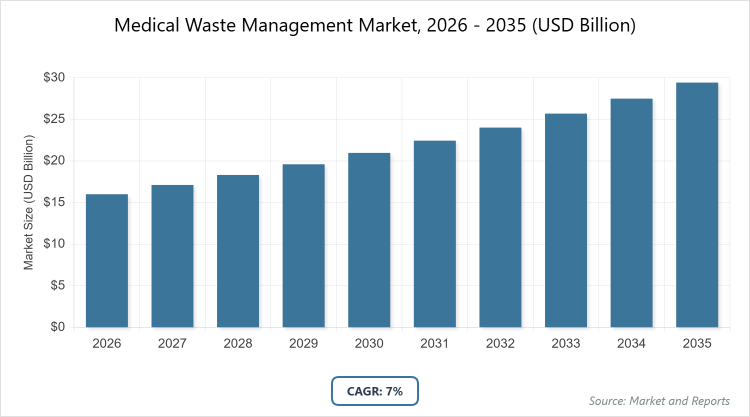
According to MarketnReports, the global Medical waste management market size was estimated at USD 16 billion in 2025 and is expected to reach USD 32 billion by 2035, growing at a CAGR of 7% from 2026 to 2035. Medical Waste Management Market is driven by the rising global volume of healthcare waste generated by an aging population and expanding medical infrastructure, coupled with increasingly stringent environmental regulations mandating safe and environmentally responsible disposal practices.
What are the Key Insights into the Medical Waste Management Market?
- Global medical waste management market valued at approximately USD 16 billion in 2025, projected to reach USD 32 billion by 2035.
- Expected CAGR of around 7% from 2026 to 2035, driven by regulatory compliance and healthcare expansion.
- Dominant subsegment by type: Hazardous waste, accounting for the largest share due to stringent handling requirements.
- Dominant subsegment by service: Treatment & disposal services, holding over 50% market share for core waste neutralization.
- Dominant subsegment by treatment site: Offsite treatment, leading with around 70% share for centralized efficiency.
- Dominant region: North America, contributing over 40% of global revenue with the United States as the leading country.
What is the Medical Waste Management Industry Overview?
Industry Overview
Medical waste management encompasses the systematic handling, collection, transportation, treatment, and disposal of waste generated by healthcare facilities, including hospitals, clinics, laboratories, and pharmaceutical companies, to prevent environmental contamination and public health risks. This market involves specialized processes to manage various types of waste such as infectious, hazardous, radioactive, and general non-hazardous materials, adhering to stringent regulatory standards set by governments and international bodies to ensure safe neutralization through methods like incineration, autoclaving, chemical treatment, or landfilling.
It plays a critical role in the healthcare ecosystem by mitigating the spread of infections, reducing ecological impact, and promoting sustainability through recycling and waste-to-energy initiatives, driven by the increasing volume of medical waste from expanding healthcare services, pandemics, and medical research. The industry integrates advanced technologies for tracking, segregation, and efficient processing, involving a network of service providers, equipment manufacturers, and regulatory compliance experts to maintain hygiene and safety in medical environments while addressing global concerns over pollution and resource conservation.
What are the Market Dynamics in the Medical Waste Management Sector?
Growth Drivers
The medical waste management market is driven by the escalating volume of healthcare waste generated from rising hospital admissions, diagnostic procedures, and pharmaceutical production, amplified by global population growth and the prevalence of chronic diseases requiring ongoing medical interventions. Stringent government regulations mandating proper waste disposal to curb infection risks and environmental hazards compel healthcare facilities to adopt professional management services, fostering market expansion.
Technological advancements in waste treatment, such as automated segregation systems and eco-friendly incinerators, enhance efficiency and compliance, attracting investments from both public and private sectors. The aftermath of pandemics like COVID-19 has heightened awareness and demand for robust waste handling infrastructures, while urbanization and expanding healthcare access in developing regions further propel the need for scalable solutions.
Restraints
High operational costs associated with advanced treatment technologies and compliance with diverse regulatory frameworks pose significant restraints, particularly for small-scale healthcare providers in resource-limited areas where budget constraints limit adoption of comprehensive services. Inadequate infrastructure in developing countries leads to improper waste handling practices, increasing risks and regulatory penalties that deter market growth. Volatility in raw material prices for disposal equipment and fluctuating fuel costs for transportation add financial burdens, while public opposition to incineration facilities due to emission concerns can delay project implementations. Limited awareness and training among healthcare workers on waste segregation exacerbates inefficiencies, hindering overall market penetration.
Opportunities
Opportunities abound in the integration of sustainable practices like waste-to-energy conversion and recycling programs, which can reduce environmental impact and generate revenue streams, appealing to eco-conscious stakeholders and aligning with global green initiatives. Emerging markets in Asia and Africa present untapped potential with rapid healthcare infrastructure development, offering avenues for service providers to expand through partnerships and localized solutions. Innovations in digital tracking using IoT and AI for real-time monitoring can optimize operations and ensure compliance, creating niches for tech-driven companies. Government incentives for adopting green technologies and increasing focus on circular economy models further open doors for investment in advanced, low-emission treatment facilities.
Challenges
Challenges include navigating complex and varying international regulations that require constant updates to compliance strategies, increasing administrative burdens and costs for global operators. The hazardous nature of medical waste demands specialized handling to prevent occupational exposures and spills, necessitating ongoing training and safety investments. Supply chain disruptions, particularly for treatment chemicals and equipment, can impede service delivery, while the rise of counterfeit or substandard disposal products undermines trust and efficacy. Balancing cost-effectiveness with environmental sustainability remains a hurdle, as greener alternatives often entail higher upfront expenses amid pressure to minimize carbon footprints.
Medical Waste Management Market: Report Scope
| Report Attributes | Report Details |
| Report Name | Medical Waste Management Market |
| Market Size 2025 | USD 16 Billion |
| Market Forecast 2035 | USD 32 Billion |
| Growth Rate | CAGR of 7% |
| Report Pages | 230 |
| Key Companies Covered | Stericycle, Veolia Environnement SA, Clean Harbors, Inc., Waste Management, Inc., Republic Services, Inc., Sharps Compliance, Inc., and REMONDIS SE & Co. KG |
| Segments Covered | By Type, Service, Treatment Site and Region |
| Regions Covered | North America, Europe, Asia Pacific (APAC), Latin America, The Middle East and Africa (MEA) |
| Base Year | 2025 |
| Historical Year | 2020 – 2024 |
| Forecast Year | 2026 – 2035 |
| Customization Scope | Avail customized purchase options to meet your exact research needs. |
How is the Medical Waste Management Market Segmented?
The medical waste management market is segmented by type, service, treatment site, and region
By Type The hazardous waste segment dominates the medical waste management market, primarily due to its inclusion of infectious, pathological, and chemical wastes that require specialized treatment to prevent health and environmental risks, driven by strict regulations like those from the EPA and WHO that mandate secure handling and disposal. This dominance propels the market by necessitating advanced technologies and services, increasing revenue through high-value contracts with healthcare facilities and fostering innovation in safe neutralization methods, thereby enhancing overall industry standards and compliance.
The non-hazardous waste segment ranks second, encompassing general waste like paper and plastics that constitute the bulk of medical refuse by volume, helping to drive the market through cost-effective recycling and bulk collection services that support sustainability goals and reduce landfill usage, appealing to budget-conscious providers and expanding market accessibility.
By Service Treatment & disposal services lead the service segment, as they involve critical processes like incineration, autoclaving, and chemical disinfection essential for rendering waste harmless, supported by regulatory imperatives that prioritize effective elimination of biohazards. This subsegment drives market growth by commanding premium pricing for specialized equipment and expertise, encouraging investments in eco-friendly technologies that align with global sustainability trends and generate steady income from long-term contracts.
Collection, transportation, and storage follow as the second dominant, focusing on safe logistics from generation points to treatment sites, contributing to market expansion by ensuring chain-of-custody compliance and enabling scalable operations through fleet optimizations and tracking systems, thus facilitating broader geographic coverage.
By Treatment Site Offsite treatment dominates the treatment site segment, favored for its centralized facilities that handle large volumes efficiently with economies of scale, reducing costs for healthcare providers who outsource to specialized vendors. This leadership accelerates market growth by promoting professional services that comply with stringent transport and disposal laws, driving consolidation among providers and innovation in secure transportation, thereby increasing market penetration in urban areas.
Onsite treatment ranks second, offering immediate processing within facilities to minimize transport risks and costs, helping to propel the market through customizable solutions for large hospitals and integration with hospital infrastructure, supporting rapid response to waste surges like during pandemics.
What are the Recent Developments in the Medical Waste Management Market?
- In 2023, Stericycle expanded its sustainable waste solutions by launching an enhanced recycling program for single-use devices, aiming to reduce landfill contributions and comply with emerging green regulations, which strengthened its market leadership through eco-friendly innovations.
- Veolia acquired a regional waste management firm in 2024 to bolster its North American operations, integrating advanced autoclave technologies to handle increased post-pandemic waste volumes, enhancing service efficiency and geographic reach.
- In 2025, Clean Harbors introduced AI-driven waste tracking software, improving compliance and reducing errors in hazardous waste handling, which appealed to hospitals seeking digital solutions amid regulatory scrutiny.
- Republic Services partnered with a tech startup in early 2026 for developing waste-to-energy plants, focusing on converting medical waste into renewable energy, aligning with sustainability goals and opening new revenue streams.
What is the Regional Analysis of the Medical Waste Management Market?
- North America to dominate the market
North America dominates the global medical waste management market, propelled by advanced healthcare infrastructure, high waste generation from extensive medical services, and rigorous regulations enforced by agencies like the EPA and OSHA, with the United States as the dominating country due to its vast network of hospitals, pharmaceutical industries, and leading service providers that drive innovation and compliance. The region’s growth is supported by technological integrations such as automated systems and sustainable practices, alongside public-private partnerships that enhance waste handling efficiency; Canada contributes through similar regulatory frameworks and growing biotech sectors, but the U.S. leads with its market consolidation, export of technologies, and response to healthcare expansions, boosting overall revenue through high-value contracts and R&D investments.
Europe exhibits robust growth in the medical waste management market, emphasizing environmental sustainability and circular economy principles under EU directives like the Waste Framework Directive, with Germany as the dominating country owing to its engineering expertise, strict waste segregation laws, and leadership in green technologies like advanced incinerators. The region benefits from collaborative efforts among member states to standardize practices, driving demand for eco-friendly disposal methods; the UK and France follow with strong pharmaceutical and hospital sectors, but Germany’s dominance stems from its export-oriented firms and investments in recycling, fostering market development by addressing aging populations and increasing medical tourism, thereby enhancing property values and compliance across the continent.
Asia-Pacific is the fastest-growing region in the medical waste management market, fueled by rapid urbanization, expanding healthcare access, and rising medical tourism, with China as the dominating country due to its massive population, government initiatives for pollution control, and burgeoning pharmaceutical manufacturing that generate substantial waste volumes. The region’s expansion is driven by investments in infrastructure to meet WHO standards, with India and Japan contributing through biotech advancements and regulatory reforms; China’s leadership arises from its large-scale treatment facilities and localization of technologies, propelling market growth by tackling waste from pandemics and chronic diseases, thus increasing adoption of professional services and sustainable solutions.
The Rest of the World, encompassing Latin America, the Middle East, and Africa, shows emerging growth in the medical waste management market, with Brazil dominating in Latin America through healthcare reforms and urban hospital developments, while Saudi Arabia leads in the Middle East with Vision 2030 investments in medical infrastructure. Growth is spurred by international aid and private investments addressing inadequate facilities, though challenges like economic instability persist; South Africa contributes in Africa with regulatory progress, but the region’s advancement relies on imported technologies and training programs to improve compliance, gradually expanding market share through targeted initiatives in high-waste generating sectors like hospitals.
Who are the Key Market Players and Their Strategies in the Medical Waste Management Industry?
Stericycle: Focuses on comprehensive service offerings including collection and treatment, with strategies emphasizing acquisitions for market expansion and investments in sustainable technologies to reduce environmental impact and enhance regulatory compliance.
Veolia Environnement SA: Employs global expertise in waste solutions, prioritizing innovation in eco-friendly disposal methods and strategic partnerships to enter emerging markets, aiming for carbon-neutral operations.
Clean Harbors, Inc.: Specializes in hazardous waste management, with strategies centered on advanced treatment facilities and emergency response services, leveraging R&D for chemical neutralization to serve industrial healthcare clients.
Waste Management, Inc.: Utilizes integrated logistics and recycling, focusing on cost-efficient collection and conversion to energy, with expansion through mergers to dominate North American markets.
Republic Services, Inc.: Emphasizes customer-centric solutions with fleet optimizations, pursuing sustainability certifications and digital tracking to improve efficiency and attract long-term contracts.
Sharps Compliance, Inc.: Targets sharps and pharmaceutical waste, with strategies involving mail-back programs and compliance training, expanding via e-commerce for small generators.
REMONDIS SE & Co. KG: Focuses on European operations with circular economy models, investing in recycling plants and collaborations for waste minimization in healthcare settings.
What are the Current Market Trends in the Medical Waste Management Sector?
- Adoption of sustainable technologies like waste-to-energy and microwave treatment to minimize emissions and promote recycling.
- Integration of IoT and AI for real-time waste tracking and predictive analytics to enhance compliance and efficiency.
- Increased focus on single-use device reprocessing to reduce waste volumes and costs amid regulatory pushes.
- Growth in outsourced services due to cost pressures on healthcare facilities, favoring offsite treatment.
- Emphasis on pandemic preparedness with scalable systems for surge waste management.
- Rising demand for eco-friendly packaging and segregation tools to support circular economy initiatives.
What Market Segments are Covered in the Report?
By Type
-
- Hazardous Waste
- Non-Hazardous Waste
By Service
-
- Treatment & Disposal Services
- Collection, Transportation & Storage
- Recycling Services
By Treatment Site
-
- Offsite Treatment
- Onsite Treatment
By Region
-
- North America
- U.S.
- Canada
- Europe
- UK
- Germany
- France
- Rest of Europe
- Asia Pacific
- China
- India
- Japan
- Rest of Asia Pacific
- Latin America
- Brazil
- Mexico
- Rest of Latin America
- Middle East & Africa
- UAE
- South Africa
- Rest of Middle East & Africa
- North America
Chapter 1. Preface
Chapter 2. Executive Summary
Chapter 3. Global Medical Waste Management Market - Industry Analysis
Chapter 4. Global Medical Waste Management Market- Competitive Landscape
Chapter 5. Global Medical Waste Management Market - Type Analysis
Chapter 6. Global Medical Waste Management Market - Service Analysis
Chapter 7. Global Medical Waste Management Market - Treatment Site Analysis
Chapter 8. Medical Waste Management Market - Regional Analysis
Chapter 9. Company Profiles
Frequently Asked Questions
Medical waste management refers to the processes involved in collecting, transporting, treating, and disposing of waste generated from healthcare activities to ensure safety, environmental protection, and regulatory compliance.
Key factors include increasing healthcare waste volumes from population growth and chronic diseases, stringent regulations, technological advancements in treatment, and sustainability initiatives.
The medical waste management market is projected to grow from approximately USD 16 billion in 2026 to USD 32 billion by 2035, reflecting expansion across segments.
The CAGR for the medical waste management market during 2026-2035 is expected to be around 7%, driven by regulatory and healthcare demands.
North America will contribute notably, accounting for over 40% of the market value, led by advanced infrastructure in the United States.
Major players include Stericycle, Veolia Environnement SA, Clean Harbors, Inc., Waste Management, Inc., Republic Services, Inc., Sharps Compliance, Inc., and REMONDIS SE & Co. KG, through innovations and expansions.
The global medical waste management market report provides insights into size, segmentation, dynamics, regional analysis, players, trends, and forecasts for strategic decision-making.
The value chain includes waste generation at healthcare sites, collection and transportation, treatment and disposal, recycling or final disposal, and regulatory monitoring.
Market trends are evolving toward sustainable and tech-integrated solutions, with preferences shifting to eco-friendly services that ensure compliance and cost-efficiency.
Regulatory factors include strict disposal laws like EPA guidelines, while environmental factors involve emission controls and sustainability mandates, driving green innovations but increasing costs.